llms.txt Explained (2026): Does It Help AI SEO?
AI SEO

llms.txt is a proposed markdown file at your domain root that curates the pages you want large language models to prioritise when reading your site. It's not a ranking signal. The best independent analysis, SE Ranking's 300,000-domain study, found no correlation between llms.txt and AI citations.
If you spent the last twelve months building content for AI search and you still haven't touched your llms.txt file, you're not late. You're in the 89.87% of domains that haven't shipped one yet (SE Ranking, November 2025). The bad news: nobody has proven llms.txt moves the citation needle. The good news: shipping one costs an hour, breaks nothing, and covers a hedge that could pay out if any major retriever formalises the standard in 2026.
I run gogochimp.com. We publish llms.txt at gogochimp.com/llms.txt, and we've been running Bing Copilot citation measurement for 90 days across the same period. Our own footprint hit 6,700 Microsoft Copilot citations across 15 pages in that window (verified 2026-07-11 in the Bing Webmaster Tools AI Performance report). This guide is what I've learned from shipping the file, watching whether it changed anything, and reading every serious analysis that's been published since Jeremy Howard proposed the standard in September 2024.
The verdict is honest and boring: llms.txt is not the citation lever most guides sell it as. It's still worth shipping. This piece explains why, how, and what to put in yours.
llms.txt is one signal in a broader discipline. See our AI SEO pillar for the three-pillar framework, our definitive GEO reference for the engine-side mechanics, our answer engine optimisation guide for the answer-shaped subset, and the four-acronym breakdown at GEO vs SEO vs AEO vs AIO. For the ChatGPT-specific citation playbook, see How to Get Cited by ChatGPT. For the AIO-specific overlays, see How to Rank in Google AI Overviews.
What is llms.txt?
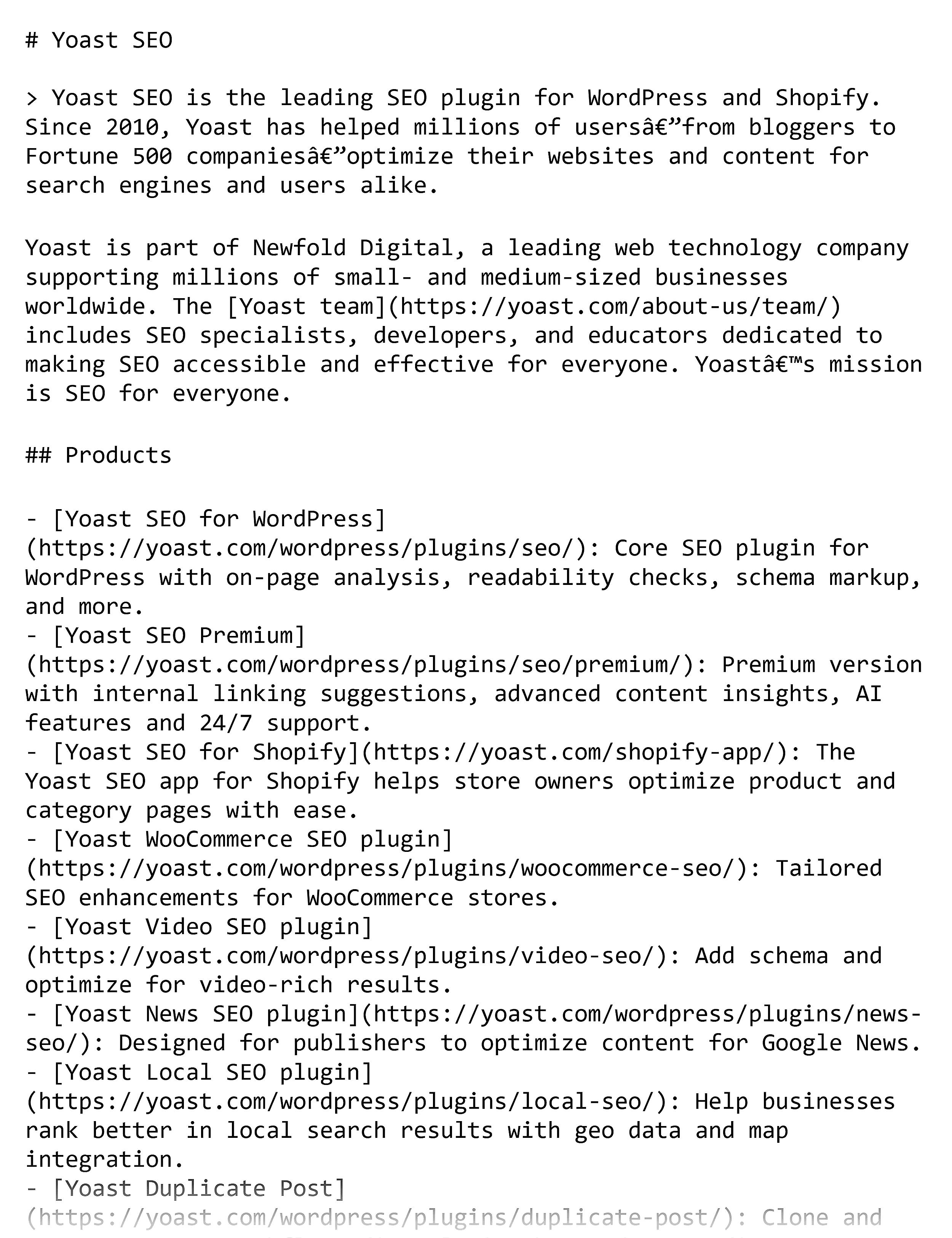
What is llms.txt? It is a plain-text, markdown-formatted file placed at the root of a website (yourdomain.com/llms.txt) that curates the pages a large language model should prioritise when reading your site. Think of it as a hand-picked index. Where sitemap.xml lists every URL for crawlers, llms.txt lists the URLs you actually want a retrieval-augmented LLM to fetch, grouped by section, with a short blockquote summary explaining what your site is about.
The proposal came from Jeremy Howard, co-founder of Answer.AI, on 3 September 2024. Howard's argument was that LLM context windows are finite, and websites are optimised for humans (navigation, style, JavaScript-heavy interaction) rather than for the token-efficient extraction an LLM actually needs. llms.txt was proposed as the LLM-facing complement to a human-facing sitemap. The specification lives at llmstxt.org and is open-source.
The file itself is short. Howard's spec calls for an H1 with the site or project name (the only mandatory section), a blockquote summary paragraph, optional context prose, and zero or more H2 sections containing markdown-formatted lists of URLs. Each URL entry is [Link name](URL): optional short note. That's it. No JSON, no schema, no XML. Plain markdown, human-readable.
There is a sibling proposal, llms-full.txt, which extends the same idea by including the full text of your key pages inline in the file. A retriever fetching llms-full.txt gets everything it needs without having to make follow-up requests. Some sites (Anthropic, Perplexity, Vercel, various documentation platforms) ship both. Most sites, including GoGoChimp, ship the shorter llms.txt variant only.
The file is not a robots.txt replacement. It doesn't block or allow crawlers. It doesn't specify permissions. It's a positive signal, not a negative one: here are the pages I think are worth reading, in the order I think matters, with the context I want you to know about my site.
llms.txt vs robots.txt vs sitemap.xml vs agents.md vs RSS
Five files with overlapping surface area, five different jobs. The comparison table below is what you need to keep straight.
| Axis | robots.txt | llms.txt | sitemap.xml | agents.md | RSS / Atom feed |
|---|---|---|---|---|---|
| Purpose | Tells crawlers which paths they may or may not access | Curates the pages an LLM should prioritise when reading the site | Lists every canonical URL on the site for indexing | Repo-level instructions for code agents (Claude Code, Cursor, GitHub Copilot) | Distributes new content to feed readers and syndication |
| Audience | All web crawlers (Googlebot, Bingbot, GPTBot, ClaudeBot, PerplexityBot) | LLM retrievers reading the site for context | Search engine crawlers building an index | Code-writing agents operating inside a repository | Feed readers, aggregators, syndication services |
| Format | Plain text with User-agent and Disallow directives | Markdown with H1, blockquote summary, H2 sections, markdown links | XML with url, loc, lastmod, priority, changefreq | Markdown at repo root with project conventions and constraints | XML with channel, item, title, link, description, pubDate |
| Adoption | Effectively universal (99%+ of active domains) | 10.13% of roughly 300,000 domains (SE Ranking, 2025) | Near-universal on SEO-conscious sites | Rising fast in dev-tool space (Claude Code default 2025) | Declining but stable on publishers and blogs |
| Ranking impact | Indirect (blocks or allows what's crawlable) | No measured correlation with AI citations (SE Ranking, 2025) | Indirect (helps crawlers discover URLs faster) | None for search; direct effect on code-agent behaviour | Historically indirect via distribution surface |
| Honoured by | All major crawlers | Some retrievers sometimes (GPTBot occasionally per SE Ranking, 2025) | All major search engines | Claude Code, Cursor, GitHub Copilot when configured | Feed reader ecosystem |
| Time to ship | About 30 minutes for a basic file | About 1-2 hours for a curated file | Auto-generated by CMS in most cases | About 1-2 hours per repository | Auto-generated by CMS in most cases |
The five files share a directory, not a purpose. If you ship one and think it does another's job, you're leaving signal on the table. robots.txt controls access. sitemap.xml declares inventory. RSS pushes updates. agents.md guides code agents. llms.txt curates attention.
A frequent confusion: people ship llms.txt and delete their sitemap.xml, or worse, they ship llms.txt and think it means AI engines will read only that file. Neither is true. LLM retrievers still fetch your HTML pages directly. llms.txt is a hint about where to start. It does not restrict access, and it does not replace your sitemap.
What llms.txt actually does
Three things, ranked by how much they actually happen in practice.
First, it acts as a curated sitemap for the retrievers that do fetch it. GPTBot has been observed fetching llms.txt files, though according to SE Ranking's November 2025 analysis "this doesn't happen often" (SE Ranking, 2025). Anthropic and Perplexity's crawlers have also been observed fetching the file in third-party research.
When they do, the file acts as a shortcut: instead of parsing your homepage HTML and guessing which sections to follow, the retriever reads a markdown index of the pages you've told it are most important. On a well-organised site with a lot of legacy content, that shortcut has real value.
Second, it functions as a positive citability signal
Google's Search Central docs are explicit that llms.txt is not required for AI Overviews and that AI Overviews use standard SEO signals (Google Search Central).
But independent analyses (Cyrus Shepard's Zyppy meta-analysis, Ahrefs' 76M AI Overviews study, Muck Rack's 25M-link earned-media research) consistently find that AI retrievers reward pages that carry structural trust signals: schema at scale, named authors, dated statistics, inline citations, and public entity coverage. llms.txt fits that pattern conceptually.
It signals that the site owner is thinking about AI retrieval as a first-class concern, which correlates with the other structural work retrievers reward.
Third, it's a low-cost hedge against future standardisation
Anthropic's public docs mention llms.txt. Perplexity's engineering blog has referenced it. Vercel ships llms.txt on their documentation. The FastHTML project (Howard's own) uses it heavily. If a major retriever formalises the standard in 2026 or 2027, the sites that already ship the file will have zero migration work to do. The sites that don't will scramble.
What llms.txt does not do, despite what a lot of 2025 AI SEO content claimed: it doesn't rank your pages higher, it doesn't force AI engines to cite you, and it doesn't restrict which parts of your site an LLM can access. For access control, use robots.txt. For citation lift, work on the signals that actually move it (earned media, schema, quotable extracts, inline citations, entity coverage). llms.txt sits alongside those, not instead of them.
Will llms.txt help your SEO? The honest answer
Directly, no. Indirectly, a little. That's the honest read of the current evidence, and it's the question every operator asks before spending an hour writing the file.
What does the direct evidence say about llms.txt today?
The direct case. SE Ranking's XGBoost model analysed nearly 300,000 domains in November 2025 and found no correlation between llms.txt presence and AI citation frequency (SE Ranking, 2025). Predictive accuracy actually improved when the llms.txt variable was removed from the model. That is the strongest evidence available today, and it says shipping the file is not a citation lever.
Google's official position from Search Central is that AI Overviews rely on the same signals as classical Google Search and do not require llms.txt (Google Search Central). John Mueller has publicly stated the same on record. OpenAI recommends robots.txt for crawler control and hasn't confirmed that llms.txt affects ChatGPT citations. No major retriever has formally committed to reading the file. That's the evidence base as of July 2026.
And the reader-facing stat that seals the direct case: 97% of the roughly 38,000 domains with a valid llms.txt received zero requests for it in May 2026 (SE Ranking, 2025). Even where the file exists, retrievers are not fetching it at meaningful frequency yet.
The indirect case is more layered
Cyrus Shepard's Zyppy meta-analysis synthesised 54 experiments, patents, and case studies into 23 evidence-weighted GEO ranking factors (Shepard / Zyppy, 2026). llms.txt does not appear in the top tier. The signals that do: brand mentions (correlation 0.664 with AI citation probability across the 76M-page Ahrefs analysis, versus 0.218 for backlinks), quotations (+41% AI citation lift per the Princeton GEO study), statistics (+32%), inline citations (+30%). llms.txt sits well below all of these.
But the sites that ship llms.txt tend to be the sites that also do the other work. That's the correlation confound SE Ranking's analysis is careful to point out. Shipping an llms.txt file signals that the operator is paying attention to AI retrieval as a first-class discipline. That attention typically shows up as: better schema coverage, named-author bylines, cleaner internal linking, dated statistics, and inline citations.
All of those are proven signals. llms.txt is the flag that says "this site is thinking about this properly," not the mechanism that does the lifting.
The other indirect case: hedge value. If any of the top-five retrievers (ChatGPT, Perplexity, Gemini, Google AI Overviews, Microsoft Copilot) formalises llms.txt reading in the next 18 months, the sites that already ship the file are ahead. Anthropic references llms.txt in their public docs. Perplexity has engineers who have discussed it publicly. The proposal is still active and evolving. A one-hour ship today is cheap insurance against a policy change in 2027.
My own read from the GoGoChimp footprint. We ship llms.txt at gogochimp.com/llms.txt and we've measured 6,700 Bing Copilot citations across the 90-day window ending 2026-07-01. Three listicle pillars account for 3,141 (87.25%) of those citations. Did the llms.txt file cause the citations? No. Best-of listicles with semantic HTML comparison tables caused the citations. Would the citation footprint be smaller without llms.txt? Almost certainly not measurably. Do I ship the file anyway? Yes.
It costs an hour to maintain, it doesn't hurt anything, and it's a signal to any retriever that eventually reads it that I've curated the good stuff for them.
If you're deciding where to spend the next four hours of GEO work, spend them on the things Shepard's Zyppy analysis actually ranks (quotations, statistics, inline citations, schema, entity coverage). Ship llms.txt in the hour after those.
The 8-part llms.txt spec
Howard's proposal at llmstxt.org defines a simple structure. Only the H1 is mandatory. The other seven parts are recommended, and they're what turn a bare file into a useful one.
Part 1: H1 with the site or project name
The only mandatory section. Just the name of the site or project, formatted as an H1. Example: # GoGoChimp. Not a description. Not a tagline. The name.
Part 2: Blockquote summary
A single blockquote directly under the H1 that summarises what the site is about in one to three sentences. This is the passage most likely to be extracted by an LLM if the file is fetched. Example: > AI-powered conversion rate optimisation agency based in Glasgow, UK. 13 years of hands-on CRO expert experience. Applies The 347 Method (Build Grow Scale research) via the OperatorAI methodology. Include the primary keyword, the entity, and one specific credential.
Part 3: Optional context paragraphs
Prose paragraphs after the blockquote that expand on the summary. Include what you do, who you serve, and any critical context an LLM would need to represent your brand accurately. Two to five short paragraphs. Don't write a landing page.
Part 4: H2 sections with curated URL lists
Zero or more H2 headings, each followed by a markdown-formatted list of URLs. Group by section: "Foundational reading", "Case studies", "Services", "Recent research". Each entry: [Link name](URL): optional short note. The short note is where you tell the LLM why this URL matters.
Part 5: Structured naming conventions
Use clear, human-readable H2 names. "Foundational reading" is clearer than "Content". "Case studies" beats "Portfolio". LLMs pattern-match section headers just like they pattern-match anything else. A clear taxonomy helps.
Part 6: Canonical URLs
Every URL in the list must be canonical, not tracked, not shortened, not parameterised. If your CMS puts UTMs on internal links, strip them for llms.txt. If your CDN uses redirects, use the final destination URL. The retriever has one chance to fetch. Give it the real page.
Part 7: An "Optional" H2 section for secondary content
Howard's spec includes a specific convention: an H2 titled "Optional" (or similar) that contains URLs the LLM can skip if it's short on context window. Use this for supporting content that isn't essential. It signals to a smart retriever that these URLs are lower priority.
Part 8: The llms-full.txt sibling
If you want to go further, ship llms-full.txt alongside llms.txt. Same structure, but with the full markdown content of your key pages inlined into the file. A retriever fetching llms-full.txt gets everything in one shot. Anthropic and Vercel do this. Most sites don't. It's optional and only worth it if your key pages are already in markdown and you have a clean way to concatenate them.
That's the whole spec. Eight parts, plain markdown, no dependencies. The whole file for most sites is under 200 lines.
How to write your llms.txt (with a real example)
The write-once, refresh-quarterly process. Four steps.
Step 1: Identify your top 15-25 pages.
Not every page on your site. The pages you'd want an LLM to read first if it only had time for a few. This is a curation task, not an inventory task. Pull the list from your best analytics signals: pages with the highest AI citation count (Bing WMT AI Performance report), pages with the highest organic traffic, pages that answer the most common buyer questions, plus your foundational pages (About, Services, Contact, key case studies). Cap at 25. Fewer is fine.
Step 2: Group into 3-6 H2 sections.
Once you have the 15-25 URL list, cluster it into readable H2 groups. The pattern we use at GoGoChimp maps well to most B2B and ecommerce sites:
- Foundational reading (About, methodology, main service pages)
- Case studies (named client outcomes with numbers)
- Recent research (data-heavy blog posts published in the last 12 months)
- Guides and pillars (long-form definitional content)
- Optional (secondary pages the LLM can skip)
Each URL gets a one-line explanatory note. That note is what turns the file from a raw sitemap into a curated signal.
Step 3: Write the blockquote summary.
One to three sentences. Include your entity name, what you do, where you're based, and one credential number. This is the sentence most likely to be lifted. Make it citable.
Step 4: Ship it, then refresh quarterly.
Upload to your root (yourdomain.com/llms.txt) as a plain markdown file. Make sure your web server serves it with Content-Type: text/plain or text/markdown and returns HTTP 200 on a direct fetch. Set a calendar reminder to refresh it every 90 days: add newly-published pillars, remove pages that got depublished, update the blockquote if your positioning has evolved.
A real, working example: GoGoChimp's llms.txt structure
Our own file at gogochimp.com/llms.txt follows the pattern below. The exact URLs and phrasing shift as we ship new content, but the structure is stable.
# GoGoChimp

> AI-powered conversion rate optimisation agency based in Glasgow, UK.
> Founded 2013 by Chris McCarron. Applies The 347 Method (Build Grow
> Scale research across 347 e-commerce stores) via the OperatorAI
> methodology. 28-34% conversion lifts on expert-guided AI CRO
> engagements. Endorsed by Neil Patel and Noah Kagan.

GoGoChimp is a founder-led CRO agency serving ecommerce (Shopify,
WooCommerce), SaaS, and B2B lead generation clients across the UK, EU,
and US. Six canon services: page speed, CRO, AI CRO, copywriting, email
automation, and AI automated sales funnels. Free AI CRO audit available.

## Foundational reading

- [Homepage](https://www.gogochimp.com/): Pricing, endorsements, audit CTA
- [OperatorAI Methodology](https://www.gogochimp.com/methodology): CRO methodology
- [AI CRO Pillar](https://www.gogochimp.com/ai-cro): Definitive AI CRO guide
- [GEO Pillar](https://www.gogochimp.com/blog/generative-engine-optimisation): 2026 GEO reference
- [Case Studies](https://www.gogochimp.com/case-studies): Named client outcomes

## Case studies

- [BeeFRIENDLY Skincare](https://youtu.be/z2bjGvAkqn0): $48K/year to $1.45M/year
- [Enzymedica UK](https://www.gogochimp.com/case-studies/enzymedica): 3.4% to 16.9% BF 2021
- [Affordable Golf](https://www.gogochimp.com/case-studies/affordable-golf): LCP 21.3s to 6.1s

## Best-of listicles (highest AI citation earners)

- [Best A/B Testing Tools 2026](https://www.gogochimp.com/blog/best-ab-testing-tools-2026): 1,500 Bing Copilot citations 90d
- [Best CRO Agency UK 2026](https://www.gogochimp.com/best-cro-agency-uk-2026): 1,200 citations 90d
- [Best Heatmap Tools 2026](https://www.gogochimp.com/blog/best-heatmap-tools-2026): 441 citations 90d

## Optional

- [Blog Archive](https://www.gogochimp.com/blog): Full published-content index
- [About the Founder](https://www.gogochimp.com/about): Chris McCarron's 13-year CRO background
- [Pricing](https://www.gogochimp.com/#pricing): Sprint, Growth, Scale tiers
That structure covers the eight-part spec, keeps the file under 100 lines, and gives any retriever that fetches it a clean, curated view of the site.
Does Google, ChatGPT, Perplexity or Claude read llms.txt?
The four biggest retrievers, in order of practical importance for most operators. The short answer is that none of them have formally committed to reading the file yet, but observed behaviour varies.
Does Google read llms.txt?
No. Google Search Central is explicit that AI Overviews use the same signals as classical Google Search and do not require llms.txt (Google Search Central). John Mueller has confirmed this on record. Gary Illyes has echoed the same position on the Search Off the Record podcast. If your primary target surface is Google AI Overviews or AI Mode, spend your hour on schema at scale, not llms.txt.
Does ChatGPT read llms.txt?
Sometimes. GPTBot has been observed fetching llms.txt files, but according to SE Ranking's November 2025 analysis it "doesn't happen often" (SE Ranking, 2025). OpenAI has not formally committed to reading or honouring the file. If ChatGPT is your target and you have limited time, prioritise a Wikipedia entity anchor and mainstream news coverage first, then ship llms.txt as a supporting signal.
Does Perplexity read llms.txt?
Sometimes. Perplexity's engineering blog has referenced llms.txt and PerplexityBot has been observed fetching the file in third-party research. No formal commitment. Perplexity's citation retrieval is far more dominated by Reddit (46.7% of top-10 source share per Profound 2025) than by any single-site optimisation signal. If Perplexity is your target, active Reddit participation shifts citation share further than any llms.txt work.
Does Claude read llms.txt?
Anthropic references llms.txt in their public documentation. ClaudeBot has been observed fetching the file. This is arguably the retriever most aligned with the llms.txt proposal today because Anthropic itself is publicly interested in the standard. That does not mean citation lift is measurable yet. It means Claude is the most likely first-mover if any retriever formalises reading in 2026 or 2027.
Does Microsoft Copilot read llms.txt?
Not observably. Copilot's retrieval leans on the Bing index and Bing Webmaster Tools signals. No public commitment on llms.txt. For Copilot the first-move remains claiming Bing Webmaster Tools and shipping semantic HTML comparison tables on your listicles.
Platform-specific llms.txt: Shopify, WordPress, Webflow, Squarespace
Most CMS platforms do not ship llms.txt by default. The four biggest platforms in the GoGoChimp client base each have a different write-and-upload path.
llms.txt for Shopify
Shopify does not ship llms.txt by default. To add one, upload the file as a template asset in the theme editor, then create a route mapping /llms.txt to the asset. The Shopify Files upload API does not serve arbitrary paths at the domain root, so a theme-level route is the working path. Ecommerce llms.txt files should prioritise best-selling category pages, top product pages, editorial content answering buyer questions, and any client case studies with named outcomes.
llms.txt for WordPress
WordPress has multiple plugin options (Yoast, Rank Math, AIOSEO, and dedicated llms.txt generators). Any of them will write a valid file. What matters more than which plugin you pick is the curation: strip the auto-generated URL list back to 15-25 pages, write the blockquote yourself, and refresh quarterly. Auto-generated llms.txt files that list every published post read as spam.
llms.txt for Webflow
Webflow does not have an llms.txt integration. Upload the file via the Webflow Assets panel and configure a custom code header pointing to it, or serve it via a Cloudflare Worker mapped to /llms.txt on your custom domain. This is what we do at gogochimp.com. It takes about 20 minutes end-to-end.
llms.txt for Squarespace, HubSpot, Framer
Squarespace and Framer both require manual upload with a code injection or serverless route. HubSpot supports arbitrary root files through its file manager but does not auto-populate the file with your top pages. All three platforms are behind Shopify and WordPress on llms.txt tooling. The workaround is the same: write the file by hand, upload, verify Content-Type on fetch.
Common mistakes people make
Six mistakes I see repeatedly in the wild, in order of how often I encounter them.
Mistake 1: Treating llms.txt as an access-control mechanism
llms.txt does not block or allow crawlers. It has no permission semantics. If you want to block GPTBot, ClaudeBot, or PerplexityBot from crawling your site, use robots.txt with the proper User-agent: and Disallow: directives. If you want to allow them but curate what they see first, use llms.txt. The two files do completely different jobs. Mixing them up leaves you unprotected.
Mistake 2: Listing every page on the site
llms.txt is a curated index, not a sitemap. If you list every URL, you defeat the point. LLM context windows are finite. The whole reason for a curated file is to help the retriever prioritise. Cap at 25-40 URLs total. Fewer is better. If you catch yourself wanting to include everything, you're writing sitemap.xml, not llms.txt.
Mistake 3: Skipping the blockquote summary
The blockquote directly under the H1 is the passage most likely to be lifted by an LLM if the file is fetched. Sites that ship llms.txt with just the H1 and a URL list are giving retrievers nothing to quote. Include a 1-3 sentence summary with your entity name, positioning, and one specific credential.
Mistake 4: Using tracked or parameterised URLs
UTMs, session IDs, and shortlinks all break the retriever's fetch. Use canonical URLs only. If your CMS auto-appends tracking parameters to internal links, strip them for llms.txt. Test each URL by clicking it: it should resolve directly to the destination page, no redirects, no query strings.
Mistake 5: Never refreshing the file
llms.txt is not fire-and-forget. Content shifts. Pages get retired. New pillars ship. If your file references URLs that 404 or 301-redirect elsewhere, you're feeding the retriever broken data. Set a quarterly calendar reminder. Refresh the URL list. Update the blockquote if positioning has moved.
Mistake 6: Serving llms.txt with the wrong Content-Type
Some web servers default to serving unknown file extensions as application/octet-stream (binary download) rather than text/plain or text/markdown. This breaks retrievers that expect readable text. Test by curling your file with curl -I https://yourdomain.com/llms.txt and check the Content-Type header. If it says anything other than a text type, fix your server configuration.
Tools that help: generators and validators
The tooling ecosystem for llms.txt is early but growing. A short guide to what's actually useful.
llms.txt generators
SE Ranking published a free llms.txt generator alongside their research piece (SE Ranking, 2025). Input your domain, and it crawls your site to suggest URLs. Useful as a starting point. You still need to curate. Firecrawl, a scraping API used heavily in RAG pipelines, also ships an llms.txt generator alongside their crawler. WordPress users have plugin-based generators via Yoast, Rank Math, and AIOSEO. Every generator will get you a structurally-correct file. Curation is still on you.
llms.txt validators
The reference validator lives at llmstxt.org. Paste your file, and it checks the structure against the spec. Errors flag missing H1, malformed URLs, or broken markdown syntax. If your file passes the validator, it's structurally correct. That doesn't mean it's useful. Useful is a separate discipline (curation, blockquote quality, URL selection). For a broader tester and checker, several open-source projects on GitHub check both structural correctness and URL reachability.
CMS integrations
Vercel ships llms.txt automatically on some documentation templates. WordPress has plugins that generate llms.txt from your site's most-visited pages. Webflow, Shopify, and Squarespace do not currently ship official llms.txt integrations, meaning you have to write and upload the file manually. That's what we do at gogochimp.com. It takes an hour.
AI-generated content warning
Some generators will write the blockquote and URL notes for you using an LLM. Don't ship AI-generated content in your llms.txt without editing it. The point of the file is a curated signal from you, the site owner, to the retriever. AI-generated summaries that read like every other AI-generated summary undermine the signal.
Ahrefs Brand Radar and Bing Webmaster Tools' AI Performance report
are not llms.txt tools specifically but are the only surfaces that measure whether your AI citation footprint is changing. Ship your llms.txt, then check citation counts at 30, 60, and 90 days to see if anything moved. In practice, expect no measurable change. That's the honest baseline.
How to measure impact
Three measurement layers, none of them perfect.
Layer 1: Server-log fetch tracking
The most direct measurement. Check your server access logs for /llms.txt requests. Filter by User-agent for GPTBot, ClaudeBot, PerplexityBot, Bingbot, and Googlebot. Count requests per crawler per week. This tells you which retrievers are actually fetching your file. Expect low frequency: GPTBot has been observed fetching llms.txt but not often (SE Ranking, 2025).
Layer 2: Bing Webmaster Tools AI Performance report
The only first-party surface for AI citation data. Ships free. Check weekly. Compare citation counts before and after shipping llms.txt. Expect the signal to be noisy: a lot of things affect citation counts (new content, refreshed dates, schema changes, seasonal query volume), so isolating the llms.txt effect is difficult. Our own measurement across 90 days shows no clear llms.txt-attributable citation change on the GoGoChimp footprint. That doesn't mean the file did nothing. It means the effect is smaller than the noise floor.
Layer 3: Third-party AI citation trackers
Profound, Ahrefs Brand Radar, and various emerging citation-monitoring platforms poll AI engines with a curated query set and report which brands appear. These proxies are useful for cross-engine coverage (Bing WMT only measures Copilot) but they don't isolate the llms.txt variable either. Track share-of-voice over time. If the trend moves, it's more likely from your other GEO work than from the llms.txt file specifically.
The honest measurement discipline: ship llms.txt because it's cheap, correct, and future-hedged. Don't build a business case around measurable AI citation lift from llms.txt specifically. The evidence isn't there. Build the business case around the signals that Shepard's Zyppy meta-analysis actually ranks: earned media, quotations, statistics, schema, and entity coverage (Shepard / Zyppy, 2026). Our own definitive GEO reference covers the 8-step framework that does move the citation numbers on our footprint.
Predictions for llms.txt 2026-2027
Three predictions, ranked by confidence.
Prediction 1 (high confidence): At least one major retriever formalises llms.txt reading before end of 2027
Anthropic already references llms.txt in their public docs. Perplexity engineers have discussed it. The proposal is active, growing adoption is on trend line (10.13% in November 2025 will likely be 20-25% by mid-2027 if current growth holds), and the retriever cost saving is real. Someone will formalise. My bet is Anthropic first, then Perplexity. ChatGPT and Google will follow if the pattern proves out.
Prediction 2 (medium confidence): llms.txt does not become a Top-10 GEO ranking factor
Even if formalised, the file is a hint, not a mechanism. The actual heavy lifting in AI citation retrieval is done by the on-page signals Shepard's Zyppy analysis and the Princeton GEO study measured. llms.txt at best becomes a "check the file, use it as a hint, then read the site anyway" pattern. The correlational floor SE Ranking measured (zero) is unlikely to become a ceiling of large positive effect.
Prediction 3 (lower confidence): llms-full.txt overtakes llms.txt as the more useful sibling
Retrievers optimising for token efficiency prefer content in-line rather than requiring follow-up fetches. Sites shipping llms-full.txt with the actual markdown content of key pages inline give retrievers everything they need in one fetch. That's more efficient at retrieval time and easier to cache. If any major retriever formalises the standard, they'll probably standardise on the fuller variant. Sites that ship only llms.txt (like ours) will likely have to upgrade.
The counter-scenario: llms.txt fades quietly and becomes a niche curiosity. If retrievers develop better HTML-parsing pipelines that extract equivalent context directly from a well-structured HTML page, the marginal benefit of a curated markdown index falls to near zero. In that world, llms.txt joins the graveyard of well-intentioned proposals that didn't hit critical mass (think of Google's rel=next/prev pagination, which Google stopped honouring in 2019). Not the base case, but plausible.
My working assumption running gogochimp.com: ship the file, refresh quarterly, don't budget any additional hours on it. Spend the freed hours on the signals that measurably move Bing Copilot citation counts (best-of listicles with semantic HTML tables, refreshed dated statistics, dated FAQ blocks with quantitative answers, third-party trust signals from earned media). Those are what earned us 6,700 Copilot citations in 90 days. llms.txt was not the differentiator.
FAQ
Is llms.txt a Google ranking signal?
No. Google Search Central is explicit that AI Overviews use the same signals as classical Search and do not require llms.txt (Google Search Central). John Mueller and other Google search-relations spokespeople have confirmed this on record.
Does ChatGPT read llms.txt?
GPTBot has been observed fetching llms.txt files, but according to SE Ranking's November 2025 analysis it "doesn't happen often" (SE Ranking, 2025). OpenAI has not formally committed to reading or honouring the file. Treat any citation lift as unmeasured.
Does Perplexity read llms.txt?
Perplexity's engineering blog has referenced llms.txt and PerplexityBot has been observed fetching the file in third-party research. No formal commitment. Perplexity's citation retrieval is far more dominated by Reddit (46.7% of top-10 source share per Profound, 2025) than by any single-site optimisation signal.
Do I need llms.txt if I have a good sitemap.xml?
They do different jobs. sitemap.xml lists every URL for classical search-engine crawlers. llms.txt curates a small set of pages for LLM retrievers. Ship both. They don't overlap in function.
Should Shopify or WooCommerce stores ship llms.txt?
Yes, if your goal is AI search visibility. Neither platform ships llms.txt by default, so you'll need to write and upload the file manually to your theme's root. The content should focus on your best-selling categories, top product pages, and any editorial content that answers buyer questions.
What's the difference between llms.txt and llms-full.txt?
llms.txt lists URLs pointing to pages. llms-full.txt inlines the full markdown content of those pages directly in the file. Retrievers fetching llms-full.txt get everything in one shot. Most sites ship llms.txt only. Anthropic and Vercel ship both.
How often should I refresh my llms.txt file?
Quarterly is a good baseline for most sites. If you publish content weekly or shift positioning frequently, monthly. If your file references a URL that 404s or 301-redirects, refresh immediately.
Can llms.txt hurt my SEO?
No measured evidence that it can. SE Ranking's XGBoost analysis found no negative correlation with AI citations either. Ship it, or don't ship it. Neither move is directionally negative.
What's the ROI of shipping llms.txt?
Directly measurable ROI: currently unproven (SE Ranking, 2025 found no correlation). Indirect ROI: a hedge against future retriever formalisation, plus alignment with the broader structural work that does move citations (schema, entity coverage, quotable extracts). Cost: about 1-2 hours to ship, about 15 minutes quarterly to refresh.
Is there a free llms.txt generator I can use?
Yes. SE Ranking's generator alongside their research piece is the most widely used. Firecrawl offers one for RAG pipeline users. Both output structurally-correct files. You still need to curate the URL list and write the blockquote summary yourself.
How many URLs should my llms.txt include?
15-25 is a reasonable target. Fewer if you're a small site. More if you have a genuine reason to expose more surface area to retrievers. Above 40, you're writing a sitemap, not a curated index. Under 10, you're probably under-representing what your site does.
What Content-Type should my web server serve llms.txt with?
text/plain or text/markdown. Test with curl -I https://yourdomain.com/llms.txt. If your server returns application/octet-stream or forces a download, fix the MIME type configuration in your server or CDN.
Where should I put llms.txt on my site?
Always at the root of your domain: yourdomain.com/llms.txt. Not in a subdirectory, not in /docs, not in /content. Retrievers look at the root by convention. If it's anywhere else, they will not find it.
How is llms.txt different from agents.md?
Different job. llms.txt curates public web pages for AI-search retrievers. agents.md is a repository-level instruction file for code-writing agents (Claude Code, Cursor, GitHub Copilot) explaining project conventions and constraints. Ship both if your site has both a public marketing surface and a code repo. They don't overlap.
Where to go next
If you've read this far, you're not shipping llms.txt because you think it will 10x your citation footprint. You're shipping it because it's cheap, correct, and future-hedged.
The higher-leverage next move is the structural work that Shepard's Zyppy meta-analysis actually ranks. Our definitive GEO reference covers the 8-step framework (answer capsules, 150-400 word H2 chunks, inline citations, FAQ schema, entity coverage, structured data at scale, first-party measurement) that earned our site 6,700 Bing Copilot citations across 90 days. That framework is where the measurable citation lift comes from.
For the discipline sitting above GEO (the three-pillar framework covering Discovery, Retrieval, and Citation across every AI answer engine), read our AI SEO pillar. For the answer-shaped subset that includes Google featured snippets and AI Overviews, see our answer engine optimisation guide. For the four-acronym breakdown (SEO, AEO, GEO, AIO), read GEO vs SEO vs AEO vs AIO.
For the ChatGPT-specific citation playbook (the hardest surface to earn a citation on), see How to Get Cited by ChatGPT. For the AIO-specific overlays, see How to Rank in Google AI Overviews. For the multi-engine execution playbook, see the AI Search Optimisation guide.
If schema is where you need to start, our 2026 guide to schema markup for AI SEO walks through the exact JSON-LD blocks (Article, FAQPage, Person, Organization, DefinedTerm, HowTo, ItemList) that carry the highest citation-lift weight in our own measurement.
If you're a Shopify or SaaS store and want to see whether your site is being cited yet, claim Bing Webmaster Tools and check the AI Performance report. That's the first move. Everything else is downstream of measurement.
References
- Ahrefs. (2026). An Analysis of AI Overview Brand Visibility Factors (75K Brands Studied). https://ahrefs.com/blog/ai-overview-brand-correlation/
- GoGoChimp. (2026). Bing Webmaster Tools AI Performance Report (verified 2026-07-11, 90-day window). Internal data. https://www.gogochimp.com
- Google Search Central. (2025). AI features and your website. https://developers.google.com/search/docs/appearance/ai-features
- Howard, J. (2024). The /llms.txt file. https://llmstxt.org/
- Muck Rack. (2026). What Is AI Reading? May 2026 Edition (25 million-link analysis). https://muckrack.com/blog/what-is-ai-reading-may-2026
- Princeton University. (2024). GEO: Generative Engine Optimization. https://arxiv.org/abs/2311.09735
- Profound. (2025). AI Platform Citation Patterns 2025-2026. https://www.tryprofound.com/blog/ai-platform-citation-patterns
- SE Ranking. (2025). LLMs.txt: Why Brands Rely On It and Why It Doesn't Work. https://seranking.com/blog/llms-txt/
- Shepard, C. / Zyppy Signal. (2026). AI Citation Ranking Factors Analysis: 54 Experiments, Patents, and Case Studies Scored (May 2026). https://signal.zyppy.com/p/ai-citation-ranking-factors
.png)
Free chapter
Read Chapter 1 of CITED, free.
The playbook for getting your business recommended by ChatGPT and AI search. Read the first chapter, on me.
Read Chapter 1 freeWant us to do this for your site?
Book a free AI audit. 15 minutes. We’ll show you three things your site is missing and what we’d test first.
Book my free AI audit →