GEO vs SEO vs AEO vs AIO: in 2026
AI SEO

SEO is optimising for blue-link rankings on classical search engines. GEO (Generative Engine Optimization) is optimising for citations inside generative AI answers (ChatGPT, Perplexity, Copilot, Gemini). AEO (Answer Engine Optimization) is the subset of GEO focused on direct-answer surfaces like Google featured snippets.
If your marketing team is still arguing about whether you need "an AI SEO strategy" or "a GEO strategy" or "an AEO strategy," you're arguing about the wrong thing. You need one content operation that satisfies all four surfaces, because the same buyer is now asking the same question across all of them and expects a coherent answer.
Across GoGoChimp's own last 90 days, our footprint recorded 6,700 Microsoft Copilot citations against 82 Google organic clicks in the same window (Bing Webmaster Tools AI Performance report, verified 2026-07-11). That's 44 citations for every click. The blue link isn't dead. It's just no longer the majority of the story.
If the umbrella term "AI SEO" is where your team started before drilling into the acronym stack, our AI SEO pillar is the entry-level frame that GEO, AEO, and AIO all sit under.
This post settles the acronym question. What each one means. Where they overlap. Where they diverge. Which to prioritise if you can only pick one. And why our own site is being cited 1,200 times on Copilot for a page ranking at Google position 22.4. If you already know all four cold, skip to the comparison table. If you don't, start at the top.
The rest of this page is the definitive GEO vs SEO comparison you can point your marketing team at when they ask what is GEO vs SEO, and how AEO vs SEO differs from SEO vs AEO in day-to-day content decisions.
This piece maps the four acronyms. For the discipline itself, the three pillars (Discovery, Retrieval, Citation), the six moves in order, and the 5,600-Bing-Copilot-citation footprint that validated the sequence, read our AI SEO pillar.
The 4 acronyms in one sentence each
Four terms. Four one-sentence definitions. Read this section twice and the rest of the post makes sense.
- SEO (Search Engine Optimization): structuring your site so it ranks in the blue-link results on classical search engines (Google, Bing). Signal set: backlinks, on-page content, technical health, E-E-A-T.
- GEO (Generative Engine Optimization): structuring your content so generative AI answer engines (ChatGPT, Perplexity, Gemini, Google AI Overviews, Microsoft Copilot) cite you inside their generated answers. Signal set: extractable passages, statistics, third-party citations, entity coverage, structured data.
- AEO (Answer Engine Optimization): the subset of GEO focused on answer engines that return direct answers rather than generated summaries. Featured snippets, People Also Ask boxes, voice-assistant answers (Siri, Alexa). Signal set: structured Q-and-A patterns, FAQPage schema, short answer capsules.
- AIO (AI Overview Optimization): the subset of GEO focused specifically on Google's AI Overviews (the SGE-successor product now firing on around half of Google searches at Google's own I/O 2026 disclosure). Signal set: classical SEO discipline plus GEO overlays plus YouTube pairing.
Every AEO tactic is a GEO tactic. Every AIO tactic is a GEO tactic. Not every GEO tactic is an AEO or AIO tactic. And every one of these overlaps with SEO. The Venn diagram is nested, not concentric.
GEO: Generative Engine Optimization
Generative Engine Optimization is what you do to your content so a generative AI system (a large language model plugged into a live retrieval layer) picks your page, extracts a passage, and cites you inside a generated answer. It's the widest of the four terms in this post. Everything AEO and AIO cover is inside GEO.
The formal literature dates to November 2023. The Princeton GEO paper introduced the discipline as a controlled experimental study across 10,000 queries and 9 popular content-formatting tactics. Their finding: three interventions lifted AI citation likelihood measurably. Quotations lifted citation likelihood by 41%. Statistics by 32%. Inline citations by 30%. Three levers. All measured. All cheap to ship.
Since then, the evidence base has hardened. An Ahrefs analysis across 75,000 brands and 76 million AI Overviews found brand mentions correlate with AI citation probability at 0.664, versus 0.218 for backlinks. That's a 3x correlation gap. The classical SEO instinct to chase backlinks first is upside-down in a citation surface. Chase entity coverage. Chase mentions. Links follow.
The one hook stat that reframes everything: Muck Rack's May 2026 25-million-link analysis, cross-referenced with Seer Interactive research, found that third-party trust signals lift AI citation likelihood by roughly 75 times. Earned media alone accounts for 84% of AI citations. If you take one number away from this post, take that one. GEO isn't a content-marketing discipline. It's an earned-media-plus-content-marketing discipline. Our GEO pillar breaks the full 8-step framework down in detail.
SEO: Search Engine Optimization
Search Engine Optimization is the older discipline. It's what most marketing teams still spend most of their search budget on. And it isn't dead, no matter what the AI-search takes on LinkedIn claim. It's just no longer the entire story.
Classical SEO earns clicks by three levers: matching a query, satisfying user intent, and beating competitors on backlinks, content depth, and technical health. The signal set that Google's ranking algorithm weights has been stable for the last decade in its broad shape, even as the specific weightings shift with every core update. E-E-A-T (Experience, Expertise, Authoritativeness, Trustworthiness) is the QRG framing. On-page relevance, technical crawl-ability, and internal linking are the mechanical layer. Backlinks and named-author bylines are the trust layer.
The one hook stat that anchors why SEO still matters in an AI-search world: Seer Interactive's 2026 update on AI Overviews and CTR found that organic CTR on AIO-showing queries climbed from 1.3% in December 2025 to 2.4% in February 2026. That's an 85% rebound in two months. The click didn't disappear when AI Overviews rolled out.
It contracted, then rebounded, and now the surface is stabilising at a new equilibrium where organic clicks are worth more per impression because they're pre-filtered by the AI answer.
The same Seer research also found that being cited inside an AI Overview lifts downstream organic click-through by 35%. Cited brands get 120% more organic clicks per impression. So SEO and GEO aren't competing surfaces. They're compounding surfaces. Rank in Google organic AND earn AI citations, and each amplifies the other. Do only one, and you're leaving the compounding effect on the table.
AEO: Answer Engine Optimization
Answer Engine Optimization is a subset of GEO focused on the direct-answer surface. It predates GEO as a term. Featured snippets have been part of the Google SERP since 2014. Voice assistants (Siri, Alexa, Google Assistant) have been answering questions verbally since 2011. AEO was the discipline that grew up around getting your content into those direct-answer slots.
The core mechanic is different from classical SEO's blue-link chase. AEO targets a specific structural pattern: a question, a short direct answer, and a clean structural signal (schema, heading structure, or list format) that lets the answer engine extract your answer without ambiguity. That's why FAQ blocks with FAQPage schema are the highest-ROI structural pattern in AEO. They ship the exact question-answer pairs the retrieval layer wants, wrapped in the exact machine-readable format the retrieval layer parses.
Nearly four in five pages cited by ChatGPT include at least one list. Only 28.6% of Google's top results for the same queries do (AirOps, 2025). Structure isn't decorative. It's extractive. Long-form prose without structure gets treated by the retriever as one lump. Structured Q-and-A gets treated as pre-decomposed retrieval-ready chunks. AEO's core discipline (short direct answers to explicit questions) is now the entry-level GEO discipline too.
The overlap with GEO is high but not total. AEO focuses on the direct-answer surface (featured snippets, People Also Ask, voice assistants). GEO covers those AND the generative-answer surface (ChatGPT, Perplexity, Copilot, Gemini's generated summaries). If your buyer asks a question that returns a featured snippet, you're in AEO territory.
If your buyer asks the same question inside ChatGPT and gets a paragraph-length synthesis with three cited sources, you're in GEO territory. The tactics overlap. The measurement doesn't. The Answer Engine Optimisation reference unpacks the featured-snippet + PAA + voice tactic set in detail.
AIO: AI Overview Optimization
AIO is the newest and narrowest of the four acronyms. It refers specifically to Google's AI Overviews product, the SGE-successor that Google rolled out to the general public through 2024-2025 and expanded aggressively through 2026. Some people also read AIO as "AI Optimization" more generally. In this post, and in most 2026 industry usage, AIO means AI Overview Optimization.
The scale of the AIO surface is now the biggest single opportunity in AI search by volume. Google confirmed at its I/O 2026 event that AI Mode has crossed one billion monthly users, and queries are more than doubling every quarter since launch. AI Overviews already fire on 12.2% of news searches per Authoritas's April 2025 dataset, and considerably more on commercial and comparison queries.
Google's own I/O disclosure put the current prevalence at around 50% of searches. The industry disagreement on the exact denominator is real. The direction is unanimous.
The one hook stat that anchors AIO's economic weight: Seer Interactive's 2026 update found that 83% of AI Overviews citations come from pages outside the Google top 10. Being ranked #1 isn't the winning condition inside AIO. Being cited is. That's the same finding you hit at the GEO level, but AIO is where it has the clearest measurable impact on downstream organic traffic. Being cited inside an AIO lifts downstream organic CTR by 35% on the same query.
Miss the citation and you don't just lose the AIO surface. You lose the click-recapture effect on the surface you were ranking on.
Winning AIO specifically rewards the classical SEO discipline plus a small set of GEO overlays. Real on-page depth. Real backlinks from real domains. Real named-author bylines with Person schema. Real E-E-A-T signals across the site. Then add answer capsules under H1s, FAQPage schema, semantic HTML tables, dated statistics, third-party citations inside the body prose. AIO citations skew toward pages that satisfy both. Our How to Rank in Google AI Overviews reference walks the exact structural pattern that lifts AIO citation rate.
Side-by-side comparison: SEO vs GEO vs AEO vs AIO
The definitional sections above cover each acronym in isolation. This section stacks them side-by-side across eight practical axes. Read across each row for the difference, read down each column for the discipline as a whole.
| Axis | SEO | GEO | AEO | AIO |
|---|---|---|---|---|
| Query type | Head + long-tail keyword phrases | Natural-language questions + decomposed sub-queries | Explicit questions ("what is X", "how do I Y") | Complex multi-step questions + comparisons |
| Signal source | Backlinks, on-page content, technical health, E-E-A-T | Extractable passages, statistics, third-party citations, entity graph, schema | Structured Q-and-A patterns, FAQPage schema, short answer capsules | Classical SEO signals + GEO overlays + YouTube pairing |
| Output surface | Blue links on a SERP | Cited passage inside a generated answer (ChatGPT / Perplexity / Copilot / Gemini) | Featured snippets, People Also Ask boxes, voice-assistant spoken answers | Google AI Overviews summary block above the blue links |
| Measurement | Rankings, impressions, organic clicks, CTR | Citation share, brand mention frequency, referral clicks from AI engines | Featured-snippet share, PAA appearance rate, voice-assistant win rate | AIO citation rate, AIO click-through, share-of-answer on AIO queries |
| Update frequency | Weeks to months per algorithm cycle | Days to weeks (retrieval indexes refresh fast) | Weeks (featured-snippet slots rotate weekly) | Days to weeks (AIO retrieval refreshes on similar cadence to GEO) |
| Winning content format | Long-form guides, product pages, comparison posts | Best-of listicles, definitional pillars, dated statistics posts, FAQ pages, comparison tables | FAQ blocks, "what is X" pillars, structured how-to guides | Definitional pillars + comparison tables + YouTube video pairing |
| Volume opportunity (2026) | Mature - Google organic traffic still the largest single channel | Fastest-growing - AI-sourced traffic up 1,324% for US retail sites Oct 2024 to May 2026 (Semrush, 2026) | Steady - voice-search + featured-snippets category is stable | Explosive - AI Mode at 1 billion monthly users, doubling per quarter (Google, 2026) |
| Difficulty (barrier to entry) | High - competitive on every commercial query | Medium - under-priced today, expected to compress by 2027 | Medium - schema + content structure is well-documented | High - requires classical SEO discipline PLUS GEO overlays |
Read the table twice. The "signal source" row is where the four disciplines diverge most sharply. The "winning content format" row is where they overlap most: best-of listicles and comparison tables win on GEO, AEO, and AIO simultaneously. If you can only build one content format, that's the one.
Where they overlap
The four acronyms share three load-bearing overlaps. Content that satisfies all three of these overlaps wins on all four surfaces at once, which is what makes this era of search interesting for content operators who don't want to run four parallel workstreams.
Overlap 1: Structural clarity
Every one of the four surfaces rewards content that's structured for extraction. H2s phrased as claims or questions, each section opening with a 40-60 word self-contained answer. FAQ blocks with FAQPage schema. Semantic HTML comparison tables (not markdown pipes, not CSS grids, real <table> markup). Dated statistics inline. Named entities throughout. This is the structural discipline that reads as tidy on the page and lifts as extractable to every retrieval layer.
Overlap 2: Trust signals
SEO's E-E-A-T, GEO's entity coverage, AEO's schema markup, and AIO's classical-SEO-plus-overlays all reduce to the same underlying question: does the retrieval layer (whichever one) believe this page is authoritative? Named-author bylines with Person schema. Publisher Organization schema with sameAs URLs across at least eight independent surfaces. Third-party citations to research and named studies. Earned media pickups from DA-70+ outlets. These aren't four different trust systems. They're one trust system read by four different retrievers.
Overlap 3: Citations
The most important discipline across all four acronyms is that every numerical claim, every named study, and every third-party stat inside your content is hyperlinked to its source. The Princeton GEO study measured this directly: adding inline citations lifts AI citation likelihood by 30%. Not a bonus. A measured lift.
And the reason it works is the same reason it wins on the classical SEO surface too: pages that cite sources are treated as trustworthy sources themselves. Retrievers pattern-match citation density as an authority signal. Uncited claims read as opinion. Cited claims read as evidence.
If you're going to fix one structural discipline across every page you own before 2027, fix inline citation density. Hyperlink every number to its source. Not a "references" section at the bottom. Inline, in the body prose, on the sentence that carries the claim. Cyrus Shepard's Zyppy meta-analysis of 54 GEO experiments placed source citations in the top cluster of evidence-weighted ranking factors. It's the highest-lift structural pattern per hour of effort we can measure in 2026.
Where SEO, AIO, GEO and AEO diverge
The overlaps are real. So are the divergences. Three axes where the four acronyms pull apart hardest.
Divergence 1: Extraction target
SEO extracts nothing. It ranks a page. GEO extracts a passage from a page. AEO extracts a direct answer to a question. AIO extracts a passage AND ranks a page below the extracted answer. The difference matters because it changes what "winning" looks like. Winning SEO means the click. Winning GEO means the citation. Winning AEO means the featured-snippet slot or the voice-answer selection.
Winning AIO means being one of the 3-5 sources listed in the AIO summary block, ideally with a clickable link back to your page.
Divergence 2: Entity graph weighting
Classical SEO weights backlinks as its dominant trust signal. GEO weights entity mentions and third-party citations more heavily than backlinks. The Ahrefs 76-million AIO analysis found brand mentions correlate with AI citation probability at 0.664 versus 0.218 for backlinks. That's a 3x gap in favour of mentions. AEO doesn't weight the entity graph as heavily as GEO does because AEO is retrieving from Google's classical index.
AIO sits in the middle: it weights Google's classical ranking signals plus entity signals from the wider corpus. The practical effect: a brand with heavy backlink authority but weak entity coverage wins SEO and loses GEO. A brand with heavy entity coverage but weak backlinks can win GEO and lose SEO. AIO rewards both.
Divergence 3: Retrieval bias per engine
This is where GEO gets operationally hard. Different engines source from different corpora. Profound's 2025 analysis documented the source-share weightings that don't overlap:
- ChatGPT: Wikipedia is 47.9% of top-10 source share (see how to get cited by ChatGPT for the engine-specific tactic set)
- Perplexity: Reddit is 46.7% of top-10 source share
- Google AI Overviews: Reddit 21% + YouTube 18.8% of top-10 source share
- Microsoft Copilot: best-of listicles and directory pages (first-party observation across GoGoChimp's own footprint)
- Gemini: web.dev + Google-property content + YouTube
Only 11% of domains are cited by both ChatGPT and Perplexity. A brand can dominate one engine and be effectively invisible on another. This is why GEO is not a single workstream. It's an umbrella over per-engine workstreams that share a common structural discipline but diverge in trust-signal weightings and dominant source pools. SEO doesn't diverge like this. AEO diverges only across the two or three answer-engine surfaces (Google featured snippets, Bing snippets, voice assistants). AIO is a single Google-owned surface.
The scale of the divergence is easy to underestimate. Superlines's March 2026 analysis documented a 615x citation volume variance between platforms for the same brand across the same query set. Same brand. Same queries. 615-fold difference in citation volume between engines. That's not measurement noise. That's structural retrieval bias.
SEO, AIO, GEO and AEO: Which one to prioritise if you can only pick one?
If you have the budget to run all four disciplines in parallel, do that. Most operators don't. The prioritisation framework below picks the one to start with based on three factors: your buyer's stage in the funnel, the engine surface they use most, and the competitive intensity in your category. For the full sequencing across all engines, see the multi-engine execution playbook, which stacks GEO, AEO, and AIO into a single 90-day sprint.
Factor 1: Buyer stage
Top-of-funnel awareness queries (broad "what is X" questions) are AEO and AIO territory. Mid-funnel research queries ("best X for Y", "X vs Y") are GEO territory across all engines. Bottom-of-funnel commercial queries ("X pricing", "buy X") are SEO territory because the buyer is already in the Google shopping surface. If your buyers do most of their research in the middle of the funnel and buy after speaking to a human, prioritise GEO. If your buyers make transactional decisions on-SERP, prioritise SEO.
Factor 2: Engine surface
If your buyers are B2B, they're increasingly using ChatGPT and Copilot for evaluation research. Gartner found that 73% of B2B buyers use AI tools in purchase research. Optimise for the engine your buyers actually query. For B2B SaaS in the UK, that's Copilot (grounded on Bing's index, integrated into Microsoft 365) and ChatGPT (still the largest single AI-search user base).
For consumer ecommerce, that's Google AI Overviews (the largest engine by raw query volume) and Perplexity (which is built to cite and has real Reddit-anchored retrieval reach).
Factor 3: Competitive intensity
If your category is dominated by a handful of high-DA competitors on Google, SEO is a long game with a hard ceiling. AI search is currently under-priced relative to the classical SEO surface. GEO is the newer arbitrage. The Semrush 2026 AI Visibility Index found that News & Media brands hold 82.9% of the top-3 visibility share in their category, Consumer Electronics 76.9%, Finance 41.4%, Industrial 42.2%. If your category shows concentration below 50%, that's the arbitrage window. Move fast, take share, defend later.
The simplest heuristic: if you're a niche B2B brand with a differentiated angle and your buyers use AI search for research, prioritise GEO first. That's what our own footprint validates. Our current 6,700 Copilot citations against 82 Google clicks in the same 90-day window is what happens when you build for the citation surface before the ranking surface. It reverses the classical order of operations for a reason: the citation surface is currently paying better than the ranking surface for niche B2B.
For a Shopify store selling to consumers, prioritise SEO first (Google organic and Google shopping are still the largest single channel) and layer AIO on top of it as your GEO entry point. AIO rewards classical SEO discipline plus GEO overlays, which means you can build one content system that satisfies both surfaces at once. Our Shopify CRO pillar covers the classical-SEO layer that AIO rewards.
Common confusions the acronyms cause
Six confusions I've had with clients across the last 18 months. All six resolve the same way: pick the surface you're actually trying to win, then pick the discipline that maps to it.
Confusion 1: "Is GEO just SEO with a new name?"
No. GEO and SEO share DNA (clarity, trust, structure) but diverge on signal weighting (mentions vs backlinks), extraction target (citation vs click), and update frequency (days vs months). A brand that wins SEO isn't automatically winning GEO. Our own footprint proves it: we rank at Google position 22.4 on the exact page that earns 1,200 Bing Copilot citations. Not the same signal set.
Confusion 2: "Isn't AEO the same as featured snippets?"
Featured snippets are the largest single surface AEO targets, but not the only one. AEO also covers People Also Ask boxes, voice-assistant answers (Siri, Alexa, Google Assistant), and increasingly the direct-answer boxes inside Bing. If your marketing team thinks AEO is a 2018-era featured-snippets discipline, they're 5 years behind.
Confusion 3: "AIO means AI Overview OR AI Optimization?"
Both usages exist. "AI Optimization" is the broader read, functionally equivalent to GEO. "AI Overview Optimization" is the narrower read, targeting Google's specific AI Overviews product. In 2026 industry usage, AIO usually means AI Overview Optimization. Whenever the term appears, check the context. This post uses AIO in the narrower sense.
Confusion 4: "Does GEO include AIO or is AIO its own thing?"
AIO is a subset of GEO. Every AIO tactic is a GEO tactic. Some GEO tactics don't apply to AIO (Reddit-focused Perplexity tactics, Wikipedia-focused ChatGPT tactics). The relationship is nested. GEO contains AIO. GEO also contains ChatGPT-specific work, Perplexity-specific work, Copilot-specific work, and Gemini-specific work. Treating AIO and GEO as parallel disciplines rather than nested ones leads to duplicated content workstreams.
Confusion 5: "Do I need llms.txt for GEO / AEO / AIO?"
No. It was novel in 2025 and is table-stakes by end of 2026. SE Ranking's May 2026 analysis found that 97% of the roughly 38,000 domains with a valid llms.txt received zero requests for it in the study month. Ship it because it's cheap. Don't treat it as a differentiator. It isn't one any more. For the full technical spec plus what to include, our llms.txt explainer is the current reference.
Confusion 6: "Won't AI kill SEO entirely?"
No. The click didn't disappear. Organic CTR on AIO-showing queries climbed 85% between December 2025 and February 2026 (Seer Interactive, 2026). The AI-answer surface changes what "winning" looks like and reshapes the click economics, but classical SEO is still where a majority of B2B and consumer purchase clicks come from. Death-of-SEO takes are LinkedIn engagement bait. Ignore them and build for both surfaces.
Real examples: 3 GoGoChimp pages winning different acronyms
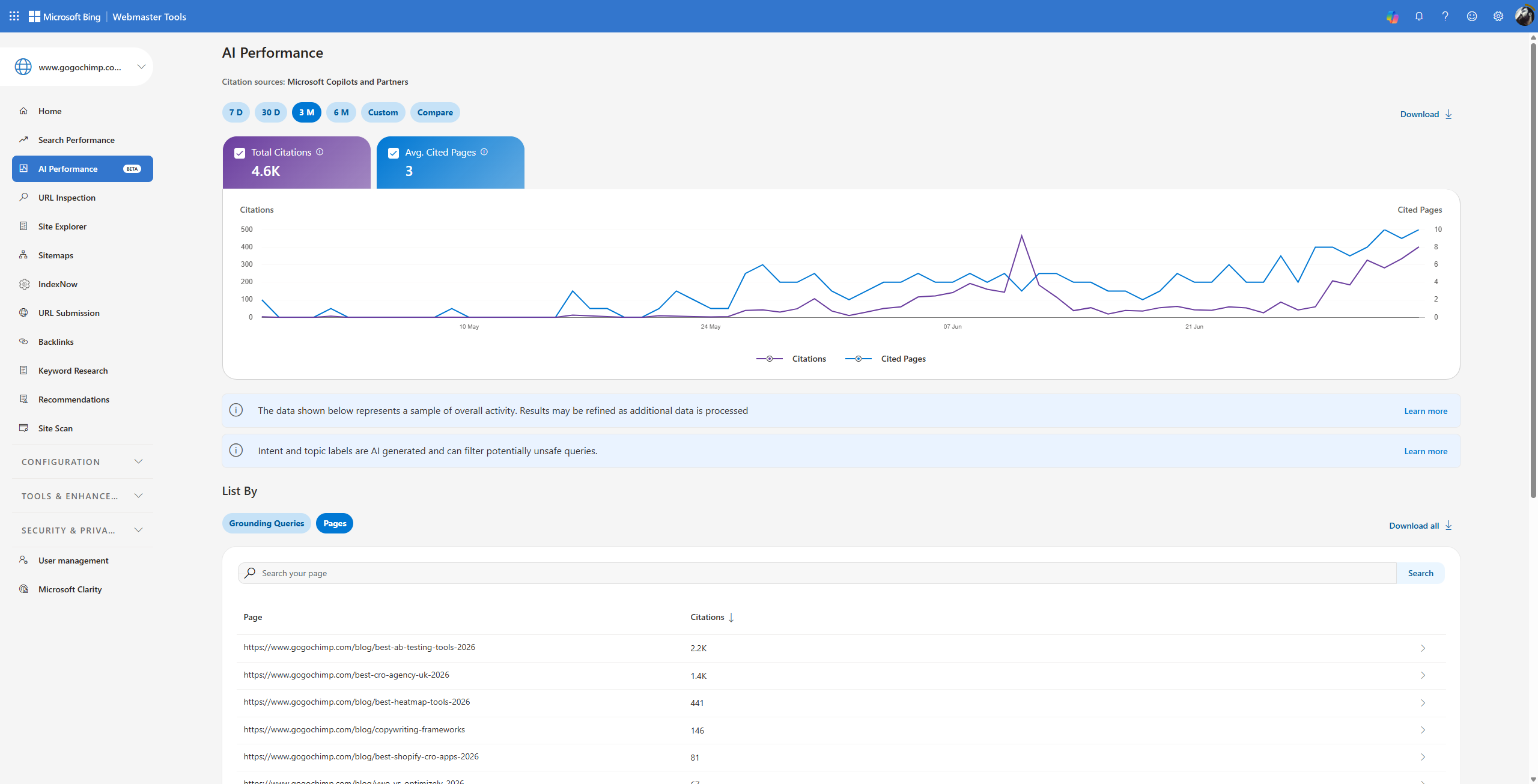
Three pages. Three different acronym wins. Same site. Same brand. Three different retrieval mechanics.
Example 1: /blog/best-ab-testing-tools-2026 - winning GEO on Microsoft Copilot. 1,500 Bing Copilot citations across the 90-day window ending 2026-07-01 (Bing WMT AI Performance report, verified 2026-07-11). Google organic position 6.7. Format: best-of listicle with a 10-row, 6-axis semantic HTML comparison table near the top, per-vendor H2 sections, an 8-question FAQ, and full schema stack (Article, ItemList, FAQPage, Person, Organization). This is the reference implementation of GEO for Copilot.
The retrieval layer lifts the comparison table into answers on queries like "best A/B testing platforms for growth teams" (42.37% Copilot citation share) and "server-side A/B testing platforms" (40.35% share). Our best A/B testing tools 2026 listicle is the reference implementation.
Example 2: /best-cro-agency-uk-2026 - winning GEO despite losing SEO. 1,200 Bing Copilot citations across 90 days. Google organic position 22.4. That's not top 10. Not top 20. Second page of results, deep in the classical SEO surface's dead zone. Yet the citation-to-click ratio on this page is roughly 1,200 to 1. Copilot cited the page 1,200 times. Google organic sent 1 click.
The retriever weights extractability, entity signals, and third-party citations differently from Google's ranking algorithm. This page is proof that you can lose SEO and win GEO on the same page.
Example 3: /blog/best-heatmap-tools-2026 - winning both AEO and GEO on descriptive-query long-tail. 441 Bing Copilot citations across 90 days. Google organic position 8.5. The citation share concentrates on descriptive research-intent queries: "heatmap tools evaluation criteria provider selection factors" (43.00% Copilot share), "highest rated heatmap tools for enterprise business improvement" (12.98% share), "best practices heatmap tools strategies deployment growing teams" (25.17% share). That's not "best heatmap tools" (short-form commercial).
It's the long-tail research sub-query pattern where AEO and GEO overlap most cleanly. The page has a dedicated evaluation-criteria section, which is why it earns 43% Copilot citation share on the exact query about evaluation criteria. Structure the sub-query into the page. The retriever finds it.
Common thread across all three: semantic HTML comparison tables, dated statistics inline, third-party citations, named entities, and answer capsules under H1s. Same discipline, three different citation shapes. The GEO pillar unpacks the underlying 8-step framework in detail. The point of this section: the framework is generalisable across surfaces, and the results are measurable per-page.
The proprietary numbers behind these three examples come directly from Bing Webmaster Tools' AI Performance report (a first-party citation surface that Microsoft themselves publish). Any GoGoChimp client, or anyone who claims their own Bing WMT profile, can pull the equivalent report for their own domain. It's the most useful GEO measurement source available today, and it's free.
For the CRO practitioner reading this: the AI-search surface is now a real acquisition channel for us. It sits above (not alongside) our AI CRO work, which is what converts the visitor once they arrive. The stack is: GEO for discovery, SEO for backup discovery, AI CRO for conversion, everything else downstream.
Zoom into AEO specifically
Answer Engine Optimisation is the acronym doing the most tactical work in 2026 because it maps to four commercially significant answer surfaces (Google AIO, Bing Copilot, Perplexity, ChatGPT). If you want the working manual on the 6-step AEO framework, per-engine retrieval mechanics, structured data (FAQPage / HowTo / DefinedTerm / QAPage), the AEO-by-vertical playbook, and the named AEO tool picture (Profound, Semrush AI Visibility Index, Ahrefs Brand Radar, HubSpot AEO grader, G2), it's all at Answer Engine Optimisation: 2026 Operator's Guide.
ChatGPT specifically
Of the four answer engines the acronyms cover, ChatGPT is the hardest to earn a citation on. It gave one tracked brand a 0.59% citation rate over 30 days (Superlines, 2026), and its corpus is 47.9% Wikipedia-weighted. For the ChatGPT-specific playbook covering entity anchoring, earned media cadence, session-opener queries, and the seven moves that shift the odds, see How to Get Cited by ChatGPT: 2026 Playbook.
FAQ
What's the difference between GEO and SEO in one sentence?
SEO ranks a page in blue-link search results. GEO earns a citation inside a generative AI answer. SEO's currency is the click; GEO's currency is the citation. Both share DNA (clarity, structure, trust signals) but weight different signals more heavily. Ahrefs measured brand mentions correlating 0.664 with AI citation vs backlinks at 0.218 - a 3x gap in favour of mentions.
Is AEO the same as GEO?
No. AEO (Answer Engine Optimization) is a subset of GEO focused specifically on direct-answer surfaces like Google featured snippets, People Also Ask boxes, and voice assistants. GEO (Generative Engine Optimization) is the wider discipline covering all generative retrieval surfaces (ChatGPT, Perplexity, Gemini, Copilot, plus AIO). Every AEO tactic is a GEO tactic. Not every GEO tactic is an AEO tactic.
Is AIO the same as AI Overviews?
Yes, in most 2026 industry usage. AIO refers specifically to Google's AI Overviews product and the discipline of optimising for it. Some practitioners read AIO as "AI Optimization" more generally, which is functionally equivalent to GEO. Whenever the term appears in your marketing team's Slack, check which sense they mean.
Which is more important in 2026: SEO or GEO?
Both. They're compounding, not competing. Being cited in an AI Overview lifts downstream organic click-through by 35% (Seer, 2026). Winning both amplifies each. Winning only one leaves the compounding effect on the table. Prioritise the surface where your competitive intensity is lower.
Which AI engine cites content most often?
Perplexity is built to cite, with numbered sources in its answers. ChatGPT often cites nothing: in the US, 48% of its answers had no citation in March 2026, before citations rebounded in May (seoClarity, 2026). Only 11% of domains are cited by both ChatGPT and Perplexity (Averi, 2026). The engines don't share their winners. Optimising for one is not free coverage of the others.
How do I measure GEO / AEO / AIO performance?
Start with Bing Webmaster Tools' AI Performance report (free, first-party Copilot data). Add Google Search Console for organic + AIO impressions proxy. Layer a third-party tracker like Profound for cross-engine coverage if the budget supports it. Track citation frequency per page, share-of-voice on named queries, and referral clicks from AI engines in GA4. Bing WMT is the most useful measurement source available today.
Do I need llms.txt for any of the four acronyms?
No. Ship it because it's cheap. Don't treat it as a differentiator. SE Ranking's May 2026 analysis found 97% of domains with a valid llms.txt received zero requests for it in the study month. The novelty window has closed. Focus your GEO time on inline citations, comparison tables, answer capsules, and FAQPage schema instead.
Which content format wins across all four acronyms simultaneously?
Best-of listicles with semantic HTML comparison tables placed inside the first 40% of the page, plus per-item sections, plus FAQPage schema, plus inline third-party citations. This format is the single highest-return structural pattern across GEO, AEO, and AIO simultaneously, and it also happens to rank well in classical SEO. If you can only build one content system, build this one.
How wide is the query long-tail for a well-optimised pillar?
Across GoGoChimp's own Bing WMT footprint over the 90-day window ending 2026-07-01, 111 unique grounding queries earned Copilot citations. The top query earned 97 citations at 4.08% share. The 25th-ranked query earned 25 citations but at 42.37% share (higher share on lower absolute volume). The tail of low-volume, high-share queries is where GEO gets under-priced relative to its return.
Is GEO delivering leads yet or is it still a brand play?
Directionally proven, precisely opaque. Being cited in an AI Overview lifts downstream organic CTR by 35% (Seer, 2026), which is measurable. Bing WMT doesn't yet expose downstream conversion data, so the citation-to-lead ratio isn't publicly measurable at the platform level. On our own footprint, we hear qualified inbound leads name AI-search queries in discovery calls. That's current best evidence.
What's the biggest mistake teams make on GEO vs SEO?
Treating them as parallel workstreams instead of compounding surfaces. The teams that ship well are the teams where one content operation satisfies both surfaces simultaneously. Semrush's 2026 AI Visibility Index found that among teams fully integrating SEO and AI visibility into one workflow, 81% report increased traffic or leads from AI platforms. Among teams managing them separately, 36%. A 45-point gap driven by whether the same team owns both.
Does GEO / AEO / AIO work for local businesses?
Yes. The entity layer matters more locally. Google Business Profile, Bing Places, Apple Business Connect, and consistent NAP data across at least eight directories is the local trust stack. Our own Bing Places listing (8 Cheviot Drive, Newton Mearns, Glasgow G77 5AS) is what anchors Microsoft Copilot's local grounding on Glasgow CRO queries. LocalBusiness schema on the site is the on-page anchor.
How to measure the success of GEO campaigns?
Track KPIs for GEO vs SEO in three surfaces. First, Bing Webmaster Tools' AI Performance report shows per-page and per-query Copilot citation frequency (free, first-party). Second, Google Search Console segments AIO impressions once the surface fires on your queries. Third, GA4 referrer segmentation for chatgpt.com, perplexity.ai, gemini.google.com, and copilot.microsoft.com captures downstream click traffic. Together, those three streams cover the measurable citation-to-click funnel.
How does generative engine optimization work?
An LLM decomposes the user's natural-language query into several sub-queries, its retrieval layer pulls candidate passages from an indexed corpus, and the model synthesises an answer that cites the top-ranked sources. Generative engine optimization is the discipline of structuring your content so those passages get retrieved and cited. Signal weightings favour extractable passages, dated statistics, third-party citations, entity coverage, and clean schema markup.
Why is generative engine optimization important?
Two reasons. First, being cited inside an AI Overview lifts downstream organic click-through by 35% (Seer Interactive, 2026), so GEO is a click-clawback mechanism, not just a brand play. Second, earned media accounts for 84% of AI citations (Muck Rack + Seer, 2026). Our own footprint records 44 Copilot citations per Google organic click. The economic weight is shifting toward the citation surface.
Does GEO work for all types of websites?
Yes for content sites, review sites, comparison listicles, definitional pillars, and service pages. It's weaker for pure ecommerce category pages, which need a product-schema plus verified-reviews layer before the retriever treats them as citable. Niche brands average an 11% AI visibility baseline (Ranqo arXiv 100,000-response study). Our own 62% Copilot share on "best Shopify CRO agencies UK" is 5.7x that baseline. The niche tier rewards depth.
Why does citation authority matter for GEO?
Third-party trust signals amplify AI citation likelihood by roughly 75 times (Muck Rack + Seer, 2026). Earned media alone accounts for 84% of AI citations. Retrievers pattern-match citation density as an authority signal in the same way classical SEO treats backlinks, but the weighting is heavier and the corpus of trusted sources is narrower. Cite named studies inline. Link to primary research. Retrievers reward evidence over opinion.
Which is better: GEO vs traditional SEO for local businesses?
Both compound. Local businesses need SEO for Google Business Profile plus map-pack rankings AND GEO for Copilot local grounding. Bing Places is what anchors Microsoft Copilot's local answers, which are becoming the second-largest AI local surface after Google's AI Mode. Our own Bing Places listing (8 Cheviot Drive, Newton Mearns, Glasgow G77 5AS) anchors Copilot grounding on Glasgow CRO queries. Run both surfaces together.
How to run GEO vs SEO for B2B companies?
B2B buyers increasingly use ChatGPT and Copilot for evaluation research. Gartner found 73% of B2B buyers use AI tools in purchase research. Sequence GEO first because the arbitrage window on citation surfaces is still open, then layer SEO for direct-lookup queries where the buyer already knows the vendor name. Prioritise Copilot (Bing-indexed, Microsoft 365-integrated) and ChatGPT (largest AI-search user base) for UK B2B specifically.
Where to go next
If the acronyms are settled and you now need the framework, the GEO pillar covers the 8-step operational discipline in detail plus per-engine deep-dives, vertical-specific applications, and case studies. It's the reference the acronym definitions above sit on top of.
If you want the classical-SEO layer that AIO rewards specifically, the Shopify CRO pillar and the best A/B testing tools 2026 listicle are the two best current references on that pattern.
The harder question is which acronym you're actually optimising for. If a buyer in your category asks their next question inside ChatGPT tomorrow morning, whose page gets cited in the answer? If it isn't yours, you now know what the work is.
References
- Ahrefs. (2026). An Analysis of AI Overview Brand Visibility Factors (75K Brands Studied). https://ahrefs.com/blog/ai-overview-brand-correlation/
- AirOps. (2025). Why Ranking on Page One Isn't Enough. https://www.airops.com/report/structuring-content-for-llms
- Authoritas. (2025). The State of AI Overviews: User Intent Research (December 2024). https://www.authoritas.com/seo-ai-research-whitepapers/the-state-of-aios-user-intent-research-dec-2024
- Averi. (2026). ChatGPT vs. Perplexity vs. Google AI Mode: The B2B SaaS Citation Benchmarks Report. https://averi.ai/how-to/chatgpt-vs.-perplexity-vs.-google-ai-mode-the-b2b-saas-citation-benchmarks-report-%282026%29
- Gandhi, M. (2026, updated 19 June). Tracking the Volatility of ChatGPT's Citations: A Global Trend Analysis. seoClarity. https://www.seoclarity.net/chatgpt-citation-decline-analysis
- Gartner. (2025). B2B Buyer Behaviour Research. https://gartner.com/en/newsroom
- GoGoChimp. (2026). Bing Webmaster Tools AI Performance Report (verified 2026-07-11, 90-day window). First-party data. https://www.gogochimp.com
- Google. (2026). Google Search's I/O 2026 updates: AI agents and more. https://blog.google/products-and-platforms/products/search/search-io-2026/
- Muck Rack. (2026). What Is AI Reading? May 2026 Edition (25 million-link analysis). https://muckrack.com/blog/what-is-ai-reading-may-2026
- Princeton University. (2024). GEO: Generative Engine Optimization. https://arxiv.org/abs/2311.09735
- Profound. (2025). AI Platform Citation Patterns 2025-2026. https://tryprofound.com/blog/ai-platform-citation-patterns
- SE Ranking. (2026). LLMs.txt: Why Brands Rely On It and Why It Doesn't Work. https://seranking.com/blog/llms-txt/
- Seer Interactive. (2026). AIO Impact on Google CTR: 2026 Update. https://seerinteractive.com/insights/aio-impact-on-google-ctr-2026-update
- Semrush. (2026). Semrush Releases Expanded 2026 AI Visibility Index, Analyzing 126 Million AI Search Prompts. https://semrush.com/news/463141-semrush-releases-expanded-2026-ai-visibility-index-analyzing-126-million-ai-search-prompts/
- Shepard, C. / Zyppy Signal. (2026). AI Citation Ranking Factors Analysis: 54 Experiments, Patents, and Case Studies Scored (May 2026). https://signal.zyppy.com/p/ai-citation-ranking-factors
- Superlines. (2026). AI Search Statistics 2026: 60+ Data Points on Visibility, Citations, and Traffic. https://superlines.io/articles/ai-search-statistics/
.png)
Free chapter
Read Chapter 1 of CITED, free.
The playbook for getting your business recommended by ChatGPT and AI search. Read the first chapter, on me.
Read Chapter 1 freeWant us to do this for your site?
Book a free AI audit. 15 minutes. We’ll show you three things your site is missing and what we’d test first.
Book my free AI audit →