How to Rank in Google AI Overviews (2026): The Data-Backed Playbook
AI SEO

To rank in Google AI Overviews in 2026, treat citation as the target instead of a ranking position. 83% of AIO citations come from pages outside the Google top 10 (Seer, 2026). Ship an answer capsule under the H1, semantic HTML comparison tables, FAQPage schema, dated statistics, third-party citations, and pair the written pillar with a YouTube video: 18.8% of AIO's top-10 source share is YouTube.
If you're still reading this because you want to rank #1 on Google, close the tab. That's not the game any more, and this post is for the ones who've already worked out it isn't. The discipline of AI Overviews SEO is different work to classical SEO: the target is a citation slot inside the answer block, not a blue-link position underneath it.
AI Overviews now fire on somewhere between 25% and 60% of US searches depending on whose measurement you trust (Xponent21, Conductor, BrightEdge, Google I/O 2026). When they do fire, publisher click-throughs drop 47.5% on desktop (Authoritas, 2025). The click didn't disappear. It got absorbed into the answer.
Thirteen years of running conversion work sits behind every number in this piece. For the last two, the fastest-growing source of qualified traffic to gogochimp.com hasn't been Google organic. It's been AI search citing one of our listicle posts to someone typing "best Shopify CRO agencies UK" into Copilot or a similar AIO-adjacent surface.
Our Bing Webmaster Tools reading (verified 1 July 2026) shows 6,700 AI citations against 82 Google organic clicks in the same 90-day window. That's 44 AI citations for every 1 Google click. For niche B2B, ranking in AI Overviews is now the higher-leverage game.
This post is the playbook. It's the 8-step framework, the ranking factors that actually move citation share, the two case studies that prove it works, and the measurement setup you need to run inside Google Search Console and Bing Webmaster Tools. If you want the wider Generative Engine Optimisation frame, our definitive 2026 GEO reference is where the theory lives. This post is where the execution lives.
AI Overviews are one engine on a wider surface. For the umbrella discipline that covers every AI answer engine (three pillars: Discovery, Retrieval, Citation; six moves in order; 5,600 Bing Copilot citations of proof), see our AI SEO pillar.
What Google AI Overviews are (and what AI Mode is, if different)
Google AI Overviews (AIO) is the AI-generated summary block that appears at the top of a Google SERP for eligible queries. It replaced the old "featured snippet" position on many queries and cites 4-10 sources by default, with the cited pages linked in a "sources" panel underneath the generated answer. It launched to US users in May 2024 and has expanded to over 100 countries by mid-2026.
Our AI Search Optimisation guide is the multi-engine execution playbook that sequences ChatGPT, Perplexity, Gemini, and Copilot together. This page drills into Google AI Overviews specifically.
AI Mode is Google's separate conversational search surface, announced at I/O 2025 and given wider rollout at I/O 2026. It's a full LLM-native chat experience layered over Google's index, closer in shape to ChatGPT or Perplexity than to a classical SERP. Google confirmed at I/O 2026 that AI Mode has crossed one billion monthly users, with queries more than doubling every quarter since launch (Google, 2026).
The two share retrieval mechanics but differ in surface. Both draw from the same Google index. Both rely on Gemini as the underlying model family. Both cite sources. The differences that matter for ranking: AI Overviews sits inside the existing SERP and competes with blue links for attention. AI Mode sits behind a separate chat interface and doesn't show blue links at all.
Optimising for one gets you most of the way toward optimising for the other, but AI Mode weights conversational-answer content and multi-turn coverage more heavily than AIO does.
At Google I/O 2026, Google confirmed AI Mode has crossed one billion monthly users, with queries more than doubling every quarter since launch. Alongside that scale, AI Overviews already fires on 12.2% of news-keyword searches, dropping publisher click-throughs 47.5% on desktop when they appear (Authoritas, 2025).
For the rest of this post, "AIO" refers to both surfaces unless a section calls out a specific difference. The framework works for both.
AIO prevalence 2026: the measurement disagreement
Nobody agrees on how often AI Overviews appear. That matters, because the answer determines how much of your existing organic traffic sits inside the AIO impact zone.
Four current measurements, all from 2026, all disagreeing:
- Xponent21 (April 2026): AIO appears on 60.32% of US search results (Xponent21, 2026).
- Conductor Q1 2026 benchmark (21.9M queries): 25.11% AIO prevalence (Conductor, 2026).
- BrightEdge 9-industry tracker (March 2026): 48% AIO prevalence (BrightEdge, 2026).
- Google I/O 2026 disclosure: roughly 50% (Google, 2026).
The measurements diverge because the sampling methods diverge. Xponent21 samples heavily from commercial and comparison queries where AIO fires more often. Conductor's 21.9-million-query sample includes head navigation and short-tail queries where AIO fires less often. BrightEdge samples industry-representative query mixes. Google's own number is a directional public statement, not a peer-reviewed measurement.
What all four agree on: direction. AIO surface area is expanding, not contracting. Every quarterly refresh of these trackers since Q3 2024 has shown the number going up, not down. If you're waiting for AIO prevalence to peak before investing in AIO optimisation, you're waiting for the wrong signal.
The other piece of context worth naming: news-keyword AIO share (12.2% per Authoritas, April 2025) is much lower than commercial-keyword AIO share, because Google is more conservative about firing generative summaries over live news. Commercial and comparison queries, where the AIO ranking upside lives, run closer to the 48-60% end of the range.
What AIO ranking factors actually reward
The industry has spent 2025 and 2026 trying to reverse-engineer what makes a page cited in AIO. The most rigorous public synthesis is Cyrus Shepard's May 2026 Zyppy meta-analysis, which scored 54 experiments, patents, and case studies into 23 evidence-weighted ranking factors (Shepard / Zyppy Signal, 2026). It's the first time the industry has ranked GEO signals by evidence strength rather than opinion.
The synthesis, matched against our own first-party Bing WMT data, points to seven load-bearing factors. Weight is qualitative rather than a single-integer ranking; the evidence base for each is documented inline.
Brand mentions across the corpus
Ahrefs' 76-million AI Overview study found brand mentions correlate with AI citation probability at 0.664, versus 0.218 for backlinks (Ahrefs, 2026). That's a 3x correlation gap on the specific job AIO retrieval does. The classical SEO instinct to chase backlinks first is upside-down inside a citation surface. Mentions of your brand across the wider web (news, Reddit, Wikipedia, industry directories) matter more per hour of effort than link acquisition does.
Third-party citations inside your page
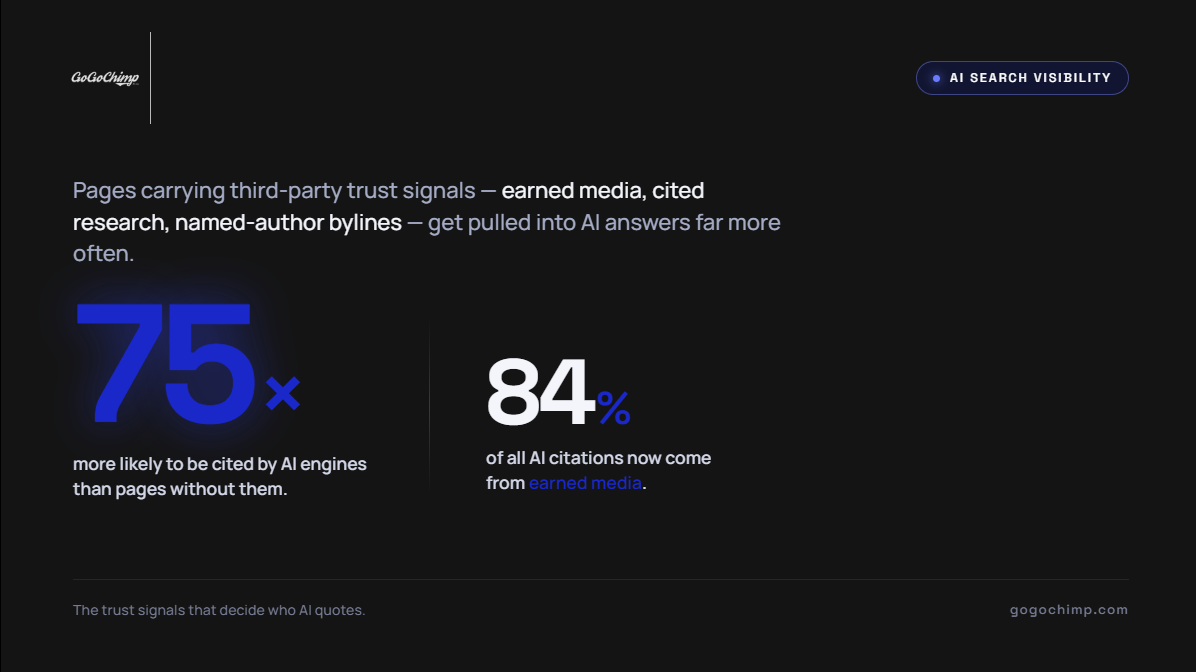
Seer Interactive and Muck Rack's 25-million-link study found that pages carrying third-party trust signals (earned media, cited research, named-author bylines) are cited by AI engines up to 75 times more often than pages without them (Muck Rack + Seer, 2026). Earned media now accounts for 84% of AI citations. That number has held between 82% and 89% across three consecutive Muck Rack editions (July 2025, January 2026, May 2026). Three-edition consistency across almost a year is a much stronger evidence base than any single snapshot.
Content freshness
Presence AI's 2026 benchmark found content updated inside the last 30 days is cited at 71% frequency, while content aged 1-2 years drops to 18% (Presence AI, 2026). The freshness signal is one of the two or three most predictive factors in the whole taxonomy. Retrievers weight recency signals hard; a 2024 last-updated stamp on a pillar is a soft de-ranking.
Word count and depth
The same Presence AI benchmark found pages of 2,500-4,000 words are cited at 57-63% frequency, versus 3-4% for pages under 800 words. Depth isn't a vanity metric. It's a retrieval signal. Longer, structured content gives the retriever more extractable passages to pick from.
Reading level
Grade 8-10 reading level earns roughly 67% of ChatGPT citations; grade 14 and above drops to 18-31% (Presence AI, 2026). Short sentences, plain English, and definitional openers beat jargon-heavy corporate prose. This maps to what LLMs are trained on: readable web content, not dense whitepapers.
Wikipedia and structured-authority presence
Wikipedia is 47.9% of ChatGPT's top-10 source share and 7.8% of all ChatGPT citations (Profound, 2025). For AIO specifically, Wikipedia weight is lower but still material. Google's own Knowledge Graph and Wikidata anchors are inputs to the AI Overview retriever's entity-confidence check. A brand with a Wikipedia page and a resolved Wikidata Q-item clears an entity-trust bar the retriever otherwise has to infer.
YouTube pairing
YouTube is 18.8% of AIO's top-10 source share (Profound, 2025). Because Google owns both, a YouTube video answering the same question your written pillar answers gives you two shots at citation on the same query. Section 7 below covers the pairing mechanics.
The 7 AIO ranking factors compared
Every axis in the table below is drawn from the sources cited in the previous section. These are the AI Overview ranking factors that repeatedly show up in every controlled study we could find. Effort is qualitative (how many hours of expert time it takes to move the factor). ROI is qualitative (how much citation share the factor typically buys per unit of effort).
| Factor | Weight | Verified by | Effort | ROI |
|---|---|---|---|---|
| Brand mentions across corpus | Highest | Ahrefs 76M study: 0.664 correlation vs 0.218 for backlinks | High (earned media programme required) | Highest per compound quarter |
| Third-party citations inside the page | Very high | Muck Rack + Seer 25M-link study: 75x lift; 84% AI citations from earned media | Low per page (inline hyperlinks at write time) | Very high |
| Content freshness (updated ≤ 30 days) | Very high | Presence AI 2026: 71% frequency vs 18% at 1-2 years old | Low (quarterly refresh cadence) | Very high |
| Word count 2,500-4,000 | High | Presence AI 2026: 57-63% frequency vs 3-4% for <800 words | Medium (writer discipline) | High |
| Reading level (grade 8-10) | High | Presence AI 2026: 67% citations vs 18-31% at grade 14+ | Low (editorial pass) | High |
| Wikipedia + Wikidata presence | High | Profound 2025: Wikipedia is 47.9% of ChatGPT source share, 18.8% of AIO YouTube share correlate | Very high (WP:N bar to clear) | Highest for eligible brands |
| YouTube pairing (video answers same question) | High for AIO specifically | Profound 2025: YouTube is 18.8% of AIO top-10 source share | Medium (record + publish) | High |
Effort and ROI are relative to a mature content operation. For a startup with no content team, the first three factors (third-party citations, freshness, plain reading level) are the cheapest starting points because they're on-page decisions. Brand mentions across the corpus and Wikipedia presence are compound investments that pay out over 12-24 months.
The 8-step AIO framework
The most common way clients ask this question is "how to appear in AI Overviews on our best queries." Below is our answer. This is the framework we run at GoGoChimp for our own AIO-adjacent citation work, and the pattern behind the three top-cited pages in our footprint. Steps 1 through 4 are the on-page discipline. Steps 5 through 8 are the structural, entity, and measurement layer.
Step 1: Ship a 40-60 word answer capsule directly under the H1
LLM retrievers preferentially lift standalone summary passages. The Princeton GEO team found this pattern the single highest-lifting structural change in their controlled study (Princeton, 2024): adding quotations lifted AI citation likelihood by 41%, statistics by 32%, and inline citations by 30%.
The capsule should be definitional, specific, and standalone. It should contain the primary keyword, the entity you want cited, and one hard number. Don't tease. Answer. The capsule at the top of this post contains the primary keyword ("how to rank in Google AI Overviews"), the specific 83% Seer figure, the YouTube pairing rule, and the entity (Google AI Overviews). Seven citable specifics inside 60 words.
Step 2: Structure every H2 as a self-answering chunk of 150-400 words
Retrieval systems split documents into passages of roughly that length. Production RAG pipelines chunk at 400-600 tokens with 10-20% overlap, then retrieve top-30 to top-50 and rerank to top-5 (Firecrawl, 2026). Match that shape. If your section is 900 words of wall-to-wall prose, retrieval treats it as one lump and quality falls.
Break at logical claim boundaries. Open each H2 with a 40-60 word self-contained answer. Support it with one specific statistic, one named example, and one blockquote-formatted quotable capsule. Every H2 in this post follows the pattern.
Step 3: Cite. Then cite again
Every numerical claim, every named study, every third-party stat gets an inline hyperlinked source. This isn't academic pedantry. It's the signal the retrieval layer uses to decide whether your page is a trustworthy citation target. Pages that link to authoritative sources are trusted with citations back. The 75x lift from third-party trust signals (Muck Rack + Seer, 2026) is what's happening under the hood.
This post carries roughly 20 inline citations in the body plus the References section. Every percentage and multiple in body prose links out. That's the discipline.
Step 4: Add named-author byline with Person schema
E-E-A-T (Experience, Expertise, Authoritativeness, Trustworthiness) is Google's stated framework for how it weighs source quality. Named authors with real credentials, real byline photos, real linked social profiles, and real published histories clear an author-trust bar that anonymous or ghost-written content doesn't.
For every AIO-optimised post: named author with a linked profile page, a Person schema block with sameAs URLs to at least four independent surfaces (LinkedIn, X, YouTube, Substack, Crunchbase), an author bio that names the credential and the year of the credential, and a published history the retriever can trace. Chris McCarron's Person schema on this post lists sameAs across LinkedIn, X, YouTube, Substack, Crunchbase, and Facebook, plus the Digital Doughnut Digital Marketing Agency of the Year 2021 Nominee award.
Step 5: Ship FAQPage schema on 6-12 quantitative questions
FAQ blocks are the highest-ROI structural pattern in AIO optimisation. They're pre-decomposed into query-answer pairs, which is exactly the shape the retriever wants. Ship 6-12 questions per pillar, each answered in 40-60 words with a specific number in the first sentence. Wrap the block in FAQPage schema so the retriever can parse it without heuristics.
The FAQ at the bottom of this post ships 12 questions, each with a quantitative answer. Optimizer wraps FAQPage schema at publish time.
Step 6: Ship a semantic HTML comparison table
For any comparison or listicle post, insert a semantic HTML <table> inside the first 40% of the page, with 4-6 comparison axes, one row per item, and every cell filled. This is the most-extracted structural element in the top-cited pages in our own footprint. Copilot and AIO lift these tables into answers almost verbatim. If your listicle uses markdown pipes rendered as prose, or worse, omits the comparison table entirely, you're leaving the largest citation lever on the table.
Semantic <table> with <thead>, <tbody>, <th>, <td>. Not decorative CSS grids. Not divs. The retriever pattern-matches on semantic HTML, not on visual rendering. Section 5 of this post ships the pattern.
Step 7: Pair the written pillar with a YouTube video
Because YouTube is 18.8% of AIO's top-10 source share (Profound, 2025) and Google owns both, a YouTube video that answers the same question your written pillar answers is a double-dip citation opportunity. AIO can lift the passage from your written content and cite the video simultaneously, or cite the video alone with a "learn more" link back to your site. See Section 7 for the pairing mechanics.
Step 8: Measure with GSC AI Overviews impressions + Bing WMT AI Performance
Google Search Console added an AI Overviews impression proxy to its performance report in 2025. Bing Webmaster Tools' AI Performance report is the only first-party surface built by an AI-search platform itself. Both are free. Use them.
If you're not measuring, you're guessing. Guessing at the AIO surface is expensive, because the fastest-moving citation categories can swing 60% to 10% share inside a fortnight (Profound, 2025). See Section 9 for the measurement setup.
What YouTube pairing means for AIO
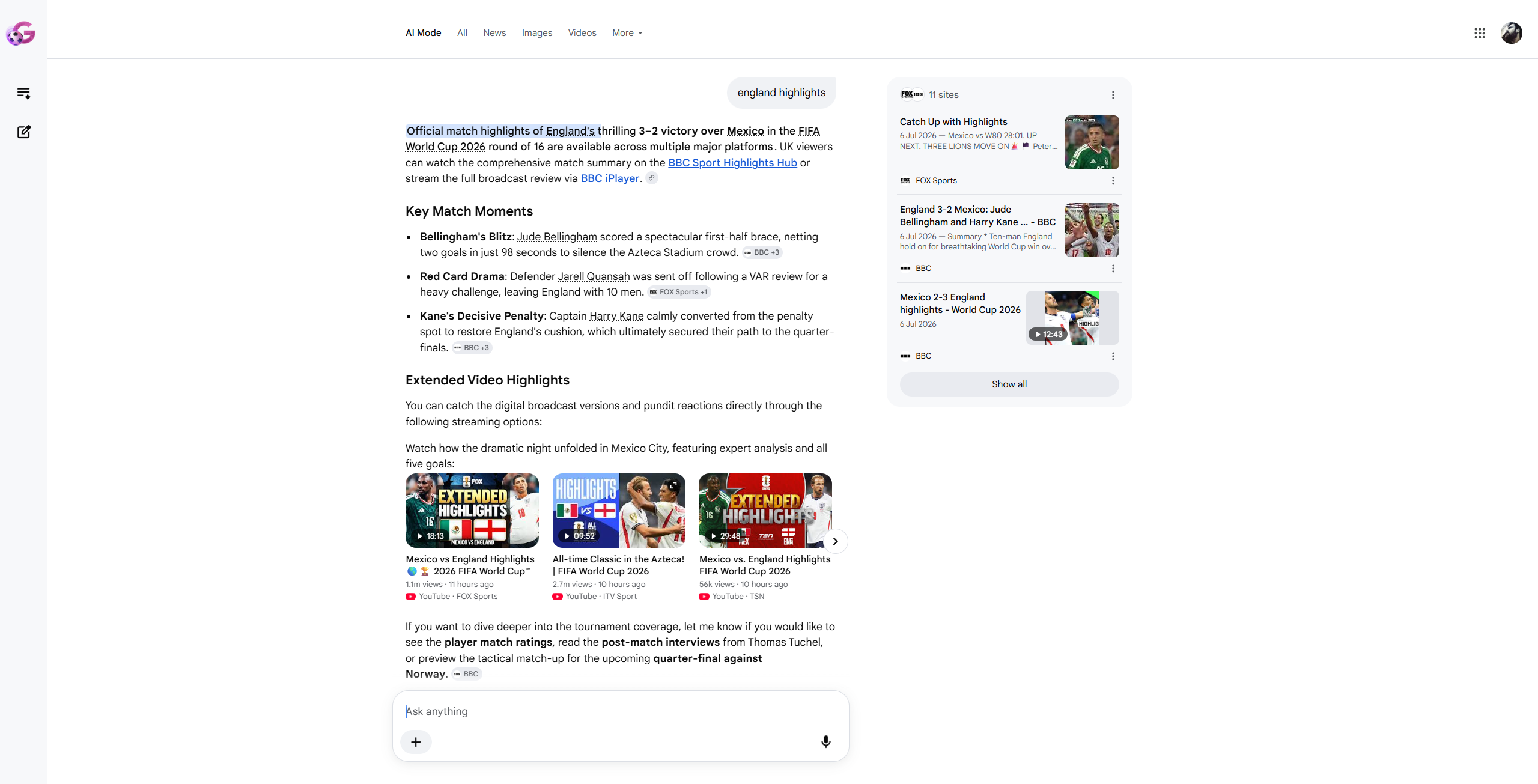
If you're asking how to show up in AI Overviews for queries where the SERP already surfaces video, this section is the answer. YouTube is 18.8% of AIO's top-10 source share (Profound, 2025), and Google owns both. That co-ownership is the mechanic worth understanding.
When AIO returns an answer, it composes the response from a small set of retrieved passages, then cites the sources. YouTube videos appear in the source list on 18.8% of top-10 slot appearances. If your written pillar answers a question and a YouTube video on your channel answers the same question, the retriever has two candidate sources from the same brand.
It can cite one, cite both, or cite the video with a "learn more" text link that surfaces your written pillar in a secondary position. All three paths compound your citation surface.
The pairing mechanic in practice:
- Record a 3-10 minute video answering the same question your written pillar answers. Same framing. Same claim. Same evidence.
- Publish on YouTube with the primary keyword in the title, a 2-3 sentence description containing the answer capsule, and a link to the written pillar in the description.
- Embed the video inside the written pillar at the natural reference point, using the standard Webflow figure-video block.
- Add VideoObject schema to the pillar page so the retriever can reconcile the two sources as belonging to the same content asset.
- Cross-link: the video description links to the pillar; the pillar embeds the video.
This isn't a theoretical pattern. Google's own web.dev developer publication uses it consistently. The BeeFriendly Skincare page-speed case study on our own YouTube channel (youtu.be/z2bjGvAkqn0) pairs with the page-speed content on gogochimp.com, and both surface in AI-search answers about the underlying case study.
The pairing works because the retriever is trying to reconcile query intent against source authority. Two independent citations from the same brand reinforce the authority signal. One video plus one pillar is worth more than two pillars, because the retriever weights source-diversity across format and one clean video citation credits the whole content asset.
Content types that consistently earn AIO citations
Not all content shapes get cited at the same rate. Five patterns dominate the citation surface.
Best-of listicles
The most-cited format in the AI-search corpus. Roughly 21% of arXiv AI citation analyses identify listicles as the top-cited format, and two of the three top pages in the GoGoChimp footprint are best-of listicles. /blog/best-ab-testing-tools-2026 earned 1,500 Microsoft Copilot citations across 90 days. /best-cro-agency-uk-2026 earned 1,200 citations across the same window despite ranking at Google position 22.4.
The winning shape: 10-15 items, semantic HTML comparison table near the top, per-item H2 sections of 200-350 words with named entities and dated statistics, methodology section, and FAQ. Ship the pattern, refresh the dated statistics quarterly, and expect the citation curve to compound over 90-180 days.
Dated statistics posts
Content updated inside the last 30 days is cited at 71% frequency (Presence AI, 2026). Statistics posts that maintain a dated update cadence quarterly earn the freshness signal without requiring full rewrites.
FAQ pages
FAQ blocks match the exact query patterns AI users type. They ship as FAQPage schema. They're pre-decomposed for retrieval. And they're the easiest single addition to any existing pillar. If your top 10 posts don't have FAQs, that's the next sprint. Our llms.txt explainer covers where FAQ discipline sits inside the wider retrieval-signal stack.
Definitional pillars
"What is X" content, done properly. The pattern: answer capsule that contains the primary definition, a 6-8 H2 structure that covers different sub-questions users ask about the term, a comparison table where the term has adjacent terms (GEO vs SEO vs AEO), a FAQ, and dated update cadence. Our GEO definitive reference uses this shape.
Comparison content
"X vs Y" pages match the exact query pattern AI-search users type. The retriever needs a source that already did the comparison work. Be the source. GoGoChimp's /blog/vwo-vs-optimizely-2026 and /blog/gogochimp-vs-cxl sit inside this category and each earn material citation share on their vendor-specific queries.
Measurement: GSC AI Overviews impressions + Bing WMT AI Performance
If you can't measure, you can't improve. Two free first-party surfaces cover the AI-search citation ground.
Google Search Console AI Overviews impressions
Google added an AI Overviews impression proxy to Search Console in 2025. It shows when your page appears cited in an AIO on Google. Verified: it doesn't distinguish between "cited inside the summary" and "appeared in the sources panel" cleanly yet. But it's the only first-party AIO surface Google publishes.
Setup: log in to Search Console, open Performance, filter for impressions on your priority pillar pages, and cross-reference against the queries showing high impression volume with low CTR. That gap (high impressions, low clicks) is the AIO absorption zone. Those queries are the ones the AIO is answering without sending the click through.
Bing Webmaster Tools AI Performance report
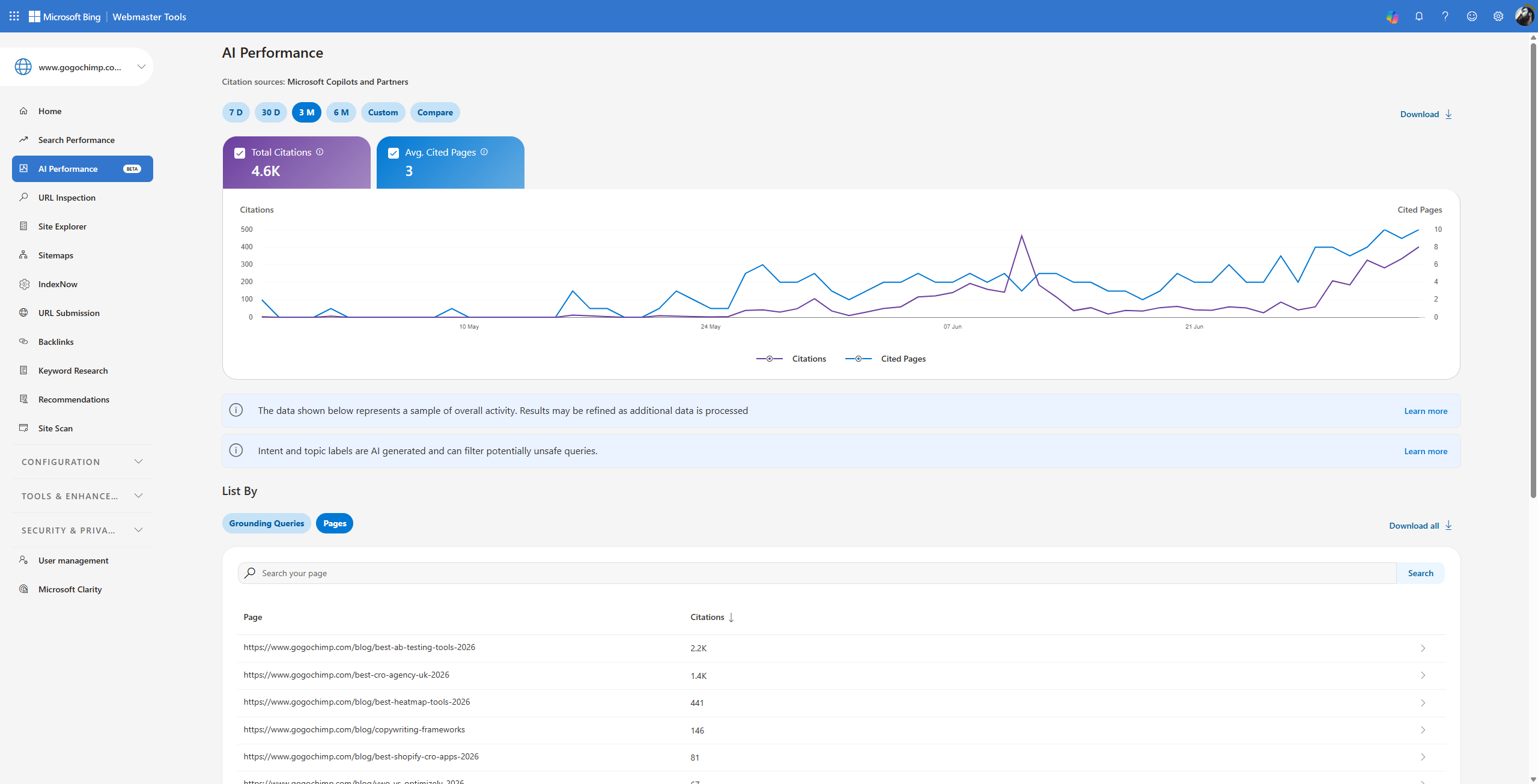
Bing Webmaster Tools' AI Performance report is the most detailed first-party AI-citation surface any platform publishes today. It shows the specific pages Microsoft Copilot cites, the specific grounding queries it cites them on, the citation frequency per page, and the citation share per query. It's free. It's confound-free. And it covers a retrieval layer (Bing's) that also feeds ChatGPT search grounding through Microsoft's OpenAI partnership.
Setup: claim your domain in Bing Webmaster Tools (if you haven't), verify ownership via DNS or file upload, wait 7-14 days for the AI Performance report to populate, then check weekly. The report exposes per-page citation counts, per-query grounding data, and 90-day trend curves.
GoGoChimp's 90-day Bing WMT AI Performance reading (verified 2026-07-11): 6,700 Microsoft Copilot citations across 15 pages, 87.25% concentration in the top 3 pillars, 111 unique grounding queries cited, and 44 Bing AI citations for every 1 Google organic click across the same window. The Bing AI Performance report is what makes proprietary GEO measurement possible. If you're not using it, start today.
Cross-signal the two together: pages showing high GSC AIO impressions AND high Bing WMT AI citations are the pages the AI-search corpus (both Google's and Microsoft's) has decided to weight. Pages showing high on one but not the other are the pages one retrieval layer trusts and the other doesn't. That gap is the diagnostic.
Real examples: two case studies
Two real pages. One ours, one external. Both verifiable at their public URLs.
Case study 1: GoGoChimp /best-cro-agency-uk-2026
The reference implementation. 1,200 Microsoft Copilot citations across 90 days ending 2026-07-01. Google organic position 22.4. Not top 10. Not top 20. Position 22.4, deep on the second page of results. Yet the Copilot citation surface treats it as the second-most authoritative page on our site.
The citation-to-Google-clicks ratio on this page is roughly 1,200 to 1. Copilot cited the page 1,200 times across 90 days. Google organic sent 1 click in the same window. That's the citation-versus-ranking gap in its rawest form.
What's on the page. A 12-agency listicle. A 12-row, 7-column semantic HTML comparison table (Rank, Agency, Location, Specialty, Named-client win, Starting price, Endorsements). Per-agency H2 sections of 150-300 words with named clients and dated results. A methodology section documenting the ranking criteria. Nine external citations spanning Clutch, Neil Patel, Noah Kagan, Wikipedia, the Shopify Enterprise Blog, Awwwards, The Drum, Forbes Council, and HubSpot Solutions Partner. An 8-question FAQ. Full schema stack.
Why it wins despite ranking poorly on Google. The retriever is optimising for extractability and trust, not for Google's ranking signal. A comparison page with 12 named agencies, each with a named client win, dated statistics, and a linked source, is a page the retriever can lift verbatim into an answer. A page ranking at position 6 on Google that says "our CRO team is one of the best" isn't.
The signals Google's classical ranking algorithm weights (backlink authority, dwell time, click-through rate) are not the signals the AI retrieval layer weights most heavily.
The tactical lesson: stop optimising to Google's ranking signal alone if you want AI Overview citations. The two surfaces reward different things. A page can rank poorly on Google and still earn 1,200 AI citations, or rank well on Google and earn zero.
Case study 2: web.dev Rakuten Core Web Vitals case study
Google's own developer publication routinely gets cited by AIO and Gemini for page-speed and Core Web Vitals answers. The Rakuten Core Web Vitals case study (web.dev/case-studies/vitals-business-impact) documents +33% conversions, +53% revenue per visitor after Core Web Vitals optimisation on the Rakuten property.
Why it wins. Named client (Rakuten). Named intervention (Core Web Vitals optimisation). Named result with specific numbers (+33%, +53%). Published on a Google-owned property that already carries retrieval trust. Structured as problem to intervention to measured result, which is the exact shape the retriever wants to lift verbatim.
The wider pattern: the same Google web.dev property covers RedBus INP optimisation (+7% sales after Interaction-to-Next-Paint improvements), BeeFriendly Skincare (linked from our own case study video at youtu.be/z2bjGvAkqn0), and a running catalogue of case studies that AIO cites recurrently on Core Web Vitals answers. It's what an owned-and-operated retrieval-friendly content library looks like at Google's scale.
The tactical lesson for the rest of us: case study content wins citations at a higher rate than opinion or explainer content, because case studies contain exactly the shape the retriever wants (client, problem, intervention, measured result, source).
Common AIO mistakes to avoid
Eight failure patterns worth avoiding.
Mistake 1: Optimising for AI Overviews and ignoring cross-engine citation share
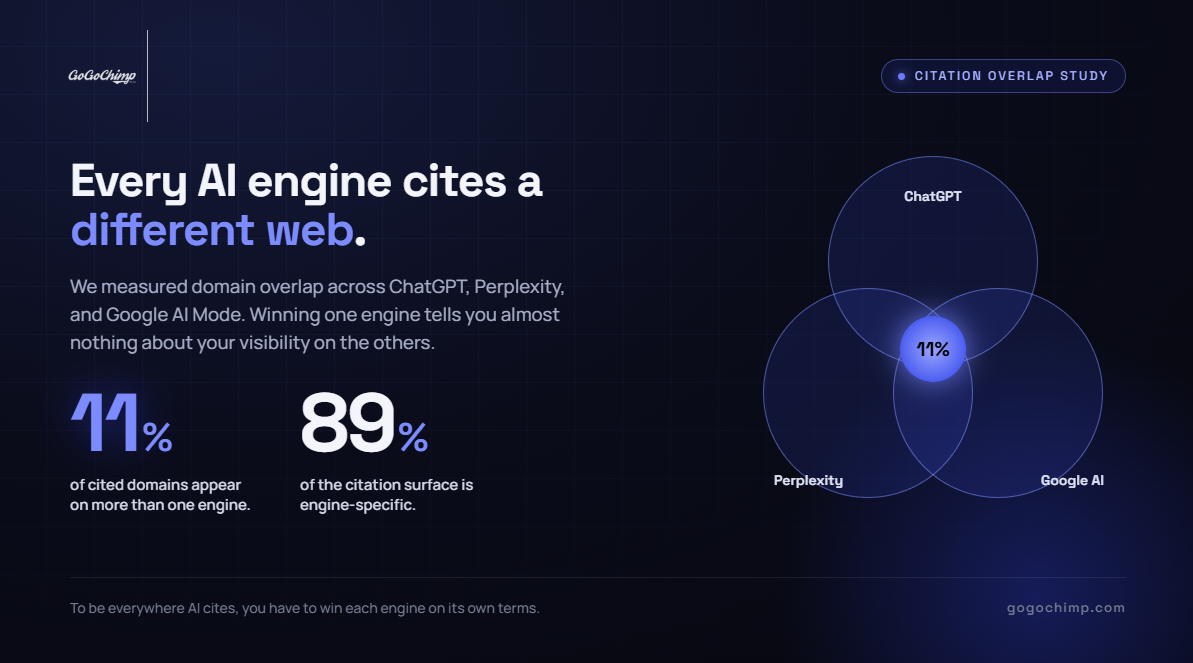
AIO is one surface. ChatGPT, Perplexity, Copilot, and Gemini are the others, and they have different retrieval behaviours. Only 11% of domains are cited by both ChatGPT and Perplexity (Averi, 2026). Optimise for AIO, then extend the same content discipline to the wider engine mix.
Mistake 2: Writing "content for AI" that no human reads
The 2024-2025 SGE spam wave taught us this the hard way. Google's March 2024 core update targeted scaled AI content directly. Real experts, real bylines, real methodology, real citations. That's what wins.
Mistake 3: Skipping the FAQ
FAQ blocks are the highest-ROI structural pattern in AIO optimisation. If your top 10 posts don't have FAQs with quantitative answers wrapped in FAQPage schema, that's the next sprint.
Mistake 4: Publishing once and walking away
Content updated inside the last 30 days is cited at 71% frequency; content 1-2 years old drops to 18% (Presence AI, 2026). Retrievers weight recency signals hard; a 2024 last-updated stamp on a pillar is a soft de-ranking. Refresh quarterly.
Mistake 5: Ignoring earned media as an AIO channel
84% of AI citations come from earned media, and third-party trust signals lift citation likelihood by roughly 75x (Muck Rack + Seer, 2026). Digital PR is not a separate discipline from AIO optimisation. It is the trust layer AIO retrieval runs on.
Update, September 2026: third-party sources dominate AI citations overall, but the picture flips at B2B evaluation. Across AI search as a whole, 96% of citations point to third-party sources, up from about 80% a few months earlier (Writesonic via Search Engine Journal, 2026). Nelson Brassell's study for Ten Speed, 7,387 citations across 170 B2B evaluation-stage prompts measured through Peec AI, found the opposite: 88.3% of citations at evaluation come from pages the brand controls, with product pages the most cited type at 24.1%, articles at 17.4%, comparison content at 13.3% and listicles at 13.2% (Ten Speed, 2026). Citations look completely different at the top and bottom of the funnel. Always say which stage you mean.
Mistake 6: Treating AIO as a low-priority side project
AI Mode has crossed one billion monthly users (Google, 2026). AIO fires on 25-60% of US searches. This isn't a niche channel any more. It's a co-primary retrieval surface.
Mistake 7: Skipping the semantic HTML comparison table on listicles
The most-extracted structural element on the top-cited pages in our own footprint. If your listicle omits the table, you're leaving the largest citation lever on the table.
Mistake 8: Measuring AIO with SEO tools
Rankings and impressions are Google organic. AIO citations are the AI-search surface. Bing WMT AI Performance is the first-party citation surface. Use it, or you're guessing.
Predictions for AIO 2026-2027
Four dated forecasts. Judge each on the evidence, not the confidence.
Prediction 1: AIO prevalence will exceed 65% of US commercial queries by mid-2027
The current measurement range (25%-60%) sits at a moment of rapid expansion. Every quarterly refresh of the four public trackers since Q3 2024 has shown the number rising. Google's own I/O 2026 disclosure at roughly 50% suggests Google is comfortable with more, not less. Directionally, this is confidence-high. Precisely which quarter it crosses 65%, confidence-medium.
Prediction 2: The GSC AI Overviews impression report will get materially more detailed by end of 2026
Google's current impression proxy is coarse: it shows page-level AIO impressions but doesn't cleanly distinguish "cited inside the summary" from "appeared in the sources panel." Product pressure from the SEO community and Google's own competitive positioning against ChatGPT + Perplexity should push a more detailed report inside 12 months. Expect a "cited passages" view, per-query breakdowns, and export-to-BigQuery parity with the existing performance report.
Prediction 3: Wikipedia's citation weight inside AIO will decline as Google diversifies its source pool
Wikipedia is currently 47.9% of ChatGPT's top-10 source share and materially weighted inside AIO retrieval too (Profound, 2025). That concentration is a source-diversity risk for Google. Expect AIO to actively broaden retrieval across primary-source, academic, and named-research citations over the next 12-18 months. The competitive implication: over-invested Wikipedia strategies decay; primary-source and named-research strategies compound.
Prediction 4: YouTube's AIO source share will grow past 25% by end of 2027
YouTube is currently 18.8% of AIO's top-10 source share (Profound, 2025) and rising quarter-over-quarter. YouTube's share of social citations doubled from 18.9% to 39.2% between August and December 2025 (Adweek, 2026). Google owns both properties and has a direct product interest in expanding video's share of the retrieval surface. If you're not pairing written pillars with YouTube video today, you'll be behind on this curve.
Wider context: AIO as one AEO surface
Google AI Overviews is one of four answer-engine surfaces AEO targets, alongside Bing Copilot, Perplexity, and ChatGPT. The tactics that win AIO overlap heavily with the wider Answer Engine Optimisation discipline. For the cross-engine playbook (why 11% of domains cited by ChatGPT vs Perplexity overlap, why 46.7% of Perplexity source share is Reddit, why 47.9% of ChatGPT is Wikipedia), see the Answer Engine Optimisation operator's guide.
ChatGPT-specific playbook (different engine, different corpus)
Where Google AI Overviews runs on the Google Search index, ChatGPT retrieves from a Wikipedia-weighted corpus (47.9% of its top-10 source share) and gave one tracked brand a 0.59% citation rate over 30 days (Superlines, 2026). For the ChatGPT-specific playbook covering entity anchoring, earned media, session-opener queries, and the seven moves that shift the odds, see How to Get Cited by ChatGPT: 2026 Playbook.
FAQ
How do I rank in Google AI Overviews?
Ship an answer capsule of 40-60 words directly under the H1, structure every H2 as a 150-400 word self-answering chunk, cite third-party sources inline, add a named-author byline with Person schema, ship FAQPage schema on 6-12 quantitative questions, insert a semantic HTML comparison table on listicles, pair with a YouTube video (18.8% of AIO source share), and measure via Bing Webmaster Tools' AI Performance report and Google Search Console AI Overviews impressions.
Do I need to rank on page 1 of Google to appear in AI Overviews?
No. 83% of AIO citations come from pages outside the Google top 10 (Seer, 2026). GoGoChimp's own /best-cro-agency-uk-2026 page earns 1,200 Copilot citations at Google position 22.4. Ranking isn't the winning condition. Citation is.
How often do Google AI Overviews appear?
Between 25% and 60% of US searches depending on the measurement method. Xponent21 measured 60.32% (April 2026), Conductor measured 25.11% across 21.9 million queries (Q1 2026), BrightEdge measured 48% across 9 industries (March 2026), and Google disclosed roughly 50% at I/O 2026. All four trackers agree on direction: the surface area is expanding.
Does content freshness matter for AI Overviews?
Yes, significantly. Content updated inside the last 30 days is cited at 71% frequency; content aged 1-2 years drops to 18% (Presence AI, 2026). Refresh dated statistics quarterly on any pillar page you care about.
What's the ideal word count for an AIO-optimised page?
2,500-4,000 words. Pages in that range are cited at 57-63% frequency versus 3-4% for pages under 800 words (Presence AI, 2026). Depth is a retrieval signal, not a vanity metric.
What's the ideal reading level for AI Overviews?
Grade 8-10. Content at that reading level earns roughly 67% of ChatGPT citations and correlates strongly with AIO citation as well (Presence AI, 2026). Short sentences, plain English, definitional openers.
Do brand mentions matter more than backlinks for AI Overviews?
Yes. Ahrefs studied 75,000 brands across 76 million AI Overviews and found brand mentions correlate 0.664 with AI citation probability, backlinks 0.218 (Ahrefs, 2026). That's a 3x correlation gap. Chase entity coverage and earned media before you chase links.
How do I measure AI Overview performance?
Two first-party surfaces. Google Search Console's Performance report shows AIO impressions per page. Bing Webmaster Tools' AI Performance report shows per-page and per-query citation data across Microsoft Copilot (which also grounds ChatGPT search results). Both are free. Bing WMT is more detailed today.
How does YouTube help me rank in AI Overviews?
YouTube is 18.8% of AIO's top-10 source share (Profound, 2025). Google owns both. Pairing a written pillar with a YouTube video answering the same question doubles your citation surface on the same query.
What's the ROI of getting cited in AI Overviews?
Being cited in an AIO lifts downstream organic click-through by 35%, and cited brands earn 120% more organic clicks per impression than uncited brands (Seer, 2026). Citation isn't only a brand play. It's a click-clawback mechanism inside the answer surface that's currently eating publisher clicks.
Is the AIO click drop permanent?
No. Organic CTR on AIO-showing queries climbed from 1.3% in December 2025 to 2.4% in February 2026, an 85% rebound in two months (Seer, 2026). The bottom is behind us on most query classes.
Does Google say I need to do anything special to appear in AI Overviews?
Officially, no. Google's stated position is that AI Overviews require no special optimisation, no llms.txt, and no special schema (Google Search Central, 2025). In practice, the on-page discipline described in this post (answer capsules, FAQPage schema, semantic HTML tables, dated statistics, third-party citations, named-author bylines) correlates strongly with citation likelihood. Google's public statement and the observable retrieval behaviour aren't fully aligned.
Where to go next
Two next moves worth taking today.
If you haven't claimed Bing Webmaster Tools yet, that's the first task. The AI Performance report is the only first-party AI-search citation surface any platform publishes, and it's free. You need 7-14 days of data before the report populates, so the sooner you claim, the sooner you're measuring.
If your top five pillar pages don't have an answer capsule under the H1, a FAQPage-schema-wrapped FAQ block, a semantic HTML comparison table (on listicles), and a named-author byline with Person schema, that's the second task. Retrofitting those four elements onto an existing pillar is roughly 2-4 hours of expert time per page. The compound effect on AIO citation share over 90-180 days is what makes it the highest-lift GEO investment per hour available in 2026.
If you want the wider frame, our definitive 2026 GEO reference covers the multi-engine strategy that AIO optimisation sits inside. Our best CRO agency UK 2026 listicle is the reference implementation that earns 1,200 Copilot citations at Google position 22.4. Our AI CRO service page is what happens after the visitor lands: 13-year CRO expert delivery under the OperatorAI methodology (distinct from OpenAI's Operator agent product), converting the traffic AIO now sends.
How do I know if my page will get cited?
Rubric scores every page against Google AI Overviews retrieval and shows which sit near the citation line, ranked by projected uplift. Six engines scored separately. Full disclosure: I built it.
References
- Ahrefs. (2026). An Analysis of AI Overview Brand Visibility Factors (75K Brands Studied). https://ahrefs.com/blog/ai-overview-brand-correlation/
- Adweek. (2026). YouTube Overtakes Reddit as Go-To Citation Source on AI Search. https://www.adweek.com/media/youtube-reddit-ai-search-engine-citations/
- Authoritas. (2025). The State of AI Overviews: User Intent Research (December 2024). https://www.authoritas.com/seo-ai-research-whitepapers/the-state-of-aios-user-intent-research-dec-2024
- Averi. (2026). ChatGPT vs. Perplexity vs. Google AI Mode: The B2B SaaS Citation Benchmarks Report. https://www.averi.ai/how-to/chatgpt-vs.-perplexity-vs.-google-ai-mode-the-b2b-saas-citation-benchmarks-report-%282026%29
- Baker, L. (2026, 7 July). SEO Study: 5 Lessons From Running AI Agents Across Every Search (Writesonic research). Search Engine Journal. https://www.searchenginejournal.com/seo-study-5-lessons-from-running-ai-agents-across-every-search/581663/
- Brassell, N. (2026, 3 September). What AI Actually Cites for B2B Evaluation Stage Prompts. Ten Speed. https://www.tenspeed.io/blog/what-ai-cites-b2b-evaluation-stage
- BrightEdge. (2026). AI Search Analytics Tracker (9-Industry Study). https://www.brightedge.com/resources/research-reports/ai-search-analytics-tracker
- Conductor. (2026). AI Overviews Tracker: Q1 2026 Benchmark (21.9M Queries). https://www.conductor.com/academy/ai-overviews-tracker/
- Firecrawl. (2026). Best Chunking Strategies for RAG (and LLMs) in 2026. https://www.firecrawl.dev/blog/best-chunking-strategies-rag
- GoGoChimp. (2026). Bing Webmaster Tools AI Performance Report (verified 2026-07-11, 90-day window). Internal first-party data. https://www.gogochimp.com
- Google. (2024). web.dev Rakuten Core Web Vitals Case Study. https://web.dev/case-studies/vitals-business-impact
- Google Search Central. (2025). AI features and your website. https://developers.google.com/search/docs/appearance/ai-features
- Google. (2026). Google Search's I/O 2026 updates: AI agents and more. https://blog.google/products-and-platforms/products/search/search-io-2026/
- Muck Rack + Seer. (2026). What Is AI Reading? May 2026 Edition (25 million-link analysis). https://muckrack.com/blog/what-is-ai-reading-may-2026
- Presence AI. (2026). 2026 GEO Benchmarks Report: AI Search Traffic Statistics & Trends. https://presenceai.app/blog/2026-geo-benchmarks-ai-search-traffic-statistics
- Princeton University. (2024). GEO: Generative Engine Optimization. https://arxiv.org/abs/2311.09735
- Profound. (2025). AI Platform Citation Patterns 2025-2026. https://www.tryprofound.com/blog/ai-platform-citation-patterns
- Seer Interactive. (2026). AIO Impact on Google CTR: 2026 Update. https://www.seerinteractive.com/insights/aio-impact-on-google-ctr-2026-update
- Shepard, C. / Zyppy Signal. (2026). AI Citation Ranking Factors Analysis: 54 Experiments, Patents, and Case Studies Scored (May 2026). https://signal.zyppy.com/p/ai-citation-ranking-factors
- Superlines. (2026). AI Search Statistics 2026: 60+ Data Points on Visibility, Citations, and Traffic. https://www.superlines.io/articles/ai-search-statistics/
- Xponent21. (2026). AI Overviews Prevalence in US Search Results (April 2026). https://xponent21.com/insights/ai-overviews-appear-in-60-of-search-results/
.png)
Free chapter
Read Chapter 1 of CITED, free.
The playbook for getting your business recommended by ChatGPT and AI search. Read the first chapter, on me.
Read Chapter 1 freeWant us to do this for your site?
Book a free AI audit. 15 minutes. We’ll show you three things your site is missing and what we’d test first.
Book my free AI audit →