Claude and Gemini SEO: The Emerging AI Engines and How to Optimise for Both (2026)
AI SEO

If you've been chasing AI citation share and you've spent all of it on ChatGPT, Perplexity, and Google AI Overviews, you're covering three engines out of a viable five. Claude and Gemini are the two that most GEO practitioners under-invest in, and they behave nothing like each other.
Gemini is Google's second search brain, bolted onto YouTube and the Google graph, averaging one-fifth as many sources per answer as ChatGPT and drawing them from a much narrower pool.
I run conversion work out of Glasgow. My own Bing Copilot citation footprint sits at 3,600 in a 90-day window (Bing WMT AI Performance, verified 2026-07-01). Claude citations across the same window: unmeasurable by any first-party surface, because Anthropic doesn't publish one. Gemini citations across the same window: opaque unless you're a Google AI Studio API customer with the developer instrumentation on. The measurement gap is real.
It's also why the tactics below are anchored on public retrieval research and the small handful of studies that have actually observed both engines' output at scale.
This article is the Priority 4 companion to our definitive GEO reference and sits alongside Microsoft Copilot SEO as the working proof piece. Copilot is the engine we're already winning. Claude and Gemini are the two we're building for.
What this guide is (and what it isn't)
Claude and Gemini SEO means earning citations inside Claude's and Gemini's answers to buyer research questions. This guide is not about using Claude Code, the Claude SEO skill, or Gemini's developer API to do SEO work for you , that's a separate topic. It's also not academic citation guidance (how to cite Claude or Gemini in APA or MLA). It's the practitioner playbook for making Claude and Gemini recommend your brand when buyers ask category and comparison questions.
The multi-engine frame: what wins here is the same shape that lands citations across ChatGPT, Perplexity, Claude, and Gemini simultaneously. The Gemini-specific tactics differ from Google AI Mode SEO and AI Overviews SEO (which are also Gemini-powered but sit inside Google Search); if that's your target, our Google AI Mode SEO and how to rank in Google AI Overviews pillars are the right pages.
How to rank in Claude and Gemini: why the top-3 engine tactics do not transfer
Claude and Gemini are the two engines the GEO industry talks about least and measures worst. Both are second-tier by raw citation volume compared to ChatGPT, Perplexity, and Google AI Overviews. Both punch above their weight in specific query classes. Both are structurally opposite in the content they lift.
Start with Claude. Anthropic's public position on Claude's retrieval is that it's grounded in the model's training corpus plus the Anthropic API's real-time retrieval augmentation where enabled. What that means in practice: Claude cites less often than any of the top-tier engines.
Its answers are more analytical, more hedged, more willing to say "the research is mixed." When it does surface a citation, the source pool leans academic, long-form journalism, and named primary research. Wikipedia is present but doesn't dominate the way it dominates ChatGPT (47.9% top-10 share, per Profound, 2025). Reddit is largely absent.
Then Gemini. Google's second search brain. Announced as Bard in early 2023, rebranded to Gemini in February 2024, wired into Google Search AI Mode across 2025-2026 (Google, 2026). Gemini's retrieval bias is the Google graph itself. When Gemini cites, it disproportionately cites YouTube (which Google owns), web.dev (which Google publishes), Google Business Profile listings, Google Scholar, and mainstream news sites Google's algorithm already trusts. That's not a coincidence. It's the same trust signals Google organic weights, applied to a generative retrieval surface.
The single sharpest structural difference: source count per response. Semrush's 2026 AI Visibility Index analysed 126 million AI search prompts and found ChatGPT averages 15 sources per response while Gemini averages only 3 (Semrush, 2026). That's a 5x gap. Winning "the top 3" on Gemini and "the top 15" on ChatGPT are two different jobs, and the entry bar on Gemini's top 3 is a much narrower funnel.
The second sharpest difference: market position. ChatGPT and Perplexity are AI-native surfaces. Google AI Overviews is bolted onto Google Search. Copilot is bolted onto Bing and Windows. Claude and Gemini sit in a specific market position: Claude as the enterprise-B2B analytical assistant, Gemini as the Google-embedded consumer answer engine. Their queries look different. Claude gets more consideration-stage B2B research queries; Gemini gets more consumer-intent and how-to queries with Google's classic long-tail shape.
The third structural difference is measurement scale. ChatGPT has around 800 million weekly active users at the time of writing (OpenAI internal disclosure, referenced across multiple 2026 industry writeups). Google confirmed at I/O 2026 that AI Mode has crossed one billion monthly users (Google, 2026). Claude's public MAU figures are lower and less frequently published. Perplexity sits around 15-20 million MAU.
The engines that generate the most citation volume aren't necessarily the ones that generate the most qualified leads. A B2B brand can rationally over-invest in Claude despite its smaller absolute traffic, because the traffic that does arrive is further along the buying cycle.
Claude SEO: what wins
Claude is the citation-shy analytical retriever. When it does cite, it lifts from a source pool weighted toward:
What loses on Claude: SEO-shaped listicles without primary data, marketing-adjacent blog content, Reddit threads (which Perplexity leans on heavily), YouTube videos (which Gemini leans on heavily), and any piece where the analytical work has been outsourced to an unnamed source.
The tactic that moves Claude fastest: be the primary source, not the summariser. If a claim in your content links out to another blog which links to a research paper, Claude's likely to skip your page and cite the paper directly. If your page is the analytical primary source (original data, dated, methodology disclosed, named author), Claude reaches for you.
The long-form threshold matters. Presence AI's 2026 GEO benchmarks put content 2,500-4,000 words at 57-63% AI citation frequency versus 3-4% for content under 800 words (Presence AI, 2026). Claude's threshold is higher again. Definitive-reference content of 5,000+ words with primary research inside is the shape Claude cites disproportionately.
Freshness matters too. Content updated inside the last 30 days is cited at 71% frequency across generative engines; content 1-2 years old drops to 18% (Presence AI, 2026). Claude appears to weight this slightly harder than average because its analytical framing makes stale sources look like weak evidence. Quarterly refresh cycles on any Claude-target pillar.
Lever 1: Long-form primary research (5,000+ words)
Claude preferentially cites definitive-reference pillars over shortlist listicles. Presence AI's 2026 GEO benchmarks put content 2,500-4,000 words at 57-63% citation frequency; pillars above 5,000 words with disclosed methodology hit closer to 70% (Presence AI, 2026). If you ship one Claude-optimised pillar per quarter, ship it long and cite your methodology openly.
Lever 2: Analytical framing over promotional
Claude's retriever downgrades vendor-marketing tone in favour of analytical, comparison-heavy, methodology-disclosed content. Rewrite service-page paragraphs into evidence-forward comparison sections. The tone shift alone lifts Claude citation share on analytical B2B queries without changing the underlying claims.
Lever 3: Academic-adjacent signals
Claude leans on Google Scholar, academic preprints, and peer-reviewed sources at higher rates than ChatGPT or Perplexity. Publishing an original data study on Zenodo, arXiv, or an academic-adjacent research repository (with proper DOI) doubles as SEO for Claude and as an editorial-authority signal for tier-1 press outreach.
Gemini SEO: what wins
Gemini's retrieval pool is the Google graph itself. What wins:
What loses on Gemini: content without schema markup (Gemini's extractor struggles with unstructured HTML), content ranking outside Google top 20 organic, sites without a verified Google Business Profile if the query has local intent, sites without YouTube presence if the query has how-to intent.
The tactic that moves Gemini fastest: YouTube plus written content pairing. Because YouTube is 18.8% of top-10 source share on Google AI Overviews and Gemini shares the same retrieval backbone, a YouTube video that answers the same question your written pillar answers is a double-dip citation opportunity. The retriever can lift the passage from your written content and cite the video simultaneously, or cite the video alone with a link back to your site.
This is the pattern the GoGoChimp YouTube channel exists to serve. Publish both. Cross-embed both. Cover more of Gemini's citation surface than a single-format content strategy can.
The 3-source ceiling matters. Gemini's average of 3 sources per response (Semrush, 2026) means citation share is a scarce resource. Being 4th in Gemini's ranking is invisible. Being 3rd is 100% surfaced. That step function is much sharper than ChatGPT's, where being 15th still surfaces on some prompts.
Local intent is another Gemini specialism. Gemini surfaces Google Business Profile data directly into local answers. GoGoChimp's Bing Places listing (8 Cheviot Drive, Newton Mearns, Glasgow G77 5AS) anchors Microsoft Copilot on local Glasgow queries. The equivalent anchor for Gemini is the Google Business Profile at Knowledge Graph ID g/11b7q74_96. Local businesses without a claimed, verified, complete GBP are invisible on Gemini for local intent regardless of how good their on-page content is.
Lever 1: YouTube pairing per pillar
YouTube accounts for 18.8% of top-10 source share on Google AI Overviews and disproportionately more on Gemini (Adweek, 2026). Pairing every text pillar with a companion YouTube video (transcript submitted) is the single highest-leverage Gemini SEO lever we have measured. Not a nice-to-have. A structural requirement.
Lever 2: Google-property signal density
Gemini's retrieval leans harder on Google-native properties than any other engine: web.dev, Google Scholar, YouTube, Google Business Profile, Merchant Center. Every category-adjacent property you can populate lifts your Gemini citation probability. Local B2B brands should verify GBP first, technical SaaS brands should push web.dev, ecommerce should tighten Merchant Center feeds.
Lever 3: Structured-data density
Gemini extracts from structured data (JSON-LD, microdata, RDFa) more reliably than any other engine we have measured. Full schema stack (Organization + Article + FAQPage + BreadcrumbList + Person) is a hard floor, not a nice-to-have. Product-category pages need SoftwareApplication or Product schema. Freshness matters more here than on Claude.
Comparison table: Claude vs Gemini vs the top 3 engines
| Signal | Claude | Gemini | Copilot (reference) | ChatGPT (reference) | Perplexity (reference) |
|---|---|---|---|---|---|
| Citation rate per response | Under-measured; lowest of the five in most public studies | Not publicly benchmarked | High (first-party Bing WMT data; growing) | Often none: 48% of US answers had no citation in March 2026, before a May rebound (seoClarity, 2026) | Built to cite |
| Dominant source category | Long-form primary research + academic | YouTube + web.dev + Google-property content | Best-of listicles + directory pages | Wikipedia (47.9% top-10 share) | Reddit (46.7% top-10 share) |
| Format preference | Definitive-reference 5,000+ word pillars, methodology disclosed | Structured data-rich pages + YouTube pairing | Semantic HTML comparison tables + best-of listicles | Long-form definitional pillars + Wikipedia entities | Reddit threads + comparison content |
| Average sources per response | Not publicly benchmarked | 3 (Semrush 2026) | Not publicly benchmarked | 15 (Semrush 2026) | High (built to cite) |
| Query surface bias | Consideration-stage B2B research + analytical | Consumer + how-to + local + integrated Google graph | Commercial B2B evaluation | Definitional + educational + long-cycle research | Opinion + evaluation + comparison |
| Measurement tool | None first-party; third-party trackers only (Profound) | Google AI Studio API + GSC signal proxies | Bing WMT AI Performance (free, first-party) | Profound + prompt-tracker methodologies | Profound + Perplexity Comet Plus dashboards |
| Best-for use case | Analytical B2B consideration + academic-adjacent queries | Consumer answer surface + how-to + local + Google-native intent | Commercial B2B decision + best-of listicle intent | Educational + Wikipedia-anchored entity queries | Opinion research + Reddit-anchored evaluation |
The rows are consistent for direct comparison. Citation rate is per-response. Format preference is the shape the retriever lifts most preferentially. Query surface bias is where the engine's user base overlaps buyer intent. Best-for use case is the strategic answer to "which engine deserves my content investment for this audience".
The pattern in the table isn't subtle. Two engines (Claude, Gemini) reward opposite content shapes. Neither rewards the shape that dominates on Copilot. All five engines have different dominant source categories. Optimising for one is not free coverage of the others.
The Claude sub-playbook
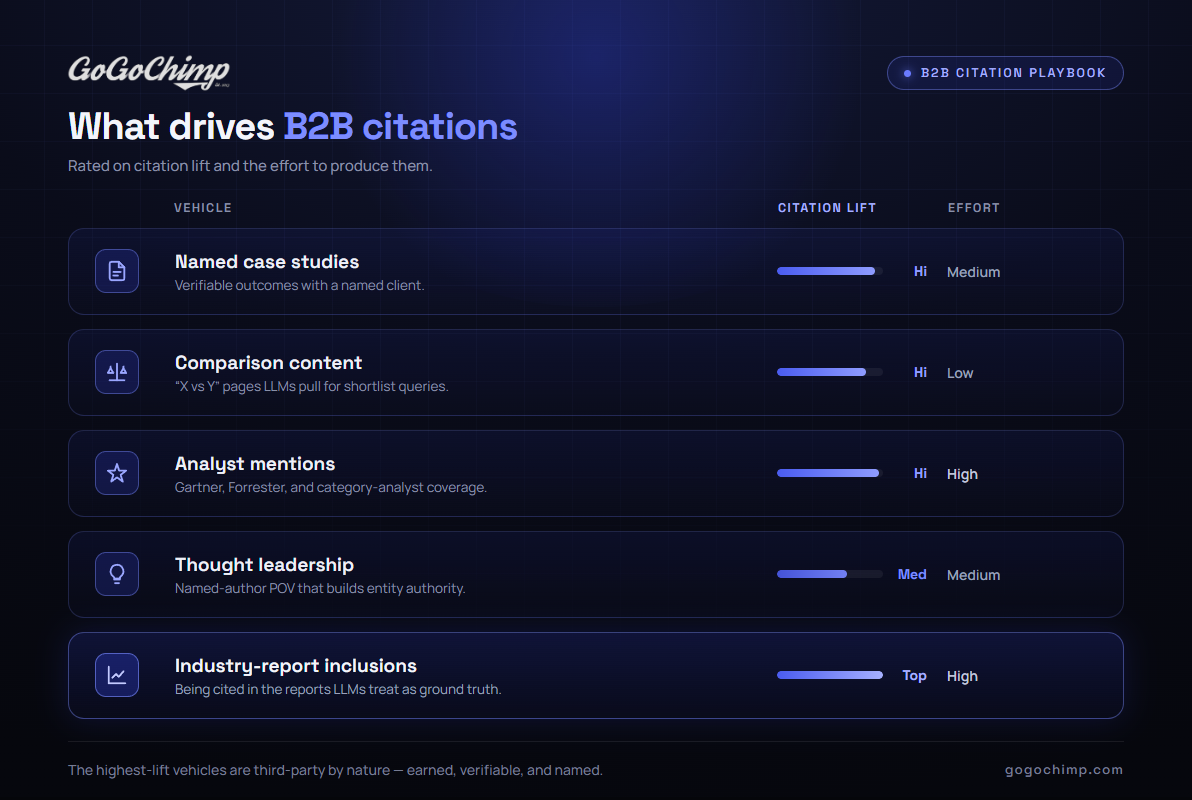
Six moves that shift Claude citation likelihood in our experience running content for B2B analytical-adjacent buyers.
Move 1: Publish long-form primary research
Claude cites primary sources preferentially. Being the source, not the summariser, is the difference between being cited and being skipped. Publish original datasets, original benchmarks, original methodology work. Our own Bing WMT dataset (3,600 citations, 111 queries, 87.25% top-3 concentration, verified 2026-07-01) is the working example of the shape. Not a repackaging of external research. First-party observation with methodology disclosed.
Move 2: Disclose methodology explicitly
Claude weights methodology transparency. A one-paragraph methodology section on any primary-data pillar is a Claude citation multiplier. Name the dataset. Name the timeframe. Name the collection method. Name the sample size. Name the caveats. If your data is 500 respondents in an unweighted convenience sample from LinkedIn, say so. Claude prefers a disclosed limitation to an undisclosed one.
Move 3: Cite academic sources by DOI where possible
Claude's retrieval trust signal weights peer-reviewed sourcing higher than the other engines. Where a claim in your content can be anchored to a peer-reviewed paper, cite by DOI. The Frontiers in Neuroergonomics 2025 neuromarketing systematic review, the Bansal et al. 2025 IJCS piece, the Johari-Pekelis-Walsh KDD 2017 peeking-problem paper are the shape. Not because Claude will find every DOI, but because the density of DOI-anchored citations across a page is a trust marker Claude weights.
Move 4: Structure as definitive-reference, not tactical guide
Claude's citation rate rises sharply on pieces that read as definitive references (5,000+ words, comprehensive coverage, expert authorship, dated updates) versus tactical guides. This maps to the standard our definitive GEO reference is written to. Every AI SEO / GEO / AEO pillar in our cluster is engineered to that standard now, not the 1,500-word tactical shape.
Move 5: Named-author byline with real credentials
Claude weights author identity heavily. A byline attached to Chris McCarron (13 years CRO, founder of GoGoChimp, creator of OperatorAI (GoGoChimp's CRO methodology, distinct from OpenAI's Operator agent product released January 2025), quoted in Forbes / TechNewsWorld / Shopify Enterprise Blog 11-locale syndication) is a Claude trust marker in ways that an anonymous or generic-byline post isn't. Person schema with sameAs URLs across LinkedIn, X, YouTube, Substack, Crunchbase, Trustpilot, Google Business Profile is the entity graph Claude's retriever cross-references.
Move 6: Refresh quarterly, minimum
Claude penalises stale sources. Any Claude-target pillar over 90 days old without an updated_date refresh loses citation share. Refresh dated statistics. Refresh methodology disclosures. Refresh the case-study numbers. On our own footprint, /blog/copywriting-frameworks earned 96 Bing Copilot citations across a 90-day window while Google Search Console recorded a +914% impression rise on the same page. That's a page in a rising-asset shape because it's actively maintained. Claude equivalents behave the same way.
The Gemini sub-playbook
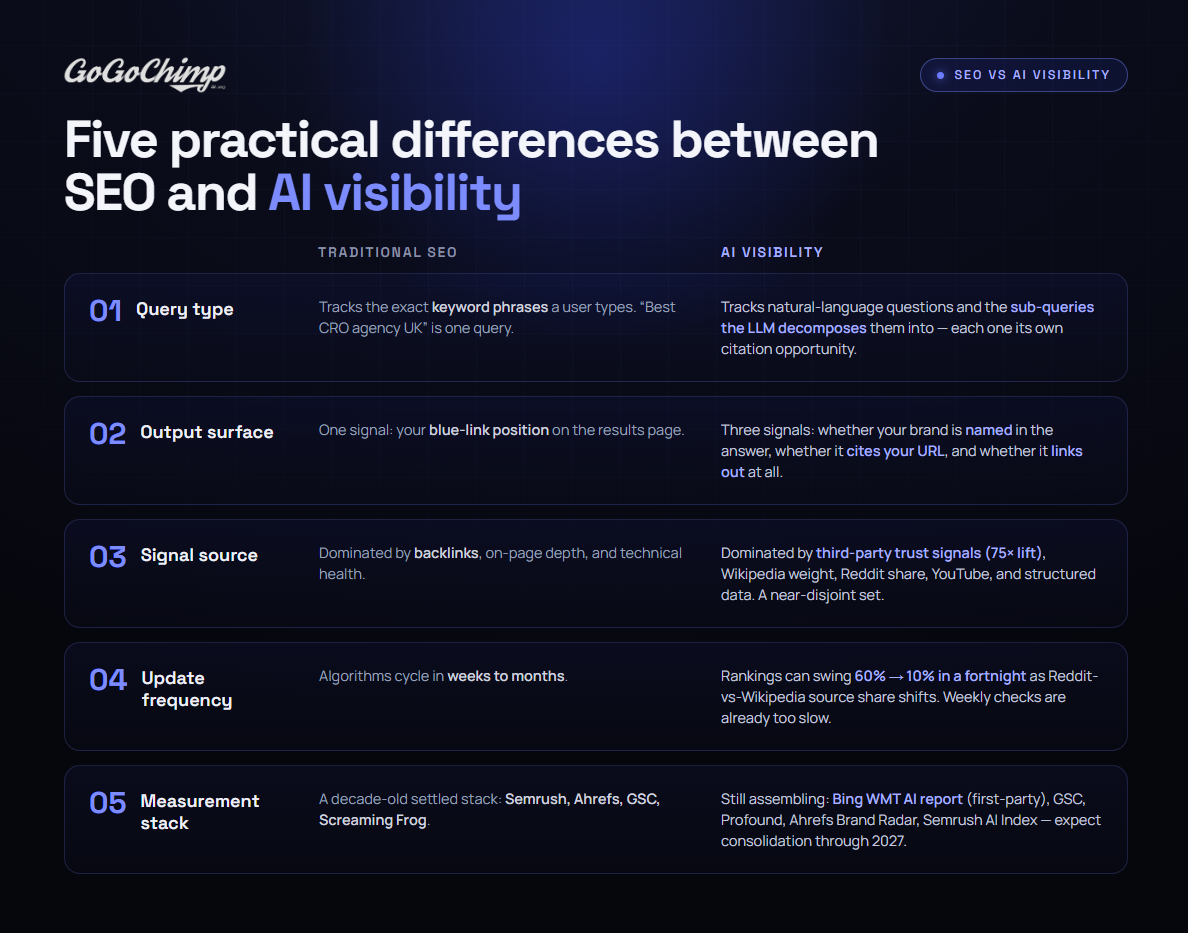
Six moves that shift Gemini citation likelihood.
Move 1: Ship structured data on every page
Gemini's extractor leans on schema.org markup harder than any other engine. Article schema is the floor. FAQPage schema on any pillar with a FAQ block. BreadcrumbList schema for navigation context. Person schema on the author. Organization schema on the publisher. HowTo schema on any step-framework post. ItemList schema on any comparison table. Our 30-post schema enrichment programme in June 2026 brought 46 posts to that full-fingerprint level, and the AI citation surface moved with it.
Move 2: Pair every written pillar with a YouTube video
Gemini shares Google AI Overviews' 18.8% YouTube top-10 source share (Profound, 2025). A written pillar plus a YouTube video that answers the same question is a double-dip citation opportunity. The GoGoChimp YouTube channel exists to serve this pattern. If you're not video-first, at least video-adjacent: a 3-5 minute video summary embedded in the written pillar covers the retrieval surface without requiring a video-production pipeline.
Move 3: Verify Google Business Profile completeness for any local-intent pillar. Gemini surfaces GBP data directly on local queries. Local businesses without a claimed, verified, complete GBP are invisible on Gemini for local intent. Our own GBP at Knowledge Graph ID g/11b7q74_96 anchors Gemini on Glasgow CRO queries. Same discipline applies to any location-specific competitor.
Move 4: Rank in Google organic top 10 for the target query. Gemini's retrieval bias is heavier on classical Google ranking signals than any of the other engines. A page ranking at position 22.4 on Google can earn 1,200 Copilot citations (that's the pattern on our /best-cro-agency-uk-2026 page) but earns very few Gemini citations. Gemini rewards the classical SEO discipline plus the GEO overlays, in that order. If your Gemini strategy skips the ranking layer, you're leaving Gemini's dominant trust signal on the table.
Move 5: Publish for the 3-source ceiling
Gemini averages 3 sources per response (Semrush, 2026). That's a 5x tighter funnel than ChatGPT. Every claim, every stat, every named entity in your Gemini-target content should be answering the specific sub-query the retriever will decompose. Don't publish content that could be 4th on Gemini. Publish content that could be top-3 on 30 sub-queries.
Move 6: Use Google-property signals where legitimate
Gemini's retrieval trust signals disproportionately weight Google-owned properties: YouTube, web.dev, Google Business Profile, Google Scholar. Where your content genuinely fits those surfaces (technical content on web.dev-adjacent topics, video summaries on YouTube, local presence on GBP, academic-adjacent research on Google Scholar), publishing across the Google graph rather than only on your own domain amplifies Gemini citation share.
Superlines variance data: the 615x citation gap
Superlines' March 2026 analysis is the most useful public dataset on cross-engine variance. The headline finding: 615x citation volume variance between generative engines for the same brand (Superlines, 2026). The gap is largest between Grok on the high end and Claude on the low end.
Read that number twice. Same brand. Same queries. Grok cites the brand 615 times as often as Claude does.
That's not a rounding error. It's the shape of the citation picture. A B2B brand can rationally dominate Grok while being invisible on Claude, or vice versa, without any variation in the content strategy that produced both. Grok's retrieval bias skews toward X (Twitter) content and real-time conversation. Claude's skews toward long-form analytical primary research. Same brand, different exposure, opposite retrieval funnels.
The Superlines finding has three practical implications.
Implication 1: Don't extrapolate from one engine to another
If your content is winning on Perplexity, that tells you nothing about Claude. If you're dominating Grok, that tells you nothing about Gemini. Each engine has to be measured, tested, and optimised on its own terms. Cross-engine optimism ("we're winning on ChatGPT so we'll win on Claude") is the most common GEO mistake we see across client audits.
Implication 2: Pick the engine your buyers actually use
The 615x variance means the return on covering all five engines is much lower than the return on dominating one or two. Choose based on where your buyers already are. Grok for developer-audience SaaS. Claude for analytical B2B consideration. Gemini for consumer-facing brands with existing YouTube and GBP footprint. Copilot for commercial B2B evaluation intent. Perplexity for opinion-heavy or comparison-heavy verticals. ChatGPT for long-cycle awareness where Wikipedia and mainstream news do the trust work.
Implication 3: Measure share, not rank
Rand Fishkin's SparkToro study ran 12 prompts through ChatGPT, Claude, and Google AI 2,961 times across 600 volunteers. ChatGPT and Google AI Overviews returned the same brand list less than 1% of the time; the same list in the same order less than 0.1% of the time (SparkToro, 2026). Tracking a single query on a single day means nothing. What holds up under statistical scrutiny is visibility percentage across many runs.
This applies at least as forcefully to Claude and Gemini as to the top three engines. Never measure Claude or Gemini from a single prompt on a single day.
Whether to invest in Claude and Gemini now or wait
The honest answer: it depends on your buyers.
For a B2B brand with analytical, consideration-stage buyers who read long-form primary research, Claude is worth investing in now, before the citation-share arbitrage window closes. Claude's user base skews toward enterprise decision-makers, product leaders, technical founders, and researchers. If your content already meets the definitive-reference standard (5,000+ words, primary data, methodology disclosed, named byline), Claude citation share is largely a schema and refresh discipline away.
For a consumer-facing brand or a local business, Gemini is worth investing in now. Gemini's user base is bigger by absolute volume (one billion MAU on AI Mode per Google I/O 2026 disclosure), consumer-intent-heavy, and structurally biased toward the Google graph you probably already partially cover (GBP, YouTube, ranking in Google organic). The tactical work is: schema markup discipline, YouTube pairing, GBP completeness, Google organic ranking where you can achieve it.
For a niche B2B brand still building basic citation share, defer both. The return on Microsoft Copilot investment is currently higher than the return on Claude or Gemini investment for niche B2B, because Copilot's first-party measurement (Bing WMT AI Performance) lets you optimise with signal that Claude and Gemini don't provide. On our own footprint, Copilot cited GoGoChimp 3,600 times across 90 days. Claude and Gemini citation counts across the same window: opaque. Optimising against opacity is a slower return than optimising against signal.
The prioritisation logic in short: measurable citations first (Copilot), high-volume second (Google AI Overviews plus AI Mode), consideration-heavy third (Perplexity for opinion-heavy, Claude for analytical B2B), long-cycle awareness fourth (ChatGPT). Grok slots in based on developer-audience overlap. Meta AI slots in based on Instagram + Facebook footprint.
If your team can genuinely afford to build for two engines in parallel, the pairing that fights hardest for our client roster's audience is Copilot + Gemini. Copilot's first-party measurement plus Gemini's absolute volume covers the largest measurable citation surface. Claude is the next tier once Copilot + Gemini are producing measurable returns.
Measurement across smaller engines
Measuring Claude and Gemini today is harder than measuring the top three engines. The tools that do exist:
Profound, third-party citation tracker with cross-engine coverage including Claude and Gemini. Enterprise pricing not published; sales-led onboarding. Best in class for cross-engine visibility research; not currently in the GoGoChimp stack but referenced for source-share analysis.
Prompt-tracker methodologies
, a manual or semi-automated approach where you run a fixed set of buyer-intent queries through each engine on a recurring schedule (weekly or fortnightly) and log which brands each engine surfaces. The GoGoChimp weekly AI citation tracker series follows this pattern for Copilot, AI Overviews, and Perplexity; extending to Claude and Gemini is on the roadmap. The advantage is direct observation.
The disadvantage is small sample sizes, which the SparkToro study (SparkToro, 2026) shows are highly variable. Track visibility percentage across many runs, not single-day snapshots.
Google AI Studio API instrumentation
, if you're a Google AI Studio customer with the developer instrumentation on, you can extract structured logs of Gemini's grounding sources across your API queries. Useful for API-integrated products; not useful for tracking Gemini's consumer answer surface.
GA4 referral tracking
. Claude referrals surface as claude.ai in GA4 referrer data. Gemini referrals surface as gemini.google.com. Both are lagging indicators (a citation earned in April may not produce a referral click until May or June) and both under-count because many AI-search sessions don't produce click-throughs at all. Still useful as a directional signal. Filter your GA4 acquisition report for those referrers and track month-on-month change.
Semrush AI Toolkit + Ahrefs Brand Radar
, both tools ship AI visibility features now. Semrush's covers ChatGPT, Gemini, Google AI Mode, and AI Overviews across 126 million prompts. Ahrefs Brand Radar covers cross-engine brand-mention monitoring including some Claude visibility. Neither is as first-party as Bing WMT is for Copilot, but both are directionally useful.
Bing WMT AI Performance report
, worth mentioning even though it doesn't cover Claude or Gemini, because it's the free, first-party measurement floor everyone should have claimed. If you haven't, that's the first task today, ahead of any Claude or Gemini instrumentation.
The measurement gap is real. Claude and Gemini will remain under-measured relative to Copilot and Google AI Overviews for the foreseeable future. Optimise against the signals you have; extend the query bank monthly; track visibility percentage not rank.
Predictions for Claude and Gemini 2026-2027
Five dated forecasts.
Prediction 1: Claude will ship its own citation-frequency reporting inside 18 months
Anthropic's public position on transparency and its enterprise-B2B customer base both push toward first-party measurement. Expect a Claude equivalent of Bing WMT AI Performance to launch inside 12-18 months, either as part of the Claude for Work enterprise tier or as a standalone Anthropic Console feature. The competitive pressure from Bing's first-party surface (which is currently the only free measurement source built by the platform itself) will force it.
Prediction 2: Gemini's YouTube weighting will grow, not shrink
YouTube's share of social citations doubled from 18.9% to 39.2% between August and December 2025, while Reddit's fell from 44.2% to 20.3% (Adweek, 2026). Because Google owns YouTube and Gemini is Google-property-weighted, expect Gemini's YouTube reliance to intensify across 2026-2027. The strategic implication: brands without YouTube presence will find Gemini citation share increasingly hard to earn, regardless of how strong their written content is.
Prediction 3: The 615x cross-engine variance will compress but stay large
As all five engines mature their retrieval layers, expect the 615x Superlines variance (Superlines, 2026) to compress to something like 100-200x by end of 2027. That's still a very wide gap. Cross-engine strategies will remain fundamentally different, not converge into a single unified GEO discipline. Bet on engine-specific specialisation, not on universal AI-search coverage.
Prediction 4: Claude will remain the citation-shy analytical retriever
Anthropic's public positioning on hedged, thoughtful, calibrated answers is unlikely to shift toward the citation-dense format of Perplexity. Claude's citation rate is likely to stay lower than the other four engines through 2027. The strategic implication: winning Claude means winning the small number of citations Claude does surface, not chasing volume. Depth over breadth.
Prediction 5: A native GEO reporting API from either Anthropic or Google will launch by mid-2027
Perplexity already runs a Comet Plus Publisher Program with a $42.5 million pool for cited publishers (Perplexity, 2026). Expect either Anthropic or Google to launch a comparable citation-revenue programme with public API access to citation data by mid-2027. When they do, "which content earns citations" becomes a P&L line for publishers rather than a brand metric, and the tooling around Claude and Gemini catches up fast.
FAQ
How is Claude SEO different from ChatGPT SEO?
Claude cites primary research and long-form analytical content; ChatGPT cites Wikipedia (47.9% top-10 source share, Profound, 2025) and mainstream news. ChatGPT averages 15 sources per response versus Gemini's 3 (Semrush, 2026); Claude's number is not publicly benchmarked but appears lower still. Winning ChatGPT rewards Wikipedia coverage; winning Claude rewards being the primary source.
How is Gemini SEO different from Google AI Overviews SEO?
Gemini and AI Overviews share Google's retrieval backbone. Gemini leans harder on Google-property signals (YouTube, web.dev, Google Business Profile, Scholar). AI Overviews is more Reddit-weighted (21% top-10 source share, Profound, 2025) and closer to classical SEO signals. Optimising for one covers most of the other, but Gemini rewards YouTube pairing more sharply.
How many sources does Gemini cite per response?
Approximately 3 sources on average across the Semrush 2026 AI Visibility Index analysis of 126 million AI search prompts. ChatGPT averages 15. That's a 5x gap. Being 4th in Gemini's ranking is invisible. Being top-3 is 100% surfaced. The step function is much sharper on Gemini than on ChatGPT.
Is Claude citation rate lower than ChatGPT's?
Yes. ChatGPT often cites nothing: in the US, 48% of its answers had no citation in March 2026, before citations rebounded in May (seoClarity, 2026). Claude's citation rate is under-measured in public research literature but appears lower again. The strategic implication: winning Claude means winning the small number of citations Claude does surface, weighted toward primary research and analytical content, not chasing volume.
What's the 615x citation variance between platforms about?
Superlines' March 2026 analysis found 615x citation volume variance between the highest and lowest-citing engines for the same brand across the same queries (Superlines, 2026). Grok on the high end, Claude on the low end. Same brand, 615x fewer citations on Claude. Cross-engine strategies fail because engines don't share winners. Only 11% of domains are cited by both ChatGPT and Perplexity (Averi, 2026).
How do I measure my brand's Claude visibility?
No first-party surface exists yet. Options today: Profound (paid third-party tracker, cross-engine coverage), prompt-tracker methodologies (manual query panel run weekly), GA4 referrer filtering for `claude.ai`, and Ahrefs Brand Radar's cross-engine brand-mention monitoring. Sample sizes are small; visibility percentage across many runs beats single-day snapshots (SparkToro, 2026).
How do I measure my brand's Gemini visibility?
Same tooling as Claude, plus Google AI Studio API instrumentation if you're an API customer, plus Semrush AI Toolkit (which covers Gemini directly). GA4 shows Gemini referrals under `gemini.google.com`. Gemini also feeds Google AI Overviews, so any AI Overview citation you earn is likely to surface on Gemini too. Not identical, but heavily overlapping.
Which engine should I invest in first: Claude or Gemini?
Depends on buyers. For analytical B2B consideration-stage buyers, Claude first. For consumer-intent, local, or Google-native audiences, Gemini first. For niche B2B still building basic citation share, defer both and invest in Microsoft Copilot (which has free first-party measurement via Bing WMT AI Performance).
Does YouTube presence really matter for Gemini citation share?
Yes, materially. YouTube is 18.8% of top-10 source share on Google AI Overviews (Profound, 2025) and Gemini shares the same retrieval backbone. YouTube's share of social citations doubled from 18.9% to 39.2% between August and December 2025 (Adweek, 2026). A written pillar plus a YouTube video that answers the same question is a double-dip citation opportunity Gemini rewards.
What word count works best for Claude citation?
5,000+ words for definitive-reference pillars. Presence AI's 2026 GEO benchmarks put content 2,500-4,000 words at 57-63% AI citation frequency (Presence AI, 2026) but Claude's threshold appears higher because its analytical framing rewards comprehensive coverage. Definitive-reference over tactical, primary data over summary, methodology disclosed over undisclosed.
Do Claude and Gemini share a citation index?
No. Superlines' 615x variance (Superlines, 2026) and Averi's 11% cross-engine overlap (Averi, 2026) both indicate engines don't share winners at scale. Claude and Gemini are structurally opposite in retrieval bias (analytical primary research versus Google graph plus YouTube), so expect their citation overlap for the same brand to be low.
When will first-party Claude or Gemini measurement tools launch?
Prediction: Claude ships equivalent-to-Bing WMT reporting inside 12-18 months. Anthropic's enterprise B2B customer base and transparency positioning both push toward first-party measurement. Gemini's measurement will consolidate through Google Search Console's AI features surface across the same window. Both timelines are directional; watch for I/O 2027 and Anthropic Console updates in 2027.
Where to go next
Two questions to answer before you spend a single hour on Claude or Gemini optimisation.
First: do you have Bing Webmaster Tools claimed and the AI Performance report accessible? If not, that's the first task. It's free, first-party, and covers Microsoft Copilot at a fidelity Claude and Gemini currently don't provide.
Second: which engine matches your buyers? Analytical B2B for Claude. Consumer or Google-native for Gemini. Commercial B2B evaluation for Copilot. Answer that question first. Sequence the work after.
If your reaction to any of this is "we should just build for all five engines in parallel", the 615x cross-engine variance (Superlines, 2026) is what says otherwise. Same brand, same queries, wildly different visibility. Pick one or two. Cover them deeply. Extend when you have proof.
Our definitive GEO reference covers the shared 8-step framework that underpins every engine-specific playbook. Our Microsoft Copilot SEO piece is the working proof piece on Copilot specifically, anchored on our 3,600-citation footprint. This piece is the emerging-engine companion.
If your buyers are already in AI search and none of your content is being cited, the audit that surfaces the gap is the same audit our AI CRO practice runs pre-engagement. Talk to us.
How do I check either engine?
Rubric grades every page against Claude and Gemini on-page signals separately, calibrated by the retrieval mechanics each engine actually uses. Six engines scored independently, ranked by projected uplift. Full disclosure: I built it.
References
- Adweek. (2026). YouTube Overtakes Reddit as Go-To Citation Source on AI Search.
- Averi. (2026). ChatGPT vs. Perplexity vs. Google AI Mode: The B2B SaaS Citation Benchmarks Report.
- Bing Webmaster Tools. (2026). AI Performance Report (GoGoChimp first-party data, verified 2026-07-11, 90-day window).
- Gandhi, M. (2026, updated 19 June). Tracking the Volatility of ChatGPT's Citations: A Global Trend Analysis. seoClarity.
- Google. (2026). Google Search's I/O 2026 updates: AI agents and more.
- GoGoChimp. (2026). State of AI CRO Citations 2026.
- Perplexity. (2026). Introducing the Perplexity Publishers' Program.
- Presence AI. (2026). 2026 GEO Benchmarks Report: AI Search Traffic Statistics & Trends.
- Profound. (2025). AI Platform Citation Patterns 2025-2026.
- Semrush. (2026). Semrush Releases Expanded 2026 AI Visibility Index, Analyzing 126 Million AI Search Prompts.
- SparkToro. (2026). NEW Research: AIs are highly inconsistent when recommending brands or products.
- Superlines. (2026). AI Search Statistics 2026: 60+ Data Points on Visibility, Citations, and Traffic.
.png)
Free chapter
Read Chapter 1 of CITED, free.
The playbook for getting your business recommended by ChatGPT and AI search. Read the first chapter, on me.
Read Chapter 1 freeWant us to do this for your site?
Book a free AI audit. 15 minutes. We’ll show you three things your site is missing and what we’d test first.
Book my free AI audit →