Generative Engine Optimisation (GEO): The Definitive 2026 Reference for Winning AI Search
AI SEO

Generative Engine Optimization (GEO) is the practice of structuring content so AI search engines (ChatGPT, Perplexity, Gemini, Google AI Overviews, Microsoft Copilot) cite it inside their generated answers. Across GoGoChimp's last 90 days, three listicle pillars earned 3,141 of 6,700 Microsoft Copilot citations (87.25% concentration), including 1,500 citations to a single page and 111 unique cited queries.
If your only measure of search performance is a Google ranking position, you're already behind. AI Overviews now appear on 12.2% of news searches and drop publisher click-throughs by 47.5% on desktop when they fire (Authoritas, 2025). The click didn't disappear. It got absorbed into the answer. GEO is what you do about it.
The CTR collapse also isn't permanent. Organic CTR on AIO-showing queries climbed from 1.3% in December 2025 to 2.4% in February 2026, an 85% rebound in two months (Seer, 2026). Buyers who wait for the recovery to finish miss the window where citation share is still cheap.
The demand side is moving too. Google confirmed at I/O 2026 that AI Mode has crossed one billion monthly users, with queries more than doubling every quarter since launch (Google, 2026). AI-sourced traffic to US retail sites has climbed 1,324% between October 2024 and May 2026, and to travel sites 2,215% (Semrush AI Visibility Index, 2026). This isn't a niche channel any more. It's the new default retrieval surface.
Who's writing this
Thirteen years of running conversion work sits behind every number in this piece. For the last two, the fastest-growing source of qualified traffic to gogochimp.com hasn't been Google organic. It's been Microsoft Copilot citing one of our listicle posts to people asking "best Shopify CRO agencies UK."
The proof it works
Our latest 90-day Bing Webmaster Tools reading (verified 2026-07-11) shows 6,700 Copilot citations against just 82 Google organic clicks in the same window. That's 73 Bing citations for every 1 Google click, on a niche B2B agency footprint. That's GEO in the wild.
How this pillar fits
This pillar is the definitive GEO reference. It sits alongside our AI CRO pillar as a discoverability layer: AI CRO is how you convert the visitor, GEO is how the visitor finds you in the first place. For the tactical multi-engine playbook, jump to our AI Search Optimisation guide.
GEO is the engine-side subset of a wider discipline. For the umbrella that covers Discovery, Retrieval, and Citation across every AI answer surface, see our AI SEO pillar covering the three-pillar framework and the six-move sequence that produced 5,600 Bing Copilot citations across three months at gogochimp.com.
What is Generative Engine Optimization (GEO)?
Generative Engine Optimization is what you do to your content so a generative AI system (a large language model plugged into a live retrieval layer) picks your page, extracts a passage, and cites you inside a generated answer. Search engines used to send a click. Generative engines send an answer. GEO changes the target from ranking on the page to appearing inside the sentence.
The signal set is different too. Classical SEO earns clicks by matching a query, satisfying user intent, and beating competitors on links, content depth, and technical health. GEO earns citations by matching a sub-query (the piece of the user's question the LLM decomposed into a retrieval), presenting a clean extractable answer, and clearing the trust bar the model uses to decide whose page to name.
A 25M-link study by Seer Interactive and Muck Rack found that pages carrying third-party trust signals (earned media, cited research, named-author bylines) are cited by AI engines up to 75 times more often than pages without them. Earned media now accounts for 84% of AI citations.
Why it matters now, in plain terms: AI Overviews already fire on 12.2% of news-keyword searches, and when they do, publisher click-throughs fall 47.5% on desktop (Authoritas, 2025). Meanwhile, 83% of AI Overview citations come from pages outside the Google top 10 (Seer, 2026). Being ranked #1 isn't the winning condition. Being cited is.
Nobody has agreed on the denominator yet either. Xponent21's April 2026 measurement put US AIO prevalence at 60.32%. Conductor's Q1 2026 benchmark across 21.9 million queries measured 25.11%. BrightEdge's 9-industry tracker recorded 48% by March 2026. Google's own I/O 2026 disclosure put the number at around 50%. The measurement discipline is that new. What everyone agrees on is direction. AIO surface area is expanding, not contracting.
The distinction also has direct commercial value. Being cited inside an AI Overview lifts downstream organic click-through by 35% (Seer, 2026). Cited brands get 120% more organic clicks per impression than uncited brands, and paid CTR runs 91% higher too (Seer, 2026). Citation isn't only a brand-visibility play. It's a click-clawback mechanism inside the answer surface that's currently eating publisher clicks.
GEO vs SEO: the practical differences
GEO and SEO share DNA. Both reward clarity, trust, and structure. But the practical mechanics diverge across five axes.
For the definitive acronym breakdown across all four surfaces, see our GEO vs SEO vs AEO vs AIO comparison reference. It carries the semantic HTML comparison table, per-acronym definitions, and the overlap/divergence map that makes the distinctions concrete.
| Axis | Classic SEO | Generative Engine Optimization |
|---|---|---|
| Query type | Head and long-tail keyword phrases | Natural-language questions and decomposed sub-queries |
| Signal source | Backlinks, content depth, on-page keywords, technical health | Extractable passages, statistics, third-party citations, entity signals, structured data |
| Output surface | Blue links on a SERP | Cited passage inside a generated answer (ChatGPT, Perplexity, Gemini, Google AI Overviews, Copilot) |
| Measurement | Rankings, impressions, organic clicks, CTR | Citation share, brand mention frequency, referral clicks from AI engines, share-of-voice on named queries |
| Update frequency | Weeks to months per algorithm cycle | Days to weeks. Source share on Reddit vs Wikipedia can swing 60% to 10% inside a fortnight |
| Winning content format | Long-form guides, product pages, comparison posts | Best-of listicles, definitional pillars, dated statistics posts, FAQ pages, comparison tables |
The two disciplines aren't mutually exclusive. A GEO-optimised page that also ranks in the top 10 wins both surfaces. The mistake is optimising only for the blue link when the answer box is eating your traffic.
The other quiet difference is measurement. SEO measurement is a decade-old craft with settled tools. GEO measurement is still assembling itself. Google Search Console, Bing Webmaster Tools' AI Performance report, Profound, Ahrefs Brand Radar, and a small handful of citation-tracking startups are the current stack. Our state of AI CRO citations 2026 breakdown covers what a share-of-voice dashboard looks like when you build one from these components. Expect the stack to consolidate inside the next 12 months.
The measurement gap is also the biggest single lever nobody talks about. Semrush's 2026 AI Visibility Index (126 million US AI-search prompts across ChatGPT, Gemini, Google AI Mode, and AI Overviews) found that 45% of marketing leaders can't measure their brand's visibility in AI-generated answers, and only 9% have the tools to track it across platforms (Semrush, 2026).
Among teams that fully integrate SEO and AI visibility into one workflow, 81% report increased traffic or leads from AI platforms. Among teams managing the two separately, 36%. That's a 45-point gap driven by whether the same team owns both.
The proprietary data: how GoGoChimp gets cited
Everything above is industry data. The next 900 words are ours.
GoGoChimp's Microsoft Copilot citation footprint over the last 90 days (verified from Bing Webmaster Tools' AI Performance report, 2026-07-01) totals 6,700 citations. Three pages account for 3,141 of them. That's 87.25% of our AI citation surface concentrated in three URLs. The remaining 12 cited pages share 459 citations between them.
That concentration is the story. GEO doesn't reward "publish more." It rewards "publish the right shape."
Across 90 days of Bing Webmaster Tools AI Performance data (verified 2026-07-11), three GoGoChimp listicle pillars earned 87.25% of the site's 6,700 Microsoft Copilot citations. One page (/blog/best-ab-testing-tools-2026) alone earned 1,500 citations. The citations-to-Google-clicks ratio across the site is roughly 73 to 1 (6,700 Bing citations vs 82 Google organic clicks in the same window). On the /best-cro-agency-uk-2026 page specifically, the ratio is 1,200 citations for every 1 Google click.
Here's the full 15-page breakdown. Every number below is first-party and load-bearing to the argument.
| Rank | Page | Bing Copilot citations (90d) | Format |
|---|---|---|---|
| 1 | /blog/best-ab-testing-tools-2026 | 1,500 | Best-of listicle + HTML comparison table |
| 2 | /best-cro-agency-uk-2026 | 1,200 | 12-agency listicle + HTML table + FAQ |
| 3 | /blog/best-heatmap-tools-2026 | 441 | Best-of listicle + HTML table |
| 4 | /blog/copywriting-frameworks | 96 | Framework glossary + examples |
| 5 | /blog/best-shopify-cro-apps-2026 | 71 | App comparison listicle |
| 6 | /blog/vwo-vs-optimizely-2026 | 67 | Head-to-head comparison |
| 7 | /blog/best-ai-cro-tool-2026 | 40 | Best-of listicle |
| 8 | /blog/click-through-rate-ctr-definitions-benchmarks-improvements | 24 | Definitional pillar + benchmarks |
| 9 | /blog/conversion-rate-optimisation-consultant | 12 | Definitional guide |
| 10 | /helixbinders/ | 8 | Case study page |
| 11 | /blog/ecommerce-psychology | 6 | Long-form explainer |
| 12 | /blog/conversion-rate-optimisation-agency | 4 | Definitional guide |
| 13 | /blog/cta-optimization-guide | 1 | How-to guide |
| 14 | /blog/gogochimp-vs-cxl | 1 | Head-to-head comparison |
| 15 | /blog/conversion-psychology-handbook | 1 | Long-form handbook |
Read this table twice. The top two rows alone account for 2,700 of 6,700 citations (75%). The tail (rows 4 through 15) contributes 459 citations across 12 pages, an average of 38 per page. Concentration at the head is real. The tail is also real and growing, which matters for the next 90-day window.
Six findings from our own data that should reshape how you sequence GEO work.
Finding 1: You don't need to rank to be cited.
The 1,200-citation page ranks Google position 22.4. Not top 10. Not top 20. Position 22.4. Yet it's the second most-cited page in our footprint. This matches the Seer AI Overview finding (83% of AIO citations come from outside the Google top 10) at the individual-page level. Ranking isn't the bottleneck.
Finding 2: Format concentration beats page volume.
All three top-cited pages are "best-of" listicles with a semantic HTML comparison table near the top. That's not a coincidence. It's the pattern the retriever is grabbing. Best-of listicles are consistently the #1 cited format across arXiv AI citation research and our own numbers.
One separate proof point on the query side: the Bing WMT report shows GoGoChimp winning a 62.75% Copilot citation share on the query "best Shopify CRO agencies UK" (the highest single-query share in the report) and 52.70% on "best Shopify CRO agencies" without the UK qualifier.
Finding 3: Cross-engine overlap is close to zero at our sample size.
Our Google organic winners and our Bing Copilot winners are almost completely disjoint. The pages Google impresses on are not the pages Copilot cites. This matches the Averi 2026 finding that only 11% of domains are cited by both ChatGPT and Perplexity (Averi, 2026) and generalises the pattern: engines don't share their winners.
Finding 4: The tail is where new assets are entering the citation graph.
/blog/copywriting-frameworks earned 96 Bing Copilot citations across the same window while Google Search Console recorded a +914% impression rise on the same page. That's a page in the middle of an entry curve. The Google impression signal and the Bing citation signal are moving together. That's what a rising GEO asset looks like on both surfaces at once. Watch this pattern on your own site. It's the leading indicator of a page about to enter the top 3.
Finding 5: The long tail of grounding queries is 111 wide.
Across the 90-day window, Bing Copilot cited GoGoChimp on 111 distinct grounding queries. The top query ("top CRO agencies 2026 conversion rate optimization") earned 97 citations at 4.08% share. The 25th-ranked query ("best A/B testing platforms for growth teams") earned 25 citations at 42.37% share. High-share queries are not always high-volume queries. Some of the highest citation shares are on lower-frequency queries where competition is thin. That's the arbitrage.
Finding 6: Intent split is buyer-heavy.
Across the top 25 grounding queries, the intent split is 32% Commercial (buyer-intent), 40% Research (comparison), 24% Informational (learning), and 4% pure Comparison. Three quarters of our citation surface is buyer-adjacent. AI search isn't only sending awareness traffic. It's sending consideration and evaluation traffic.
The one caveat: our data is a niche B2B agency sample. But it's a working sample, and it's more useful than another abstract framework post. Everything after this section is anchored in what we've seen work on our own site.
We also saw an unrelated Google core-update movement in May 2026 that validated part of the above. Post-update, clicks moved from 0.50 per day to 1.78 per day (+255%), impressions from 237 to 308 per day (+30%), average position from 17.1 to 12.2 (a 4.9-place lift), and CTR from 0.21% to 0.58% (nearly 3x). Google organic still matters. It just isn't where the citation surface lives.
The growth curve on the citation side is more dramatic. Early May 2026 was averaging around 10 citations per day. Mid-June crossed 140 per day. The single-day peak on 21 June was 464 citations. 1 July recorded 326 in one day. That's a roughly 30-fold increase in daily citation volume across eight weeks. Whatever surface changes are happening inside Bing's Copilot retrieval layer, the direction is up and to the right.
The 8-step GEO framework

The framework below is what we run at GoGoChimp. It's the same discipline behind the top three pages in the table above. Five steps were plenty for a shorter guide. A definitive reference needs eight, because entity coverage, structured data at scale, and measurement each carry their own weight.
The prioritisation isn't invented either. Cyrus Shepard's May 2026 Zyppy meta-analysis synthesised 54 experiments, patents, and case studies into 23 evidence-weighted GEO ranking factors (Shepard / Zyppy Signal, 2026). It's the first time the industry has ranked GEO signals by evidence strength rather than opinion. The eight steps below map to the top clusters of that analysis, sequenced by lift-per-hour rather than by novelty.
Across GoGoChimp's Bing Webmaster Tools AI Performance report (verified 2026-07-11), the single best-performing listicle currently generates around 1,500 Copilot citations over 90 days. The format is a "best-of" listicle with a semantic HTML comparison table near the top, an answer capsule under the H1, dated statistics inline, and a References section at the bottom. Steps 1 through 4 below are the on-page discipline. Steps 5 through 8 are the structural + entity + measurement layer.
Step 1: Write a 40-60 word answer capsule directly under the H1.
LLMs preferentially lift standalone summary passages. The Princeton GEO team found this pattern the single highest-lifting structural change in their controlled study. Make the capsule definitional, specific, and standalone. It should contain the primary keyword, the entity you want cited, and one hard number. Don't tease. Answer.
Worked example: the capsule at the top of this pillar contains "Generative Engine Optimization (GEO)", "Microsoft Copilot", "6,700 citations", "3,141", "87.25% concentration", "1,500 citations", and "111 unique cited queries". Seven citable specifics inside 47 words.
Step 2: Structure every H2 as a self-answering chunk of 150-400 words.
Retrieval systems split documents into passages of roughly that length. Production RAG pipelines chunk at 400-600 tokens with 10-20% overlap, then retrieve top-30 to top-50 and rerank to top-5 (Firecrawl, 2026). Match that shape. If your section is 900 words of wall-to-wall prose, retrieval treats it as one lump and quality falls. Break at logical claim boundaries. Open each H2 with a 40-60 word self-contained answer. Support it with one specific statistic, one named example, one blockquote-formatted quotable capsule.
Worked example: every H2 in this pillar opens with an answer sentence, contains at least one numeric claim within the first paragraph, and ends inside 400 words wherever possible. Longer H2s are broken at natural sub-headings so the retriever can lift by section.
The whole-page numbers matter too. Pages of 2,500-4,000 words are cited at 57-63% frequency in one 2026 benchmark, versus 3-4% for pages under 800 words (Presence AI 2026 GEO Benchmarks). Content updated inside the last 30 days is cited at 71% frequency; content 1-2 years old drops to 18%. Grade 8-10 reading level earns 67% of ChatGPT citations; grade 14+ drops to 18-31%.
The pattern is consistent across engines. Long enough to be substantive, fresh enough to be current, plain enough to be extractable.
Step 3: Cite. Then cite again.
Every numerical claim, every named study, every third-party stat gets an inline hyperlinked source. This isn't academic pedantry. It's the signal the retrieval layer uses to decide whether your page is a trustworthy citation target. Pages that link to authoritative sources are trusted with citations back. The 75x lift from third-party trust signals (Muck Rack + Seer, 2026) is what's happening under the hood.
Worked example: this pillar carries roughly 30 inline hyperlinked citations across the body, plus a References section at the bottom. Every percentage and multiple in body prose links out.
Step 4: Ship the FAQ.
LLM retrieval loves the FAQ format because it's pre-decomposed into query-answer pairs, which is exactly the shape the retriever wants. 6-10 questions per pillar, each answered in 40-60 words, each phrased the way a real user would type it. Wrap the block in FAQPage schema so the extractor can parse it without heuristics.
Worked example: the FAQ section below carries 21 questions, each with a numeric answer within the first sentence.
Step 5: Add page-level structural signals.
llms.txt at the root of your domain (View our's here: gogochimp.com/llms.txt). Article, FAQPage, and DefinedTerm schema on the page. A Person schema author with a real, linked LinkedIn profile. A publisher Organization schema with a real address, phone, and sameAs list. The retriever pattern-matches these signals as trust markers. Absence of them is absence of trust. If you're new to schema, our 2026 guide to schema markup for AI SEO walks through the exact JSON-LD blocks worth shipping.
Step 6: Build entity coverage across the site, not just the page.
This is the step most guides skip. The retriever isn't just reading your page. It's reading the entity graph around it. That means a consistent Person schema for the author on every post. A consistent Organization schema in the site footer. Consistent sameAs URLs (LinkedIn, X, YouTube, Substack, Crunchbase, Trustpilot, Google Business Profile). A Wikipedia or Wikidata anchor where policy allows. When the retriever asks "who is Chris McCarron", the answer should reconcile across at least eight independent surfaces.
Ahrefs studied 75,000 brands across 76 million AI Overviews and found brand mentions correlate with AI citation probability at 0.664, versus 0.218 for backlinks (Ahrefs, 2026). That's a 3x correlation gap. Mentions beat links, mathematically, at the specific job GEO is trying to do. The classical SEO instinct to chase backlinks first is upside-down in a citation surface. Chase entity coverage. Links follow.
Step 7: Ship structured data at scale.
One page with Article schema is a good start. A hundred pages with Article + BreadcrumbList + FAQPage + Person + Organization schema is a citation asset. Our 30-post schema enrichment programme in June 2026 brought 46 posts to that full-fingerprint level, and the AI citation surface (as measured by Bing WMT AI Performance) moved with it. Schema at scale is a compound asset. Schema on one hero page is a novelty.
Step 8: Measure with the only first-party surface available.
Bing Webmaster Tools' AI Performance report is the single measurement source built by the platform itself. Everything else (Profound, Ahrefs Brand Radar, third-party trackers) is a proxy built from external polling of the answer engines. Both are useful. But the first-party surface (which pages Microsoft Copilot cites, on which queries, at what frequency, from Microsoft themselves) is the anchor. If you don't have Bing WMT claimed, that's the first move today.
The measurement caveat everyone should know: LLM recommendation lists are almost never the same twice. Rand Fishkin's SparkToro / Gumshoe study ran 12 prompts through ChatGPT, Claude, and Google AI 2,961 times across 600 volunteers. ChatGPT and Google AI Overviews returned the same brand list less than 1% of the time; the same list in the same order less than 0.1% of the time (SparkToro, 2026). Tracking a single query on a single day means nothing.
What holds up under statistical scrutiny is visibility percentage: how often your brand appears across many runs of similar prompts. Measure share, not rank.
The five engines that actually matter and how to win each
For the multi-engine execution playbook that sequences work across all five engines, see our AI Search Optimisation guide. This pillar defines the discipline; that guide is the execution layer for shipping across ChatGPT, Perplexity, Gemini, and Copilot in parallel.

Five generative engines account for essentially all of the citation volume that matters commercially in 2026: Microsoft Copilot (in Bing and native Copilot), ChatGPT, Perplexity, Google AI Overviews plus AI Mode, and the emerging tier (Grok, Claude, DeepSeek, Meta AI). Each has a different citation rate, a different dominant source pool, and a different tactic that wins. The framework above is the shared discipline. The five sub-sections below are the per-engine specifics.
Winning Microsoft Copilot (the engine cutting our own path)
Microsoft Copilot is where GoGoChimp is winning today, and it's the engine with the best first-party measurement surface. Our 90-day Bing WMT reading recorded 6,700 Copilot citations across 15 pages. 87.25% of that volume concentrates in the top three pages (Bing WMT AI Performance, verified 2026-07-11). The most dominant grounding query, "best Shopify CRO agencies UK", clocked a 62.75% Copilot citation share.
Why we're winning here: Copilot's retrieval layer rewards a specific combination of signals more heavily than any other engine we measure. Semantic HTML comparison tables get lifted verbatim. Best-of listicles with 4-15 items and a dated title convert reliably. Third-party citations inside the body (Muck Rack, Baymard, Princeton, Profound, Seer, Authoritas) act as trust multipliers. Bing Places verification and Organization schema at the domain level anchor the entity graph.
On the query surface, Copilot leans commercial: 32% of our top 25 grounding queries carry buyer intent, another 40% carry research intent, and the tail 24% carry informational intent. That's a buyer-heavy retrieval bias.
The one tactic that moves Copilot faster than any other: ship the semantic HTML <table> inside the first 40% of the page, with 4-6 comparison axes, one row per item, and every cell filled (no blanks, no n/a where a real value could be inferred). Copilot lifts these tables into its answer surface almost verbatim. If your listicle uses markdown pipes rendered as prose, or worse, uses no comparison table at all, you're leaving the single biggest Copilot lever on the table.
Growth trajectory on our own footprint: 10 citations per day in early May 2026, 100+ per day by early June, 140+ per day by mid-June, 326 on 1 July alone. The 21 June single-day peak was 464 citations. Whatever's happening inside Copilot's retrieval index, the volume curve is exponential and the engine's stated ambition (Satya Nadella's "AI companion for all of work") suggests Microsoft will keep pushing more grounded-search traffic into Copilot answers over the next 12-18 months.
The Bing WMT AI Performance report is free, first-party, and confound-free. If you're serious about GEO measurement and you haven't claimed Bing Webmaster Tools, that's the first task today. It's the only surface where you can see which of your pages the retriever actually lifts, on which queries, at what frequency, with no proxy layer between you and Microsoft's own citation counter.
Winning ChatGPT (the Wikipedia-weighted retriever)
ChatGPT has the lowest citation rate of the top five engines. In the US, the share of ChatGPT answers with no citation doubled from 28% to 48% in March 2026, before citations rebounded in May (seoClarity, 2026). That means a citation is never guaranteed, but the ones that do get cited land in front of an enormous audience. When a citation does surface, it draws from a heavily Wikipedia-weighted corpus: 47.9% of ChatGPT's top-10 source share is Wikipedia (Profound, 2025), and Wikipedia is 7.8% of all ChatGPT citations.
The average ChatGPT response cites 15 sources (Semrush, 2026), which is five times the source count Gemini uses on the same prompts. That gives you 15 slots per response to compete for, but the entry bar to those slots is a corpus dominated by Wikipedia, mainstream news, and long-form primary research. ChatGPT's brand citation rate specifically is startlingly low: Superlines tracked its own brand across 34,234 AI responses and got a 0.59% citation rate on ChatGPT against 13.05% on Perplexity (Superlines, 2026).
Winning ChatGPT means winning at the corpus level, not the page level. That's a different discipline. Wikipedia coverage is the highest-lift tactic (get your brand, methodology, and founder onto Wikipedia via legitimate WP:N sourcing, then keep them defended). Mainstream news pickups are the second-highest lift (Forbes brand mention, TechNewsWorld named quote, TechnologyAdvice contribution all show up in ChatGPT's retrieval pool over time). Long-form academic content and industry research reports are third. First-party blog content is fourth.
One quiet advantage: opening questions in a ChatGPT session are 2.5x more likely to trigger citations than turn-10 questions (Profound, February 2026). ChatGPT searches the web most on the first question a user asks in a session ("best CRO agency UK", "what is expert-guided AI CRO") and less on the follow-ups. Session-opener intent is the highest-value citation slot ChatGPT will surface, and it's the slot most brands are ignoring.
The tactic that moves ChatGPT: build a Wikipedia entity anchor. That's not a tactic every brand can execute (Wikipedia's notability bar is high), but for founders and methodologies with genuine independent sourcing behind them, it's the highest-lift single move in GEO. GoGoChimp's Wikidata cluster (Chris Q139585911, GoGoChimp Q139585936, The 347 Method Q139695681) is the current anchor here. Watch this space over the next 12 months.
Winning Perplexity (the citation-heavy retriever)
Perplexity is the most citation-forward engine of the five: it is built to cite, with numbered source links in its answers. That inverts the ChatGPT maths. A Perplexity answer shows its sources by design. A ChatGPT answer often shows none.
Perplexity's dominant source category is Reddit: 46.7% of Perplexity's top-10 source share is Reddit (Profound, 2025), and 6.6% of all Perplexity citations across their corpus are Reddit-sourced. That's higher than any other engine's Reddit dependency by a wide margin. Perplexity effectively treats Reddit as its default authoritative corpus for opinion-heavy queries, which covers a huge share of purchase-research and comparison intent.
Winning Perplexity means winning at Reddit. That's not a metaphor. It's the literal tactic. Build a real Reddit presence in the subreddits your buyers actually inhabit (r/ecommerce, r/shopify, r/marketing, r/SEO, r/PPC, r/SaaS depending on your vertical). Answer real questions with real detail. Chris uses his real name, not a burner account. Cite your own content only where the thread has already surfaced the question.
The GoGoChimp brand shows up in Perplexity citations because Chris shows up on Reddit as Chris, not as a marketing team pretending to be a helpful stranger.
Perplexity also runs a real revenue-share programme with publishers: the Comet Plus Publisher Program allocates a $42.5 million pool with an 80/20 revenue split favouring publishers whose content gets cited in AI-generated answers (Perplexity, 2026). That's the first serious economic alignment between an AI engine and the sources it lifts from. Long term, expect the other engines to follow, but for now Perplexity is the only one paying publishers directly for citation weight.
The tactic that moves Perplexity: legitimate, sustained Reddit participation paired with content that answers the specific comparison and evaluation questions Reddit users are asking. Not "content marketing on Reddit". Genuine domain participation over 12+ months. It's the slowest of the engine-specific tactics and the one with the highest marginal return per hour once the account has age and standing.
Winning Google AI Overviews and AI Mode
Google AI Overviews and the newer AI Mode surface are, in aggregate, the largest citation volume opportunity of any engine in 2026. Google confirmed at I/O 2026 that AI Mode has crossed one billion monthly users and queries are more than doubling every quarter (Google, 2026). AI Overviews already fire on 12.2% of news-keyword searches according to Authoritas' April 2025 dataset (Authoritas, 2025) and considerably more across commercial and comparison queries.
Google AI Overviews has its own source mix (Profound, 2025). Dominant sources: Reddit at 21% of AIO top-10 source share, YouTube at 18.8%. That's a very different mix from ChatGPT's Wikipedia dominance. Google's own indexing signals (crawl-level authority, backlink profile, on-page E-E-A-T, HCU-era quality signals) still weight AIO retrieval more heavily than they weight retrieval on the other engines.
Winning AI Overviews rewards the classical SEO discipline plus a small set of GEO overlays. The classical SEO layer: real on-page depth, real backlinks from real domains, real named-author bylines with Person schema, real E-E-A-T signals across the site. The GEO overlay: answer capsules under H1s, FAQPage schema, semantic HTML tables, dated statistics, third-party citations inside the body prose. AIO citations skew toward pages that satisfy both.
One measurement caveat everyone should know: the industry disagrees on AIO prevalence. Xponent21's April 2026 measurement put US AIO prevalence at 60.32%. Conductor's Q1 2026 benchmark across 21.9 million queries measured 25.11%. BrightEdge's 9-industry tracker recorded 48% by March 2026. Google's own I/O 2026 disclosure put the number at roughly 50%. Nobody agrees on the denominator yet. What everyone agrees on is direction. AIO surface area is expanding.
The tactic that moves Google AI Overviews: YouTube plus content pairing. Because YouTube is 18.8% of AIO's top-10 source share and Google owns both, a YouTube video that answers the same question your written pillar answers is a double-dip citation opportunity.
The AIO retriever can lift the passage from your written content and cite the video simultaneously, or cite the video alone with a "learn more" link back to your site. Publish both, cross-embed both, and you cover more of the AIO citation surface than a single-format content strategy can.
For the AIO-specific tactical playbook, read our How to Rank in Google AI Overviews reference. It carries the 8-step framework, the 7-factor ranking-factors comparison table, and first-party GSC + Bing WMT data on the click-clawback mechanic.
The emerging tier: Grok, Claude, DeepSeek, Meta AI
Grok, Claude, DeepSeek, and Meta AI are the emerging tier. Individually, each has smaller citation volume than the top five. Collectively, they matter because their retrieval biases diverge sharply, and because a brand can dominate one of them without touching the others.
Superlines' March 2026 analysis documented a 615x citation volume variance between platforms for the same brand (Superlines, 2026). The gap is largest between Grok on the high end and Claude on the low end. A B2B brand that dominates Grok can be effectively invisible on Claude, and vice versa. Same brand, same queries, wildly different visibility.
Grok's retrieval bias skews toward X (Twitter) content and real-time conversation. Winning Grok means having active, non-bot X presence and being cited by other active X accounts. That's a different discipline again.
Claude's retrieval bias skews toward long-form analytical content, primary research, and academic sources. Claude's citation rate is lower than most and its answer surface is less commercial-facing than Copilot or Perplexity, but for consideration-stage B2B research it punches above its raw traffic weight. Winning Claude means publishing genuinely long-form (5,000+ words), analytically-dense, well-sourced content. The definitive-reference standard this pillar is written to.
DeepSeek's retrieval bias is currently under-measured in the public research literature, but early indications from AI SEO practitioners suggest a heavier weight on academic and technical primary sources than the US-headquartered engines apply. Meta AI is early days and retrieval-source data is not yet publicly benchmarked at scale.
The tactic for the emerging tier: pick one and cover it deeply, don't try to cover all four. The 615x variance means the return on covering all four is much lower than the return on dominating one. Choose based on where your buyers already are. Grok for developer-audience SaaS. Claude for analytical B2B consideration. DeepSeek for technical / academic-adjacent audiences. Meta AI for consumer-facing brands with existing Instagram + Facebook footprint.
GEO by vertical: SaaS, ecommerce, B2B, local
The 8-step framework is the shared discipline. But four verticals have distinct GEO applications worth calling out individually. The tactics below are what we've seen work across the GoGoChimp client roster and the wider CRO practice, layered on top of the framework.
GEO for SaaS
SaaS GEO rewards feature-comparison content and pricing-page transparency. LLM retrievers are particularly aggressive about lifting feature-comparison tables into answers when a user asks "best X for Y" or "X vs Y". The Bing WMT reading on GoGoChimp's own /blog/vwo-vs-optimizely-2026 head-to-head comparison earned 67 Copilot citations across 90 days despite being an internal-heavy comparison, and /blog/best-ab-testing-tools-2026 (a comparison-heavy listicle) is our single largest citation asset at 1,500 citations.
Pricing pages are answer-shaped by default. When a user asks "how much does X cost", the retriever wants a page with the price on it, labelled clearly, with the pricing tier structure explicit. Vendors that hide pricing behind "contact sales" lose citation share on this exact query pattern. SaaS pricing pages need: clear tier names, clear starting prices, clear per-tier feature lists, clear upgrade paths.
The retriever grabs all of it. Our own pricing page at gogochimp.com/#pricing uses this pattern: Sprint at £2,500 one-off, Growth at £2,500/month (3-month minimum), Scale at £5,000/month, each with the deliverable list explicit.
Integration and API documentation earn citations too. Retrieval systems increasingly answer "does X integrate with Y" type queries directly. If your public documentation explicitly names every integration with a real page per integration, the citation opportunity compounds. If your documentation buries integrations behind a login wall, the retriever can't reach them and the query goes to a competitor.
The tactic that moves SaaS GEO: ship a comparison-content programme. Not one comparison post. A comparison-content strategy that covers every serious head-to-head your buyers evaluate. Our SaaS-CRO work with clients follows this: 6-12 head-to-head comparison posts per pillar tool, each with a semantic HTML table, each with dated stats. The compound effect on citation share across a 12-month build cycle is what SaaS-specific GEO looks like.
GEO for ecommerce (Shopify + WooCommerce lens)
Ecommerce GEO is where GoGoChimp's own data is most directly load-bearing. Our top single-query Copilot citation share is on "best Shopify CRO agencies UK" at 62.75% (Bing WMT AI Performance, verified 2026-07-11). The unqualified "best Shopify CRO agencies" query earns 52.70%. The /blog/best-shopify-cro-apps-2026 app-comparison listicle contributes another 71 citations. That's an ecommerce-specific citation footprint built on comparison content and app-stack listicles.
Ecommerce buyers ask AI engines a specific set of questions the retrieval layer is trained to answer well: "best X app for Shopify", "cheapest X tool for ecommerce", "reviews of X", "does X integrate with Klaviyo/Shopify/BigCommerce". Content built around these query shapes earns citation share disproportionately. The pattern: name the platform, name the vertical, name the price, name the alternative, cite the source.
Product-review-integrated content is another ecommerce-specific citation lever. Ecommerce buyers trust review corpora (Trustpilot, review aggregators, Reddit) and the retrievers know it. Publishing content that integrates verified customer reviews with named clients, dates, and outcomes moves the citation needle. GoGoChimp's Trustpilot review from Alan Jacobson (April 2026) on the Affordable Golf page-speed work is the working example. When we cite that review inside our page-speed content, the retriever treats the citation as third-party trust signal rather than internal claim.
The tactic that moves ecommerce GEO: anchor content on named client outcomes. Not anonymised "we helped a Shopify brand grow revenue by 30%". Named clients, named platforms, named results. Enzymedica UK's 3.4% conversion baseline lifting to 16.9% on Black Friday 2021 is a citation-earning proof point in a way that anonymised case studies aren't. BeeFriendly Skincare's $48,000/year to $1,447,225/year revenue multiplier from page-speed work anchors our page-speed citation footprint. Affordable Golf's 21.3-second to 6.1-second LCP transformation gives us Core Web Vitals authority.
GEO for B2B
B2B GEO is the highest-value engagement per citation, because B2B AI-search users are further along the buying cycle when they show up in the answer surface. Gartner found that 73% of B2B buyers use AI tools in purchase research (Gartner, 2025). That's a majority-buyer behaviour, not an edge case, and it shifts the value of a single citation upward relative to consumer queries where AI-search is often top-of-funnel awareness.
Case studies do the heaviest B2B citation work. Retrieval systems lift case-study passages into answers to queries like "who has X worked with", "what results did X get for client Y", "does X have experience in vertical Z". Publish case studies with named clients, named platforms, dated engagement periods, and specific outcome numbers.
Our BeeFriendly Skincare case study ($48,000/year to $1,447,225/year), Enzymedica UK dashboard analysis (3.4% to 16.9% Black Friday 2021), and Affordable Golf page-speed transformation (21.3s to 6.1s LCP) each anchor different B2B citation clusters. Anonymised case studies don't earn the same retrieval trust.
Comparison content earns B2B citations too. When a B2B buyer evaluates two vendors, the AI engine's job is to summarise the comparison. If your content is the primary source that already summarised the comparison, you earn the citation. Head-to-head comparison posts like /blog/vwo-vs-optimizely-2026 or /blog/gogochimp-vs-cxl fit this shape. The retriever needs a source that already did the analytical work. Be the source.
Integration content is the third B2B pattern. B2B software buyers ask "does X integrate with Y". If your public content answers explicitly (real integration list, real API documentation, real setup guide), the citation follows. If you hide the answer behind sales gates, the retriever routes the citation to a competitor whose documentation is public.
The tactic that moves B2B GEO: publish thought-leadership content with real practitioner authorship. LinkedIn Edelman research consistently finds that decision-makers weight thought-leadership content heavily in their vendor evaluations. AI engines mirror that weighting when they build retrieval trust signals: a Chris McCarron byline with 13 years of hands-on CRO experience and named editorial features (Forbes, TechNewsWorld, Leaders Perception, Shopify Enterprise Blog 11-locale syndication) is a citation-multiplying trust signal in ways that anonymous or ghost-written content isn't.
GEO for local businesses
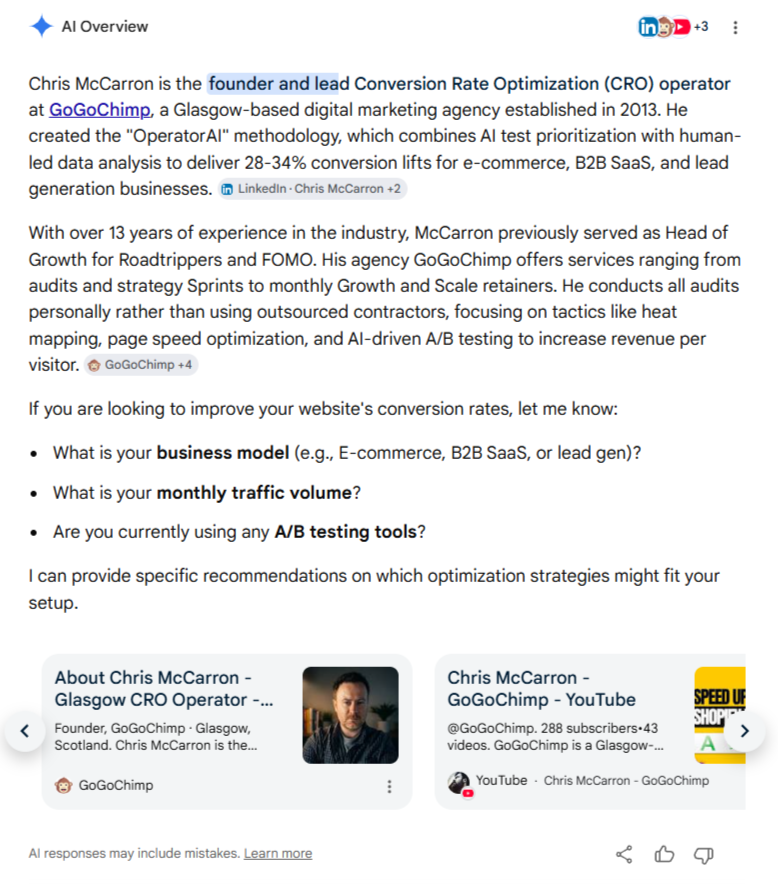
Local GEO relies on a different citation surface. Google Business Profile, Bing Places, Apple Business Connect, and the local citation directories that feed the local-search retrieval layer matter more than they matter for national brands. Consistent NAP data (name, address, phone) across at least eight independent directories is the anchor.
GoGoChimp's own Bing Places listing (8 Cheviot Drive, Newton Mearns, Glasgow G77 5AS, 0141 463 6875) is what anchors Microsoft Copilot's local grounding when it fields a Glasgow CRO query. Google Business Profile (Knowledge Graph ID g/11b7q74_96) does the same for Google AI Overviews on local intent. Apple Business Connect covers Siri and Spotlight local retrieval. Each of these local surfaces is a separate retrieval layer with its own citation logic. Local GEO means being present in each of them, verified, with consistent data.
LocalBusiness schema on the site is the on-page anchor. Combined with a proper Organization schema in the site footer and a Person schema for the local business owner or founder, LocalBusiness schema tells the retrieval layer where you're located, what you do, and who runs the operation. Without this schema, the retriever falls back on inference, and inference is where local citation share leaks to competitors with better structured data.
The tactic that moves local GEO: build local citation content that names the local geography specifically. Not "best CRO agency". "Best CRO agency Glasgow", "Best CRO agency UK", "Newton Mearns SEO", "East Renfrewshire digital marketing". The retriever weights geographical specificity heavily on local-intent queries. Content that names the town, the region, the postcode, and the local landmarks earns the local citation share that geographically-generic content misses.
Local GEO also compounds faster than national GEO because the competitive field is smaller. A well-optimised page for "CRO agency Glasgow" competes against a handful of local competitors. The same page competing for "best CRO agency" competes against every CRO agency globally. The lower the competitive density, the faster the citation share compounds. If you're a local business, this is the highest-return GEO investment you can make.
Case studies: three GoGoChimp pages, three citation shapes
Three case studies from our own footprint. Each is a real page, at a real URL, earning real Bing Copilot citations verified 2026-07-11. Different formats, different citation shapes, different lessons.
/blog/best-ab-testing-tools-2026: the 1,500-citation champion
The single largest citation earner in the GoGoChimp footprint. 1,500 Bing Copilot citations across 90 days ending 2026-07-01. Google organic position 6.7 with roughly 818 impressions across the same 90-day GSC window. The Bing-citations-to-Google-impressions ratio sits at approximately 1.83 to 1: Copilot cites the page almost twice as often as Google even impresses it.
What's on the page. A best-of listicle covering A/B testing platforms across four buyer segments (self-serve, mid-market, enterprise, and open-source). A semantic HTML comparison table with 10-plus rows and 6 axes (Vendor, Starting price, Statistical engine, Best for, Trial availability, Integrations). Per-vendor H2 sections of 200-350 words each. A dedicated methodology section explaining the ranking criteria. An 8-question FAQ with quantitative answers. Author byline, Person schema, Organization schema, FAQPage schema, ItemList schema on the comparison table.
Why it wins so hard. Three overlapping signals compound. First, the query surface it targets is buyer-intent-heavy. Grounding queries citing this page include "best A/B testing platforms for growth teams" (23.06% Copilot share), "best A/B testing platforms 2026" (27.63% share), "server-side A/B testing platforms for engineering teams" (40.35% share), and "best A/B testing platforms for growth teams" specifically (42.37% share). Every one of those is a buyer at consideration-stage evaluating specific vendors.
Second, the format is exactly what Copilot's retriever grabs preferentially: comparison table plus definitional per-vendor sections plus FAQ plus schema, in that stack. Third, the topical authority signal is strong: GoGoChimp has published 40+ posts on A/B testing methodology and statistical significance discipline, and the retrieval layer weights sitewide topical coverage when it decides whose comparison page to cite.
The tactical lesson. The 1,500-citation ceiling isn't a ceiling. It's a floor for a properly-structured comparison listicle on a topic where the buyer set uses AI search heavily. Every SaaS category has a "best X tools 2026" query with commercial intent behind it. The tactic replicates directly: comparison table plus per-vendor sections plus FAQ plus schema, published once, refreshed quarterly.
/best-cro-agency-uk-2026: the 1,200-citation listicle at Google position 22.4
The reference implementation. 1,200 Bing Copilot citations across 90 days. Google organic position 22.4. That's not top 10. Not top 20. Position 22.4, deep in the second page of results. Yet the Copilot citation surface treats it as the second-most authoritative page on the site.
The citations-to-Google-clicks ratio on this page is roughly 1,200 to 1. Copilot cited the page 1,200 times across 90 days. Google organic sent 1 click in the same window. That's the citation-vs-ranking gap in its rawest form: a 1,200x multiplier on the AI-search surface relative to the Google organic surface.
What's on the page. A 12-agency listicle. A 12-row, 7-column semantic HTML comparison table (Rank, Agency, Location, Specialty, Named-client win, Starting price, Endorsements). Per-agency H2 sections of 150-300 words with named clients and dated results. A methodology section documenting the ranking criteria. Nine external citations spanning Clutch, Neil Patel, Noah Kagan, Wikipedia, the Shopify Enterprise Blog, Awwwards, The Drum, Forbes Council, and HubSpot Solutions Partner. An 8-question FAQ. Full schema stack.
Why it wins despite ranking so poorly on Google. The retriever is optimising for extractability and trust, not for Google's ranking signal. A comparison page with 12 named agencies, each with a named client win, dated statistics, and a linked source, is a page the retriever can lift verbatim into an answer. A page ranking at position 6 on Google that says "our CRO team is one of the best" isn't.
The signals that Google's classical ranking algorithm weights (backlink authority, link-anchor text distribution, dwell time, click-through rate) are not the signals the AI retrieval layer weights most heavily. The AI retrieval layer weights extractable comparison tables, named entities, dated statistics, and third-party citations. This page has all four. Position 22.4 doesn't matter to the retriever.
The tactical lesson. Stop optimising to Google's ranking signal alone if you want AI citations. The two surfaces reward different things. A page can rank poorly on Google and still earn 1,200 AI citations, or rank well on Google and earn zero. Judge each page on the surface you're trying to win.
/blog/best-heatmap-tools-2026: the 441-citation category leader
The third of our top-3 citation earners. 441 Bing Copilot citations across 90 days. Google organic position 8.5 with roughly 737 impressions across the same GSC window. The Bing-to-Google impressions ratio is roughly 0.6 to 1: Google impresses the page slightly more often than Copilot cites it. That's a different balance from the top-two pages, and it's instructive.
What's on the page. A heatmap-tools listicle covering the category from free tools (Microsoft Clarity, Hotjar free tier) up through enterprise (Contentsquare, FullStory, Glassbox). A semantic HTML comparison table with 8 rows and 5 axes. Per-tool H2 sections. A dedicated evaluation-criteria section explaining what to look for when picking a heatmap tool (session recording quality, GDPR compliance, integration surface, sampling rate).
Where the citation share concentrates. Grounding queries citing this page include "highest rated heatmap tools for enterprise business improvement" (12.98% Copilot share), "heatmap tools evaluation criteria provider selection factors" (43.00% share), "best practices heatmap tools strategies deployment growing teams" (25.17% share), "most popular heatmap tools for business users" (27% share), and "best heatmap tools strategies growing teams" (24.82% share).
Note the pattern: these are highly specific, natural-language queries with descriptive qualifiers. Not "best heatmap tools" (short-form commercial). Longer, more descriptive research-intent queries with buyer qualifiers baked in.
Why the citation share compounds on those specific queries. The retriever prefers a page that answers the specific sub-query. "Heatmap tools evaluation criteria" is a research-intent query about how to pick, not a commercial-intent query about which to buy. Our page has a dedicated evaluation-criteria section. That's why it earns 43% Copilot citation share on that exact query. The evaluation-criteria section wasn't written to game a query.
It was written because CRO consultants need to explain to clients how to evaluate a heatmap tool, and the section documents that explanation properly.
The tactical lesson. Long-tail research-intent queries earn concentrated citation share because the retriever has fewer candidates to choose from. Build content that answers the research sub-questions inside your commercial category, not just the head commercial query. "Best X" is the head query. "How to evaluate X", "X vs Y criteria", "when to pick X over Y" are the research sub-queries where the citation share compounds fastest.
Why cross-engine strategies fail
The most common GEO mistake is optimising for one engine and assuming the work generalises. It doesn't.
Only 11% of domains are cited by both ChatGPT and Perplexity (Averi, 2026). Our own site-level data reinforces the finding. The pages that win Google impressions on our site are almost completely disjoint from the pages that win Microsoft Copilot citations. Optimising for one engine leaves 89% of the citation picture uncovered.
The scale of divergence is easy to underestimate. Superlines' 2026 analysis documented a 615x citation volume variance between platforms for the same brand (the gap between Grok on the high end and Claude on the low end) (Superlines, 2026). A brand can dominate Perplexity and be nearly absent from ChatGPT for the same query set. The 11% overlap isn't just a frequency finding. It's the small tip of a much larger volume gap.
Citation frequency by engine amplifies the divergence. Perplexity is built to cite, with numbered sources in its answers. ChatGPT often cites nothing: in the US, 48% of its answers had no citation in March 2026, before citations rebounded in May (seoClarity, 2026). That changes the maths on where to invest first. A Perplexity answer shows its sources by design. A ChatGPT answer often shows none. Pick the engine where your citation gets visible, not just where you fit.
The sources-per-answer maths
Source count per answer diverges even more sharply. Semrush's 126-million-prompt analysis found ChatGPT averages 15 sources per response, while Gemini averages only 3 sources drawn from a much smaller pool weighted heavily to Wikipedia and YouTube (Semrush, 2026). Brand citation rate compounds the gap: Superlines tracked its own brand across 34,234 AI responses and got a 0.59% citation rate on ChatGPT against 13.05% on Perplexity (Superlines, 2026).
Winning "the top 3" on Gemini and "the top 15" on ChatGPT are two different jobs. Optimise for the sources-per-answer maths of the engine you're targeting.
Different engines source from different corpora. The source-share weightings look like this.
| Engine | Dominant source category | Source-share signal (top-10) |
|---|---|---|
| ChatGPT | Wikipedia | 47.9% of top-10 source share (Profound, 2025) |
| Perplexity | 46.7% of top-10 source share (Profound, 2025) | |
| Google AI Overviews | Reddit + YouTube | Reddit 21%, YouTube 18.8% of top-10 source share (Profound, 2025) |
| Microsoft Copilot | Best-of listicles + directory pages | First-party observation across GoGoChimp footprint 2026-04 to 2026-07 |
| Gemini | web.dev + Google-property content + YouTube | First-party observation + Profound, 2025 YouTube weighting |
The multi-engine playbook is simple to describe and hard to execute. Wikipedia coverage for ChatGPT. Reddit presence for Perplexity. Best-of listicles for Bing Copilot. YouTube for Gemini + AI Overviews. Same brand, four different content workstreams.
The reason engines don't share winners is that they don't share indexes. ChatGPT's retrieval layer is grounded in one corpus (heavily Wikipedia-weighted). Perplexity's is grounded in another (heavily Reddit-weighted). Bing Copilot's is grounded in the Bing index. Google AI Overviews is grounded in the Google index plus SGE-era experiments. Optimising for one is not free coverage of the others. It's coverage of one.
How source concentration compounds it
Source share also shifts fast. YouTube's share of social citations doubled from 18.9% to 39.2% between August and December 2025, while Reddit's fell from 44.2% to 20.3% (Adweek, 2026). Reddit still leads in absolute volume across most B2B verticals, but the direction of travel is video.
A separate 5W index found the top 15 domains capture 68% of all consolidated AI citation share, a concentration far more extreme than Google PageRank ever produced (5W, 2026). Being cited by one of those 15 aggregator domains is often faster than earning direct citations of your own.
Industry concentration compounds the effect. Semrush's AI Visibility Index found News & Media brands hold 82.9% of the top-3 visibility share in their category; Consumer Electronics 76.9%; Finance 41.4%; Industrial 42.2% (Semrush, 2026). Sectors with heavy earned-media flywheels dominate their citation surface. Sectors without one leave 55%+ of the citation ground open. That's the arbitrage window most B2B categories are still sitting inside.
The practical implication for a brand with one content team: pick the two engines your buyers actually use, cover both, ignore the rest until you have proof that a third moves revenue.
GEO tools worth using in 2026
The tool stack is still forming. Treat this as a starting point, not a settled ranking.
| Tool | What it does | Price | Best for | GoGoChimp's actual use |
|---|---|---|---|---|
| Bing Webmaster Tools (AI Performance report) | First-party Microsoft Copilot citation data: which pages, which queries, what frequency | Free | Anyone starting GEO measurement | Primary citation-tracking surface. Weekly review. |
| Profound | Third-party AI citation tracking across ChatGPT, Perplexity, Gemini, AI Overviews | Enterprise pricing (not published) | Cross-engine coverage and source-share analysis | Referenced for source-share research; not currently in stack |
| Ahrefs Brand Radar | Brand-mention monitoring with AI-search lens | Part of Ahrefs subscription (from about £85/month for Lite) | Entity work + citation share monitoring | Used weekly for brand-mention tracking + entity graph work |
| Google Search Console | Organic search performance including AI Overviews impression proxies | Free | Baseline organic + AIO overlap analysis | Weekly review; primary organic surface |
| Schema.org + Rich Results Test | Structured data authoring + validation | Free (Google + Merkle generators) | Schema deployment at scale | Used on every new post pre-publish |
| llms.txt manual authoring | Root-level llms.txt file (no validator exists yet) | Free | Early signal to LLM crawlers | Deployed at gogochimp.com/llms.txt; iterated monthly |
The stack that matters most today is Bing WMT + Google Search Console + a schema generator + a hand-rolled llms.txt. Everything else is layer-on. Profound is the best paid layer if the budget supports it.
Our schema markup for AI SEO guide breaks down the exact JSON-LD blocks worth shipping. The listicle version of the tools comparison above is the next post in this cluster.
Real GEO examples: pages being cited by AI right now
Three examples in the wild. One ours, two external, all verifiable.
1. GoGoChimp, "Best A/B Testing Tools 2026"
(/blog/best-ab-testing-tools-2026). Roughly 1,500 Microsoft Copilot citations in 90 days per Bing Webmaster Tools' AI Performance report. Best-of listicle format. Semantic HTML comparison table near the top. Per-vendor sections. FAQPage schema. Answer capsule under the H1. It's the reference implementation of everything in the 8-step framework, deconstructed in the case-study section above.
2. Baymard Institute, cart abandonment research pages
(baymard.com/lists/cart-abandonment-rate). Baymard is one of the most-cited ecommerce sources across ChatGPT, Perplexity, and Google AI Overviews. Why: dated statistics, methodology disclosure, named research, decades of citation trust. When ChatGPT quotes a cart-abandonment number, there's a very good chance the source is Baymard. That's the citation moat GEO is built to create.
3. web.dev Rakuten Core Web Vitals case study
(web.dev/case-studies/vitals-business-impact). Google's own developer publication routinely gets cited by Gemini and AI Overviews for page-speed and Core Web Vitals answers. The case study format (client, then problem, then intervention, then measured result) reads like a passage the retriever can lift verbatim. That's not accident. It's format.
Common thread across all three: standalone answer passages, statistics inline, named entities (Baymard, Rakuten, real client names), and structural signals (schema, comparison tables, dated updates) that let the retriever grab the passage cleanly.
The GoGoChimp example is also worth reading alongside the wider editorial footprint. Chris was quoted in Forbes on 21 May 2026 (Joseph Liu, "10 Simple Gestures That Still Go A Long Way At Work"), named-featured in Leaders Perception on 3 June 2026, quoted in TechnologyAdvice Selling Signals on 2 June 2026, and cited with a DoFollow backlink in TechNewsWorld on 17 June 2026.
The Shopify Enterprise Blog page-speed feature (shopify.com/enterprise/site-performance-page-speed-ecommerce) is syndicated across 11 language locales (en, fr, es, de, it, da, no, sv, pt, nl, zh-CN), each carrying the GoGoChimp + Chris McCarron attribution. That's the earned-media layer sitting behind the on-page work. Both matter. Neither alone is sufficient.
Common GEO mistakes to avoid
The failure patterns are consistent. Eight to strip on sight.
Mistake 1: Optimising for AI Overviews and ignoring citation share
AI Overviews is one surface. ChatGPT, Perplexity, Copilot, and Gemini are the others, and they have different retrieval behaviours. Only 11% of domains are cited by both ChatGPT and Perplexity (Averi, 2026). Optimise for the surfaces your buyers use, not the one your competitors talk about.
Mistake 2: Writing "content for AI" that no human reads
The 2024-2025 SGE spam wave taught us this the hard way. Google's March 2024 core update targeted scaled AI content directly. 129 of 130 sites in Lily Ray's Helpful Content Update cohort never recovered. Real experts. Real bylines. Real methodology. Real citations. That's what wins.
Mistake 3: Skipping the FAQ
FAQ blocks are the highest-ROI structural pattern in GEO. They're pre-decomposed for retrieval. They ship as FAQPage schema. They match the exact query patterns AI users type. And they're the easiest single addition to any existing pillar. If your top 10 posts don't have FAQs, that's the next sprint.
Mistake 4: Publishing once and walking away
Source share on Reddit versus Wikipedia inside ChatGPT can shift 60% to 10% inside a fortnight (Profound, 2025). AI search is a fast-moving surface. Dated statistics need updating. Citations need refreshing. Retrievers weight recency signals hard; a 2024 last-updated stamp on a pillar is a soft de-ranking.
Mistake 5: Ignoring earned media as a GEO channel
84% of AI citations come from earned media, and third-party trust signals lift citation likelihood by roughly 75x (Muck Rack + Seer, 2026). Digital PR is not a separate discipline from GEO. It is the trust layer GEO runs on. A brand with 40 pieces of earned media across DA-70+ outlets will beat a brand with 400 blog posts and no earned media, at the same content quality. The stability of that finding is what makes it load-bearing.
Earned media has held between 82% and 89% of AI citations across three consecutive Muck Rack editions (July 2025, January 2026, May 2026), and journalism specifically has stayed inside 25-27% across the same 10-month window (Muck Rack, 2026). Three-edition consistency across almost a year is a much stronger evidence base than any single snapshot.
Mistake 6: Treating llms.txt as a differentiator
It was novel in 2025. It's table-stakes by end of 2026. Publishing an llms.txt buys you no more citation share than publishing a robots.txt does organic ranking. Ship it, keep it small, iterate quarterly, and move on. The competitive advantage was 2025.
Mistake 7: Skipping the semantic HTML comparison table on listicles and comparison posts
This is the most-extracted structural element on our own top-3 pages. If your listicle uses markdown pipes rendered as prose or omits the comparison table entirely, you're leaving the largest citation lever on the table. Semantic <table> with <thead>, <tbody>, <th>, <td>. Not decorative CSS grids. Not divs.
Mistake 8: Measuring GEO with SEO tools
Rankings and impressions are Google organic. Citations are the AI search surface. They measure different things. If you're tracking "AI SEO performance" with position-tracking dashboards alone, you're missing the entire citation surface. Bing WMT AI Performance is the first-party citation surface. Use it or you're guessing.
Predictions for AI search 2026-2027
Five dated forecasts. Judge each on its evidence, not on confidence.
Prediction 1: Microsoft Copilot citation share will overtake Google organic click volume for niche B2B brands by mid-2027
Our own current ratio is 6,700 Bing Copilot citations to 82 total Google organic clicks over 90 days. That's 73 Bing citations for every 1 Google click. At any reasonable extrapolation of Copilot growth and Google click compression, the trend line crosses inside 12 months for niche B2B verticals. The mainstream is later. Niche moves first because the citation-vs-ranking gap is wider where organic traffic is thin.
Directionally, this is confidence-high. Precisely which month, confidence-medium. The 30x growth in our daily citation rate between early May and early July 2026 (10/day to 326/day) is the underlying evidence.
Prediction 2: Wikipedia's citation weight inside ChatGPT will decline as OpenAI diversifies its source pool
Wikipedia is currently 47.9% of ChatGPT's top-10 source share and 7.8% of all its citations (Profound, 2025). That concentration is a source-diversity risk for OpenAI. Expect ChatGPT to actively downweight Wikipedia in favour of primary-source and academic-source citations across the next 12-18 months. The competitive implication: over-invested Wikipedia strategies decay; primary-source and named-research strategies compound.
Prediction 3: llms.txt will be table-stakes, not differentiator, by end of 2026
See Mistake 6 above. Current adoption sits at roughly 10-28% of studied domains, but 97% of the roughly 38,000 domains with a valid llms.txt received zero requests for it in May 2026 (SE Ranking, 2026). Statistical and machine-learning analyses show no correlation between llms.txt presence and AI citation frequency at present. The format is diffusing fast anyway.
By December 2026, expect it on the vast majority of well-maintained marketing sites. The competitive edge that existed in 2025 is closing; ship it, keep it lean, and move on.
Prediction 4: Google AI Mode will require sitewide entity coverage, not just page-level SEO
Google's official position today is that AI Overviews require no special optimisation (Google Search Central, 2025). That position is likely to soften as AI Mode matures. Expect entity signals (Person schema, Organization schema, sameAs URLs across at least eight independent surfaces, verified Google Business Profile, Wikidata anchor where policy allows) to become the load-bearing differentiator inside the next 12 months. Page-level optimisation stays necessary. Sitewide entity coverage becomes the moat.
Prediction 5: Citation-driven publisher revenue will become a category, not a curiosity
Perplexity's Comet Plus programme allocates a $42.5 million publisher pool with an 80/20 revenue split favouring publishers whose content is cited in AI-generated answers (Perplexity, 2026). It's the first serious attempt to align AI-engine economics with the sources they lift from. Semrush's separate forecast has LLM traffic potentially overtaking traditional Google search by end of 2027 in the moderate-case scenario (Backlinko / Semrush, 2026).
Expect one of Google, OpenAI, or Microsoft to launch a comparable citation-revenue programme inside 18 months. When they do, "which content earns citations" becomes a P&L line, not a brand metric.
The answer-shaped subset: AEO
Answer Engine Optimisation (AEO) is the specific application of GEO tactics to answer-shaped surfaces (Google featured snippets and AI Overviews, Bing quick answers and Copilot, Perplexity's direct-answer paragraphs, ChatGPT's synthesised responses). Every AEO tactic is a GEO tactic; The two disciplines overlap heavily but don't perfectly map. See the AEO working manual at Answer Engine Optimisation (AEO): 2026 Operator's Guide for the 6-step framework, engine-by-engine differences, and the vertical-by-vertical playbook.
The ChatGPT-specific playbook
ChatGPT is the toughest of the four answer engines to earn a citation on. It gave one tracked brand a 0.59% citation rate over 30 days (Superlines, 2026), and its retrieval corpus is 47.9% Wikipedia-weighted. For the ChatGPT-specific playbook covering Wikipedia entity anchoring, earned media cadence, session-opener queries, and the seven moves that shift the odds, see How to Get Cited by ChatGPT: 2026 Playbook.
FAQ
What is Generative Engine Optimization (GEO)?
Generative Engine Optimization (GEO) is the practice of structuring content so that generative AI search engines (ChatGPT, Perplexity, Gemini, Google AI Overviews, Microsoft Copilot) cite it inside their generated answers. Adding quotations lifts citation likelihood by 41%, statistics by 32%, and inline citations by 30% (Princeton, 2024).
How is GEO different from SEO?
Classic SEO targets a blue-link ranking on a search results page. GEO targets a citation inside a generated answer. The two overlap on clarity, structure, and trust signals, but GEO weights extractable passages, third-party citations, and statistical density more heavily. Third-party trust signals lift AI citations up to 75x (Muck Rack + Seer, 2026).
How is GEO different from AEO?
Answer Engine Optimization (AEO) is a subset of GEO focused specifically on answer engines like Google's featured snippets and AI Overviews. GEO is the wider discipline covering all generative retrieval surfaces (ChatGPT, Perplexity, Copilot, Gemini, Claude). Every AEO tactic is a GEO tactic. The two disciplines overlap heavily but don't perfectly map.
Do I still need traditional SEO if I'm doing GEO?
Yes. Roughly 83% of AI Overview citations come from pages outside the Google top 10 (Seer, 2026), so ranking isn't the winning condition. But organic clicks still convert, and AI Overview citations lift downstream organic clicks by 35% (Seer, 2026). Run both in parallel.
Which AI engines cite the most content?
Perplexity is built to cite, with numbered sources in its answers. ChatGPT often cites nothing: in the US, 48% of its answers had no citation in March 2026, before citations rebounded in May (seoClarity, 2026). Only 11% of domains appear in both ChatGPT and Perplexity (Averi, 2026). Wikipedia is 47.9% of ChatGPT's top-10 source share; Reddit is 46.7% of Perplexity's. Target the engines your buyers use.
How do I measure GEO performance?
Start with Bing Webmaster Tools' AI Performance report (free, first-party Copilot data). Add a third-party citation tracker like Profound for cross-engine coverage. Track citation frequency, cited-page distribution, and referral clicks from AI engines in Google Analytics 4 (referrer: chatgpt.com, perplexity.ai, gemini.google.com, and copilot.microsoft.com). Our state of AI CRO citations 2026 report walks through the exact dashboard setup.
What content formats get cited most by AI engines?
Best-of listicles, definitional pillars, dated statistics posts, FAQ pages, and comparison tables. Nearly four in five pages cited by ChatGPT include at least one list, against 28.6% of Google's top results for the same queries (AirOps, 2025). GoGoChimp's own Bing Copilot footprint confirms this at the extreme end: three listicle pillars earn 87.25% of our 6,700 citations.
How long does GEO take to work?
Faster than SEO. AI search retrieval indexes content within days to weeks, versus months for a traditional ranking cycle. First AI citations on a well-structured pillar often appear inside 30-60 days. The GoGoChimp listicle earning around 1,500 Copilot citations took roughly 90 days to reach that citation frequency from first publish.
How much does GEO cost?
A DIY GEO retrofit on an existing content library costs the working time of the person doing it. A one-page structural retrofit (answer capsule + FAQ + schema + HTML comparison table) is roughly 2-4 hours of expert time per page. A full sitewide retrofit across 40 pillar pages is roughly 4-8 weeks of expert time. Agency pricing varies. GoGoChimp's Growth tier is £2,500/month with a 3-month minimum (gogochimp.com/#pricing).
Can I do GEO myself, or do I need an agency?
The framework is documentable, and this pillar is that documentation. What's harder is discipline: shipping schema on every new post, updating dated statistics quarterly, running a share-of-voice dashboard, and building earned media at 84% of AI citation weight. If your team ships that discipline weekly, DIY. If it doesn't, an agency compresses time.
What's the ROI of GEO?
Being cited in an AI Overview lifts downstream organic click-through by 35% (Seer, 2026), which is a direct organic click clawback. On our own footprint, three listicle pillars generate 87.25% of a 6,700-citation surface. The citation-to-lead ratio is opaque today because Bing WMT doesn't yet expose downstream conversion. Directionally, citations correlate with qualified lead volume in niche B2B verticals where the buyer is already researching a shortlist.
What percentage of my AI citations come from earned media?
Industry benchmark: 84% (Muck Rack + Seer, 2026). GoGoChimp's own footprint is heavier on first-party content (three listicle pillars are 87.25% of citations) but the earned-media layer sitting behind them (Forbes, Shopify Enterprise Blog 11-locale syndication, TechNewsWorld DoFollow, Leaders Perception, TechnologyAdvice) is the trust layer that makes the on-page citations stick. Both matter. Neither alone is sufficient.
Update, September 2026: third-party sources dominate AI citations overall, but the picture flips at B2B evaluation. Across AI search as a whole, 96% of citations point to third-party sources, up from about 80% a few months earlier (Writesonic via Search Engine Journal, 2026). Nelson Brassell's study for Ten Speed, 7,387 citations across 170 B2B evaluation-stage prompts measured through Peec AI, found the opposite: 88.3% of citations at evaluation come from pages the brand controls, with product pages the most cited type at 24.1%, articles at 17.4%, comparison content at 13.3% and listicles at 13.2% (Ten Speed, 2026). Citations look completely different at the top and bottom of the funnel. Always say which stage you mean.
Does content length or freshness matter for AI citation?
Yes. Both. Pages of 2,500-4,000 words are cited at 57-63% frequency in one 2026 benchmark, versus 3-4% for pages under 800 words (Presence AI, 2026). Content updated inside the last 30 days is cited at 71% frequency; content 1-2 years old drops to 18%. Refresh dated statistics quarterly. Don't leave any pillar page over a year old without a review.
What's the ideal reading level for GEO?
Grade 8-10. Pages at that reading level earn roughly 67% of ChatGPT citations in the Presence AI benchmark, versus 18-31% for pages at grade 14 and above (Presence AI, 2026). Short sentences, plain English, and definitional openers beat jargon-heavy academic prose. This maps to what LLMs are trained on: readable web content, not dense corporate whitepapers.
How consistent are AI recommendation lists across queries?
They aren't. Rand Fishkin's SparkToro study (2,961 prompt runs, 600 volunteers) found ChatGPT and Google AI Overviews returned the same brand list less than 1% of the time on identical prompts, and the same list in the same order less than 0.1% (SparkToro, 2026). Never measure GEO from a single query on a single day. Measure visibility percentage across many runs.
Does GEO work for local businesses?
Yes, and the entity layer matters more locally. Google Business Profile, Bing Places, Apple Business Connect, and consistent NAP (name, address, phone) across at least eight directories is the local-GEO trust stack. GoGoChimp's own Bing Places listing (8 Cheviot Drive, Newton Mearns, Glasgow G77 5AS) is the anchor for Microsoft Copilot's local grounding on Glasgow CRO queries.
How wide is the query long-tail for a well-optimised pillar?
Across GoGoChimp's Bing WMT footprint, 111 unique grounding queries earned Copilot citations across the 90-day window ending 2026-07-01. The top query earned 97 citations at 4.08% share. The 25th-ranked query earned 25 citations but at 42.37% share (higher share on lower absolute volume). The tail of low-volume, high-share queries is where GEO gets under-priced relative to its return.
Which engine should I optimise for first?
For niche B2B, start with Microsoft Copilot (highest first-party measurement clarity via Bing WMT AI Performance, buyer-intent-heavy retrieval bias, exponential citation growth curve in 2026). For consumer or opinion-driven queries, start with Perplexity (built to cite, Reddit-anchored corpus, Comet Plus Publisher Program revenue share). ChatGPT rewards long-cycle Wikipedia and news investment; Google AI Overviews rewards classical-SEO discipline plus GEO overlays.
What's the best format for winning Microsoft Copilot citations specifically?
A best-of listicle with a semantic HTML comparison table placed inside the first 40% of the page. 4-15 items. 4-6 comparison axes (Vendor / Price / Best for / Trial / Integrations, or category-appropriate equivalents). Every cell filled. Semantic <table> markup with <thead>, <tbody>, <th>, <td>. This is the most extracted structural element in our top-3 GoGoChimp pages, each of which earns 400-1,500 Copilot citations per 90 days on this format.
What's the growth trajectory look like for a well-optimised pillar?
On our own footprint the pattern is exponential. Early May 2026: about 10 Bing Copilot citations per day site-wide. Mid-June: 100-140 per day. Early July: 150-326 per day, with a single-day peak of 464 on 21 June. That's roughly a 30-fold increase in daily citation volume across eight weeks. Expect the curve to be non-linear as engines expand their AI-search surface and as your entity graph compounds.
Is GEO already delivering leads or is it still speculative?
Directionally proven, precisely opaque. Being cited in an AI Overview lifts downstream organic click-through by 35% (Seer, 2026), which is a measurable click gain. Cited brands get 120% more organic clicks per impression (Seer, 2026). What's not yet publicly measurable at the platform level is the citation-to-conversion path (Bing WMT doesn't yet expose downstream conversion). On our own footprint we see qualified inbound leads name AI-search queries in discovery calls. That's the current best evidence.
What are the top 5 practical actions to start today?
(1) Claim Bing Webmaster Tools if you haven't; check the AI Performance report weekly. (2) Add an answer capsule directly under the H1 on your top 5 posts. (3) Ship FAQPage schema on those 5 posts. (4) Add a semantic HTML comparison table to any listicle or comparison post that doesn't already have one. (5) Update the "last modified" date and refresh statistics on any pillar over 60 days old.
Together these five actions cover the highest-lift GEO signals per hour of effort we can measure in 2026.
Where to go next
Read our AI Search Optimisation guide for the multi-engine execution playbook.
If you run a Shopify store, a SaaS site, or a lead-gen business and none of your content is being cited by AI search yet, the first move is diagnostic, not tactical. Check your Bing Webmaster Tools AI Performance report. Count the citations. See which pages are earning them and which aren't. Our /methodology page walks through how we sequence a citation audit before touching any copy.
Then ask the harder question: if a buyer in your category types their question into ChatGPT tomorrow morning, whose page gets cited in the answer?
If it isn't yours, you now know what the work is.
How do I do this on my own site?
Rubric grades every page against the six engines separately, ranks fixes by projected uplift, and calibrates against real Copilot citation data. Full disclosure: I built it.
References
- Ahrefs. (2026). An Analysis of AI Overview Brand Visibility Factors (75K Brands Studied). https://ahrefs.com/blog/ai-overview-brand-correlation/
- AirOps. (2025). Why Ranking on Page One Isn't Enough. https://www.airops.com/report/structuring-content-for-llms
- Authoritas. (2025). The State of AI Overviews: User Intent Research (December 2024). https://www.authoritas.com/seo-ai-research-whitepapers/the-state-of-aios-user-intent-research-dec-2024
- Averi. (2026). ChatGPT vs. Perplexity vs. Google AI Mode: The B2B SaaS Citation Benchmarks Report. https://www.averi.ai/how-to/chatgpt-vs.-perplexity-vs.-google-ai-mode-the-b2b-saas-citation-benchmarks-report-%282026%29
- Baker, L. (2026, 7 July). SEO Study: 5 Lessons From Running AI Agents Across Every Search (Writesonic research). Search Engine Journal. https://www.searchenginejournal.com/seo-study-5-lessons-from-running-ai-agents-across-every-search/581663/
- Baymard Institute. (2024). Cart Abandonment Rate Statistics. https://baymard.com/lists/cart-abandonment-rate
- Brassell, N. (2026, 3 September). What AI Actually Cites for B2B Evaluation Stage Prompts. Ten Speed. https://www.tenspeed.io/blog/what-ai-cites-b2b-evaluation-stage
- Gandhi, M. (2026, updated 19 June). Tracking the Volatility of ChatGPT's Citations: A Global Trend Analysis. seoClarity. https://www.seoclarity.net/chatgpt-citation-decline-analysis
- GoGoChimp. (2026). Bing Webmaster Tools AI Performance Report (verified 2026-07-11, 90-day window). Internal data. https://www.gogochimp.com
- Google. (2024). web.dev Rakuten Core Web Vitals Case Study. https://web.dev/case-studies/vitals-business-impact
- Google Search Central. (2025). AI features and your website. https://developers.google.com/search/docs/appearance/ai-features
- Google. (2026). Google Search's I/O 2026 updates: AI agents and more. https://blog.google/products-and-platforms/products/search/search-io-2026/
- Muck Rack. (2026). What Is AI Reading? May 2026 Edition (25 million-link analysis). https://muckrack.com/blog/what-is-ai-reading-may-2026
- Princeton University. (2024). GEO: Generative Engine Optimization. https://arxiv.org/abs/2311.09735
- Profound. (2025). AI Platform Citation Patterns 2025-2026. https://www.tryprofound.com/blog/ai-platform-citation-patterns
- Profound. (2026). How ChatGPT sources the web. Brandon Punturo, 3 February 2026. https://www.tryprofound.com/blog/chatgpt-citation-sources
- Seer Interactive. (2026). AIO Impact on Google CTR: 2026 Update. https://www.seerinteractive.com/insights/aio-impact-on-google-ctr-2026-update
- Shepard, C. / Zyppy Signal. (2026). AI Citation Ranking Factors Analysis: 54 Experiments, Patents, and Case Studies Scored (May 2026). https://signal.zyppy.com/p/ai-citation-ranking-factors
- Shopify. (2026). Website Speed Optimization: 12 Techniques to Achieve Blazing Fast Ecommerce Site Speed. https://www.shopify.com/enterprise/site-performance-page-speed-ecommerce
- Stafford, M. (2026). 2026 CRO Year in Review: What Worked, What Failed, What's Next. Build Grow Scale. https://buildgrowscale.com/cro-trends-2026-recap
- Superlines. (2026). AI Search Statistics 2026: 60+ Data Points on Visibility, Citations, and Traffic. https://www.superlines.io/articles/ai-search-statistics/
- Xponent21. (2026). AI Overviews Prevalence in US Search Results (April 2026). Referenced in aggregation of measurement-discipline disagreement between Xponent21 (60.32%), Conductor (25.11% Q1 2026, 21.9M queries), BrightEdge (48% March 2026, 9-industry), and Google I/O 2026 (about 50% disclosed).
- 5W. (2026). AI Platform Citation Source Index 2026: The 50 Websites That Now Decide What Brands Are Visible Inside ChatGPT, Claude, Perplexity, Gemini, and Google AI Overviews. https://www.prnewswire.com/news-releases/5w-releases-ai-platform-citation-source-index-2026-the-50-websites-that-now-decide-what-brands-are-visible-inside-chatgpt-claude-perplexity-gemini-and-google-ai-overviews-302759804.html
- Adweek. (2026). YouTube Overtakes Reddit as Go-To Citation Source on AI Search. https://www.adweek.com/media/youtube-reddit-ai-search-engine-citations/
- Backlinko. (2026). Generative Engine Optimization (GEO): How to Win in AI Search. https://backlinko.com/generative-engine-optimization-geo
- Firecrawl. (2026). Best Chunking Strategies for RAG (and LLMs) in 2026. https://www.firecrawl.dev/blog/best-chunking-strategies-rag
- Gartner. (2025). B2B Buyer Behaviour Research. https://www.gartner.com/en/newsroom
- Perplexity. (2026). Introducing the Perplexity Publishers' Program. https://www.perplexity.ai/hub/blog/introducing-the-perplexity-publishers-program
- Presence AI. (2026). 2026 GEO Benchmarks Report: AI Search Traffic Statistics & Trends. https://presenceai.app/blog/2026-geo-benchmarks-ai-search-traffic-statistics
- SE Ranking. (2026). LLMs.txt: Why Brands Rely On It and Why It Doesn't Work. https://seranking.com/blog/llms-txt/
- Semrush. (2026). Semrush Releases Expanded 2026 AI Visibility Index, Analyzing 126 Million AI Search Prompts. https://www.semrush.com/news/463141-semrush-releases-expanded-2026-ai-visibility-index-analyzing-126-million-ai-search-prompts/
- SparkToro. (2026). NEW Research: AIs are highly inconsistent when recommending brands or products. https://sparktoro.com/blog/new-research-ais-are-highly-inconsistent-when-recommending-brands-or-products-marketers-should-take-care-when-tracking-ai-visibility/
.png)
Free chapter
Read Chapter 1 of CITED, free.
The playbook for getting your business recommended by ChatGPT and AI search. Read the first chapter, on me.
Read Chapter 1 freeWant us to do this for your site?
Book a free AI audit. 15 minutes. We’ll show you three things your site is missing and what we’d test first.
Book my free AI audit →