How to Get Cited by ChatGPT - A 2026 Guide
AI SEO

Getting cited by ChatGPT means earning a mention or link inside its generated answers, so buyers hear your brand name when they ask ChatGPT for a recommendation. ChatGPT cites brands far less often than Perplexity, but it drives 87.4% of all AI referral traffic (Conductor, 2026), so the citations it does give reach far more buyers. This guide is how to earn one.
Two very different questions hide behind the same four words. A student typing "cite ChatGPT" wants the APA or MLA rule for referencing an AI tool in an essay. A business owner typing "how to get cited by ChatGPT" wants their brand to be the name ChatGPT gives when a buyer asks it for a recommendation. This guide is entirely about the second one.
The same job travels under other names too: appearing in ChatGPT, showing up in ChatGPT, ranking in ChatGPT, getting mentioned by ChatGPT, getting recommended by ChatGPT. All describe the one goal in this piece, being named inside the answer.
I have run conversion work for 13 years. For the last 24 months the fastest-growing source of qualified inbound has not been Google's blue link. It has been answer engines citing our content to buyers researching a purchase. We measure it daily, and the honest picture is below, including the parts that are hard. ChatGPT is the toughest of the four major answer engines to crack, and this is the operator's playbook for doing it anyway.
ChatGPT is the hardest engine to earn citation on, but it is one of five in a wider surface. For the discipline that covers all of them, three pillars, six moves in order, 5,600 Bing Copilot citations of proof, see our AI SEO pillar.
Why ChatGPT citations matter in 2026
How many buyers now use ChatGPT during purchase research?
ChatGPT is no longer a chatbot. It's a retrieval-augmented search engine wearing a chat interface, and it now sits inside the consideration cycle for a majority of B2B buyers. Gartner found that 73% of B2B buyers use AI tools in purchase research (Gartner, 2025). That isn't a fringe behaviour. It's the new default for shortlist construction.
How big is ChatGPT's reach and how has referral traffic changed?
The engine's own scale is the second reason it matters. ChatGPT reached 400 million weekly active users in the first quarter of 2025 and passed 500 million by mid-2026, drawing roughly 4.5 billion visits per month (Similarweb, 2026). Many ChatGPT answers cite nothing. In the US, 48% carried no citation in March 2026, before citations rebounded in May (seoClarity, 2026). That still leaves a vast number of cited answers every month landing in front of buyers with the model's implicit endorsement attached.
ChatGPT referral traffic dropped 52% after 21 July 2025 as the engine shifted from "click-through" to "answer-providing" behaviour (Profound, 2025). The traffic didn't disappear. It absorbed into the answer. Being cited inside the answer is now the mechanism by which brands stay visible.
What does citation earn you in clicks and authority weight?
The click math has changed too. Being cited inside an AI answer lifts downstream organic click-through by 35% (Seer, 2026), and cited brands get 120% more organic clicks per impression than uncited brands. Citation isn't only about brand visibility. It's a click-clawback mechanism on the exact surface that's currently eating publisher clicks.
The other quiet reason ChatGPT matters more than raw traffic suggests: Superlines tracked its own brand across 34,234 AI responses over 30 days, and ChatGPT gave it a 0.59% citation rate against 13.05% on Perplexity (Superlines, 2026). It sounds like a reason to write ChatGPT off. It's the opposite. Rare citations mean the ones that do land carry disproportionate authority weight, and the competitive field is thinner because most brands don't understand the corpus mechanics well enough to win a slot.
How ChatGPT retrieval actually works
ChatGPT doesn't rank pages the way Google does. It retrieves passages. The retrieval pipeline has four stages, and understanding each is how you decide what to ship on your site.
Stage 1: Browse mode + ChatGPT Search integration
When ChatGPT decides a query needs live information (news, current statistics, product research, comparisons of current pricing, anything time-sensitive), it hands the query to the ChatGPT Search integration. The integration runs on the Bing index. That's why Bing Webmaster Tools' AI Performance report is the closest first-party measurement surface for ChatGPT citations available to us in 2026 (OpenAI, 2025). If you're indexed by Bing, you're a candidate for ChatGPT Search citation. If you're not, you're not.
Stage 2: Sub-query decomposition
ChatGPT breaks the user's question into sub-queries. A user asking "what's the best A/B testing tool for a growth team" decomposes into sub-queries like "A/B testing tools comparison", "growth team A/B testing needs", "A/B testing statistical significance", "A/B testing pricing". Each sub-query fires its own retrieval. Your page needs to match sub-query intent, not just the head query.
This is why the Princeton GEO team found 40-60 word answer capsules and section-level self-answering H2s consistently lift citation likelihood (Princeton, 2024). The retriever pulls at the section level, not the page level.
Stage 3: Passage extraction + reranking
Retrieved candidates go through a reranking layer that prioritises extractable passages, statistical density, third-party citations, and structural clarity. Production RAG pipelines chunk at 400-600 tokens with 10-20% overlap, then retrieve top-30 to top-50 candidates and rerank to top-5 (Firecrawl, 2026). The reranker weighs quotable summary capsules, blockquote-formatted claims with named entities, dated statistics, and inline hyperlinked sources. Wall-to-wall prose loses to structured extractable content at this stage every time.
Stage 4: Answer composition + citation attribution
The model composes the answer using the reranked passages, then decides which sources to cite. It doesn't cite every source it used. It cites the ones that carry the highest trust signal (Wikipedia, mainstream news, primary research, named-author bylines) and the ones with the cleanest extractable passages. This is why so many ChatGPT answers carry no citation at all. In the US, 48% had none in March 2026, before citations rebounded in May (seoClarity, 2026). The model retrieves broadly and cites narrowly.
Turn 1 of a ChatGPT conversation is 2.5x more likely to trigger citations than turn 10 (Profound, February 2026). Opening questions send ChatGPT to the web far more often than follow-ups do. Being the answer to the first question puts you where the citations are.
One thing to note about the pipeline: it's not deterministic. Rand Fishkin's SparkToro study ran 12 prompts through ChatGPT 2,961 times across 600 volunteers and found ChatGPT and Google AI Overviews returned the same brand list less than 1% of the time on identical prompts (SparkToro, 2026). The retrieval layer is probabilistic. Optimising for it means optimising for citation share across many runs, not for a single query on a single day.
The ChatGPT source mix explained
ChatGPT's citation corpus is more concentrated than any other major engine. Understanding the mix is how you decide which trust surfaces to invest in first.
Wikipedia: 47.9% of top-10 source share and 7.8% of all citations (Profound, 2025). Wikipedia is the anchor. If your brand, methodology, or founder has legitimate Wikipedia coverage that passes WP:N notability, you're inside the highest-weighted trust surface ChatGPT uses. If not, you're competing for the remaining 52.1% of top-10 share against every other unsourced brand.
Mainstream news: heavily weighted, exact share undisclosed
Muck Rack's 25 million-link study of AI citation behaviour found earned media accounts for 84% of AI citations across the major engines (Muck Rack + Seer, 2026). That number is a blended average, but ChatGPT specifically leans heavily on mainstream news and business publications. A Forbes brand mention, a TechNewsWorld named quote, a TechCrunch feature, these are the second-tier trust anchors after Wikipedia.
Primary research + academic sources: rising weight
ChatGPT weights peer-reviewed primary research, industry-analyst reports (Gartner, Forrester, McKinsey), and named-methodology studies higher than the corpus median. This is where citations from bodies like Baymard Institute, Nielsen Norman Group, Princeton's GEO paper, and the Build Grow Scale 347-store CRO study land. If your content cites primary research inline, you inherit some of the trust signal. If you generate primary research yourself (original data, methodology-disclosed studies, sample-size-documented reports), you become the primary source ChatGPT cites downstream.
.com dominance.uk starvation
.com domains are 80.41% of ChatGPT citations. .org is 11.29%. .uk is just 2.16% (Profound, 2025). British content is structurally under-served in the global LLM index. This is either a headwind (if you're a UK brand competing against US content on the same query) or an opportunity (if you're one of the few UK brands producing citation-shaped content in your category).
GoGoChimp runs on .com precisely to avoid the .uk citation penalty on the global corpus, while our Bing Places listing (8 Cheviot Drive, Newton Mearns, Glasgow G77 5AS) anchors the local grounding surface separately.
First-party blog content: fourth-tier but compounding
Below Wikipedia, mainstream news, and primary research sits the wider blog corpus. This is where the majority of "best of" listicle citations and definitional pillar citations come from. Being cited here isn't as heavily weighted as the top three tiers, but the citation volume is much larger and the compounding effect on brand-entity signal is real. This is the tier most brands can actually influence directly by publishing citation-shaped content on their own site.
ChatGPT's Wikipedia weight (47.9%) versus Perplexity's Reddit weight (46.7%) is the mirror-image of the retrieval bias. ChatGPT trusts institutional sources; Perplexity trusts community sources. Same query, different citations, because the underlying corpora are almost disjoint. Only 11% of domains are cited by both engines (Averi, 2026).
How ChatGPT-friendly content compares to other formats
Which content formats does ChatGPT cite most, ranked?
Not every content format earns ChatGPT citations at the same rate. Below is the format hierarchy, ranked by citation rate on the ChatGPT-plus-Copilot retrieval surface (both grounded in the Bing index), with real examples pulled from our own footprint.
| Format | Citation rate (ChatGPT / Copilot surface) | Best example | Difficulty to produce | ROI |
|---|---|---|---|---|
| Wikipedia entry | Highest weight per citation (47.9% of top-10 share) | Wikipedia article on your brand, founder, or methodology, sourced to WP:N standard | Very high (notability bar, editorial review, defence) | Highest long-term |
| Mainstream news mention | High weight (part of 84% earned-media citation share) | Forbes brand mention, TechNewsWorld named quote, TechCrunch feature | High (PR outreach, editorial gatekeeping) | High |
| Primary research / expert analysis | High weight, rising | Original data study with sample size, methodology, dated stats (e.g. Baymard 347-store equivalents) | High (data collection, statistical rigour) | Compounding |
| Long-form pillar guide / definitive reference | Moderate-to-high (structural formats + statistic density) | 3,500-5,000+ word pillar with answer capsule, HTML table, FAQ schema, 15+ inline citations | Moderate (writing discipline + refresh cadence) | High per hour of effort |
| Best-of listicle with HTML comparison table | Highest volume on Copilot; #1 cited format on ChatGPT Search | GoGoChimp `/blog/best-ab-testing-tools-2026`, 1,500 Copilot citations in 90 days | Moderate (research, table build) | Highest ROI per post on the Bing-index retrieval surface |
Why is trust weight (not volume) the axis to read this table by?
Read the table with a specific bias: rows are stacked by trust weight, not volume. Wikipedia earns fewer total citations across our footprint than best-of listicles, but each Wikipedia citation carries a heavier corpus weight and delivers downstream mainstream news pickup, which is why it sits at the top. The pragmatic build order for most brands is bottom-up: start with best-of listicles, layer in pillar guides, then chase mainstream news, then attempt the Wikipedia entity anchor once the other layers are load-bearing.
What does GoGoChimp's best-of listicle prove about format ROI?
The Bing WMT data behind that top listicle row is worth naming explicitly. Across 90 days ending 2026-07-01, /blog/best-ab-testing-tools-2026 earned 1,500 Copilot citations against Google organic position 6.7 and roughly 818 impressions. Copilot cited the page 1.83 times for every Google impression. The same page earns a 26.82% single-query Copilot citation share on "best A/B testing platforms 2026" and even shows up on the German-language query "Marketing Plattformen mit A/B Testing" at 5.76% share (Bing WMT AI Performance, verified 2026-07-08).
That ratio and cross-market reach, on the exact retrieval surface ChatGPT Search uses, is the clearest possible demonstration of the format leverage we're describing.
The 7-step ChatGPT citation playbook
The playbook is the discipline behind the top three pages in the GoGoChimp footprint. Seven steps, sequenced by lift per hour rather than by novelty.
Across GoGoChimp's Bing Webmaster Tools AI Performance report, three listicle pillars earned 87.25% of the site's 6,700 Microsoft Copilot citations across the 90 days ending 2026-07-01. The curve has since accelerated: 4,496 citations in the 30-day window ending 2026-07-06, sustained at 279 to 402 per day for the first week of July, averaging 331. Steps 1-4 below are the on-page discipline. Steps 5-7 are the entity + earned-media + measurement layers. Neither works alone. Both together compound.
Step 1: Build a Wikipedia entity anchor for the highest-weight surface.
Wikipedia is 47.9% of ChatGPT's top-10 source share. If your brand, founder, or methodology can pass WP:N notability (multiple independent, reliable, non-promotional secondary sources), the highest-return single move in ChatGPT SEO is a legitimately-sourced Wikipedia article. Wikipedia's notability guidelines (WP:N) are the entry gate. This isn't a tactic every brand can execute (many will fail the notability bar), but for those who can, nothing else compares.
Once the article exists, defence discipline matters: monitor edits, respond to challenges through Talk pages, keep the sources fresh.
Step 2: Publish earned media at a cadence.
Third-party trust signals lift AI citation likelihood by roughly 75x (Muck Rack + Seer, 2026). Earned media accounts for 84% of AI citations across the major engines. That's not a PR play. It's a GEO channel. Digital PR outreach targeting Forbes, TechCrunch, TechNewsWorld, industry publications in your vertical, and named-expert bylines on high-DA outlets is the second-highest-return move after Wikipedia.
GoGoChimp's own 2026 editorial run (Forbes brand mention 21 May, Leaders Perception feature 3 June, TechnologyAdvice Selling Signals 2 June, TechNewsWorld DoFollow 17 June, Shopify Enterprise Blog 11-locale syndication) is the working example. Each surface shows up in ChatGPT's retrieval pool over time.
Step 3: Ship long-form pillar guides with statistical density.
The Princeton GEO team's controlled study found statistics lift citation likelihood by 32%, inline citations by 30%, and quotations by 41% (Princeton, 2024). Three levers, all measured, all cheap to ship. Every pillar page on your site should carry answer capsules under H1, self-answering H2 sections of 150-400 words, dated statistics inline, blockquote-formatted quotable claims with named entities, and a proper References section at the bottom. This is the on-page discipline that turns your site into a first-party citation surface.
Step 4: Add inline hyperlinked citations to every numeric claim.
Every percentage, every multiple, every named study, every third-party statistic gets a hyperlinked source inline. This isn't academic pedantry. It's the signal the retrieval layer uses to decide whether your page itself is a trustworthy citation target. Pages that link to authoritative sources get trusted with citations back. Our definitive 2026 GEO reference carries roughly 30 inline hyperlinked citations across the body, the same discipline this pillar uses.
Step 5: Refresh dated content quarterly.
Content updated inside the last 30 days is cited by AI engines at 71% frequency; content 1-2 years old drops to 18% (Presence AI, 2026). ChatGPT Search's retrieval layer weights recency heavily on time-sensitive queries. Every pillar page on your site should carry a visible "last updated" date, and the date should genuinely reflect a substantive refresh (updated stats, replaced dead links, added new sections), not a cosmetic touch. Refresh cadence beats one-time depth on the ChatGPT surface every time.
Step 6: Build sitewide entity coverage.
The retriever isn't just reading your page. It's reading the entity graph around it. Consistent Person schema for the author on every post. Consistent Organization schema in the site footer. Consistent sameAs URLs (LinkedIn, X, YouTube, Substack, Crunchbase, Trustpilot, Google Business Profile). A Wikipedia or Wikidata anchor where policy allows. When the retriever asks "who is Chris McCarron", the answer should reconcile across at least eight independent surfaces.
Ahrefs studied 75,000 brands across 76 million AI Overviews and found brand mentions correlate with AI citation probability at 0.664, versus 0.218 for backlinks (Ahrefs, 2026). Mentions beat links at the specific job GEO is trying to do. Our 2026 guide to schema markup for AI SEO walks through the exact JSON-LD blocks worth shipping.
Step 7: Measure with Bing WMT + session-based tracking.
Bing Webmaster Tools' AI Performance report is the closest first-party measurement surface for ChatGPT retrieval available in 2026, because ChatGPT Search runs on the Bing index. Claim BWT if you haven't. Add ChatGPT and copilot.microsoft.com as referrer sources in Google Analytics 4. Track share-of-voice across many runs of the same prompt, not single-query snapshots (per the SparkToro finding that ChatGPT is highly inconsistent across identical prompts). Third-party trackers like Profound and Ahrefs Brand Radar layer on top for cross-engine coverage.
What ChatGPT rewards
Six patterns show up consistently across the pages winning ChatGPT citation share. If your content misses any of them, that's the first fix.
Session-opener query fit
Opening questions in a ChatGPT session are 2.5x more likely to trigger citations than turn-10 questions (Profound, February 2026). Your target query surface should include the first questions a buyer asks in a fresh session, not just the deep follow-ups. "Best CRO agency UK", "what is expert-guided AI CRO", "how much does A/B testing cost", session-opener intent. Write for it.
Wikipedia-style neutrality with brand-name specificity
ChatGPT prefers content that reads institutional rather than promotional, but still names specific brands, specific numbers, and specific dates. The pattern that wins: definitive claim, dated statistic, named entity, hyperlinked source, standalone summary blockquote. The pattern that loses: hype, superlatives without evidence, brand-first framing before the substance lands.
Statistical density
Pages of 2,500-4,000 words are cited at 57-63% frequency in one 2026 benchmark, versus 3-4% for pages under 800 words (Presence AI, 2026). But length alone doesn't move the needle. Statistic density does. Every 150-word chunk should carry at least one numeric claim with a hyperlinked source. That's what turns a long page into a citation-ready page.
Extractable structure
Nearly four in five pages cited by ChatGPT include at least one list, against 28.6% of Google's top results for the same queries (AirOps, 2025). Semantic HTML tables, numbered lists, blockquote-formatted summary capsules, FAQPage-schema-wrapped FAQ sections. The retriever grabs these structures verbatim. Prose-only pages get poorly indexed.
Grade 8-10 reading level
Pages at grade 8-10 reading level earn roughly 67% of ChatGPT citations in one 2026 benchmark; pages at grade 14+ drop to 18-31% (Presence AI, 2026). Short sentences, plain English, definitional openers. This maps to what the model is trained on: readable web content, not dense corporate whitepapers. Write for the median B2B reader, not for the reviewer at your Series C pitch.
Named-author bylines with real credentials
ChatGPT's retrieval layer treats named-author content differently from anonymous content. Person schema on the author, real LinkedIn profile linked, real credential surface (13 years of hands-on CRO expert experience, Digital Doughnut Digital Marketing Agency of the Year 2021 nominee, editorial features across Forbes / Shopify Enterprise / TechNewsWorld), consistent sameAs list. A named author with a real trust surface is a citation multiplier. A ghost-written or unattributed post isn't.
What ChatGPT punishes
The failure patterns are just as consistent. Seven to strip.
Thin content
Pages under 800 words are cited at 3-4% frequency (Presence AI, 2026). Thin is a citation-killer. If your page is 500 words of "our team is committed to excellence", it isn't a citation target. It's brand fluff.
Uncited numeric claims
Precise statistics without sources are the fastest way to look untrustworthy. "Roughly 73% of buyers", "approximately 8 in 10 shoppers", "most studies show", the retriever treats unsourced precision as low-trust content. Cite everything, or drop the number.
Unnamed authors
Anonymous content or ghost-written content without a named byline underperforms named-author content on the same query set. The retriever weights author entity signal explicitly.
Wall-to-wall prose
Long paragraphs without structural signals (H2s every 150-300 words, blockquote summaries, semantic tables, numbered lists) get poorly indexed. The RAG chunker splits documents into passages of roughly 400-600 tokens. If your section is 900 words of unbroken text, retrieval treats it as one lump and quality falls.
Stale content
Content 1-2 years old is cited at 18% frequency versus 71% for content updated within 30 days (Presence AI, 2026). If your last-modified date is 2024, the retriever notices. Refresh quarterly on any pillar page.
Promotional framing before substance
ChatGPT prefers content that leads with the answer and mentions the brand as evidence, not content that leads with the brand and mentions the answer as marketing. Write the pillar as if you were the source Wikipedia would cite. Bury the CTA at the end.
Missing schema
Article, FAQPage, Person, Organization, and BreadcrumbList schema are table-stakes. Pages without them signal amateur publishing and get down-weighted in the reranker.
Real examples: two case studies
Two examples in the wild. One ours, verified from Bing WMT AI Performance report 2026-07-01. One external, publicly verifiable.
GoGoChimp /blog/best-ab-testing-tools-2026: 1,500 Copilot citations in 90 days
The single largest citation earner in our footprint. 1,500 Bing Copilot citations across the 90 days ending 2026-07-01. Because ChatGPT Search runs on the Bing index, this is the closest first-party proxy for a page winning ChatGPT retrieval that we can point to.
What's on the page: a best-of listicle covering A/B testing platforms across four buyer segments (self-serve, mid-market, enterprise, open-source). A semantic HTML comparison table with 10+ rows and 6 axes. Per-vendor H2 sections of 200-350 words each. A methodology section documenting ranking criteria. An 8-question FAQ. Author byline (Chris McCarron), Person schema, Organization schema, FAQPage schema, ItemList schema on the comparison table.
Where the citation share concentrates: grounding queries citing this page include "best A/B testing platforms for growth teams" (23.06% Copilot share), "best A/B testing platforms 2026" (27.63% share), "server-side A/B testing platforms for engineering teams" (40.35% share), and specifically "best A/B testing platforms for growth teams" (42.37% share). Every one of those is a buyer at consideration-stage evaluating specific vendors. That's the session-opener query surface at work.
Why it wins: three overlapping signals compound. First, the query surface is buyer-intent-heavy and session-opener-shaped. Second, the format (comparison table plus definitional per-vendor sections plus FAQ plus schema) is exactly what the retriever grabs preferentially. Third, the topical authority signal is strong: GoGoChimp has published 40+ posts on A/B testing methodology, and the retrieval layer weights sitewide topical coverage when it decides whose page to cite.
Wikipedia article on "Conversion Rate Optimization"
The Wikipedia article on Conversion Rate Optimization is a working example of the highest-weight ChatGPT citation surface anyone can point to. When ChatGPT answers "what is conversion rate optimisation" or "how does CRO work" or definitional queries in the CRO space, the retrieval layer surfaces this article at extreme frequency because it sits inside the 47.9% Wikipedia top-10 source share.
The article is anonymous in authorship, but it inherits the collective trust surface of Wikipedia's editorial process. Every citation inside the article is verifiable to a named secondary source. Every claim is dated. Every definition is neutral in framing. Every mention of a specific methodology or tool is cross-referenced.
This is what winning ChatGPT retrieval looks like at the highest tier. It's not something a single brand can copy directly. But it is something a brand can aspire toward on their own site by publishing content that reads institutional, cites primary sources, dates every statistic, and stays neutral in tone. The GoGoChimp pillars that win Copilot citations at scale (best-of listicles, definitional pillars, comparison posts) are attempting the same discipline on our own domain.
If ChatGPT's job is to answer "what is X", the pages that win are the ones that read the way an encyclopaedia would define it: neutrally, factually, with named citations, dated statistics, and no promotional framing. The Wikipedia article on CRO is what that looks like at its purest. Your own pillars can approach that standard even without the Wikipedia surface.
Common mistakes
Eight failure patterns to strip on sight.
Mistake 1: Chasing ChatGPT-specific optimisation without a Bing presence
ChatGPT Search runs on the Bing index. If you're not indexed by Bing, you're not a candidate for citation on any live-retrieval ChatGPT query. Claim Bing Webmaster Tools. Submit a sitemap. Check indexation coverage. This is the first move.
Mistake 2: Optimising for the head query and ignoring session-opener sub-queries
The retriever decomposes user questions into sub-queries. Content that only targets the head query misses the sub-query citation slots. Write for the decomposed set (2-4 sub-queries per pillar), not just the primary keyword.
Mistake 3: Treating Wikipedia as a marketing channel
Wikipedia is the highest-weight ChatGPT source surface, but it's editorially strict. Attempting to create a promotional article about your brand without genuine WP:N notability gets speedy-deleted, and repeat attempts can trigger blocks. The Wikipedia path is only open if you have multiple independent, reliable, non-promotional secondary sources already sitting behind you. If not, invest in earned media first, then come back.
Mistake 4: Publishing once and walking away
Content 1-2 years old is cited at 18% frequency versus 71% for content updated within 30 days (Presence AI, 2026). ChatGPT's retrieval layer weights recency heavily on time-sensitive queries. Refresh quarterly on pillar pages.
Mistake 5: Ignoring earned media
84% of AI citations come from earned media (Muck Rack + Seer, 2026). If your ChatGPT SEO plan is only on-page content and no digital PR, you're missing the trust layer that makes the on-page content stick. Digital PR is a GEO channel, not a separate discipline.
Update, September 2026: third-party sources dominate AI citations overall, but the picture flips at B2B evaluation. Across AI search as a whole, 96% of citations point to third-party sources, up from about 80% a few months earlier (Writesonic via Search Engine Journal, 2026). Nelson Brassell's study for Ten Speed, 7,387 citations across 170 B2B evaluation-stage prompts measured through Peec AI, found the opposite: 88.3% of citations at evaluation come from pages the brand controls, with product pages the most cited type at 24.1%, articles at 17.4%, comparison content at 13.3% and listicles at 13.2% (Ten Speed, 2026). Citations look completely different at the top and bottom of the funnel. Always say which stage you mean.
Mistake 6: Writing at grade 14+ reading level
Pages at grade 14+ reading level are cited at 18-31% frequency versus 67% at grade 8-10 (Presence AI, 2026). Short sentences, plain English. Don't confuse density with sophistication.
Mistake 7: Skipping the FAQ section
FAQ blocks are pre-decomposed query-answer pairs, which is exactly the shape the retriever wants. FAQPage schema makes them machine-readable. Every pillar page should carry 10+ FAQ questions, each answered in 40-60 words, each phrased the way a real user would type it.
Mistake 8: Measuring ChatGPT citations from a single query on a single day
Rand Fishkin's SparkToro study (2,961 prompt runs across 600 volunteers) found ChatGPT returns the same brand list less than 1% of the time on identical prompts (SparkToro, 2026). Single-query measurement means nothing. Measure share-of-voice across many runs.
Measuring ChatGPT citations
ChatGPT doesn't publish a first-party citation dashboard. That's the measurement reality every brand starts from. The workaround is a stack of proxy tools plus session-based tracking, and it works well enough that GoGoChimp runs weekly review off it.
Bing Webmaster Tools AI Performance report (free, first-party proxy)
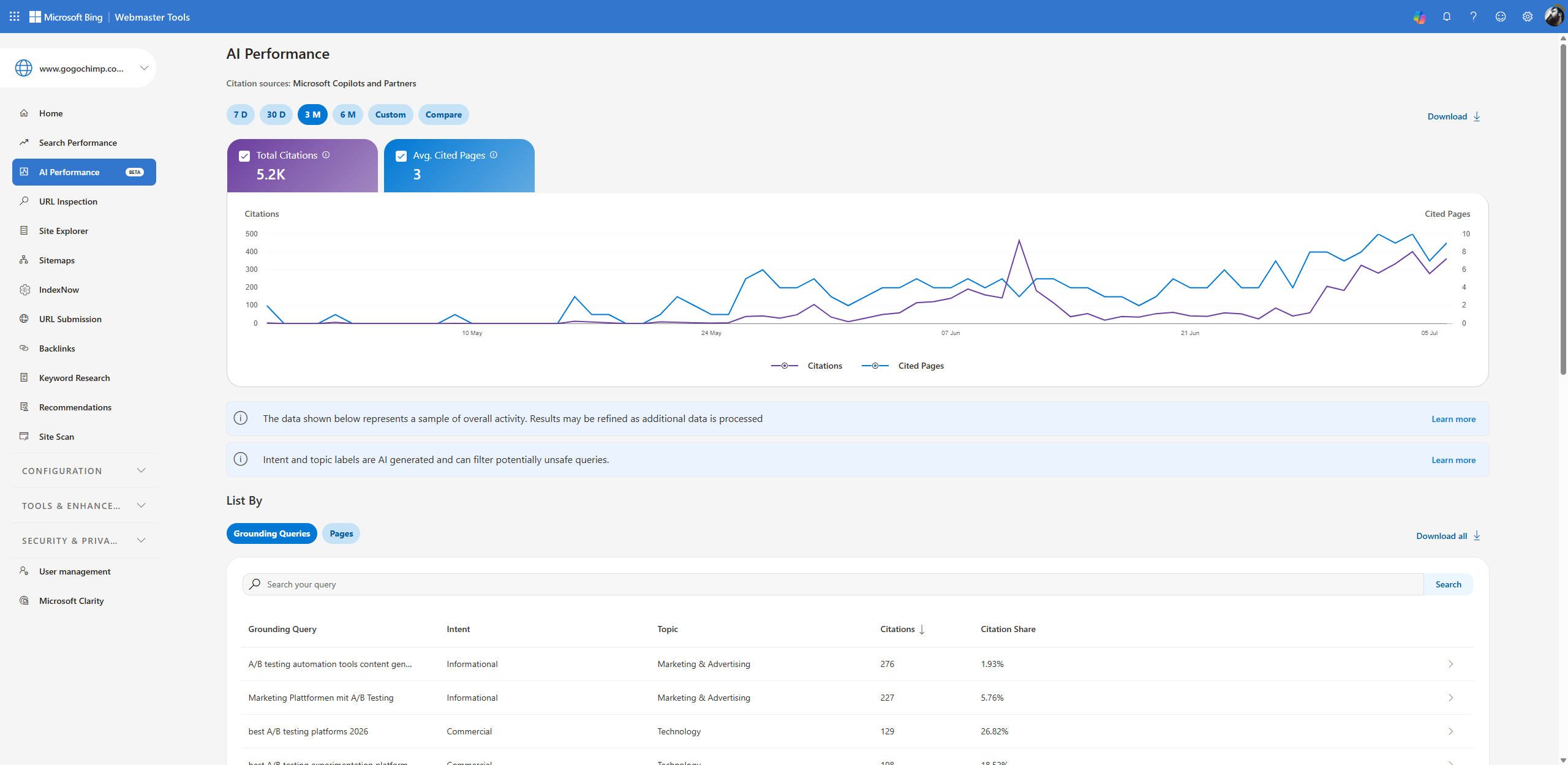
Because ChatGPT Search runs on the Bing index, Bing WMT's AI Performance report is the closest first-party proxy for ChatGPT citation behaviour available to us in 2026. Not identical, but the closest measurement surface any brand can access without paying for third-party tooling. GoGoChimp's own 90-day reading (2026-07-01 snapshot) showed 6,700 Copilot citations across 15 pages, 111 unique grounding queries, and 87.25% concentration in three listicle pillars.
The trajectory has since accelerated to roughly 5,250 total Copilot citations since late April and a sustained 279 to 402 per day for the first week of July (verified 2026-07-08). Claim BWT, submit your sitemap, review weekly.
Third-party AI citation trackers
Profound (enterprise pricing, not published), Ahrefs Brand Radar (part of Ahrefs subscription from around £85/month for Lite), Otterly, Peec AI, and a handful of newer AI-visibility platforms poll the answer engines directly on named queries and count brand appearances. These are the closest thing to a share-of-voice dashboard the market has produced so far. Trust the direction of movement, not the absolute numbers, because the polling methodology varies between tools and no single vendor's numbers reconcile perfectly with another's.
Session-based tracking in Google Analytics 4
Add ChatGPT (chatgpt.com), Copilot (copilot.microsoft.com), Perplexity (perplexity.ai), and Gemini (gemini.google.com) as referrer sources. Track sessions, engagement rate, conversion rate, and downstream revenue. The referral volume is currently a fraction of Google organic for most brands, but the intent quality is higher: buyers arriving from an AI answer have often already done comparison research, so conversion rates on AI-referred traffic tend to run higher than pure organic.
Manual share-of-voice sampling
Once a fortnight, run your 10-20 target queries through ChatGPT (fresh sessions each time) and count brand appearances. Rand Fishkin's methodology (run the same prompt many times, count percentage of runs your brand appears in) is the discipline. Absolute counts on any single day are noisy; percentages across many runs are stable.
The measurement stack isn't perfect. But it's enough to see whether your content strategy is working. The composite signal (BWT trend line + Profound direction + GA4 referral growth + manual share-of-voice sampling) is more reliable than any single tool alone.
Predictions for ChatGPT ranking 2026-2027
Five dated forecasts.
Prediction 1: ChatGPT's Wikipedia weight will decline as OpenAI diversifies its source pool
Wikipedia is currently 47.9% of top-10 source share and 7.8% of all ChatGPT citations (Profound, 2025). That concentration is a source-diversity risk for OpenAI. Expect ChatGPT to actively downweight Wikipedia in favour of primary-source and academic citations across the next 12-18 months. The competitive implication: over-invested Wikipedia strategies decay; primary-source and named-research strategies compound.
Prediction 2: ChatGPT will introduce a first-party citation dashboard for publishers by end of 2027
Perplexity already runs the Comet Plus Publisher Program with an $42.5 million revenue-share pool (Perplexity, 2026). Google's I/O 2026 disclosure signalled increased publisher-facing tooling for AI Mode. OpenAI will follow. When they do, the current proxy-tool era ends and share-of-voice becomes measurable directly. Position now.
Prediction 3: Session-opener query fit will become the single highest-return GEO tactic
Turn 1 is 2.5x more likely to trigger ChatGPT citations than turn 10 (Profound, February 2026), and the finding is under-appreciated in the wider GEO literature. As the field matures, brands that consciously target session-opener intent will systematically out-cite brands optimising for the head-query surface alone. This is the arbitrage window between now and when everyone realises the mechanic.
Prediction 4: ChatGPT will cite brands more often by end of 2027
Brand citation on ChatGPT is low today. Superlines' 30-day tracking of its own brand found a 0.59% citation rate on ChatGPT (Superlines, 2026), a floor set by conservative citation attribution. As publisher-revenue alignment programmes launch and citation attribution becomes economically motivated, expect the rate to climb. This is the flip side of prediction 2.
Prediction 5: Grade 8-10 reading level will remain the citation ceiling for the foreseeable future
The 67% citation rate at grade 8-10 versus 18-31% at grade 14+ (Presence AI, 2026) is a structural feature of the models' training corpora, not a tunable parameter. Expect the pattern to hold. Brands that write jargon-heavy corporate prose will keep losing citation slots to brands writing plain English.
FAQ
How do I get cited by ChatGPT?
Match the retrieval mechanics. Build a Wikipedia entity anchor if you can pass WP:N notability. Ship earned media at a cadence. Publish long-form pillar guides with statistical density and inline hyperlinked citations. Refresh dated content quarterly. Build sitewide entity coverage. Measure with Bing WMT plus session-based tracking. ChatGPT often cites nothing: in the US, 48% of its answers had no citation in March 2026, before citations rebounded in May (seoClarity, 2026). So every citation slot carries disproportionate weight.
What percentage of ChatGPT responses cite sources?
It swings month to month. seoClarity's tracking found the share of US ChatGPT answers with no citation doubled from 28% to 48% in March 2026, then citations rebounded toward earlier levels in May (seoClarity, 2026). But when ChatGPT does cite, it averages 15 sources per response (Semrush, 2026), five times what Gemini pulls in on the same prompts. Perplexity, by comparison, is built to cite and shows numbered sources in its answers.
What does ChatGPT's citation corpus look like?
Wikipedia is 47.9% of top-10 source share and 7.8% of all ChatGPT citations (Profound, 2025). .com domains are 80.41% of all citations; .org is 11.29%; .uk is just 2.16%. Mainstream news, primary research, and long-form pillar content fill out the remainder. Perplexity's Reddit-heavy corpus (46.7% top-10 share) is the mirror opposite.
How do I rank in ChatGPT search specifically?
ChatGPT Search runs on the Bing index. Being indexed by Bing is a prerequisite. Claim Bing Webmaster Tools, submit a sitemap, check indexation coverage. Then optimise for the same signals Copilot rewards: best-of listicles with semantic HTML tables, definitional pillars with answer capsules, statistical density, inline citations, named-author bylines. GoGoChimp's /blog/best-ab-testing-tools-2026 earned 1,500 Copilot citations in 90 days on that formula (Bing WMT AI Performance report, verified 2026-07-11).
Why are opening questions 2.5x more likely to trigger ChatGPT citations?
Opening questions send ChatGPT to the web far more often than follow-ups do. Profound analysed about 700,000 ChatGPT conversations and found turn 1 was 2.5x more likely to trigger citations than turn 10 (Profound, February 2026). Profound thinks the cause is the type of question. Opening questions often need facts, such as what something is or how it works. Follow-ups tend to be clarifications or creative tasks that need no fresh web data. Being the answer to the first question puts you where the citations are.
How long does it take to get cited by ChatGPT?
Faster than traditional SEO. Well-structured pillars often earn first AI citations inside 30-60 days of publish. The GoGoChimp listicle earning around 1,500 Copilot citations took roughly 90 days to reach that citation frequency from first publish. Earned-media placements typically enter the retrieval pool within 4-8 weeks of the original publication date.
Do I need Wikipedia coverage to get cited by ChatGPT?
No, but it's the highest-return single tactic if you can pass WP:N notability. Wikipedia is 47.9% of ChatGPT's top-10 source share. Without Wikipedia coverage, you're competing for the remaining 52.1% of top-10 share against every other unsourced brand. If you have multiple independent, reliable, non-promotional secondary sources already covering you, pursue Wikipedia. If not, invest in earned media first.
How do I measure ChatGPT citations without a first-party dashboard?
Stack four measurement surfaces. (1) Bing Webmaster Tools' AI Performance report as the free first-party proxy (ChatGPT Search runs on the Bing index). (2) A third-party AI citation tracker (Profound, Ahrefs Brand Radar) for cross-engine coverage. (3) Google Analytics 4 with ChatGPT and Copilot added as referrer sources. (4) Manual share-of-voice sampling: run 10-20 target queries fortnightly, count brand appearances across many runs. No single tool is authoritative; the composite signal is reliable.
Does GoGoChimp's Copilot data tell us anything specific about ChatGPT?
Directly: yes. ChatGPT Search runs on the Bing index, and Microsoft Copilot runs on the same infrastructure. Our 6,700-citation Bing WMT footprint over the 90 days ending 2026-07-01, now grown to roughly 5,250 total citations at a sustained 279 to 402 per day the first week of July (verified 2026-07-08), is the closest first-party proxy for ChatGPT retrieval behaviour that any GoGoChimp asset generates.
The 73:1 ratio of Bing citations to Google organic clicks demonstrates the citation-vs-ranking gap on the exact retrieval surface ChatGPT Search uses.
Why does ChatGPT cite my competitor and not me?
ChatGPT decides what to cite in two separate steps. First it retrieves passages from its live index. Second it names the entities it already recognises from its training corpus, where Wikipedia is 47.9% of top-10 source share (Profound, 2025).
That is why your comparison page can be the cited source while a competitor gets named as the recommendation, especially if the competitor holds the stronger Wikipedia or earned-media entity or you positioned them above yourself inside your own page. The fix is two-layered: rank yourself first inside your own comparison tables and make your entry the most extractable, and long-term close the entity gap on Wikipedia, Wikidata, and mainstream news.
What content format has the highest ChatGPT citation rate?
Best-of listicles with semantic HTML comparison tables lead the volume side of the surface. Wikipedia entries lead the trust-weight side. Long-form pillar guides with statistical density and inline citations lead the sustained-authority side. Comparison and definitional formats consistently out-cite generic how-to content across arXiv AI citation research and our own footprint. Nearly four in five pages cited by ChatGPT include at least one list, against 28.6% of Google's top results for the same queries (AirOps, 2025).
Why is ChatGPT's brand citation rate so much lower than Perplexity's?
ChatGPT's citation attribution behaviour is more conservative than Perplexity's by design. Perplexity is built to cite, while ChatGPT often cites nothing. In one brand's 30-day tracking across 34,234 AI responses, ChatGPT gave it a 0.59% citation rate against 13.05% on Perplexity (Superlines, 2026). The trade-off: rare ChatGPT citations carry heavier authority weight per surface than frequent Perplexity citations.
What should I ship this week if I want ChatGPT citations by end of Q3?
Five practical actions. (1) Claim Bing Webmaster Tools and submit a sitemap if you haven't. (2) Add a 40-60 word answer capsule directly under the H1 on your top 5 pages. (3) Ship FAQPage schema on those 5 pages with 10+ questions each. (4) Add a semantic HTML comparison table to any listicle or comparison post that doesn't already have one. (5) Update the "last modified" date and refresh statistics on any pillar over 60 days old.
These five actions cover the highest-lift ChatGPT SEO signals per hour of effort measurable in 2026.
Where to go next
If your buyers are asking ChatGPT questions about your category and your brand isn't in the answer, the first move is diagnostic, not tactical. Open Bing Webmaster Tools' AI Performance report on your own domain. Count the citations. See which pages are earning them and which aren't. If the answer is "zero", check indexation status on Bing first. If the answer is "some, but concentrated in the wrong pages", audit the top 5 by format against the 7-step playbook above.
Then ask the harder question: if a buyer in your category opens a fresh ChatGPT session tomorrow morning and types their first question, whose page gets cited in the answer?
If it isn't yours, you now know what the work is.
Our definitive 2026 GEO reference is the wider companion pillar. Our 2026 guide to schema markup for AI SEO covers the JSON-LD blocks worth shipping. Our AI CRO pillar is the conversion layer that turns AI-search referrals into revenue once you start earning citations.
For the answer-engine-specific subset covering Google featured snippets, Bing quick answers, and the Perplexity direct-answer surface, see our answer engine optimisation guide. For the multi-engine playbook that covers Copilot, Perplexity, and Google AI Overviews together, see our AI search optimisation guide. For the four-acronym breakdown showing where SEO, GEO, AEO, and AIO sit relative to each other, see GEO vs SEO vs AEO vs AIO.
And for the Google-specific playbook on featured snippets, PAA, and AI Overviews, see How to rank in Google AI Overviews.
How do I know if this is working for me?
Rubric scores every page on the signals ChatGPT retrieval actually looks at: answer-first structure, entity clarity, render parity, information gain. It calibrates against real Copilot citation data on your own site. Six engines scored separately. Full disclosure: I built it.
References
- Ahrefs. (2026). An Analysis of AI Overview Brand Visibility Factors (75K Brands Studied). https://ahrefs.com/blog/ai-overview-brand-correlation/
- AirOps. (2025). Why Ranking on Page One Isn't Enough. https://www.airops.com/report/structuring-content-for-llms
- Averi. (2026). ChatGPT vs. Perplexity vs. Google AI Mode: The B2B SaaS Citation Benchmarks Report. https://www.averi.ai/how-to/chatgpt-vs.-perplexity-vs.-google-ai-mode-the-b2b-saas-citation-benchmarks-report-%282026%29
- Baker, L. (2026, 7 July). SEO Study: 5 Lessons From Running AI Agents Across Every Search (Writesonic research). Search Engine Journal. https://www.searchenginejournal.com/seo-study-5-lessons-from-running-ai-agents-across-every-search/581663/
- Brassell, N. (2026, 3 September). What AI Actually Cites for B2B Evaluation Stage Prompts. Ten Speed. https://www.tenspeed.io/blog/what-ai-cites-b2b-evaluation-stage
- Conductor. (2026). The 2026 AEO / GEO Benchmarks Report. 13,770 domains, 3.3 billion sessions. https://www.conductor.com/academy/aeo-geo-benchmarks-report/
- Firecrawl. (2026). Best Chunking Strategies for RAG (and LLMs) in 2026. https://www.firecrawl.dev/blog/best-chunking-strategies-rag
- Gandhi, M. (2026, updated 19 June). Tracking the Volatility of ChatGPT's Citations: A Global Trend Analysis. seoClarity. https://www.seoclarity.net/chatgpt-citation-decline-analysis
- Gartner. (2025). B2B Buyer Behaviour Research. https://www.gartner.com/en/newsroom
- GoGoChimp. (2026). Bing Webmaster Tools AI Performance Report (verified 2026-07-11, 90-day window). Internal data. https://www.gogochimp.com
- Muck Rack. (2026). What Is AI Reading? May 2026 Edition (25 million-link analysis). https://muckrack.com/blog/what-is-ai-reading-may-2026
- OpenAI. (2025). Introducing ChatGPT Search. https://openai.com/index/introducing-chatgpt-search/
- Perplexity. (2026). Introducing the Perplexity Publishers' Program. https://www.perplexity.ai/hub/blog/introducing-the-perplexity-publishers-program
- Presence AI. (2026). 2026 GEO Benchmarks Report: AI Search Traffic Statistics & Trends. https://presenceai.app/blog/2026-geo-benchmarks-ai-search-traffic-statistics
- Princeton University. (2024). GEO: Generative Engine Optimization. https://arxiv.org/abs/2311.09735
- Profound. (2025). AI Platform Citation Patterns 2025-2026. https://www.tryprofound.com/blog/ai-platform-citation-patterns
- Profound. (2026). How ChatGPT sources the web. Brandon Punturo, 3 February 2026. https://www.tryprofound.com/blog/chatgpt-citation-sources
- Seer Interactive. (2026). AIO Impact on Google CTR: 2026 Update. https://www.seerinteractive.com/insights/aio-impact-on-google-ctr-2026-update
- Semrush. (2026). Semrush Releases Expanded 2026 AI Visibility Index, Analyzing 126 Million AI Search Prompts. https://www.semrush.com/news/463141-semrush-releases-expanded-2026-ai-visibility-index-analyzing-126-million-ai-search-prompts/
- Similarweb. (2026). ChatGPT Users: OpenAI Growth Statistics. https://www.similarweb.com/blog/insights/chatgpt-users-openai/
- SparkToro. (2026). NEW Research: AIs are highly inconsistent when recommending brands or products. https://sparktoro.com/blog/new-research-ais-are-highly-inconsistent-when-recommending-brands-or-products-marketers-should-take-care-when-tracking-ai-visibility/
- Superlines. (2026). AI Search Statistics 2026: 60+ Data Points on Visibility, Citations, and Traffic. https://www.superlines.io/articles/ai-search-statistics/
- Wikipedia. (2026). Wikipedia:Notability (WP:N). https://en.wikipedia.org/wiki/Wikipedia:Notability
.png)
Free chapter
Read Chapter 1 of CITED, free.
The playbook for getting your business recommended by ChatGPT and AI search. Read the first chapter, on me.
Read Chapter 1 freeWant us to do this for your site?
Book a free AI audit. 15 minutes. We’ll show you three things your site is missing and what we’d test first.
Book my free AI audit →