AI Search Optimisation Guide: How to get content ranking on ChatGPT, Perplexity, Gemini, Copilot in 2026
AI SEO

How to optimise for AI search in 2026: treat ChatGPT, Perplexity, Google AI Overviews, and Microsoft Copilot as four separate retrieval systems. Only 11% of domains are cited by more than one engine, and citation volume varies 615x between platforms. Ship a shared discipline (answer capsules, HTML tables, third-party citations) plus engine-specific overlays, and measure with Bing Webmaster Tools first.
You're here because someone told you "AI search is the new SEO" and you want to know what to actually do about it. Fair enough. The short version is that there's no such thing as "AI search" as a single channel. There are four dominant engines in 2026, they cite almost completely different pages, and the strategy that wins one can actively lose the others.
If your reaction to that sentence is "so I'll just optimise for all four", stop reading here. The rest of this is for the ones who have already tried and noticed nothing overlaps.
Thirteen years of running conversion work sits behind every number in this piece. For the last 90 days, our own site earned 6,700 Microsoft Copilot citations against just 82 Google organic clicks in the same window. That's 73 Bing citations for every 1 Google click. The pages Copilot cites are not the pages Google ranks. The queries Copilot grounds on are not the queries ChatGPT surfaces.
This guide is the multi-engine playbook we ship to clients, built on our own first-party data and the sharpest cross-engine research public in 2026.
The multi-engine playbook below sits inside a wider discipline. For the three-pillar framework (Discovery, Retrieval, Citation) and the six-move sequence that produced 5,600 Bing Copilot citations across three months on our own footprint, see our AI SEO pillar.
Why single-engine optimisation fails
Most GEO advice is written as if there's one AI search engine. There isn't. There are at least five that matter commercially in 2026 and the citation graph across them is almost completely disjoint.
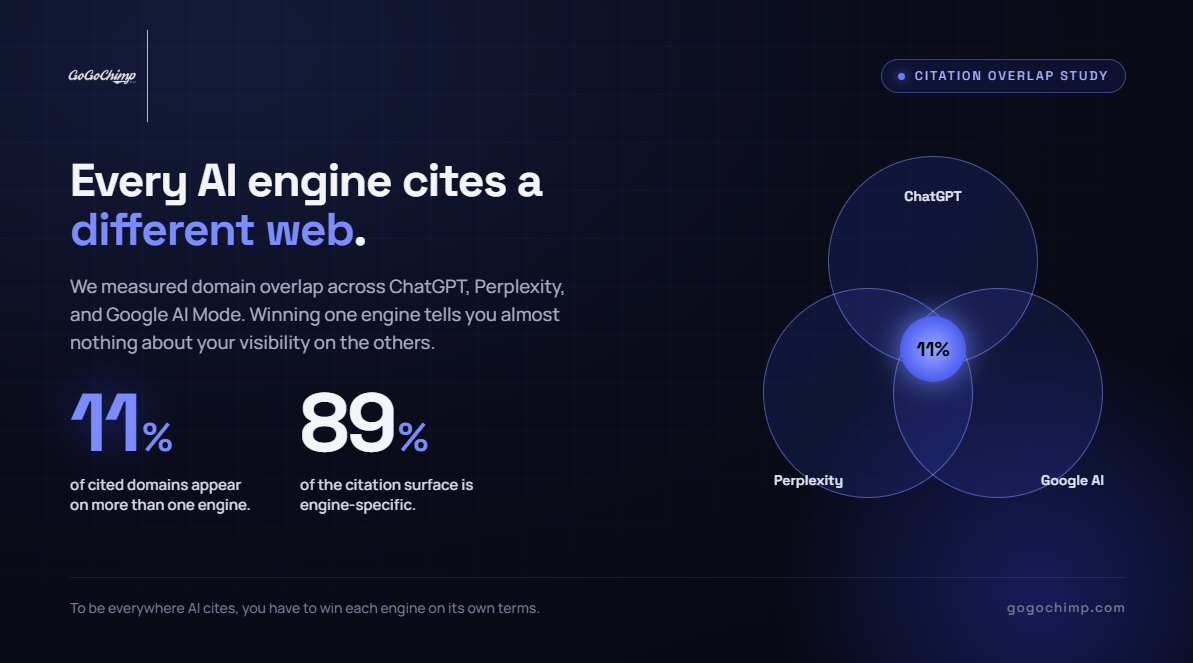
The single sharpest piece of evidence: Averi's 2026 B2B SaaS citation benchmark report measured domain overlap across ChatGPT, Perplexity, and Google AI Mode. Only 11% of cited domains appear on more than one engine. 89% of the citation surface is engine-specific. Winning one engine means almost nothing about your visibility on the others.
The variance runs deeper still. Superlines' March 2026 analysis documented a 615x citation volume variance between platforms for the same brand. Same brand, same queries, wildly different visibility. A B2B tool that dominates Grok can be effectively invisible on Claude. A DTC brand that owns Perplexity can be nowhere on ChatGPT. This isn't a rounding-error gap. It's a two-orders-of-magnitude gap.
Across GoGoChimp's own 90-day Bing Webmaster Tools reading (verified 2026-07-11), 87.25% of our 6,700 Microsoft Copilot citations concentrate in three listicle pages. Our top Google Search Console pages and our top Bing Copilot pages are almost completely disjoint. The pages Google impresses on are not the pages Copilot cites. Cross-engine overlap on our own site tracks the Averi 11% finding at the individual-page level.
The citation posture also varies. Perplexity is built to cite, with numbered sources in its answers. ChatGPT often cites nothing: in the US, 48% of its answers had no citation in March 2026, before citations rebounded in May (seoClarity, 2026). So a "successful" Perplexity strategy earns a visible citation by design. A "successful" ChatGPT strategy is less certain, and brand citation is lower still: Superlines tracked its own brand and got a 0.59% citation rate on ChatGPT against 13.05% on Perplexity (Superlines, 2026).
Different engines. Different corpora. Different retrieval logic. Different winning formats. Treating them as one is the fastest way to spend 12 months producing generic content that none of them cite.
The four dominant AI-search engines in 2026
Five engines account for essentially all commercially meaningful AI-search citation volume: Microsoft Copilot, ChatGPT, Perplexity, Google AI Overviews plus AI Mode, and the emerging tier (Grok, Claude, DeepSeek, Meta AI). The Generative Engine Optimisation pillar covers each engine's citation posture in full detail. For a multi-engine playbook, four are load-bearing.
For the Google AI Overviews playbook specifically, read our How to Rank in Google AI Overviews reference. It carries the 8-step framework, the 7-factor comparison table, and first-party Bing/GSC data on the click-clawback mechanic.
Microsoft Copilot
is the engine cutting our own path. Native Copilot in Windows, Copilot in Bing, and Copilot for Microsoft 365 share a common retrieval layer. It's the only surface with a free, first-party measurement tool: Bing Webmaster Tools' AI Performance report. Growth trajectory across the last 90 days on our own site: 10 citations/day in early May 2026, 140/day by mid-June, 326 on 1 July alone.
The June 21 single-day peak was 464 citations. Whatever surface changes are happening inside Copilot's retrieval index, the direction is exponential.
ChatGPT often cites nothing, but it has the largest audience. In the US, 48% of its answers had no citation in March 2026, before citations rebounded in May (seoClarity, 2026). When it does cite, the corpus is Wikipedia-heavy: 47.9% of ChatGPT's top-10 source share is Wikipedia, and Wikipedia is 7.8% of all ChatGPT citations. Winning ChatGPT means winning at the corpus level, not the page level.
Perplexity is the most citation-forward engine of the four, built to cite with numbered sources in its answers, and it has a Reddit-dominant retrieval bias. 46.7% of Perplexity's top-10 source share is Reddit. Winning Perplexity is a Reddit strategy. Not a metaphor, the literal tactic.
Google AI Overviews plus AI Mode
is the largest volume opportunity by scale. Google confirmed at I/O 2026 that AI Mode has crossed one billion monthly users and queries are more than doubling every quarter. Dominant sources: Reddit at 21% of AIO top-10 source share, YouTube at 18.8% (Profound, 2025). Winning AIO rewards classical SEO discipline plus a small set of GEO overlays.
The emerging tier (Grok, Claude, DeepSeek, Meta AI) is where the 615x variance really lives. Individually, each has smaller volume than the top four. Collectively, they matter because a brand can dominate one of them without touching the others. Pick one to cover deeply based on where your buyers already are. Don't try to cover all four.
The engines compared
The table below is the most useful summary I can give you. Every axis matters. Every winning tactic differs.
| Axis | Microsoft Copilot | ChatGPT | Perplexity | Google AI Overviews | Winning tactic |
|---|---|---|---|---|---|
| Citation rate | High (semantic-table lifts) | Often none: 48% of US answers had no citation in March 2026, before a May rebound (seoClarity, 2026) | Built to cite (numbered sources in its answers) | Links its sources inside the Overview | Match the engine's citation posture, don't fight it |
| Dominant source | Best-of listicles with HTML tables | Wikipedia (47.9% top-10 share) | Reddit (46.7% top-10 share) | Reddit 21% + YouTube 18.8% | Publish in the format the engine's retriever prefers |
| Query surface | Commercial + Research (72% of top 25) | Session-opener knowledge queries | Comparison + evaluation questions | Broad, matches Google intent | Write for the query shape the engine attracts |
| Format bias | Semantic HTML tables, comparison listicles | Long-form definitional + Wikipedia-anchored | Threaded discussion, direct-answer + citation blocks | Structured content + video + third-party trust signals | One engine, one format focus per production sprint |
| Measurement tool | Bing WMT AI Performance (free, first-party) | Profound / Ahrefs Brand Radar (paid, proxy) | Profound / Perplexity Publisher Program (paid + revenue share) | GSC + AIO impression segments (partial), Profound (paid) | Start with Bing WMT, expand to Profound at scale |
Read this table twice. There is no cell where the winning tactic for one engine matches the winning tactic for another. That's not a design flaw of AI search. It's a design fact. Four engines, four playbooks, one shared discipline underneath.
The shared discipline: what every engine rewards
Before the engine-specific overlays, there's a shared layer. Every AI-search engine we measure rewards this discipline regardless of quirks. Skip it, and no per-engine tactic will save you.
The shared discipline overlaps with the Answer Engine Optimisation reference. On the crawler-signal layer, our llms.txt explainer covers the emerging robots-style file for LLM crawlers.
Answer capsules under every H1 and H2
The Princeton GEO study found quotations lift AI citation likelihood by 41%, statistics by 32%, and inline citations by 30%. A 40-60 word standalone summary passage directly below the heading is the highest-lifting structural pattern in the study. LLMs preferentially extract these for verbatim quoting. Make each capsule definitional, specific, and standalone. Contain the primary keyword, the entity you want cited, and one hard number.
Semantic HTML tables, not markdown pipes
Retrieval layers extract semantic <table> markup with <thead> / <tbody> / <th> / <td> cleanly. Markdown pipes rendered as prose don't extract at the same fidelity. Every comparison, every listicle, every "best of" post needs a semantic HTML table near the top with 4-6 axes filled for every row.
Third-party citations inside body prose
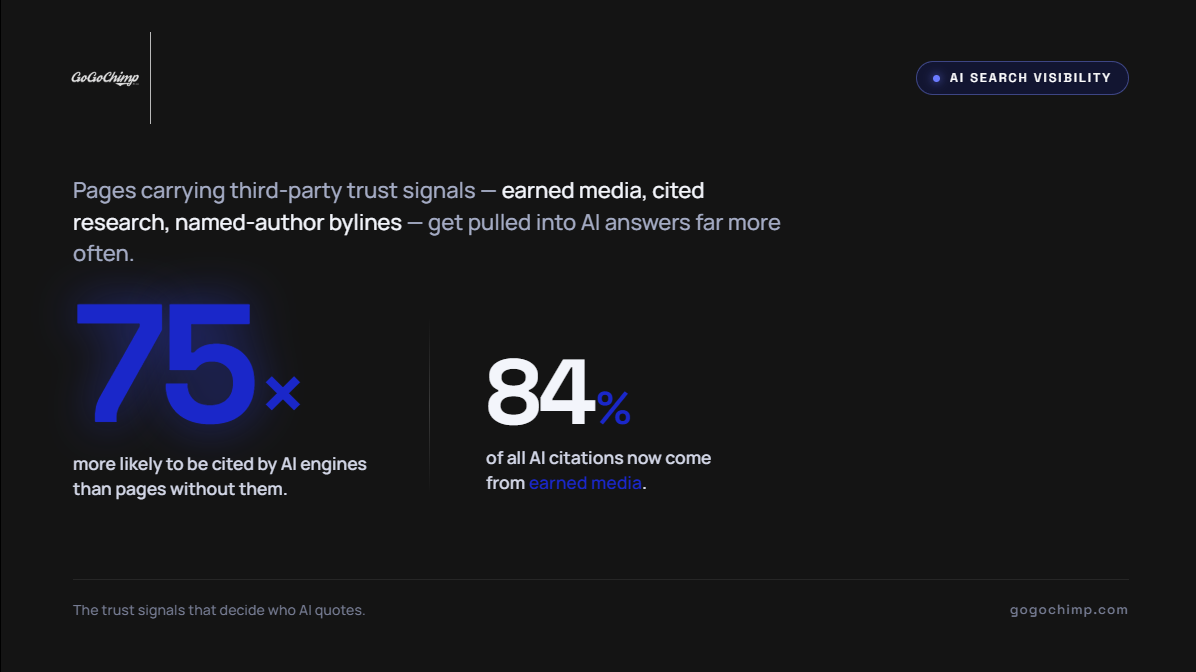
The Muck Rack + Seer 25M-link study found pages carrying third-party trust signals are cited by AI engines up to 75 times more often than pages without them. Earned media accounts for 84% of AI citations. Inline hyperlink every numerical claim, every named study, every third-party stat. This isn't academic pedantry. It's the signal the retrieval layer uses to decide whether your page is a trustworthy citation target.
Update, September 2026: third-party sources dominate AI citations overall, but the picture flips at B2B evaluation. Across AI search as a whole, 96% of citations point to third-party sources, up from about 80% a few months earlier (Writesonic via Search Engine Journal, 2026). Nelson Brassell's study for Ten Speed, 7,387 citations across 170 B2B evaluation-stage prompts measured through Peec AI, found the opposite: 88.3% of citations at evaluation come from pages the brand controls, with product pages the most cited type at 24.1%, articles at 17.4%, comparison content at 13.3% and listicles at 13.2% (Ten Speed, 2026). Citations look completely different at the top and bottom of the funnel. Always say which stage you mean.
FAQ blocks with FAQPage schema
LLM retrieval loves the FAQ format because it's pre-decomposed into query-answer pairs, which is exactly the shape the retriever wants. 6-10 questions per pillar, each answered in 40-60 words, each phrased the way a real user would type it. Wrap the block in FAQPage schema so the extractor can parse without heuristics.
Named-author bylines with Person schema
The retriever isn't just reading your page. It's reading the entity graph around it. Consistent Person schema for the author on every post. Consistent sameAs URLs (LinkedIn, X, YouTube, Substack). A publisher Organization schema with real NAP and sameAs list. When the retriever asks "who is Chris McCarron", the answer should reconcile across at least eight independent surfaces.
Pages of 2,500-4,000 words are cited at 57-63% frequency across the four dominant engines; pages under 800 words are cited at 3-4%. Content updated inside the last 30 days is cited at 71% frequency; content 1-2 years old drops to 18% (Presence AI 2026 GEO Benchmarks). Long enough to be substantive. Fresh enough to be current. Plain enough to be extractable.
Get this discipline right first. Every engine-specific overlay builds on top of it.
Engine-specific overlays: the per-engine tactics that move the needle
The shared discipline gets you eligible. The per-engine overlays get you cited. Four short sub-sections below, one tactic each that moves the needle.
Copilot: ship the semantic HTML <table> inside the first 40% of the page
Microsoft Copilot's retrieval layer lifts semantic HTML comparison tables into its answer surface almost verbatim. This is the single highest-lifting Copilot-specific tactic we've measured on our own site. Every one of our top three cited pages (/blog/best-ab-testing-tools-2026, /best-cro-agency-uk-2026, /blog/best-heatmap-tools-2026) ships a semantic HTML table with 4-6 comparison axes, one row per item, every cell filled. Between them they earned 3,141 of 6,700 Copilot citations across 90 days.
Rules:
- Place the table inside the first 40% of the page (never below the fold-and-a-half)
- 4-6 comparison axes across the columns, one item per row
- Every cell filled with a real value (no blanks, no
n/awhere a real value could be inferred) - Semantic
<table>/<thead>/<tbody>/<th>/<td>markup, not markdown pipes - Followed by a footnote
<p><em>block explaining any non-obvious axes
Two more Copilot-specific tactics worth naming: verify Bing Places (our own Bing Places listing anchors Copilot's local grounding when it fields a Glasgow CRO query), and use dated titles ("2026", "March 2026") because Copilot's retrieval clearly weights freshness. Our top-cited page carries "2026" in its slug and title. That's not a coincidence.
ChatGPT: build a Wikipedia entity anchor
ChatGPT's retrieval is Wikipedia-weighted at 47.9% of top-10 source share (Profound, 2025). If your brand, methodology, or founder isn't on Wikipedia via legitimate WP:N sourcing, you're competing for the remaining 52% against every other website on the internet.
ChatGPT's retrieval mechanics get the full breakdown in the ChatGPT-specific playbook.
Wikipedia coverage isn't a tactic every brand can execute (the notability bar is high), but for founders and methodologies with genuine independent sourcing behind them it's the highest-lift single move in AI search. The GoGoChimp Wikidata cluster (Chris Q139585911, GoGoChimp Q139585936, The 347 Method Q139695681) is our current anchor here. It took a year to build and one bad Wikipedia deletion cycle to nearly destroy. The work is defensive as much as offensive.
The second-highest lift is mainstream news pickups. Our own recent editorial run (Forbes brand mention May 2026, TechNewsWorld named quote June 2026, TechnologyAdvice Selling Signals June 2026, Leaders Perception named feature June 2026, Shopify Enterprise Blog 11-locale syndication) shows up in ChatGPT's retrieval pool over time. It won't shift citation share inside a week. It compounds over months.
The third: be the answer to a session-opener question. Opening questions in a ChatGPT session are 2.5x more likely to trigger citations than turn-10 questions (Profound, February 2026). Session-opener intent is the highest-value citation slot ChatGPT will surface, and it's the slot most brands are ignoring.
Perplexity: real Reddit participation, not marketing
Perplexity's dominant source category is Reddit at 46.7% of top-10 source share (Profound, 2025). Winning Perplexity means winning at Reddit. Not "content marketing on Reddit". Genuine domain participation, sustained across 12+ months, in the subreddits your buyers actually inhabit.
The tactic:
- Chris uses his real name on r/ecommerce, r/shopify, r/marketing, r/SEO. Not a burner account
- Answer real questions with real detail. Cite your own content only when the thread has already surfaced the question
- Build account age and karma before dropping any link
- Treat Reddit as the primary retrieval corpus for Perplexity, not as a distribution channel
Perplexity is also the only engine currently running a real revenue-share programme with publishers: the Comet Plus Publisher Program allocates a $42.5 million pool with an 80/20 revenue split favouring publishers whose content gets cited. Long term, expect other engines to follow. For now, Perplexity is the only one paying publishers directly for citation weight.
Google AI Overviews: YouTube plus written content pairing
Google AI Overviews and AI Mode reward YouTube heavily (18.8% of AIO top-10 source share is YouTube per Profound, 2025) alongside Reddit (21%) and classical SEO signals. Because Google owns both YouTube and AIO, a YouTube video that answers the same question your written pillar answers is a double-dip citation opportunity.
Google AI Overviews and AI Mode get their own reference with the 7-factor comparison table.
The tactic:
- Publish written pillar plus a YouTube video answering the same question
- Cross-embed the video inside the written pillar (per our standing instruction on YouTube embeds)
- Use the same title and answer capsule across both
- The AIO retriever can lift the passage from your written content and cite the video simultaneously
Layer that on top of the classical SEO stack (real backlinks, real E-E-A-T signals, real on-page depth, HCU-era quality signals) and you cover more of the AIO citation surface than a single-format content strategy can.
The multi-engine framework: sequencing work when you can only afford one channel at a time
Most brands can't afford to work all four engines at once. Nor should they. The 615x citation variance and 11% domain overlap tell you cross-engine wins compound slowly. Single-engine wins compound fast. The sequencing question is which engine to work first.
The sequencing rule: pick the engine where the measurement is free, the retrieval is thin, and the buyer intent is highest. For most B2B brands in 2026, that's Microsoft Copilot.
Copilot has:
- Free first-party measurement via Bing Webmaster Tools' AI Performance report
- A thinner retrieval index than Google AIO (fewer competitors dominating the citation share)
- A commercial-heavy query mix (32% of our top 25 grounding queries carry buyer intent)
- A rewarding format signal (semantic HTML tables, best-of listicles) that's cheap to produce
The four-engine sequencing framework
- Month 1-3: Microsoft Copilot. Ship 3-5 best-of listicles with semantic HTML tables in your primary vertical. Claim Bing Webmaster Tools. Verify Bing Places. Measure weekly.
- Month 4-6: Google AI Overviews. Layer YouTube video pairing onto your top 3 cited pieces. Add FAQ blocks with FAQPage schema. Watch GSC AIO impression segments if available.
- Month 7-12: ChatGPT. Pursue mainstream news pickups (HARO, Featured, direct pitches). Wikipedia entity anchor if the notability bar is defensible. This is compound work with a long lag.
- Month 12+: Perplexity + emerging tier. Real Reddit participation from a real account in your buyer subreddits. Pick one emerging-tier engine (Grok / Claude / DeepSeek / Meta AI) based on where your buyers already are.
The order matters. Copilot pays back fastest. Perplexity requires the longest account-age investment before it pays back at all. Sequencing the other way around burns 12 months on Reddit before you have any measurable data on what's working.
Cross-engine work costs roughly 4x the effort of single-engine work for 2x the reach, not 4x. Sequence one engine first. Get the discipline right. Then expand. The brands losing AI search in 2026 are the ones trying to cover all four at once.
Format across engines: what travels vs what's engine-specific
Some formats travel across engines. Others are engine-specific. Knowing which is which saves you from producing content that only works on one surface.
Formats that travel (win multiple engines)
- Best-of listicles with semantic HTML tables. #1 cited format across arXiv research, our own Bing WMT data, and cross-engine studies. Wins Copilot heavily. Wins AIO substantially. Wins Perplexity via comparison-intent queries. Loses ChatGPT (which prefers Wikipedia-anchored corpus).
- Definitional pillar guides. 3,000+ word reference pieces with answer capsules, table of contents, FAQ blocks. Wins ChatGPT (long-form + citation-density signals). Wins AIO. Wins Copilot when paired with dated titles. Mixed on Perplexity.
- Head-to-head comparison posts. "X vs Y" content with clear recommendation. Wins Copilot + AIO + Perplexity comparison intent. ChatGPT hit-or-miss.
Formats that are engine-specific:
- Wikipedia entity anchors. ChatGPT only. The other engines don't weight Wikipedia at the same 47.9% dominance.
- Reddit AMA + thread participation. Perplexity primarily. Some AIO overflow. Not Copilot. Not ChatGPT directly.
- YouTube video pairing. AIO primarily (18.8% share). Some ChatGPT surface via video transcript. Not Copilot in the retrieval layer. Not Perplexity meaningfully.
- Case studies with named clients + specific outcome numbers. B2B brand-mention signal across all four, but the retrieval weight varies. Copilot lifts these into answers when a query is about a specific vendor. ChatGPT rarely.
The takeaway
best-of listicles with HTML tables plus definitional pillars are the two formats to lead with when you can't afford engine-specific bets. Everything else is a per-engine investment.
Real examples: two GoGoChimp pages, two multi-engine shapes
Two of our own pages illustrate the multi-engine reality at the individual-page level.
Example 1: /blog/best-ab-testing-tools-2026 earned 1,500 Bing Copilot citations over 90 days (the most-cited page in our footprint). Google Search Console impressions on the same page across the same window: 818. That's a 1.83:1 Copilot-to-Google-impression ratio. On the Copilot side, this page is our top single asset. On the Google side, it's a mid-tier page ranking outside the top 10 on its primary query. Same page. Two entirely different visibility outcomes. Format: 12-item best-of listicle with a semantic HTML table near the top and dated title.
Example 2: /best-cro-agency-uk-2026 earned 1,200 Bing Copilot citations over 90 days. Google organic clicks on the same query in the same window: 1. That's a 1,200:1 Bing-to-Google ratio. This page ranks Google position 22.4, well outside the top 10.
Yet it's the second most-cited page in our footprint and it wins a 62.75% Copilot citation share on "best Shopify CRO agencies UK" (the single highest-share query in the Bing WMT report). Format: 12-agency listicle with a semantic HTML table, an FAQ block, and third-party citations throughout.
The pattern is consistent. Both pages are best-of listicles. Both ship semantic HTML tables inside the first 40% of the page. Both carry dated titles. Both cite third-party research inline. Both rank outside Google's top 10 and are Copilot's favourite pages on our site. That's the multi-engine shape a single-format investment produces: dominant on one engine, moderate on another, negligible on a third. Trying to be dominant on all four with the same page is the trap.
Measurement across engines
The measurement stack across four engines has one free tier and one paid tier.
Free tier (start here)
- Bing Webmaster Tools AI Performance report (bing.com/webmasters/aiperformance). First-party citation data from Microsoft. Per-page, per-query, per-day. Confound-free. The only surface where you can see which of your pages Copilot actually cites, on which queries. If you're serious about AI search measurement and you haven't claimed Bing Webmaster Tools, that's the first task today.
- Google Search Console (search.google.com/search-console). The AI-Overview-specific impression segment shows in GSC where AIO fires on queries you're already ranking on. Not full AIO citation data, but a workable proxy.
- GA4 referrer segments. Segment by referrer domain to isolate traffic from
chatgpt.com,perplexity.ai,gemini.google.com,copilot.microsoft.com, andbing.com. Volumes are still small in 2026, but the growth curves matter.
Paid tier (scale from here):
- Profound (tryprofound.com). Cross-engine citation tracking across ChatGPT, Perplexity, Gemini, Google AI Overviews, and Copilot. Query-level share-of-voice. The most complete cross-engine surface currently commercial.
- Ahrefs Brand Radar. AI-mention tracking across the top engines. Weekly deltas. Good for defensive monitoring of a brand's presence.
- Perplexity Publisher Program (perplexity.ai/hub/publishers). 80/20 revenue share on Perplexity-cited content. First-party, if you qualify.
The single caveat everyone should know: Rand Fishkin's SparkToro / Gumshoe study ran 12 prompts through ChatGPT, Claude, and Google AI 2,961 times across 600 volunteers. ChatGPT and Google AI Overviews returned the same brand list less than 1% of the time. The same list in the same order less than 0.1% of the time. Tracking a single query on a single day means nothing.
What holds up under statistical scrutiny is visibility percentage: how often your brand appears across many runs of similar prompts. Measure share, not rank.
The measurement gap is also the biggest single lever nobody talks about. Semrush's 2026 AI Visibility Index (126 million US AI-search prompts) found 45% of marketing leaders can't measure their brand's visibility in AI-generated answers, and only 9% have the tools to track it across platforms. Among teams that fully integrate SEO and AI visibility into one workflow, 81% report increased traffic or leads from AI platforms.
Among teams managing the two separately, 36%. That's a 45-point gap driven by whether the same team owns both.
Common mistakes: 8 anti-patterns of trying to unify what shouldn't be unified
Every one of these mistakes is the same underlying error: treating four different retrieval systems as one channel.
- Publishing one long "AI search strategy" pillar and expecting it to rank on all four engines. It won't. The retrieval mechanics reward different signals. One page can dominate one engine and be invisible on three.
- Optimising for ChatGPT first. ChatGPT has the largest audience and the hardest citation entry bar. Every engine is easier to win first. Copilot is easiest by a wide margin.
- Ignoring Bing Webmaster Tools because "Bing is small". Bing powers Microsoft Copilot's grounding layer. That's 6,700 citations to us in the last 90 days. Small share of search != small share of AI answers.
- Building "one AI search dashboard" in GA4. Different engines send referrer traffic at wildly different scales. A unified dashboard flattens the signal. Segment by engine.
- Chasing backlinks as the primary GEO signal. Ahrefs studied 75,000 brands across 76 million AI Overviews and found brand mentions correlate with AI citation probability at 0.664 versus 0.218 for backlinks. That's a 3x correlation gap. Mentions beat links, mathematically, at the specific job GEO is trying to do.
- Treating Reddit as a distribution channel. Perplexity's retriever weights genuine Reddit conversation, not marketing copy dropped into threads. Real accounts, real answers, sustained participation. Or don't bother.
- Publishing without semantic HTML tables in comparison / listicle content. Comparison and listicle posts without a semantic HTML table fail the extract-for-AI-citation baseline. Adding the table flips them to PASS. This is the single lowest-effort, highest-lift structural change in AI search work in 2026.
- Waiting for "AI search to stabilise" before starting. The citation curve is still exponential on our own site (10 citations/day in May 2026 to 326 on 1 July). The brands starting now are entering the citation graph while the space is still growable. The brands waiting are handing 12-18 months of compound citation growth to whoever moved first.
Predictions for cross-engine strategies 2026-2027
Three predictions about how multi-engine AI search will shift over the next 18 months. Each is grounded in what we've seen and what the public research surfaces.
Prediction 1: The 11% cross-engine overlap will fall to 5-8%, not rise
The engines are training on increasingly differentiated corpora. Perplexity is doubling down on Reddit. ChatGPT is doubling down on Wikipedia. Copilot is doubling down on Bing's own index. Google AIO is doubling down on YouTube plus its search graph. The differentiation is a feature, not a transition state. Expect the overlap to narrow, not widen.
Prediction 2: Copilot's citation volume will overtake AIO citation volume for niche B2B brands by mid-2027
Our own trajectory (10 citations/day to 326/day in eight weeks) suggests Microsoft's grounded-search push into Copilot is scaling faster than Google's AIO expansion for narrow B2B verticals. That's a specific claim, and it won't hold for consumer brands or high-volume commodity queries. But for B2B agencies, SaaS tools, and specialist services, Copilot will be the dominant citation surface within 18 months.
Prediction 3: A first-party measurement standard will emerge from Google, Anthropic, and OpenAI by end of 2027
Bing WMT's AI Performance report is currently the only first-party measurement tool. The pressure from marketers unable to measure AI visibility (45% per Semrush) is going to force the other engines to ship equivalents. Expect Google to ship an AIO-specific GSC segment first (or expand the existing one), then OpenAI to open a limited developer-tier citation feed, then Anthropic to follow. The paid-tier tools (Profound, Ahrefs Brand Radar) will consolidate or acquire in the same window.
Zooming in: AEO as the answer-shaped subset
Where AI search optimisation covers the wider generative-engine surface, Answer Engine Optimisation (AEO) is the specific discipline for answer-shaped surfaces: Google featured snippets and AI Overviews, Bing Copilot, Perplexity direct answers, ChatGPT synthesis. The AEO operator's guide covers the 6-step framework, the four engines' different retrieval mechanics, structured data (FAQPage / HowTo / DefinedTerm / QAPage), and vertical-specific tactics for ecommerce, SaaS, law, and healthcare.
Zooming in: ChatGPT specifically
ChatGPT is one of the four AI-search surfaces this playbook covers, and it is the hardest. Its retrieval corpus is 47.9% Wikipedia-weighted, and it gave one tracked brand a 0.59% citation rate over 30 days (Superlines, 2026). For the ChatGPT-specific playbook covering Wikipedia entity anchoring, earned media cadence, session-opener queries, and the seven moves that shift the odds, see How to Get Cited by ChatGPT: 2026 Playbook.
FAQ
What is the single biggest difference between optimising for ChatGPT and optimising for Perplexity?
ChatGPT often cites nothing, and its top-10 source share is 47.9% Wikipedia. Perplexity is built to cite, and its top-10 source share is 46.7% Reddit. Winning ChatGPT means Wikipedia + mainstream news. Winning Perplexity means real, sustained Reddit participation. Same query, two different playbooks.
How much do citations overlap across AI search engines in 2026?
Only 11% of domains are cited by both ChatGPT and Perplexity (Averi, 2026). 89% of the citation surface is engine-specific. Cross-engine wins are shaped like format concentrations (best-of listicles with HTML tables) rather than content-volume plays.
Which AI search engine should I optimise for first?
Microsoft Copilot for most B2B brands in 2026. It has free first-party measurement via Bing Webmaster Tools' AI Performance report, a thinner retrieval index than Google AIO, a commercial-heavy query mix (32% buyer intent across our top 25 grounding queries), and a cheap-to-produce rewarding format (semantic HTML tables inside best-of listicles).
How do I measure AI search visibility across ChatGPT, Perplexity, Gemini and Copilot?
Start with the free stack: Bing WMT AI Performance report (first-party Copilot data), Google Search Console (partial AIO data), and GA4 referrer segments. Scale to Profound for cross-engine tracking and Ahrefs Brand Radar for AI-mention monitoring. Measure share across many prompts, not rank on single queries.
What word count wins across all four engines?
Pages of 2,500-4,000 words are cited at 57-63% frequency across the four dominant engines; pages under 800 words are cited at 3-4% (Presence AI 2026 GEO Benchmarks). Content updated inside the last 30 days is cited at 71% frequency; content 1-2 years old drops to 18%. Aim for substantive, current, and plain.
Do semantic HTML tables really matter for AI search?
Yes. Retrieval layers extract semantic <table> markup cleanly. Every one of GoGoChimp's top three cited pages ships a semantic HTML table with 4-6 axes filled for every row. Together they earned 3,141 of 6,700 Copilot citations across 90 days (87.25% concentration). Markdown pipes rendered as prose don't extract at the same fidelity.
How long before AI search work pays back?
Copilot pays back fastest (measurable citation growth in 4-8 weeks on well-formatted best-of listicles). Google AI Overviews takes 3-6 months. ChatGPT takes 6-12 months (Wikipedia + mainstream news are compound plays). Perplexity requires 12+ months of Reddit account age and karma before it pays back at all.
What's the citation rate difference between the four dominant engines?
Perplexity is built to cite. ChatGPT often cites nothing: in the US, 48% of its answers had no citation in March 2026, before citations rebounded in May (seoClarity, 2026). Microsoft Copilot's rate isn't publicly published, but our first-party data shows sustained high-frequency citation on comparison + listicle content. Each engine has a fundamentally different citation posture.
Do I need a separate content strategy for each AI search engine?
Yes and no. The shared discipline (answer capsules, HTML tables, third-party citations, FAQ blocks, named-author bylines) applies to all four. The per-engine overlays diverge sharply. Sequence one engine first. Get the shared discipline right. Layer per-engine overlays on top. Don't try to cover all four at once.
Does Bing Webmaster Tools' AI Performance report cover ChatGPT?
Partially. ChatGPT uses Bing's search index for grounding on certain queries (the "Search the web" tool), so some ChatGPT citations do surface in Bing WMT AI Performance data. But most ChatGPT retrieval runs through its own corpus + Wikipedia weighting, which Bing WMT doesn't cover. For full ChatGPT citation tracking, use Profound.
How much traffic can I realistically expect from AI search referrals?
Traffic is still small in 2026. The value is in the citation itself: being cited inside an AI Overview lifts downstream organic click-through by 35%, and cited brands get 120% more organic clicks per impression than uncited brands (Seer, 2026). AI search is a click-clawback mechanism inside the answer surface, not a direct-traffic channel yet.
What role does Reddit play in AI search visibility in 2026?
Reddit is 46.7% of Perplexity's top-10 source share and 21% of Google AI Overviews' top-10 source share (Profound, 2025). Real, sustained Reddit participation is a two-engine tactic. Fake accounts, marketing copy, or link-drop attempts get filtered out by both engines. Chris uses his real name on Reddit. It's the only tactic that works.
Where to go next
If your reaction to reading this is "we've been optimising for one engine and calling it AI search", that's the win. Now sequence one engine deliberately. Claim Bing Webmaster Tools. Ship one best-of listicle with a semantic HTML table in your primary vertical. Measure weekly. Expand from there.
If you want the wider frame first, start with our AI SEO pillar.
The full Generative Engine Optimisation reference is the deeper read on the underlying signal set and the 8-step framework the sequencing rests on. The AI CRO pillar covers the conversion side of what happens after AI search delivers the visitor. Between them, they cover discoverability + conversion end-to-end.
If you're a Shopify store owner spending more than £10K/month on ads and converting at under 2%, our free AI audit will show you what your current AI search visibility is costing you, alongside the CRO gaps. We look at where your brand surfaces in AI-generated answers, which competitors are winning the citations you should be winning, and what the fix looks like on your specific stack.
If you already dominate Bing Copilot and don't know it, the audit will show you. If you're invisible on all four engines and losing citation share weekly, the audit will show you that too.
How do I do this on my own site?
Rubric grades every page on the signals this piece covers and ranks the fixes by projected uplift across the six engines. Full disclosure: I built it.
References
- Averi, 2026. "ChatGPT vs Perplexity vs Google AI Mode: The B2B SaaS Citation Benchmarks Report (2026)." https://www.averi.ai/how-to/chatgpt-vs.-perplexity-vs.-google-ai-mode-the-b2b-saas-citation-benchmarks-report-%282026%29
- Superlines, 2026. "AI Search Statistics: What's Working in AI Search Right Now." https://www.superlines.io/articles/ai-search-statistics/
- Profound, 2025. "AI Platform Citation Patterns." https://www.tryprofound.com/blog/ai-platform-citation-patterns
- Profound, 2026. "How ChatGPT sources the web." Brandon Punturo, 3 February 2026. https://www.tryprofound.com/blog/chatgpt-citation-sources
- seoClarity, 2026. "Tracking the Volatility of ChatGPT's Citations: A Global Trend Analysis." https://www.seoclarity.net/chatgpt-citation-decline-analysis
- Semrush, 2026. "Semrush Releases Expanded 2026 AI Visibility Index Analyzing 126 Million AI Search Prompts." https://www.semrush.com/news/463141-semrush-releases-expanded-2026-ai-visibility-index-analyzing-126-million-ai-search-prompts/
- Bing Webmaster Tools AI Performance Report, verified 2026-07-11. https://www.bing.com/webmasters/aiperformance
- Princeton GEO Study, 2024. "GEO: Generative Engine Optimization." https://arxiv.org/abs/2311.09735
- Muck Rack + Seer, 2026. "What is AI Reading? May 2026." https://muckrack.com/blog/what-is-ai-reading-may-2026
- Google, 2026. "Google I/O 2026: AI Mode crosses one billion monthly users." https://blog.google/products-and-platforms/products/search/search-io-2026/
- Perplexity, 2026. "Introducing the Perplexity Publishers Program." https://www.perplexity.ai/hub/blog/introducing-the-perplexity-publishers-program
- Ahrefs, 2026. "AI Overviews and Brand Mentions: The Correlation Analysis." https://ahrefs.com/blog/ai-overview-brand-correlation/
- Seer Interactive, 2026. "AIO Impact on Google CTR: 2026 Update." https://www.seerinteractive.com/insights/aio-impact-on-google-ctr-2026-update
- SparkToro, 2026. "New Research: AIs Are Highly Inconsistent When Recommending Brands or Products." https://sparktoro.com/blog/new-research-ais-are-highly-inconsistent-when-recommending-brands-or-products-marketers-should-take-care-when-tracking-ai-visibility/
- Presence AI, 2026. "2026 GEO Benchmarks: AI Search Traffic Statistics." https://presenceai.app/blog/2026-geo-benchmarks-ai-search-traffic-statistics
- Authoritas, 2025. "The State of AIOs: User Intent Research (Dec 2024)." https://www.authoritas.com/seo-ai-search-whitepapers/the-state-of-aios-user-intent-research-dec-2024
- Search Engine Journal, 2026. "SEO Study: 5 Lessons From Running AI Agents Across Every Search (Writesonic research)." https://www.searchenginejournal.com/seo-study-5-lessons-from-running-ai-agents-across-every-search/581663/
- Ten Speed, 2026. "What AI Actually Cites for B2B Evaluation Stage Prompts." https://www.tenspeed.io/blog/what-ai-cites-b2b-evaluation-stage
.png)
Free chapter
Read Chapter 1 of CITED, free.
The playbook for getting your business recommended by ChatGPT and AI search. Read the first chapter, on me.
Read Chapter 1 freeWant us to do this for your site?
Book a free AI audit. 15 minutes. We’ll show you three things your site is missing and what we’d test first.
Book my free AI audit →