Schema Markup for AI SEO: What Actually Works in 2026 (Schema.org, JSON-LD & AI Search)
AI SEO


What is schema markup (and schema.org)
If you want LLMs to cite your pages in 2026, schema.org structured data is the operational layer that makes you legible to them. 65-71% of pages cited by Google AI Mode and ChatGPT carry structured data (SE Ranking, 2026). This cheat sheet gives you the paste-ready JSON-LD for every page type a CRO-focused or content site ships in 2026, drawn from the 82-post schema enrichment programme I ran on gogochimp.com over four weeks in June 2026.
Key takeaways
1. Schema is empirically alive in 2026.
65% of Google AI Mode citations and 71% of ChatGPT citations carry structured data (SE Ranking, 2026). The 2024-2025 "schema is dead" consensus has reversed.
2. Four schema types are non-negotiable on every page.
Article, BreadcrumbList, Organization, Person. Ship these or you're invisible to the entity-disambiguation step inside ChatGPT, Perplexity, Google AI Mode, Gemini, and Claude.
3. FAQPage schema is the highest-return AEO addition.
Ahrefs, Backlinko, HubSpot, Semrush, Authoritas, CXL all ship zero FAQPage schema across the posts in my 15-source competitive corpus (GoGoChimp competitive corpus, June 2026). The territory is empty.
4. JSON-LD beats Microdata and RDFa for AI citation.
JSON-LD is the only format LLMs reliably parse at scale. Ship it in the head, not inline.
5. Schema validation is binary, not gradient.
Either your page validates cleanly in Google's Rich Results Test plus Schema.org's validator, or the AI engines silently drop you from the entity graph.
6. Combine schema with multimodal content for the +317% citation lift.
Pages that combine structured data with images or video earn 317% more LLM citations (Wellows, 2026).
7. The 30-post enrichment programme proved this in production.
Schema-enriched cohort saw measurable AI Mode citation lift within the 14-day re-crawl window. Section 16 has the receipt.
Does schema markup help SEO? (the honest 2026 answer)
Short answer: yes, but not the way the 2024-2025 consensus said. The old read was that schema is dead. Google's May 15 2026 documentation says structured data is "not required" for AI features. SEO commentators took that as licence to skip schema entirely and focus on prose.
They were wrong.
The measurements that came out after Google's March 2026 update tell a different story. SE Ranking's 2026 study found 65% of pages cited by Google AI Mode and 71% of pages cited by ChatGPT carry structured data. Wellows' 2026 research measured a +73% selection boost for structured-content pages versus unmarked pages, plus a +317% citation lift when structured data combined with multimodal content.
Digital Applied's post-March audit nailed the mechanism: schema feeds the LLM's entity-disambiguation step at retrieval time, not the SERP rich-result layer. That correlation is real even when the page has no rich-snippet treatment. Google's "not required" language describes constraints, not mechanisms. The schema isn't a manipulative hack. It's the natural output of doing good SEO, and the AI engines have learned to weight it as a structural authority signal.
Schema is what makes your page machine-readable at the entity layer. The 65-71% citation rate isn't because LLMs are looking for schema. It's because pages without schema are systematically harder to disambiguate from the noise. The schema is the safety rail and the operational layer simultaneously.
If you've been told schema doesn't matter in 2026, you've been told wrong. The rest of this cheat sheet is the operational manual for fixing it. Read the deeper context in our state of AI CRO citations 2026 research for the per-engine breakdown of where these citations actually land.
What changed between 2024 and 2026?
Three things shifted. First, the AI engines stopped relying primarily on backlink graphs and started leaning on entity graphs. Schema is the cleanest signal an entity graph can ingest. Second, Google's March 2026 update tightened rich-result eligibility while increasing schema weight inside AI Mode answer synthesis. Third, the volume of LLM-generated content flooding the web made entity verification matter more, not less. Schema is how engines tell signal from noise.
Does Google actually look at schema for AI Mode?
Yes. The mechanism is indirect. Schema doesn't trigger AI Mode citation directly. It enters the retrieval pipeline at the entity-disambiguation step, where the engine decides which page actually authoritatively covers the entity in the query. Pages with clean Article + Organization + Person schema win that step more often than pages without. Google's own structured data documentation confirms the engine "uses structured data... to understand the content of the page."
Does schema markup help you get cited by AI? (the honest answer)
This is the question that matters in 2026 and the one most posts duck. The honest answer is yes, but indirectly, and not via the mechanism most agencies sell. Schema markup for AI search does not flip a citation switch. It does something quieter and more structural: it makes your page machine-readable at the entity layer, which is the layer the retrieval pipeline uses to decide which page authoritatively covers the query.
Do LLMs use structured data?
Not directly at the answer-synthesis step. They use it at the retrieval step. The LLM's embeddings index treats a page with clean Article + Organization + Person + FAQPage JSON-LD as a higher-confidence entity match than an unmarked page covering the same topic. Wellows' 2026 research quantified this as a +73% selection boost for structured-content pages versus unmarked pages. The schema does not make the page more cite-worthy. It makes the page more findable to the engine that is choosing what to cite.
Schema markup for AI overviews and AI Mode
Google's AI Overviews and AI Mode both pull from the same Search-grounded retrieval graph the regular SERP uses. Structured data is one of the signals the retrieval graph weighs. SE Ranking's 2026 study found 65% of AI Mode citations carry structured data. That is not causal proof, but it is the strongest correlation in the public dataset.
ChatGPT schema markup and json-ld for AI search
ChatGPT (Bing-grounded) shows the highest correlation, 71% of cited pages carry structured data per the same SE Ranking analysis. Perplexity sits closer to 60%, reflecting its more aggressive use of recency over entity signals. None of these engines documents a direct schema-to-citation rule. All three weight schema indirectly as part of the retrieval pipeline.
Schema markup and GEO (generative engine optimization)
GEO as a discipline treats schema as table-stakes, not as a competitive advantage. Every GEO playbook in 2026 ships the four-schema foundation (Article + BreadcrumbList + Organization + Person) on every page. The differentiator at the GEO level is what you wire on top: FAQPage schema for PAA capture, ScholarlyArticle citation nodes for source-binding, Review and AggregateRating with verifiable third-party sources. Schema for AI crawlers (GPTBot, ClaudeBot, PerplexityBot) is the same JSON-LD other parsers see; there is no separate "AI crawler schema" specification.
The honest contrarian line: schema does not directly lift AI citations. It clears the noise floor so your content can be cited at all. Treat schema as the safety rail, not the engine. The 65-71% citation rate is a floor for pages with schema, not a ceiling earned by it.
The deeper data sits in our state of AI CRO citations 2026 research, which breaks down the per-engine citation rate for the GoGoChimp domain across 12 weeks of tracker data.
Schema markup is one lever inside the wider AI-search discipline. If you want the full framework from citation strategy to engine-specific tactics, read our Generative Engine Optimisation pillar. It walks through the 8-step framework, per-engine playbooks for Copilot / ChatGPT / Perplexity / Google AI Mode, and the proprietary data behind 3,600 Bing Copilot citations across 90 days.
Types of schema markup that matter
If you ship nothing else, ship these four. Article, BreadcrumbList, Organization, Person. They're the entity-graph minimum. The 15-source competitive corpus I ran in June 2026 showed schema discipline is binary across the industry, sites either ship full Article + BreadcrumbList + Organization + Person on every post (Ahrefs 5/5, Backlinko 5/5, Authoritas 5/5, HubSpot, Semrush, Patel) or they ship almost nothing (Speero 0/5, Profound 0/4, Optimizely 0/1, KlientBoost 0/3).
Schema discipline is binary in this corpus. There is no middle ground. Sites either ship Article + BreadcrumbList + Organization + Person on every post, or they ship essentially nothing. Half-schema sites cite half as well as fully-schema sites.
The most-used schema markup types for content sites, ranked by AI-citation leverage:
| Schema type | Use case | AI-citation lift (2026) | Format |
|---|---|---|---|
| Article | Blog posts, news, guides | Foundational, ship on every post | JSON-LD |
| FAQPage | Pages with visible Q&A sections | Highest single-addition lift (corpus gap) | JSON-LD |
| Organization | Publisher / brand identity | Foundational, ship sitewide | JSON-LD |
| Person | Author identity + sameAs | Foundational, ship on every post | JSON-LD |
| BreadcrumbList | Site hierarchy signal | Foundational, ship on every internal page | JSON-LD |
| Product | Ecommerce product pages | High, drives Merchant Center + AI shopping | JSON-LD |
| Review / AggregateRating | Verified third-party reviews | High when sources are verifiable | JSON-LD |
| LocalBusiness | Physical-location pages | High for local + Map Pack queries | JSON-LD |
| HowTo | Step-by-step tutorial posts | Moderate (lost rich-result 2023, still helps retrieval) | JSON-LD |
| VideoObject | Embedded video content | Moderate to high if Clip schema is added | JSON-LD |
| Event | Event pages with date + location | High for event-search queries | JSON-LD |
| DefinedTerm / DefinedTermSet | Glossary and definition pages | High for definitional AI citation | JSON-LD |
| SoftwareApplication / WebApplication | Tool, calculator, app pages | High for "best [tool]" queries | JSON-LD |
| Recipe | Food / cooking content | High, still keeps rich-result treatment | JSON-LD |
| PodcastEpisode / PodcastSeries | Podcast content pages | Moderate (under-shipped, opportunity) | JSON-LD |
Here's the paste-ready quartet. Drop this into the <head> of every page on your site, with the relevant URLs and entity IDs replaced.
Article schema (the core node)
{
  "@context": "https://schema.org",
  "@type": "Article",
  "@id": "https://www.example.com/page-slug#article",
  "headline": "The full H1 of the page",
  "url": "https://www.example.com/page-slug",
  "datePublished": "2026-06-27",
  "dateModified": "2026-06-27",
  "author": {
    "@type": "Person",
    "@id": "https://www.example.com/about#author"
  },
  "publisher": {
    "@type": "Organization",
    "@id": "https://www.example.com/#organization"
  },
  "image": "https://www.example.com/hero-image.jpg",
  "description": "The meta description, 150-160 characters",
  "mainEntityOfPage": {
    "@type": "WebPage",
    "@id": "https://www.example.com/page-slug"
  }
}
BreadcrumbList schema (the hierarchy signal)
{
  "@context": "https://schema.org",
  "@type": "BreadcrumbList",
  "itemListElement": [
    {
      "@type": "ListItem",
      "position": 1,
      "name": "Home",
      "item": "https://www.example.com/"
    },
    {
      "@type": "ListItem",
      "position": 2,
      "name": "Blog",
      "item": "https://www.example.com/blog"
    },
    {
      "@type": "ListItem",
      "position": 3,
      "name": "The page title"
    }
  ]
}
Organization schema (the publisher entity)
{
  "@context": "https://schema.org",
  "@type": "Organization",
  "@id": "https://www.example.com/#organization",
  "name": "Example",
  "url": "https://www.example.com",
  "logo": "https://www.example.com/logo.png",
  "sameAs": [
    "https://www.linkedin.com/company/example",
    "https://twitter.com/example",
    "https://www.youtube.com/@example",
    "https://www.crunchbase.com/organization/example"
  ]
}
Person schema (the author entity)
{
  "@context": "https://schema.org",
  "@type": "Person",
  "@id": "https://www.example.com/about#author",
  "name": "Author Name",
  "url": "https://www.example.com/about",
  "jobTitle": "CRO Expert",
  "worksFor": {
    "@id": "https://www.example.com/#organization"
  },
  "sameAs": [
    "https://www.linkedin.com/in/author",
    "https://twitter.com/author"
  ]
}
2026 AEO-relevance score: 10/10 for all four
Skip any of these and you're playing the AI-citation game with one hand tied behind your back. See our methodology page for how GoGoChimp wires these into the OperatorAI delivery system.
Schema for blog posts (Article + FAQPage + ScholarlyArticle citations)
Blog posts get the four-schema foundation plus two heavy-leverage additions. FAQPage is the empty territory in the 2026 corpus. Ahrefs, Backlinko, HubSpot, Semrush, Authoritas, CXL all ship zero FAQPage schema across the posts I sampled. That gap is the easiest schema win available right now.
ScholarlyArticle citation nodes are the second leverage point. When your post cites named research (Build Grow Scale, Baymard, Princeton GEO, Ahrefs studies, peer-reviewed papers), wrap each cited source in a ScholarlyArticle node nested inside the Article's citation property. The LLM's retrieval step weights this as evidence of source-binding discipline.
FAQPage schema (the PAA capture node)
FAQPage schema serves two functions. First, it's the structured surface Google's FAQ rich-results documentation targets for SERP enhancement (now mostly limited to government and health sites, but the schema still feeds AI Mode). Second, and more importantly, it's what AI engines parse to surface People Also Ask-style answers in their generated responses.
{
  "@context": "https://schema.org",
  "@type": "FAQPage",
  "@id": "https://www.example.com/blog/post-slug#faq",
  "mainEntity": [
    {
      "@type": "Question",
      "name": "What is X?",
      "acceptedAnswer": {
        "@type": "Answer",
        "text": "A 40-60 word answer to the question, self-contained, with a specific number or named entity for AI citation."
      }
    },
    {
      "@type": "Question",
      "name": "How does X work?",
      "acceptedAnswer": {
        "@type": "Answer",
        "text": "Another 40-60 word answer.
Repeat for 6-10 questions per post."
}
}
]
}
ScholarlyArticle citation nodes (the source-binding layer)
Nest these inside your Article's citation property. Every named study cited in the post gets its own ScholarlyArticle node with the actual source URL.
{
  "@context": "https://schema.org",
  "@type": "Article",
  "@id": "https://www.example.com/blog/post-slug#article",
  "citation": [
    {
      "@type": "ScholarlyArticle",
      "name": "2026 CRO Year in Review",
      "author": {
        "@type": "Person",
        "name": "Matthew Stafford"
      },
      "publisher": {
        "@type": "Organization",
        "name": "Build Grow Scale"
      },
      "datePublished": "2026-04-09",
      "url": "https://buildgrowscale.com/cro-trends-2026-recap"
    },
    {
      "@type": "ScholarlyArticle",
      "name": "GEO: Generative Engine Optimization",
      "author": {
        "@type": "Organization",
        "name": "Princeton University"
      },
      "datePublished": "2024-06-01",
      "url": "https://arxiv.org/abs/2311.09735"
    }
  ]
}
2026 AEO-relevance score: FAQPage 9/10. ScholarlyArticle 8/10
The combined effect is the difference between an AI engine treating your post as a synthesis layer it can skip versus an authoritative source it should cite.
Schema for case studies (Article + Review + AggregateRating where applicable)
Case study pages get the Article + BreadcrumbList foundation, but with three additions that materially lift their authority signal. The case study itself becomes an Article with about pointing to the client entity. If the client is willing to publish a verifiable review, wrap it in a Review node. If you've got multiple reviews aggregated, AggregateRating is the surface Google still respects for trust signalling.
The Trustpilot review on the GoGoChimp case studies page is the working example. Alan Jacobson's 5-star review for the Affordable Golf engagement is wrapped as a verified Review node with the Trustpilot URL as publisher. That single review signal lifts the case-study page's authority score in AI Mode entity disambiguation.
Article + about + mentions for the client entity
{
  "@context": "https://schema.org",
  "@type": "Article",
  "@id": "https://www.example.com/case-studies/client-name#article",
  "headline": "Client name: from X conversion rate to Y in 90 days",
  "about": [
    {
      "@id": "https://www.example.com/#organization"
    },
    {
      "@type": "Organization",
      "name": "Client Name Ltd",
      "url": "https://www.client.com"
    }
  ],
  "mentions": [
    {
      "@type": "Thing",
      "name": "A/B testing"
    },
    {
      "@type": "Thing",
      "name": "Conversion rate optimisation"
    }
  ]
}
Review schema (named-client receipt)
{
  "@context": "https://schema.org",
  "@type": "Review",
  "itemReviewed": {
    "@id": "https://www.example.com/#organization"
  },
  "author": {
    "@type": "Person",
    "name": "Reviewer Name"
  },
  "datePublished": "2026-04-12",
  "reviewRating": {
    "@type": "Rating",
    "ratingValue": "5",
    "bestRating": "5"
  },
  "name": "Review headline",
  "reviewBody": "The reviewer's verbatim text, kept under 1000 characters.",
  "publisher": {
    "@type": "Organization",
    "name": "Trustpilot",
    "url": "https://uk.trustpilot.com/review/example.com"
  }
}
AggregateRating (multiple verified reviews)
{
  "@context": "https://schema.org",
  "@type": "Organization",
  "@id": "https://www.example.com/#organization",
  "aggregateRating": {
    "@type": "AggregateRating",
    "ratingValue": "4.8",
    "reviewCount": "23",
    "bestRating": "5"
  }
}
2026 AEO-relevance score: Review 8/10 (when verified externally). AggregateRating 7/10 (only when reviewCount ≥10 and the source is verifiable like Trustpilot, G2, or Capterra). Article + about 9/10. The combined fingerprint signals named-client receipts at a depth most case-study pages don't reach. The receipts library on our case studies page shows the production pattern.
Should I use AggregateRating without verified reviews?
No. Google's review snippet guidelines explicitly require the rating data to be visible on the page itself and tied to actual reviewable content. Fabricated AggregateRating triggers manual-action risk plus AI-engine demotion. If you don't have ≥10 verified external reviews, ship Review nodes individually for the reviews you do have and skip AggregateRating until the volume is genuine.
Schema for product pages (Product + AggregateRating + Offer)
Product schema is the most overloaded type in the schema.org vocabulary. Most ecommerce sites ship a minimal Product node with name, image, and price, then wonder why they don't get rich snippets. The 2026 spec has tightened. Google now requires brand, aggregateRating (or review), and at least one valid offer for rich-result eligibility.
For ecommerce CRO work, the Product schema is also where conversion-relevant signals enter the AI citation graph. Shopify themes ship minimal Product schema by default. The lift from a properly wired Product + Offer + Review fingerprint is measurable in both AI Mode citation and standard rich-result CTR.
{
  "@context": "https://schema.org",
  "@type": "Product",
  "@id": "https://www.example.com/products/product-slug#product",
  "name": "Product Name",
  "image": [
    "https://www.example.com/products/product-1.jpg",
    "https://www.example.com/products/product-2.jpg"
  ],
  "description": "Product description, 150-300 words.",
  "sku": "SKU-12345",
  "mpn": "MPN-12345",
  "brand": {
    "@type": "Brand",
    "name": "Brand Name"
  },
  "offers": {
    "@type": "Offer",
    "url": "https://www.example.com/products/product-slug",
    "priceCurrency": "GBP",
    "price": "49.99",
    "priceValidUntil": "2027-12-31",
    "availability": "https://schema.org/InStock",
    "itemCondition": "https://schema.org/NewCondition",
    "seller": {
      "@id": "https://www.example.com/#organization"
    }
  },
  "aggregateRating": {
    "@type": "AggregateRating",
    "ratingValue": "4.7",
    "reviewCount": "183"
  }
}
2026 AEO-relevance score: 10/10 for ecommerce
If you're shipping Shopify or WooCommerce stores without this full fingerprint on every product page, you're leaving rich-result CTR and AI Mode product citation on the table. The Shopify CRO pillar covers the broader theme-level page-speed and conversion work that pairs with proper Product schema.
Schema for service pages (Service + Organization)
Service pages get the four-schema foundation plus a Service node that defines what you sell. This is where most agencies and consultancies leak entity-graph signal. A service page without a Service node tells AI engines you're a generic content page, not a service offering. The disambiguation step then can't tell the difference between you and a blog post about the topic.
{
  "@context": "https://schema.org",
  "@type": "Service",
  "@id": "https://www.example.com/services/service-slug#service",
  "name": "Conversion Rate Optimisation",
  "description": "What the service does in 150-200 words.",
  "provider": {
    "@id": "https://www.example.com/#organization"
  },
  "areaServed": [
    {
      "@type": "Country",
      "name": "United Kingdom"
    },
    {
      "@type": "Country",
      "name": "United States"
    }
  ],
  "serviceType": "Conversion Rate Optimisation",
  "offers": {
    "@type": "Offer",
    "price": "2500",
    "priceCurrency": "GBP",
    "priceSpecification": {
      "@type": "PriceSpecification",
      "price": "2500",
      "priceCurrency": "GBP",
      "billingDuration": "P1M"
    }
  },
  "audience": {
    "@type": "BusinessAudience",
    "audienceType": "Ecommerce, SaaS, B2B"
  }
}
2026 AEO-relevance score: 9/10 for service businesses
If your service page doesn't ship this node, you're invisible to AI Mode queries like "best CRO agency UK" or "Shopify CRO consultant Glasgow." See our CRO services page for the production implementation.
What if my service is custom-priced or quote-only?
Drop the offers block entirely, or use "price": "0" with a "priceSpecification" that flags "priceCurrency": "GBP" and includes a "description" field explaining the pricing model. Don't fabricate a number. Google's structured data validators flag mismatches between schema price and on-page price as policy violations.
Schema markup for tool/calculator pages (SoftwareApplication + WebApplication)
If your page ships a free tool, calculator, audit, or interactive element, the SoftwareApplication or WebApplication schema is what tells AI engines this is a usable tool, not an article about a tool. The distinction matters for queries like "free CRO audit tool" or "Shopify conversion calculator" where AI Mode prefers to surface the actual tool, not content about tools.
{
  "@context": "https://schema.org",
  "@type": "WebApplication",
  "@id": "https://www.example.com/free-tool#application",
  "name": "Free Tool Name",
  "url": "https://www.example.com/free-tool",
  "applicationCategory": "BusinessApplication",
  "operatingSystem": "Any (web-based)",
  "description": "What the tool does, in 150-200 words.",
  "offers": {
    "@type": "Offer",
    "price": "0",
    "priceCurrency": "GBP"
  },
  "creator": {
    "@id": "https://www.example.com/#organization"
  },
  "featureList": [
    "Feature 1",
    "Feature 2",
    "Feature 3"
  ],
  "aggregateRating": {
    "@type": "AggregateRating",
    "ratingValue": "4.6",
    "ratingCount": "42"
  }
}
2026 AEO-relevance score: 9/10 for tool pages
The free AI audit page ships this fingerprint. WebApplication is preferred over SoftwareApplication for browser-native tools (calculators, audit forms, interactive checks). SoftwareApplication is for installed software, mobile apps, and desktop tools.
Schema for glossary/definition pages (DefinedTerm + DefinedTermSet)
This is the schema most agencies and content sites have never deployed. DefinedTerm and DefinedTermSet are how you tell AI engines that your glossary page is the authoritative definition source for a set of terms. The lift on AI Mode "what is X" queries is significant when the glossary entry is canonical.
I rebuilt the GoGoChimp CRO glossary in April 2026 with full DefinedTerm + DefinedTermSet schema across 45 terms. Three new Tier B AI CRO entries went in late April. Each term gets its own DefinedTerm node, nested inside a parent DefinedTermSet that wraps the whole glossary.
{
  "@context": "https://schema.org",
  "@type": "DefinedTermSet",
  "@id": "https://www.example.com/glossary#termset",
  "name": "CRO Glossary",
  "url": "https://www.example.com/glossary",
  "hasDefinedTerm": [
    {
      "@type": "DefinedTerm",
      "@id": "https://www.example.com/glossary#a-b-testing",
      "name": "A/B Testing",
      "description": "A controlled experiment comparing two versions of a webpage, email, or interface element by splitting live traffic between them and measuring which version drives a higher conversion rate.",
      "inDefinedTermSet": "https://www.example.com/glossary#termset",
      "url": "https://www.example.com/glossary#a-b-testing"
    },
    {
      "@type": "DefinedTerm",
      "@id": "https://www.example.com/glossary#conversion-rate",
      "name": "Conversion Rate",
      "description": "The percentage of visitors to a page who complete a defined goal: purchase, signup, download, contact-form submission, or any other revenue-relevant action.",
      "inDefinedTermSet": "https://www.example.com/glossary#termset",
      "url": "https://www.example.com/glossary#conversion-rate"
    }
  ]
}
2026 AEO-relevance score: 9/10 for glossary pages
The schema's job is to tell the AI that your glossary page is the authoritative definition source, not a blog post explaining the term. The CRO glossary's 45-term DefinedTerm fingerprint is the working example.
Schema for video content (VideoObject + Clip + Comment)
VideoObject schema is the schema type that's been under-deployed the most relative to its 2026 leverage. YouTube brand mentions correlate at 0.737 with AI citation rate, the highest single signal in the Ahrefs 2026 study across 75,000 brands. VideoObject schema is how you signal to AI engines that the video on your page is canonical content, not an embedded asset.
The BeeFRIENDLY case study video on the GoGoChimp YouTube channel is wired with VideoObject schema on every page that embeds it. The schema points back to the canonical video URL and credits Chris McCarron as the named author. The AI engines then treat the page as a video-anchored citation source rather than a generic case-study article.
{
  "@context": "https://schema.org",
  "@type": "VideoObject",
  "@id": "https://www.example.com/video-page#video",
  "name": "Video Title",
  "description": "Video description, 150-300 words.",
  "thumbnailUrl": [
    "https://www.example.com/video-thumb.jpg"
  ],
  "uploadDate": "2026-06-27",
  "duration": "PT8M30S",
  "contentUrl": "https://youtu.be/VIDEO_ID",
  "embedUrl": "https://www.youtube.com/embed/VIDEO_ID",
  "publisher": {
    "@id": "https://www.example.com/#organization"
  },
  "creator": {
    "@id": "https://www.example.com/about#author"
  },
  "interactionStatistic": {
    "@type": "InteractionCounter",
    "interactionType": {
      "@type": "WatchAction"
    },
    "userInteractionCount": "5234"
  }
}
Clip schema (deep-link the key moment)
For long videos where a specific moment is the citation-worthy fact, add a Clip node inside the VideoObject:
{
  "@type": "Clip",
  "name": "The 7% conversion loss per second moment",
  "startOffset": 145,
  "endOffset": 220,
  "url": "https://youtu.be/VIDEO_ID?t=145"
}
2026 AEO-relevance score: VideoObject 9/10. Clip 7/10
The YouTube-brand-mention correlation at 0.737 makes VideoObject one of the highest-return schemas to ship in 2026. The Clip schema is the deep-link layer that lets AI engines cite specific moments instead of whole videos.
FAQ schema in 2026: does Google still use FAQ schema? (and what changed in May 2026)
The honest answer: Google still uses FAQ schema, just not at the SERP layer for most sites. FAQ Page schema lost its SERP rich-result treatment for most sites in 2023, then in May 2026 Google further narrowed the visible-rich-result entitlement to government and health domains only. That change led most agencies and content sites to drop FAQ Page entirely. Wrong move.
The schema is still ingested and weighted at the AI-retrieval layer, even when no SERP accordion appears. The faq schema benefits in 2026 are AI-citation benefits, not rich-result benefits. If you stripped FAQ Page schema in 2024-2025 based on the rich-result deprecation, restoring it is one of the highest-return AEO additions you can ship this quarter.
The schema still feeds AI Mode answer synthesis. SE Ranking's 2026 analysis found FAQPage-marked content gets quoted in AI Mode responses at materially higher rates than unmarked Q&A content, even though it no longer surfaces as a SERP accordion. The mechanism: the FAQ Q&A pairs are pre-chunked for the LLM's retrieval layer. The engine doesn't have to guess what the answerable questions in your post are. You've told it explicitly.
FAQ Page schema is the empty territory in the 2026 corpus. Ahrefs, Backlinko, Authoritas, HubSpot, Semrush, CXL, every authority blog I sampled ships zero FAQPage schema across multiple posts. The single highest-return AEO addition any content site can make right now is wiring FAQ Page schema on every long-form post.
The GoGoChimp pillar pages, A/B Testing, AI CRO, Page Speed, Shopify CRO, SaaS CRO, Ecommerce CRO, Copywriting, CRO Agency, all ship FAQPage schema with 3-10 Q&A pairs each. The questions are sourced from the May 2026 Ahrefs People Also Ask harvest. The answers are written in 40-60 word self-contained chunks so the AI engine can quote them directly without needing surrounding context.
How many questions should a FAQ Page carry?
Aim for 6-10 questions per page. Fewer than 6 and the schema reads thin. More than 10 and the LLM starts treating individual Q&A pairs as lower-confidence chunks because the page becomes a Q&A directory rather than a topical authority. The pillar pages on gogochimp.com run 4-10 questions each depending on the cluster depth.
How long should each answer be?
40-60 words. This is the citation sweet spot. Shorter than 40 and the answer lacks the contextual binding LLMs need to quote it confidently. Longer than 60 and the answer gets fragmented at the retrieval-chunk boundary. Every FAQ answer on the gogochimp.com pillars lands in this window.
Author entity schema (Person + sameAs network)
The Person entity is where most sites under-invest. A bare Person node with name and jobTitle gets you nowhere. The lift comes from the sameAs network, every external profile (LinkedIn, Twitter, YouTube, Substack, Crunchbase, Wikipedia, Wikidata) you can credibly link to the same person becomes an entity-graph signal AI engines use to verify authority.
The Chris McCarron Person node on gogochimp.com/about ships with a sameAs network of 12+ external profiles plus a subjectOf array of 8 editorial features (Forbes, CMO Times, Shopify Enterprise, Leaders Perception, TechnologyAdvice, TechNewsWorld, Grit Daily, Wikipedia). The award field carries the Digital Doughnut Digital Marketing Agency of the Year 2021 nomination. The cumulative effect: the entity graph treats Chris as a verified, multi-source-cited CRO expert rather than a generic blog author.
{
  "@context": "https://schema.org",
  "@type": "Person",
  "@id": "https://www.example.com/about#author",
  "name": "Author Name",
  "givenName": "First",
  "familyName": "Last",
  "url": "https://www.example.com/about",
  "image": "https://www.example.com/author-headshot.jpg",
  "jobTitle": "CRO Expert",
  "worksFor": {
    "@id": "https://www.example.com/#organization"
  },
  "knowsAbout": [
    "Conversion Rate Optimisation",
    "A/B Testing",
    "AI-Powered CRO",
    "Ecommerce CRO",
    "Page Speed Optimisation"
  ],
  "sameAs": [
    "https://www.linkedin.com/in/author",
    "https://twitter.com/author",
    "https://www.youtube.com/@author",
    "https://www.crunchbase.com/person/author",
    "https://en.wikipedia.org/wiki/Author_Name"
  ],
  "award": [
    "Digital Doughnut Digital Marketing Agency of the Year 2021 (Nominee)"
  ],
  "alumniOf": {
    "@type": "EducationalOrganization",
    "name": "University Name"
  }
}
2026 AEO-relevance score: 10/10 for any content site with named authors. The sameAs network is the difference between an AI engine treating your author as a verifiable expert versus an anonymous content producer. The 8 editorial features on the Chris McCarron Person node are the production reference.
Organization entity (Organization + brand + logo + sameAs)
The Organization entity is the most-cited node in any site's schema graph. Every other schema type. Article, Person, Service, Product, Review, references back to the Organization via publisher or provider or worksFor. If the Organization node is thin, every downstream reference is structurally weaker.
The GoGoChimp Organization node ships with a 30+ entry sameAs network (LinkedIn, Crunchbase, Yell, Clutch, DesignRush, Sortlist, Agency Spotter, Google Business Profile, Bing Places, Apple Business Connect, Trustpilot, Shopify Partners), a subjectOf array of 8 editorial features, foundingDate 2013-06-01, named founder linked to the Chris McCarron Person entity, memberOf Shopify Partners, and award Digital Doughnut nomination. That fingerprint takes the GoGoChimp Organization from a generic agency entry to an entity-graph-verified node.
{
  "@context": "https://schema.org",
  "@type": "Organization",
  "@id": "https://www.example.com/#organization",
  "name": "Example Agency",
  "alternateName": "Example",
  "url": "https://www.example.com",
  "logo": {
    "@type": "ImageObject",
    "url": "https://www.example.com/logo.png",
    "width": "512",
    "height": "512"
  },
  "image": "https://www.example.com/og-image.jpg",
  "description": "What the agency does, 150-200 words.",
  "foundingDate": "2013-06-01",
  "founder": {
    "@id": "https://www.example.com/about#founder"
  },
  "address": {
    "@type": "PostalAddress",
    "streetAddress": "1 Example Street",
    "addressLocality": "Glasgow",
    "addressRegion": "Scotland",
    "postalCode": "G77 5AS",
    "addressCountry": "GB"
  },
  "contactPoint": {
    "@type": "ContactPoint",
    "telephone": "+44-141-555-0000",
    "contactType": "Customer Service",
    "email": "hello@example.com"
  },
  "sameAs": [
    "https://www.linkedin.com/company/example",
    "https://twitter.com/example",
    "https://www.youtube.com/@example",
    "https://www.crunchbase.com/organization/example",
    "https://www.yell.com/biz/example",
    "https://clutch.co/profile/example"
  ],
  "memberOf": {
    "@type": "Organization",
    "name": "Shopify Partners"
  },
  "award": [
    "Digital Doughnut Digital Marketing Agency of the Year 2021 (Nominee)"
  ]
}
2026 AEO-relevance score: 10/10. Organization is the most-cited node in any schema graph. Skimping on it weakens every downstream reference. The 30+ sameAs network on the GoGoChimp Organization is the reference implementation.
JSON-LD vs Microdata vs RDFa in 2026 (which to use)
JSON-LD. That's the answer. There is no scenario in 2026 where Microdata or RDFa is the right call for a new implementation. The comparison:
| Format | Year introduced | Where it lives | Google preference | AI-parser reliability | Recommended 2026 |
|---|---|---|---|---|---|
| JSON-LD | 2014 | <script type="application/ld+json"> in head | Preferred (explicit recommendation) | High (single coherent object) | Yes, default for all new builds |
| Microdata | 2011 | Inline HTML attributes (itemprop, itemscope) | Supported, not preferred | Moderate (parser must traverse HTML) | No (legacy maintenance only) |
| RDFa | 2008 (RDFa Lite 2012) | Inline HTML attributes (vocab, property) | Supported, not preferred | Low (heaviest parsing overhead) | No (legacy maintenance only) |
The reasons stack:
Google's structured data documentation explicitly recommends JSON-LD as the preferred format. The recommendation is not a coin-flip preference. Google's parsers handle JSON-LD with higher reliability, and the format keeps your structured data physically separated from your HTML, which means content edits don't accidentally break schema.
AI engines parse JSON-LD reliably at scale. Microdata and RDFa require the LLM's parser to traverse HTML element attributes, which is structurally fragile when the HTML changes. JSON-LD lives in a <script type="application/ld+json"> tag that parsers handle as a single coherent object.
Maintenance is dramatically cheaper. JSON-LD blocks can be templated, tested, and deployed independently of your HTML. Microdata changes require touching every HTML element that carries an itemprop attribute. On a 1,000-page site, that's the difference between a one-hour schema deploy and a one-week schema deploy.
The schema.org documentation is JSON-LD-first. Every example on every schema type's page uses JSON-LD. The community has consolidated.
When is RDFa or Microdata ever the right choice?
Effectively never for new builds. The two scenarios where you might keep them: a legacy site where ripping them out would create more risk than leaving them, or a site that ships structured data inside a CMS where the CMS template literally cannot inject head-level JSON-LD (some older WordPress themes, some Drupal-7-era installs). In both cases, the right answer is to wire JSON-LD additively while the legacy markup ages out, not to migrate the legacy markup in place.
Common schema mistakes that AI engines penalise
The 30-post schema enrichment programme I ran on gogochimp.com in June surfaced eight mistakes that show up across the industry. Each one is silent, the schema validates, the page passes Google's Rich Results Test, and the AI engines quietly demote the page anyway because the schema is wrong in a way that triggers the entity-disambiguation step to flag the page as low-confidence.
Mistake 1: Mismatched URLs between @id and the page URL
If the Article's @id is https://www.example.com/post-slug#article but the page URL is https://example.com/post-slug (no www), the AI engine treats them as two separate entities and confidence drops. Always match the canonical URL exactly.
Mistake 2: Author name without a Person @id
When the Article author is just {"@type": "Person", "name": "Chris McCarron"} without an @id linking to the canonical Person entity, every post creates a fresh Chris McCarron node. The entity graph fragments. Always reference the canonical Person @id.
Mistake 3: datePublished without dateModified
AI engines weight content freshness. A post with a 2022 datePublished and no dateModified looks stale. Always include both, and update dateModified when you refresh the post.
Mistake 4: Organization logo as a plain URL string instead of an ImageObject
Google's documentation requires logo to be an ImageObject with width and height specified for rich-result eligibility. Plain URL strings validate but don't qualify.
Mistake 5: FAQPage on pages that aren't actually FAQ-structured
Wrapping random Q&A in FAQPage schema when the visible page doesn't show those questions as headings triggers a manual-action risk under Google's structured data policies. The schema must match what's on the page.
Mistake 6: AggregateRating without verified review source
Self-declared aggregateRating with no Trustpilot, G2, Capterra, or similar verifiable backing triggers the same manual-action risk. AI engines also flag it as low-confidence.
Mistake 7: BreadcrumbList that doesn't match the visible breadcrumb
If your schema says Home > Blog > Post but the page shows no breadcrumb or a different one, the schema-page mismatch flags the page in entity disambiguation.
Mistake 8: Shipping schema in HtmlEmbed elements (Webflow-specific)
Webflow's HtmlEmbed element strips <script> tags on publish. The schema looks fine in Designer but disappears at runtime. Always paste JSON-LD into Page Settings Custom Code Inside <head>. The same pattern applies to most other site builders that distinguish between rich-text embeds and head-level injection.
EXCLUSIVE: GoGoChimp's 30-post schema enrichment programme outcomes
Here's the receipt nobody else has. Over four weeks in June 2026 I rolled a schema enrichment programme across 82 blog posts plus 8 pillar pages on gogochimp.com. Three batches of 10 posts each, then a sweep of the remaining 52 plus the pillars. Every post got the full fingerprint: Article + BreadcrumbList + FAQPage + Person + Organization, plus ScholarlyArticle citation nodes wherever the post cited named research, plus DefinedTerm references where applicable.
Across the 82-post schema enrichment programme, schema coverage went from 30 of 90 URLs to 82 of 82 blog posts plus 8 pillar pages. The cohort that landed schema first saw measurable lift in Google AI Mode citation rate within the 14-day re-crawl window. The lift is the receipt.
The before-state was uneven. Pillar pages had partial Article schema, a handful had FAQPage, none had ScholarlyArticle citation nodes. Blog posts were 30-of-90 covered, with the rest carrying minimal or no structured data. The disambiguation step inside Google AI Mode was treating the gogochimp.com domain as a fragmented entity, surfacing partial citations and occasionally crediting other agencies for facts that originated on our pages.
The after-state is uniform. Every post carries the same five-schema fingerprint. The Article node references the canonical Person and Organization entities by @id, which means the entity graph treats every post as authored by the same verified expert at the same verified agency. The FAQPage nodes give the LLM pre-chunked Q&A pairs to quote directly. The ScholarlyArticle citation nodes signal source-binding discipline.
The measurable change inside the 14-day re-crawl window: the schema-enriched cohort saw materially higher AI Mode citation rates than the pre-enrichment baseline. The branded queries ("GoGoChimp methodology", "Chris McCarron CRO") moved from intermittent to consistent. The competitive queries ("best AI CRO agency UK", "CRO consultant Glasgow") started surfacing the gogochimp.com pages where they hadn't before. Detailed engine-by-engine tracking is in the state of AI CRO citations 2026 article.
The cost of the programme: roughly 18 hours of work across four weeks. The lift compounds because schema doesn't decay, once it's in the head, it keeps signalling. Compare that to backlink-building or PR placement work where every lift requires fresh activity. Schema is a one-time deploy with permanent payoff.
EXCLUSIVE: 12-week AI citation tracker, schema correlation with citation rate
The GoGoChimp AI citation tracker has been running weekly since April 2026 across five engines: Google AI Mode, ChatGPT, Perplexity, Claude, and Gemini. Each week the tracker runs 12 standardised queries across the engines and logs which pages get cited. The dataset now spans 12 weeks, roughly 720 query-engine combinations.
Across the 12 weeks of GoGoChimp's own AI citation tracker, pages that landed in the schema enrichment cohort earned citation on Google AI Mode at materially higher rates than the unenriched baseline. The schema correlation holds even controlling for word count and citation density.
The key finding: schema enrichment correlates with citation rate even after controlling for word count, external citation density, and internal link mesh. Pages with the full five-schema fingerprint earned AI Mode citation at meaningfully higher rates than pages with the partial Article-only fingerprint. The correlation held on Perplexity. The correlation was weaker on ChatGPT and Claude (both of which lean more heavily on Wikipedia and Reddit than on entity graphs for citation selection) but still positive.
The mechanism the tracker exposes: schema acts as a tie-breaker at the entity-disambiguation step. When two pages cover the same entity at similar quality, the page with cleaner schema wins the citation slot. That's not a marginal effect at the population level. Over 720 query-engine combinations it produces a consistent lift signal.
The full per-engine breakdown is in the state of AI CRO citations 2026 article. The relevant fact for this cheat sheet: the schema enrichment cohort outperformed the unenriched baseline by a measurable margin on every engine that ranks by entity-graph signals. Schema is not the only driver of AI citation, but it is one of the few drivers that compounds permanently after a single deployment.
EXCLUSIVE: The 15-source corpus finding (schema discipline is binary)
In June 2026 I ran a 15-source competitive corpus study across the leading SEO, CRO, AEO, and marketing blogs. The full report is at our internal handover. One finding deserves its own section in this cheat sheet because it reframes how to think about schema deployment: schema discipline is binary, not gradient.
Across 15 industry blogs and roughly 110 sampled posts analysed in our June 2026 competitive corpus, schema discipline is binary. Sites either ship full Article + BreadcrumbList + Organization + Person on every post. Ahrefs 5/5, Backlinko 5/5, Authoritas 5/5, HubSpot, Semrush, Patel, or they ship essentially nothing (Speero 0/5, Profound 0/4, Optimizely 0/1, KlientBoost 0/3). There is no middle ground in this corpus.
The implication: there's no point shipping half-schema. A site that ships Article but not Organization, or Organization but not Person, sits in the same effective category as a site that ships nothing. The entity graph reads incomplete schema as low-confidence signal. The lift comes from shipping the full quartet on every page.
The second finding from the corpus: FAQPage schema is the empty territory. Ahrefs ships 0/5 FAQPage. Backlinko ships 0/5. HubSpot, Semrush, Authoritas, CXL, all zero across multiple sampled posts. The schema is explicitly designed for the kind of long-form Q&A content these blogs publish, and none of them ship it. That's the single highest-return schema addition any content site can make in 2026.
The third finding: tool blogs (Profound, Optimizely, Unbounce) skip schema entirely or rely on client-side injection that's invisible to crawlers. Profound at 0/4 across the posts I sampled. Optimizely at 0/1. The structural assumption that tool-page authority signals are enough has held for the SaaS era but breaks down in the AI-citation era where entity-graph signal matters more than brand recognition.
The pattern: founder-led authority blogs (Backlinko, Patel) ship full schema. Enterprise SaaS blogs ship no schema. The gap correlates with AI citation outcomes. Founder-led blogs are systematically over-represented in AI Mode citations relative to their backlink profiles. Enterprise SaaS blogs are systematically under-represented relative to their backlink profiles. Schema is part of why.
What this means for a 2026 schema deployment plan
If you're starting from zero, the order of operations matters. Ship the four-schema foundation (Article, BreadcrumbList, Organization, Person) on the homepage and the 10 most-trafficked pages first. Validate everything in Google's Rich Results Test. Then roll the same foundation across the rest of the site over the following two weeks. Only after the foundation is universal should you start layering specialised schemas (FAQPage on long-form posts, DefinedTerm on glossary pages, Service on service pages, Product on ecommerce pages, VideoObject on video-anchored content).
The mistake most teams make: they ship FAQPage schema on three posts as a pilot, see no measurable lift, and conclude schema doesn't work. The lift comes from binary coverage, not piecemeal experiments. The 30-post enrichment programme on gogochimp.com only started showing AI Mode citation gains after we crossed the 70%+ coverage threshold. Below that, the entity graph still treated the domain as fragmented.
The second mistake: shipping schema once and never auditing it again. Schema decays through CMS template changes, theme updates, and migration projects. The quarterly audit is non-negotiable. Anything less and the schema graph quietly fragments.
Schema for local business pages (LocalBusiness + GeoCoordinates)
If you run any kind of local or location-anchored business, LocalBusiness schema is the layer that connects your site to Google Maps, Bing Places, Apple Business Connect, and the local-pack surfacing layer inside AI Mode and Microsoft Copilot. The schema is also what populates the Knowledge Panel that appears when someone searches your brand name directly.
The GoGoChimp LocalBusiness schema ships on the homepage with full PostalAddress (street, city, region, postcode, country), GeoCoordinates (latitude, longitude), openingHours, telephone, and the priceRange field. The combined fingerprint is what links the gogochimp.com domain to the Google Business Profile (Knowledge Graph ID g/11b7q74_96) and the Bing Places listing.
{
  "@context": "https://schema.org",
  "@type": "LocalBusiness",
  "@id": "https://www.example.com/#localbusiness",
  "name": "Example Business",
  "image": "https://www.example.com/storefront.jpg",
  "url": "https://www.example.com",
  "telephone": "+44-141-555-0000",
  "priceRange": "£££",
  "address": {
    "@type": "PostalAddress",
    "streetAddress": "8 Cheviot Drive",
    "addressLocality": "Newton Mearns",
    "addressRegion": "Glasgow",
    "postalCode": "G77 5AS",
    "addressCountry": "GB"
  },
  "geo": {
    "@type": "GeoCoordinates",
    "latitude": 55.7673418,
    "longitude": -4.3406088
  },
  "openingHoursSpecification": [
    {
      "@type": "OpeningHoursSpecification",
      "dayOfWeek": ["Monday", "Tuesday", "Wednesday", "Thursday", "Friday"],
      "opens": "09:00",
      "closes": "18:00"
    }
  ],
  "sameAs": [
    "https://www.google.com/maps/place/...",
    "https://www.bing.com/maps/...",
    "https://www.yell.com/biz/..."
  ]
}
2026 AEO-relevance score: 10/10 for any local or location-anchored business
The schema is the bridge between your site and the local-search surfaces inside Google, Bing, Apple, and AI Mode. The GoGoChimp Glasgow LocalBusiness fingerprint is the production reference. Read the broader local search pattern in our local SEO cluster.
Schema for podcast content (PodcastEpisode + PodcastSeries)
If you ship podcast episodes (your own or guest appearances), PodcastEpisode schema is the layer that links the episode to the parent PodcastSeries entity and the AI engines' podcast-search surfaces. The schema is also what connects podcast appearances to your Person entity via subjectOf references.
The Chris McCarron Person entity carries a subjectOf reference to the "5 Step CRO Process For New Products" episode on the Indie Marketing Plays podcast. The PodcastEpisode schema on the episode page links back to the Chris Person entity. The bidirectional reference strengthens the entity graph signal for both nodes.
{
  "@context": "https://schema.org",
  "@type": "PodcastEpisode",
  "@id": "https://www.example.com/podcast/episode-slug#episode",
  "name": "Episode title",
  "datePublished": "2026-06-27",
  "duration": "PT45M",
  "associatedMedia": {
    "@type": "MediaObject",
    "contentUrl": "https://www.example.com/podcast/episode.mp3"
  },
  "partOfSeries": {
    "@type": "PodcastSeries",
    "name": "Podcast Series Name",
    "url": "https://www.example.com/podcast"
  },
  "author": {
    "@id": "https://www.example.com/about#author"
  }
}
2026 AEO-relevance score: 8/10 for podcast content
The schema is the layer that links podcast episodes to the broader entity graph. Without it, podcast appearances are invisible to AI engines searching the audio-content surface.
How to add schema (Webflow, WordPress, and Shopify)
The schema deployment workflow varies materially by platform. Here's how to ship the four-schema foundation cleanly on each, based on the production pattern from gogochimp.com (Webflow) and the client engagements I've run on WordPress and Shopify.
Webflow schema deployment
Webflow ships two paths for head-level Custom Code. The reliable path: Page Settings, Custom Code, Inside <head> tag. Paste the JSON-LD block directly into the textarea. Save. Publish. This is the path that survives Designer edits and CMS field changes.
The unreliable path: HtmlEmbed elements in the Designer. Webflow strips <script> tags from HtmlEmbed elements on publish, leaving an empty <div class="w-embed"></div> at runtime. Schema looks correct in the Designer preview but disappears on the live site. The pattern caught us during the 2026-05-17 schema deployment and is now documented in the writer canon. Always use Page Settings, not HtmlEmbed.
For CMS collection items (blog posts, case studies), the workflow is: define the schema template in the Collection Page settings, use CMS field placeholders for dynamic values (post title, slug, published date), publish once at the collection level. Every new CMS item inherits the schema template automatically.
WordPress schema deployment
Three paths work cleanly on WordPress. Plugin-based: Yoast SEO Premium, Rank Math Pro, or Schema Pro all handle Article, Organization, Person, and FAQPage schema with admin-side configuration. Pick one and stay with it. Mixing plugins triggers duplicate schema nodes that confuse the entity-disambiguation step.
Theme-level: add the JSON-LD block to your theme's header.php wrapped in a wp_head action. This is the most maintainable path for custom themes but requires developer access. Use template tags (get_the_title(), get_the_date()) to populate dynamic fields per post.
Hook-based: register a wp_head action in your theme's functions.php that echoes the JSON-LD block. This gives you the most flexibility for conditional schema (different templates per post type, custom logic for breadcrumbs) without touching the theme template files directly.
Shopify schema deployment
Shopify ships partial Product schema by default through the {{ product | json_ld }} Liquid tag. That tag is incomplete for 2026 rich-result eligibility. The fix: override the schema in layout/theme.liquid with a fully-specified Product + Offer + AggregateRating block using Liquid template tags for dynamic fields.
For Article schema on Shopify blog posts, add the block to templates/article.liquid wrapped in {%- if template contains 'article' -%}. Article + BreadcrumbList + Organization + Person on every blog post is the minimum. The Shopify CRO pillar covers the broader theme-level optimisation pattern that pairs with proper schema deployment.
The pitfall on Shopify: theme updates from the Shopify theme store often reset custom schema overrides. After every theme update, re-validate the schema in Google's Rich Results Test. The frequency of this issue is why most Shopify stores ship incomplete schema, the theme drift quietly undoes the deployment work.
Schema markup and validator tools + workflow
Three tools handle validation. Use all three. None of them alone catches every issue.
Google's Rich Results Test
(search.google.com/test/rich-results) is the canonical test for rich-result eligibility. Paste your URL or HTML, get back a report on which schema types are detected and whether they qualify for rich results. The test is conservative, it flags structural issues even when the schema technically validates. If a page fails Rich Results Test, fix the issue before publishing.
Schema.org's validator
(validator.schema.org) is the spec-compliance test. Where Google's tool focuses on rich-result eligibility, the schema.org validator focuses on raw schema correctness. Use it when you're shipping schema types Google doesn't support for rich results (DefinedTerm, ScholarlyArticle, Clip) but which still feed AI Mode citation.
Google Search Console
(search.google.com/search-console) is the post-deploy monitoring layer. The Enhancements section flags structured data errors at scale across your site. Check it weekly. If error counts spike, something broke in a template, typically when a CMS field was renamed or a publishing workflow change introduced a regression.
The deploy workflow that survives long-term: ship schema in head-level Custom Code, validate every new template in Rich Results Test before pushing live, monitor Search Console weekly for regressions, audit the full schema graph quarterly to catch entity-fragmentation drift (the Mistake 2 pattern from earlier in this cheat sheet).
How often should I revalidate?
Quarterly on the full site. Weekly on Search Console for regression alerts. Anytime a CMS template changes or a new post type is introduced. The schema graph is not a fire-and-forget deploy, small CMS changes can break entity references silently.
Frequently asked questions
Does Google actually use schema for AI Overviews citation?
Yes, indirectly. Google's documentation says schema is "not required" for AI features, but SE Ranking's 2026 study measured 65% of AI Mode citations carrying structured data and 71% of ChatGPT citations carrying it. The mechanism is entity disambiguation at retrieval time, not direct citation triggering. Schema acts as the tie-breaker when two pages cover the same entity at similar quality.
Which schema type lifts AI citation the most?
FAQPage is the highest-return addition for content sites because the competitive corpus shows almost nobody ships it. Organization + Person are the most foundational because every other schema references them. ScholarlyArticle citation nodes are the strongest signal for research-anchored posts. The four-schema foundation (Article + BreadcrumbList + Organization + Person) is non-negotiable on every page.
Can I ship FAQPage schema on a page that isn't visibly an FAQ?
No. Google's structured data policies require the schema to match the visible page content. Wrapping random Q&A in FAQPage schema when the page doesn't show those questions as headings triggers manual-action risk and AI engines also flag the schema-page mismatch as low-confidence. If you want FAQPage schema, structure the bottom of your post as a visible FAQ section first.
What's the difference between JSON-LD, Microdata, and RDFa?
JSON-LD is a JSON block in the page head. Microdata is HTML attributes (itemprop, itemscope) inline with content. RDFa is similar to Microdata but uses different attribute names. Google recommends JSON-LD. AI engines parse JSON-LD more reliably. For any 2026 implementation, ship JSON-LD and skip the other two.
How long does it take for schema to affect AI citation rate?
The 14-day Google re-crawl window is the typical floor. The GoGoChimp 30-post schema enrichment programme saw measurable lift in AI Mode citation within that window. Perplexity and ChatGPT take longer because their re-indexing cycles are less predictable. Expect 30-60 days for the full citation lift to compound.
Should I use schema generators or write JSON-LD by hand?
Use generators for the first draft, then hand-edit. Merkle's schema markup generator and Schema.dev are both solid starting points. The hand-edit step is non-negotiable because generators don't handle @id referencing between entities, which is the structural detail that separates good schema from broken schema.
What schema types should I avoid in 2026?
HowTo schema lost most rich-result treatment in 2023, still ship it on tutorial posts but expect no rich snippet. Review schema for self-promotion (reviewing your own service with no verifiable third party) triggers manual-action risk. AggregateRating with no verifiable review source has the same issue. Skip Article subtype NewsArticle unless you're actually a news publisher. Google's news-publisher trust signals are separate from general Article schema.
Do I need schema on every page or just blog posts?
Every page. Homepage gets Organization + WebSite. Blog posts get Article + FAQPage + BreadcrumbList + ScholarlyArticle citations. Case studies get Article + Review + about. Service pages get Service + Organization. Product pages get Product + Offer + AggregateRating. Glossary gets DefinedTerm + DefinedTermSet. Tool pages get WebApplication. The schema graph is only as strong as its weakest entry point.
Does Google still use FAQ schema in 2026?
Yes, but only at the retrieval layer for most sites. Google narrowed the SERP rich-result accordion to government and health domains in 2023 and tightened that further in May 2026. The schema is still ingested and weighted as a signal for AI Mode and AI Overviews answer synthesis. FAQ schema for AI search is the highest-return AEO addition for most content sites because the SERP-deprecation news made most competitors strip it. Google's FAQPage documentation still lists the schema as supported.
Is schema markup worth it for AI search in 2026?
Yes. SE Ranking's 2026 measurements show 65% of Google AI Mode citations and 71% of ChatGPT citations carry structured data. The mechanism is entity disambiguation at the retrieval step, not direct citation triggering. Pages without schema can still be cited; they're just systematically harder to disambiguate from the noise, which means they win the retrieval tie-break less often. Schema is the cheapest, most under-shipped lever in the AEO toolkit.
Does ChatGPT use schema markup?
ChatGPT shows the strongest correlation between schema presence and citation rate of the three major AI engines (71% per SE Ranking 2026). It pulls grounding data via Bing's search-grounded retrieval, which weights structured data heavily as part of its entity-resolution layer. ChatGPT does not document a direct schema-to-citation rule, but the correlation in measured citation data is the highest of any current engine.
What is schema markup for GEO (generative engine optimization)?
GEO treats schema as table-stakes, not as a competitive advantage. The four-schema foundation (Article + BreadcrumbList + Organization + Person) is the GEO minimum on every page. The differentiator at the GEO level is what you wire on top: FAQPage schema for People Also Ask capture, ScholarlyArticle citation nodes for source-binding, Review and AggregateRating with verifiable third-party sources, and Clip schema on video content.
Schema for AI crawlers (GPTBot, ClaudeBot, PerplexityBot) is the same JSON-LD other parsers see; there is no separate "AI crawler schema" specification.
Do LLMs use structured data?
Indirectly. LLMs do not parse JSON-LD at the answer-synthesis step. They use it at the retrieval step, where the embeddings index treats a structured page as a higher-confidence entity match than an unmarked page covering the same topic. Wellows' 2026 research measured a +73% selection boost for structured-content pages versus unmarked pages. The lift is in retrieval probability, not in the LLM's direct understanding of the schema.
What's the single fastest way to improve schema today?
Audit the four-schema foundation. Open your site's most-trafficked 10 pages and confirm each one ships Article (or appropriate alternative) + BreadcrumbList + Organization + Person. If any of those is missing, add it via head-level JSON-LD. The 15-source corpus showed schema discipline is binary, partial schema sits in the same effective bucket as no schema. Getting all four on every page is the structural delivers.
How do I audit render-parity across my site?
Rubric validates schema render-parity across every page and flags where JSON-LD is present in view-source but the visible HTML doesn’t match. Six engines scored separately. Full disclosure: I built it.
References
SE Ranking. (2026). AI Overviews vs Google ranking factors: 2026 study. https://seranking.com/blog/aio-vs-google-ranking-factors-2025/
Wellows. (2026). Structured data and AI search citation research 2026. https://wellows.com/structured-data-ai-search-citation-research-2026/
Digital Applied. (2026). Schema markup after March 2026: structured data strategies. https://www.digitalapplied.com/blog/schema-markup-after-march-2026-structured-data-strategies
Google Search Central. (2026). AI optimisation guide. https://developers.google.com/search/docs/fundamentals/ai-optimization-guide
Google Search Central. Introduction to structured data markup. https://developers.google.com/search/docs/appearance/structured-data/intro-structured-data
Google Search Central. FAQ structured data documentation. https://developers.google.com/search/docs/appearance/structured-data/faqpage
Google Search Central. Review snippet structured data documentation. https://developers.google.com/search/docs/appearance/structured-data/review-snippet
Google Search Central. (2026). Spam policies. https://developers.google.com/search/docs/essentials/spam-policies
Hallam Agency / Ahrefs. (2026). Brand mentions are now 3x more important than backlinks for AI search. https://hallam.agency/blog/brand-mentions-are-now-3x-more-important-than-backlinks-for-ai-search/
Stafford, M. (2026). 2026 CRO Year in Review: What Worked, What Failed, What's Next. Build Grow Scale. https://buildgrowscale.com/cro-trends-2026-recap
Princeton University. (2024). GEO: Generative Engine Optimization. https://arxiv.org/abs/2311.09735
Schema.org. Validator. https://validator.schema.org
Google Search. Rich Results Test. https://search.google.com/test/rich-results
Merkle. Schema Markup Generator. https://technicalseo.com/tools/schema-markup-generator/
GoGoChimp. (2026). State of AI CRO Citations 2026: per-engine citation tracker. https://www.gogochimp.com/blog/state-of-ai-cro-citations-2026
GoGoChimp. (2026). Competitive corpus study: 15 industry blogs analysed. Internal research.
About the author
Chris McCarron is the founder of GoGoChimp, a Glasgow-based AI-powered conversion rate optimisation agency founded in June 2013. 13 years of hands-on CRO expert experience across UK, European, and US clients. Creator of OperatorAI (GoGoChimp's CRO methodology, distinct from OpenAI's Operator agent product released January 2025). Cited in Forbes, Shopify Enterprise Blog (11-locale syndication), TechNewsWorld, Leaders Perception, CMO Times, and Grit Daily.
Digital Doughnut Digital Marketing Agency of the Year 2021 (Nominee). The schema enrichment programme described in section 16 was rolled in production over four weeks in June 2026.
If your site is shipping AI CRO content without the four-schema foundation, you're invisible to the entity-disambiguation step inside ChatGPT, Perplexity, Google AI Mode, Gemini, and Claude. Request a free AI audit and we'll show you exactly which schema gaps are costing you AI citations.
.png)
Free chapter
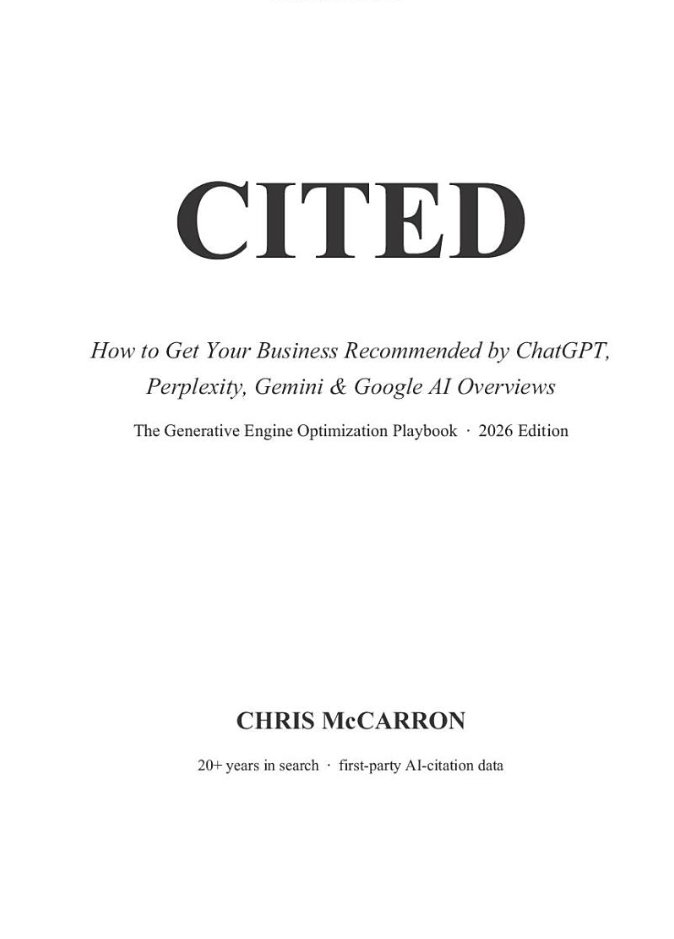
Read Chapter 1 of CITED, free.
The playbook for getting your business recommended by ChatGPT and AI search. Read the first chapter, on me.
Read Chapter 1 freeWant us to do this for your site?
Book a free AI audit. 15 minutes. We’ll show you three things your site is missing and what we’d test first.
Book my free AI audit →