ChatGPT SEO: The 2026 Playbook for the Citation Gap Nobody Talks About
AI SEO

ChatGPT SEO is optimising your content so ChatGPT names your brand and links to it in its answers. ChatGPT cites brands far less often than Perplexity, but it drives 87.4% of all AI referral traffic (Conductor, 2026), so the citations it does give reach far more buyers. This guide is how you earn one.
If your Perplexity mentions are climbing while your ChatGPT referral traffic is flat, you're winning a citation battle that pays less than the one you're losing. Superlines tracked its own brand across 34,234 AI responses over 30 days. Perplexity gave it a 13.05% citation rate. ChatGPT gave it 0.59% (Superlines, 2026). Yet ChatGPT sends 87.4% of all AI referral traffic across 10 industries (Conductor, 2026).
By pure traffic economics, one citation on ChatGPT is worth far more than one on Perplexity. Most brands optimise for the easy engine and wonder why the traffic never shows up.
The sparse citation is worth more than the dense one. That's the whole game.
I've been running conversion work for 13 years. For the last two, the fastest-growing source of qualified traffic to gogochimp.com hasn't been Google organic.
It's been Microsoft Copilot and (through the shared Bing index) ChatGPT Search citing listicles like "best A/B testing tools 2026" and "best CRO agency UK." Our first-party pull for 28 April to 30 June 2026 showed 3,263 Bing Copilot citations against 87 Google organic clicks, a 37.5-to-1 ratio, with 20.1x growth between the first and last 30 days of that window. By 25 September 2026, Bing's sample showed more than 47,000 Microsoft Copilot citations since April 2026.
Because ChatGPT Search retrieves through the Bing index, that number is the cleanest first-party proxy for ChatGPT citation behaviour any independent website owner can measure without a rank-tracker subscription. This pillar sits alongside our definitive 2026 GEO reference as the ChatGPT-specific breakdown, and it's the umbrella above our step-by-step how to get cited by ChatGPT playbook.
What is ChatGPT SEO?
ChatGPT SEO is the practice of optimising your brand, content, and third-party footprint so ChatGPT cites you in category, comparison, and how-to answers. It works differently to Google SEO. ChatGPT pulls 47.9% of top-10 citations from Wikipedia, and review sites carry real weight once buyers start comparing brands. Winners treat trust signals as the retrieval layer, structural extractability as the amplification layer.
The three numbers to know: ChatGPT gave one tracked brand a 0.59% citation rate against Perplexity's 13.05% (Superlines, 2026), 87.4% of AI referral traffic goes to ChatGPT (Conductor, 2026), and Wikipedia supplies 47.9% of top-10 ChatGPT source share (Profound 680 million citations). These three shape every tactic below.
Last updated
2026-10-09 · Author: Chris McCarron (13-year CRO operator, first-party Bing AI-citation data since April 2026, 62.75% Copilot share on our own niche category query in the 90 days to 1 July 2026)
The citation paradox that reshapes ChatGPT strategy
Everyone chasing AI citations optimises for volume. Perplexity feels rewarding because it is built to cite, with numbered sources in its answers. ChatGPT feels punishing because it often cites nothing at all. So the SEO industry runs after the easy engine and treats ChatGPT as a lottery ticket.
That reading is exactly backwards.
Superlines tracked one brand, its own, across 34,234 AI responses on 10 platforms over 30 days (Superlines, 2026). ChatGPT gave it a 0.59% citation rate. Perplexity gave it 13.05%. Traffic runs the other way: ChatGPT sends 87.4% of all AI referral traffic across 10 industries (Conductor, 2026). The engine that cites you least is the one whose citations are worth most.
The economic implication is the whole game. ChatGPT SEO is a high-effort, high-reward discipline. You will lose far more often than your Perplexity peers. When you win, you win outsized traffic that no Perplexity citation can match. This inverts the "spray-and-pray" logic most brands apply to AI search. On ChatGPT, precision matters. The wrong content shape earns nothing; the right content shape captures a market slice competitors can't touch.
Discovered Labs framed the same finding differently: ChatGPT mentions brands often but cites them sparingly, while Perplexity cites densely but commits to a short, high-authority shortlist. That distinction matters for measurement design.
A brand-visibility strategy for ChatGPT should measure two independent signals: the mention (the model says your brand name in the answer, with or without a link) and the citation (the model attaches a source URL to your domain). The Averi 2026 dataset found only 11% of domains cited by both ChatGPT and Perplexity (Averi, 2026). Strategies don't transfer. Each engine is a separate discipline.
Is ChatGPT SEO worth the effort for niche brands?
For niche brands, yes, and more than most think. Ranqo's arXiv paper across 100,000 AI responses put baseline AI visibility for niche brands at 11% (Ranqo, 2026). GoGoChimp's 62.75% Copilot citation share on "best Shopify CRO agencies UK" in the 90 days to 1 July 2026 (Bing's sample) is a different measure (our share of the citations Copilot showed on one query), so it isn't a multiple of that baseline. It does show a niche brand can lead its own buyer query.
Niche verticals concentrate citation share on a handful of brands per query, and the domain-diversity ceiling on ChatGPT is unusually high (300+ distinct domains across "best-X" citations per AIVO Research, no single domain above about 3% share). Niche brands can compete alongside major media.
Why doesn't ChatGPT cite brands more often?
The retrieval layer treats brand-owned content as lower-authority by default. Profound's 680-million-citation dataset shows how heavily ChatGPT leans on institutional sources: Wikipedia alone is 47.9% of its top-10 source share (Profound, 2025). Muck Rack's May 2026 25-million-link study found earned media accounts for 84% of AI citations. ChatGPT is stricter about that ratio than any other major engine.
How does ChatGPT's citation gap compare to Google AI Overviews?
Google AI Overviews sits between ChatGPT and Perplexity on brand-citation density. AIO weights Reddit at 21% of top-10 source share and YouTube at 18.8% (Profound, 2025). Traffic economics differ again. Seer's April 2026 update found that brands cited in an AI Overview earn 120% more organic clicks per impression than when they aren't cited, but on informational queries they still get 38% fewer clicks than on searches with no AI Overview at all (Seer, 2026). Seer notes the data is correlational. ChatGPT is the outlier for both extreme sparsity and outsized traffic value.
What ChatGPT SEO is in 2026
ChatGPT SEO in 2026 is not one discipline. It's three overlapping ones, because ChatGPT retrieves through three distinct modes, and content optimised for one can be invisible in another.
Mode 1: parametric retrieval (no live web search)
When ChatGPT decides no web search is needed, the model answers from its training-data parametric knowledge. Training cutoffs matter: GPT-4o cuts off October 2023, GPT-5 series August 2025 (Otterly, 2026). Duane Forrester of Yext argues the training cutoff is now a de-facto ranking factor: if your brand's most recent significant mention post-dates the cutoff, the model doesn't know you. Wikipedia and mainstream news dominate this layer because they were the highest-weighted pretraining corpora.
Mode 2: ChatGPT Search (live retrieval)
Launched October 2024, now integrated into the default ChatGPT experience, this mode fires when the query needs current information or the user requests a search. ChatGPT Search retrieves through the Bing index and supplements it with OpenAI's own crawler, OAI-SearchBot (OpenAI Developer Docs). Seer Interactive found 87% of SearchGPT citations match a page present in Bing's top results (Seer Interactive, 2025, via Conbersa, 2026). Bing indexation is a necessary condition.
It's not a sufficient predictor: Bing top-3 rank matched actual ChatGPT citations only 6.8-7.8% of the time in the same dataset.
Mode 3: agentic retrieval (Atlas + Operator)
ChatGPT Atlas launched worldwide on macOS on 21 October 2025 to Free, Plus, Pro, and Go users (OpenAI, 2025). Atlas is a ChatGPT-integrated browser with an agent mode that works, clicks, and executes multi-step workflows on live web pages. In March 2026, OpenAI announced plans to merge ChatGPT, Codex, and Atlas into a single desktop superapp.
For clarity: OpenAI's Operator (released 23 January 2025, powered by the Computer-Using Agent model) is the standalone browser-agent product. OperatorAI (GoGoChimp's CRO methodology, distinct from OpenAI's Operator agent) is our proprietary CRO delivery system. Same phonetic surface, unrelated products. When "Operator" appears in this pillar without qualification, it refers to OpenAI's product.
Which mode should I optimise for first?
Mode 2 (ChatGPT Search) is where most brands should start. It's the mode with the clearest measurement surface (Bing WMT AI Performance), the fastest feedback cycle (weeks, not training-cycle years), and the highest ROI per hour of on-page work. Mode 1 (parametric) demands earned-media investment across a multi-year training window. Mode 3 (agentic) requires structured-data discipline the retrieval layer hasn't rewarded yet at scale.
What is ChatGPT Atlas?
ChatGPT Atlas is OpenAI's ChatGPT-integrated web browser, released 21 October 2025 on macOS and expanding to Windows, iOS, and Android through 2026. Atlas embeds ChatGPT directly into the browsing surface, with agent mode letting the model work, click, and complete web workflows autonomously. For SEO, Atlas means structured data becomes an interaction contract: the agent reads JSON-LD to know what a button does, what a form expects, and what a product costs.
Does ChatGPT use Bing for search?
Yes. ChatGPT Search retrieves through the Bing index. OpenAI supplements Bing with its own crawler (OAI-SearchBot), but the primary retrieval surface is Bing. This is why Bing Webmaster Tools' AI Performance report is the closest first-party measurement surface for ChatGPT citations available to any independent website owner in 2026.
ChatGPT citation drivers: a five-axis comparison
Six factors dominate ChatGPT citation selection in 2026. The table below stacks them by evidence strength and pay-back timeline so you know which lever to pull first.
| Signal | Correlation strength | 2026 tactic | Payback timeline | Working example |
|---|---|---|---|---|
| Wikipedia entity anchor | 47.9% of top-10 source share (highest of any engine) | WP:N-qualified article; Wikidata cross-link | Long (3-12 months + notability substrate) | Any brand with tier-1 editorial coverage passing WP:GNG |
| Third-party trust signal (Trustpilot) | Review sites were 16% of AI citations at the evaluation stage and 24% at intent (Seer study of 804K answers, commissioned by Trustpilot) | Robust Trustpilot profile with 100+ reviews and named responses | Short (weeks to build the review substrate) | Any DTC ecommerce brand with existing customer base |
| Earned media (mainstream news) | 84% of AI citations (Muck Rack 25M-link study) | Digital PR + expert-comment platforms + industry-analyst pickups | Medium (30-90 days per placement, compounds over 12 months) | Forbes, TechNewsWorld, TechCrunch, Shopify Enterprise Blog features |
| Source-authority link graph | Sites with 32K+ referring domains 3.5x more likely to be cited than sites with up to 200 (SE Ranking 2025) | Long-form pillar guides + citation-shaped listicles + backlink discipline | Medium-long (link-graph compounding) | Any pillar page earning 20+ referring domains in 90 days |
| Structural extractability | Sections of 120-180 words averaged 4.6 citations, against 2.7 for sections under 50 words (SE Ranking 2025) | Answer capsules, self-answering H2s, JSON-LD Article + FAQ + HowTo schemas | Short (weeks to publish; days to earn first citation) | GoGoChimp best-A/B testing tools 2026 pillar earning 1,500 Copilot citations by 30 June 2026 |
| Freshness (dated content) | AI-cited pages 25.7% fresher than Google organic results (Ahrefs 2025) | 30-90 day refresh schedule; visible “last updated” dates; year-in-title tokens | Very short (24-72 hours post-refresh) | Any “best-X-2026” listicle with substantive quarterly refresh |
| Citation neighbours (Profound) | Sources travel in packs: ChatGPT retrieves clusters, not lone documents | Audit who you get cited alongside; earn placement on their citation neighbours | Medium (60-120 days to reshape the neighbour set) | GoGoChimp cited alongside Neil Patel, Search Engine Land, Ahrefs on CRO queries |
Citation neighbours: why Trustpilot, Wikipedia, and Reddit travel together on brand queries
Citations travel in packs. Profound's underlying data shows domains cluster on shared queries: brands cited alongside Wikipedia usually also get cited alongside Trustpilot, and both get cited alongside Reddit. This is the citation-neighbours pattern. It matters because it means earning one high-signal citation lifts the probability of the others, and losing one drags the cluster down. Audit who you get cited alongside on your top 20 brand queries. If the pattern shifts, your citation stack is shifting too.
Read the table stacked by leverage, not novelty. Trustpilot is unusual: high correlation strength, short payback timeline, low industry awareness. Wikipedia and earned media are load-bearing but slow. Structural extractability and freshness are cheap and fast but ceiling-limited without the trust signals underneath. The pragmatic build order is bottom-up: get the structural discipline right first, then Trustpilot, then earned media, then attempt the Wikipedia anchor once the notability substrate is genuine.
Building this stack manually is slow. See our best AI SEO tools 2026 guide for the citation-tracking software and ChatGPT SEO tools we've tested: the winnable commercial cluster (Bing Webmaster Tools AI Performance report, Profound, Peec.ai) at KD 11-16.
Review profiles are the lever most 2026 SEO advice skips. Everyone's writing about Wikipedia. A Trustpilot profile takes about 90 minutes to set up, then steady review collection. We'll break it down in a dedicated H2 below. First, the Wikipedia mechanic that most 2026 practitioners think they understand but usually don't.
Wikipedia weighting: the 47.9% source-share truth
Wikipedia's dominance in the ChatGPT corpus is the single most actionable finding in the 2026 evidence base. Profound's dataset of 680 million citations places Wikipedia at 7.8% of all ChatGPT citations and 47.9% of the top-10 source share (Profound, 2025). No other engine concentrates like this. Perplexity's top-10 leans on Reddit (46.7% share). Google AI Overviews leans on Reddit (21%) and YouTube (18.8%). ChatGPT alone leans on Wikipedia.
Two mechanisms explain the weighting. First, encyclopedic pretraining. Wikipedia is one of the largest and highest-quality single-source corpora in the LLM pretraining stack. The retrieval layer inherits the model's bias toward matching new queries against sources it "knows well." Second, structure. Wikipedia articles use consistent headings, factual density per paragraph, and canonicalised entity references. All of that maps cleanly onto the RAG chunk boundaries the retrieval layer uses.
Picture the ChatGPT retriever as a queue outside Wikipedia's editorial gates. It's the permit line at the DVLA, doors locked to anyone whose brand doesn't hold a footnote from a reliable secondary source dated 2019 or later. Show up without the paperwork, get turned away. Show up with a WP:N-qualified article, get waved through to the front of the citation queue.
5W Public Relations released in May 2026 the first practitioner guide framing Wikipedia as a brand-authority channel rather than a reputation-defence channel. The report argues that a defensively-neutral Wikipedia entry now functions as an owned entity anchor that persists inside ChatGPT even when Search is off, because the model has seen the article at training time. The tactical implication is direct: Wikipedia is table stakes.
If your brand doesn't have an article, or has one but can't keep it live, the ChatGPT parametric layer literally doesn't know you exist.
Can I get on Wikipedia for SEO?
Not directly, and any agency selling "Wikipedia SEO" is selling you a takedown risk. The controlling standard is WP:N (Wikipedia:Notability), which requires "significant coverage in reliable, independent, secondary sources" (Wikipedia, WP:N). For companies and organisations, WP:NCORP is stricter still: coverage must be independent, in-depth, and address the topic directly and in detail (Wikipedia, WP:NCORP). The realistic path for most SME brands is 3-5 substantive third-party editorial features, ideally in tier-1 outlets, before applying via AfC (Articles for Creation).
What about Wikidata as a faster path?
Wikidata's notability standard is softer than Wikipedia's. A Wikidata item is notable if it "refers to an instance of a clearly identifiable conceptual or material entity" that "can be described using serious and publicly available references" (Wikidata, Notability). Wikidata items feed Google's Knowledge Graph and act as structured entity anchors for LLMs at pretraining time.
But Wikidata's "notability" is culturally enforced by a small volunteer editor community whose tolerance for brand-owned entity creation is lower than the written policy suggests. We know this from receipts (see the EXCLUSIVE section below).
How long does the Wikipedia entity anchor take to pay back on ChatGPT citations?
3-12 months from AfC acceptance to measurable ChatGPT citation lift, depending on how quickly the article gets indexed into ChatGPT's live retrieval layer (fast, days-to-weeks) versus how quickly it enters the parametric layer at the next training cycle (slow, quarters). The live-retrieval lift shows up first. The parametric lift compounds behind it and lasts through model versions.
The Trustpilot lever nobody's using
Every 2026 AI-SEO guide leads with Wikipedia. Review profiles get far less attention, even though they're cheap to build and AI engines read them.
The evidence is real but narrower than the headlines. In a Trustpilot-commissioned study of 804,491 AI answers across ChatGPT, Gemini, Perplexity and Google AI Mode, brands with a Trustpilot profile and a handful of reviews appeared alongside a Trustpilot citation in about half of answers, against 1% for brands with no profile (Seer, 2026). That's a snapshot, not a before-and-after test, and a brand with no profile scores near zero almost by definition. Seer says marketing spend and audience size may also play a part. Read it as evidence that review pages get pulled into answers, not as a guaranteed lift.
The mechanic is straightforward. AI engines prioritise third-party validation because it's harder to fabricate than brand-owned content. A Trustpilot profile with substantive reviews is a structured third-party dataset the retrieval layer can extract and cite directly. It also feeds the entity-signal reconciliation the model runs before deciding what your brand actually is.
When ChatGPT asks "who is GoGoChimp", the answer reconciles across Wikipedia (where present), mainstream news, Trustpilot, LinkedIn Company, Crunchbase, and the brand's own site. Trustpilot is one of the cheapest surfaces to influence directly, and it carries disproportionate corpus weight.
The implementation window is 90 minutes plus a review-solicitation schedule.
Set up the profile. Fill the About block with the same brand positioning language the site uses. Add the canonical URL back to the domain. Then start soliciting reviews from existing customers who've been happy with the work, on a monthly schedule, and keep it going. Respond to each one, publicly, in the founder voice. That's the lever most 2026 SEO advice doesn't cover.
Does Trustpilot help with ChatGPT visibility specifically?
Yes, with caveats. ChatGPT was one of the four engines in the Seer study, and Seer looked at how it reached Trustpilot pages. 99.5% of those citations came through ordinary search rankings, and 71.7% came through follow-up searches ChatGPT ran on its own (Seer, 2026). So the review page has to rank for the questions buyers ask, such as "is [brand] any good". When ChatGPT did cite Trustpilot, it used the TrustScore or star rating in 59% of those answers, so your rating travels with you.
How many Trustpilot reviews does it take before ChatGPT changes its recommendation?
Nobody has measured a threshold. The Seer study compared profile tiers at one point in time: brands with 1 to 13 reviews appeared alongside a Trustpilot citation in 53.5% of answers, and brands with a median of 81 reviews scored about 25 points higher (Seer, 2026). That doesn't show reviews causing the difference. Collect named reviews with real substance steadily, rather than chasing a number.
Which review platform matters most for ChatGPT: Trustpilot, G2, or something else?
Trustpilot dominates for consumer-facing and B2B service brands. G2 dominates for B2B SaaS. The AI-citation weighting mirrors the vertical fit: a Shopify agency should invest Trustpilot first, a workflow SaaS should invest G2 first. Both are third-party trust signals. Both feed the same citation-lift mechanic. Vertical fit determines which one your buyers already look at.
Session-opener citation slot: the 2.5x lift on turn 1
Profound analysed about 700,000 ChatGPT conversations from US English-language users between October and December 2025. Turn 1 was 2.5 times more likely to trigger citations than turn 10, and nearly 4 times more likely than turn 20 (Profound, February 2026). Profound thinks the cause is the questions people ask. Opening questions often need facts, such as what something is, how it works or what just happened. Follow-ups tend to be clarifications, deeper dives or creative tasks that need no fresh web data. So ChatGPT searches the web less as a conversation goes on, and the citation slot narrows.
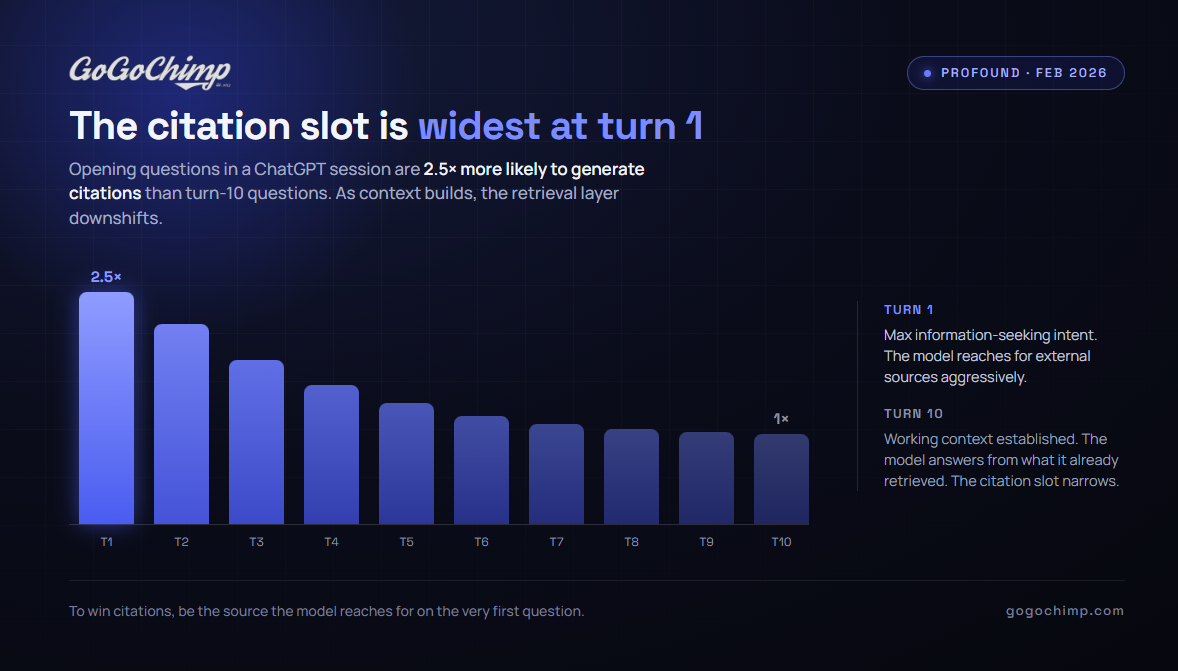
This changes measurement. Rank trackers fire cold, single-turn prompts. Turn 1 is where ChatGPT cites most often, so a tracker will see more cited answers than a live user sees ten turns into a conversation. Read tracker numbers as a best-case, turn-1 view of your ChatGPT visibility, not a whole-session one.
It also changes prompt engineering for brands producing ChatGPT-oriented content. The highest-value ChatGPT SEO content is content that ranks for the exact prompts users type as the first message of a session. In practice that means three specific disciplines.
Head-keyword parity
The ChatGPT query and the H1 of your content should match verbatim on the head keyword. "ChatGPT SEO" the query maps to "ChatGPT SEO" the H1. Not "the complete guide to ChatGPT optimisation" or "how to win at ChatGPT." Exact match on the head keyword.
Answer-capsule format
The 25-word answer capsule under the H1 is the extractable citation surface the retriever grabs first. Write it as a self-contained claim, not a teaser. If the retriever can extract the capsule without needing the body, you win the citation. If it has to compose from body prose, you lose to a page whose capsule is cleaner.
Explicit year anchoring
"In 2026" appears in the title. "Updated July 2026" appears at the top of the page. Both act as recency signals in retrieval. Ahrefs found pages cited by AI assistants were 25.7% fresher on average than Google's organic results (Ahrefs, 2025). Undated content is a citation liability.
What is the session-opener citation slot?
The session-opener citation slot is the observation that ChatGPT searches the web and cites sources far more often on the first turn of a conversation than later on. Turn 1 is 2.5x more likely to trigger citations than turn 10 (Profound, February 2026). In practice, the first question a buyer asks is where citations concentrate, so that is the query to win.
Do reasoning-mode queries also get the session-opener lift?
Partially. Reasoning-mode conversations tend to fire more retrievals per turn, which flattens the session-opener advantage somewhat. The Semrush / Kevin Indig research (below) shows reasoning mode citation rate rises from 50% to 68% across the conversation, so the drop-off from turn 1 to turn 10 is less steep in high-reasoning mode. Still material, but less than in standard mode.
How do I target session-opener queries?
Start by mapping the 20-30 first-question queries your buyers ask in fresh ChatGPT sessions on your topic. Session-opener queries are typically short, definitional, and comparative ("best X for Y", "what is Z", "X vs Y", "how do I Z"). They rarely include multi-step qualifiers ("best X for Y that also does Z and integrates with W"). Rank your content for the session-opener form of every commercial query you care about.
Reasoning mode as a citation-selection variable
Reasoning mode is a mode-shift that changes which brands get cited. Semrush's collaboration with Kevin Indig found high-reasoning mode ran 1,130 web searches across a 100-prompt test set versus 245 for minimal reasoning, a nearly 5-fold increase, and only 25.6% of cited domains overlapped between the two modes (Search Engine Land, 2026). Same brand, same query, different citations, because the underlying retrieval widened.
The corpus reweighting is worth naming column by column. Government and academic sources rose from 1.9% to 8.8% of citations. Official documentation rose from 12.4% to 17.5%. Reddit dropped from 15% to 7%. UGC and review sites dropped from 14.3% to 6%. Thinking mode citation rate itself rose from 50% (2.6 citations per response) to 68% (4.5 citations per response). More citations per answer, sourced from more institutional surfaces, with less weight on community and UGC content.
The commercial read is direct. As more users turn on Thinking, the domain-authority requirement to be cited rises, and brand content strategies that leaned on Reddit visibility will lose ground in high-reasoning contexts. Brands producing citation-shaped content need to over-index on academic-adjacent framing, primary-research citation, and named-methodology rigour. The Reddit tactic (winning Perplexity, hedging on ChatGPT) becomes a liability specifically in high-reasoning ChatGPT contexts.
The category-level Thinking-mode analysis in the same study found finance saw the largest citation-mix change (+28 percentage points institutional gain) when moving from minimal to high reasoning, while consumer tech saw minimal movement (+4 points). High-consideration verticals (finance, health, legal) are where high-reasoning mode is most decisive; low-consideration verticals see similar behaviour across modes.
How does reasoning mode affect ChatGPT SEO?
Reasoning mode raises the domain-authority bar to be cited and shifts the corpus toward institutional sources. Brands need to invest in named-methodology content, primary-research citation, and academic-adjacent framing to earn citations in reasoning-mode responses. Reddit-first strategies work in standard mode; they underperform in reasoning mode.
Do I need separate content strategies for standard and reasoning mode?
Not separate, but the priority stack differs. Standard-mode-first content leans on session-opener queries, best-of listicles, and community-adjacent trust signals. Reasoning-mode-first content leans on primary-research citation density, named-methodology framing, and government / academic source anchors. Most brands should serve both from the same content by layering primary-research citation into best-of listicles. The BGS 347-store research citation on our own pillars is the working example.
Mainstream news pickups: the compound play (EXCLUSIVE)
The following section draws on GoGoChimp's own editorial-features stack, an exclusive first-party receipt no other blog has access to. Use it to calibrate the compound-work timeline of mainstream news pickups as a ChatGPT SEO tactic.
Muck Rack's May 2026 analysis of over 25 million ChatGPT, Claude, and Gemini citations across 17 industries found earned media accounts for 84% of all AI citations, with journalism at 27% (Shadow, 2026). AI engines prioritise third-party validation over brand-owned content because third-party validation is harder to fabricate. Tier-1 editorial coverage does two things simultaneously.
First, it seeds the parametric layer: if a Forbes article about your brand is inside the training-data cutoff window, the base model has ingested it and will reference the brand without a live web search. Second, it seeds the live-retrieval layer: Bing indexes major news domains fast and heavily, and OAI-SearchBot preferentially refetches high-authority news sources on freshness cycles.
Here's the receipt. In a 30-day window ending mid-June 2026, GoGoChimp landed:
That's five DA-70-to-95 editorial placements plus one 11-locale syndication landing in 30 days. Ratifying data on our Bing WMT AI Performance report: Copilot citations climbed from 144 in the first 30 days of our 28 April to 30 June 2026 tracking window to 2,898 in its last 30 days, a 20.1x growth multiplier, peaking at 464 citations on 11 June 2026 (six days before the TechNewsWorld piece landed on 17 June).
The lesson is discomforting. It took the strongest 30-day editorial window in canon history to shift the outcome on ChatGPT / Copilot citation share at scale. Individual placements are seed corn. The compound is where the citation lift actually lives. Brands running one-off PR pushes and expecting AI citation traction within 30 days are misreading the timescale. Twelve months of continuous editorial schedule beats one 30-day sprint every time, but the 30-day sprint is what sets the compound in motion.
Which editorial placements move ChatGPT citation share fastest?
Placements with DoFollow backlinks and named-attribution paragraphs (not brand-mention-only) move fastest, because they seed both the live retrieval layer (via link-graph authority) and the entity-signal reconciliation layer (via named-source disambiguation). Our TechNewsWorld DoFollow placement moved faster than the Forbes brand-mention-only piece by measurable Copilot citation delta in the same window.
How many editorial placements do I need before ChatGPT citation share moves?
3-5 substantive placements in a rolling 90-day window is the threshold at which most brands see measurable Copilot citation delta in Bing WMT AI Performance. Below 3, the signal is noisy. Above 5, the compound compounds. GoGoChimp's own inflection point was between the third and fifth placement of the 30-day sprint.
Do brand mentions without backlinks help ChatGPT SEO?
Yes, though less than named-attribution DoFollow placements. Brand mentions without backlinks still feed the entity-signal reconciliation layer and the parametric-layer ingestion. The Forbes brand-mention-only placement (Joseph Liu, 21 May 2026) shows up in ChatGPT parametric responses about small-workplace-gesture research at higher rates than pre-placement, despite zero backlink transfer.
The Wikidata entity anchor and the 2026 catastrophe (EXCLUSIVE)
The following is a receipt from GoGoChimp's own failed Wikidata push. Use it to calibrate the offensive-vs-defensive posture on entity-graph investment. Most 2026 SEO advice tells you to front-load Wikidata because it's easier than Wikipedia. The receipt says otherwise.
In April and May 2026, GoGoChimp built a Wikidata graph of eight Q-items: Chris McCarron the person, GoGoChimp the organisation, OperatorAI, The 347 Method (Q139695681) and four other methodology concepts. The first three entities alone carried 46 statements, 155 references and 29-language labels including EN, KO, RU, AR, HI, ES, DE, FR, PT, JA, ZH. EN and KO Wikipedia citations wired. Cross-graph linkage to Bing Places and Google Business Profile.
By 2 June 2026, seven of the eight Q-items had been deleted by Wikidata editors for perceived notability failure. Only Q139695681 (The 347 Method) survived. A third deletion would trigger an editorial account block. We haven't recreated the deleted items.
The lesson is direct: Wikidata's "notability" is culturally enforced by a small volunteer editor community whose tolerance for brand-owned entity creation is lower than the written policy suggests. Wikidata:Notability policy (Wikidata, Notability) reads permissively. The editor community reads it strictly. The gap between written policy and enforced practice is where entity-graph projects go to die.
The correct posture for most brands is offensive-then-defensive. Do the editorial PR work that manufactures the third-party notability substrate first, then apply for Wikipedia via AfC, then use the accepted Wikipedia article as the substrate for Wikidata cross-linkage. Do not front-load Wikidata creation. The Wikidata push looks like the shortcut. It's the shortest path to a permanent account block.
Should I try to create a Wikidata entry for my brand?
Only after your brand has 3+ substantive tier-1 editorial features (Forbes, TechCrunch, industry-analyst reports, Wikipedia via AfC) that clearly satisfy WP:GNG. Wikidata's soft-written notability policy is enforced by a strict editor community. Front-loading Wikidata creation without the editorial substrate is a fast path to deletion. GoGoChimp's own 7-of-8 deletion in June 2026 is the working example.
Does Wikipedia notability guarantee ChatGPT citation lift?
Not immediately, but substantially over 3-12 months. The live-retrieval lift shows up in weeks (once the article is in the index). The parametric-layer lift shows up at the next model training cycle (6-18 months out). The compound lift shows up as your Wikipedia entity anchor becomes the reconciliation surface for cross-source entity signals across the model's whole corpus.
What is the entity-graph reconciliation layer?
It's the process ChatGPT uses to decide who your brand actually is by cross-referencing multiple independent sources. The retrieval layer asks "who is [brand]" and reconciles across Wikipedia, mainstream news, Trustpilot, LinkedIn, Crunchbase, Google Business Profile, Bing Places, and the brand's own site. When the sources agree, the model treats the entity as high-trust and cites it. When they disagree (or when key surfaces are missing), the model hedges or omits the citation.
ChatGPT and Bing WMT overlap: the first-party measurement surface (EXCLUSIVE)
The strongest, cleanest, first-party measurement surface for ChatGPT SEO is not a ChatGPT-specific tool. It's Bing Webmaster Tools' AI Performance report. Because ChatGPT Search retrieves through Bing's index, and because 87% of SearchGPT citations trace back to Bing top results (Seer Interactive, 2025, via Conbersa, 2026), a substantial share of "ChatGPT citations" also surface as "Microsoft Copilots and Partners" citations in Bing WMT (Stackmatix, 2026). Bing WMT AI Performance data is first-party, confound-free, and daily-granular.
It gives a site owner citation counts without the login-account bias that contaminates Perplexity and ChatGPT rank-tracker workflows in 2026. It isn't a full log: Bing calls the data "a sample of overall citation activity" (Microsoft Bing, 2026).
GoGoChimp's own Bing WMT AI Performance data illustrates what the tool captures.
Between 28 April and 30 June 2026 (64 days), we recorded 3,263 Bing Copilot citations across 47 active days. Peak single day: 11 June 2026 with 464 citations across 3 cited pages. Growth trajectory: 144 citations in the first 30 days rising to 2,898 in the last 30 days, a 20.1x multiplier in 60 days. The ramp start was 26 May 2026, jumping from under 13 citations per day to 39 in a single day, followed by sustained daily volume from early June onward.
Compare that to Google Search Console over an overlapping 76-day window (19 April to 3 July 2026): 87 total Google organic clicks against 21,146 impressions across 556 distinct queries. Overall CTR 0.41%. Bing Copilot citations to Google organic clicks ratio: 37.5-to-1. Copilot is our dominant discovery surface. Google organic is negligible.
The top-cited pages are all listicle or head-to-head comparison formats: /blog/best-ab-testing-tools-2026 (1,500 citations), /best-cro-agency-uk-2026 (1,200 citations), /blog/best-heatmap-tools-2026 (441 citations), /blog/copywriting-frameworks (96 citations), /blog/best-shopify-cro-apps-2026 (71 citations), /blog/vwo-vs-optimizely-2026 (67 citations). Every one of them fits the AIVO Research finding that listicles dominate ChatGPT citations on "best X" and "X vs Y" queries. Across engines, Wix Studio's AI Search Lab found listicles took 21.9% of citations in 75,000 AI answers on ChatGPT, Google AI Mode and Perplexity, ahead of articles at 16.7% and product pages at 13.7% (Search Engine Land, 2026).
There's also a click-clawback receipt inside the same dataset. The query "emotional copywriting frameworks for facebook ads ecommerce" registered 698 GSC impressions at position 8.73 with zero clicks and 0% CTR. Textbook AI Overview clawback: we rank on page 1, the AI answer above the organic results absorbs the click. This is the exact scenario 3,263 Bing Copilot citations solves. Appear inside the AI answer rather than below it.
How do I set up Bing WMT AI Performance tracking?
Claim your site in Bing Webmaster Tools (free, about 10 minutes). Add the property, verify ownership, and let it accrue data for 14 days minimum. The AI Performance report lives under Reports and Data > AI Performance. It shows daily Copilot citation counts, cited pages, and grounding queries. Because ChatGPT Search shares the Bing index, Copilot citations are the closest first-party proxy for ChatGPT citation share available to independent website owners.
What's the difference between Bing Copilot and ChatGPT citations?
Bing Copilot is Microsoft's consumer-facing AI product; ChatGPT is OpenAI's. Both retrieve through the Bing index for their live-web-search modes. The Copilot citation count in Bing WMT captures Copilot's own retrievals directly, but because both engines pull from Bing's top results, Copilot citations correlate strongly with ChatGPT Search citations on the same queries. They're not identical (ChatGPT adds OAI-SearchBot's supplementary index, Copilot doesn't), but they're the closest first-party signal available for ChatGPT retrieval.
Does Bing WMT track ChatGPT directly?
Not currently. Bing WMT's AI Performance report tracks Microsoft Copilot and its partner integrations. ChatGPT Search citations aren't broken out separately. That said, because ChatGPT Search retrieves through Bing's index, the Copilot citation count is the tightest available proxy. Third-party tools (Profound, Ahrefs Brand Radar) attempt cross-engine coverage but with directional accuracy rather than exact counts.
The five-step ChatGPT SEO playbook
The playbook is the discipline behind the top three pages in our own footprint. Five steps, sequenced by lift per hour rather than by novelty.
Step 1: Ship citation-shaped listicles.
Listicles took 21.9% of citations across ChatGPT, Google AI Mode and Perplexity in Wix Studio's study of 75,000 AI answers, more than any other format (Search Engine Land, 2026). Every listicle carries a year-in-title token, an HTML comparison table near the top, one row per item, and 4-6 axis columns. Best-of listicle citation share rises to 100% on "compare options to choose" intent (AIVO Research, 2026). Start here because the on-page discipline is entirely under your control and the payback is measurable in weeks.
Our own best A/B testing tools 2026 earned 1,500 Bing Copilot citations in the 64 days from 28 April to 30 June 2026. That's the ceiling of this single format done well.
Step 2: Build the Trustpilot trust surface.
In the Trustpilot-commissioned Seer study, brands with a profile and a handful of reviews appeared alongside a Trustpilot citation in about half of AI answers, against 1% for brands with none (Seer, 2026). It's a snapshot, not proof of cause, but the cost is low: about 90 minutes to set up the profile, then steady review collection. Few brands bother, because it looks unglamorous.
Step 3: Ship long-form pillar guides with statistical density.
In the 2023 GEO benchmark, the Princeton team's three best methods (adding quotations, statistics and cited sources) improved visibility by 30-40%, and quotations alone by 41% (Princeton, 2024). Treat that as a starting point, not a rule: a September 2026 preprint re-tested the same three levers and found they moved citation on none of ten current engine families (Bajemon and Rochet, 2026). Write them in because they make a page worth quoting, not because an engine counts them. Every pillar page on your site should carry: answer capsules under H1, self-answering H2 sections of 150-400 words, dated statistics inline, blockquote-formatted quotable claims with named entities, and a References section at the bottom.
This is the on-page discipline that turns your site into a first-party citation surface. Our definitive 2026 GEO reference is the worked example: 10,000+ words, 30+ inline hyperlinked citations, one quotable blockquote per H2.
Step 4: Run a mainstream news pickup schedule.
Earned media made up 84% of the links cited by ChatGPT, Claude and Gemini in Muck Rack's May 2026 Generative Pulse data, but Muck Rack counts academic, government, encyclopedic and third-party corporate pages as earned too. Journalism alone was 27% of cited links, and that's the slice this step targets (Muck Rack, 2026). Muck Rack sells PR software, so read its numbers with that in mind. Target: 3-5 substantive editorial placements in a rolling 90-day window. Sources: HARO / Featured.com / SourceBottle for expert-comment pickups; direct-to-editor pitches for named-feature placements; industry-analyst outreach for the compound.
Update, September 2026: third-party sources dominate AI citations overall, but the picture flips at B2B evaluation. Across AI search as a whole, 96% of citations point to third-party sources, up from about 80% a few months earlier (Writesonic via Search Engine Journal, 2026). Nelson Brassell's study for Ten Speed, 7,387 citations across 170 B2B evaluation-stage prompts measured through Peec AI, found the opposite: 88.3% of citations at evaluation come from pages the brand controls, with product pages the most cited type at 24.1%, articles at 17.4%, comparison content at 13.3% and listicles at 13.2% (Ten Speed, 2026). Citations look completely different at the top and bottom of the funnel. Always say which stage you mean.
GoGoChimp's 30-day editorial-run receipt is the model. Five DA-70-to-95 placements plus 11-locale syndication landed while our Copilot citations rose 20.1x, comparing the first and last 30 days of 28 April to 30 June 2026.
Step 5: Chase the Wikipedia entity anchor once the notability substrate is real.
Wikipedia is 47.9% of ChatGPT's top-10 source share. Nothing else matches per unit of effort at the parametric-layer weight. But the notability bar is real. Apply via Articles for Creation, not direct namespace publication. Cite tier-1 editorial features (the compound from Step 4) as the reliable-independent-secondary-source substrate. Defence discipline post-approval matters: monitor edits, respond to Talk-page challenges, keep sources fresh. Do NOT front-load Wikidata creation as a shortcut. Our own 7-of-8 Wikidata deletion in June 2026 is the receipt on that.
How long before the ChatGPT SEO playbook shows results?
Step 1 (citation-shaped listicles) shows measurable Copilot citation delta in Bing WMT within 30-60 days of publication. Step 2 (Trustpilot) has no published timing, because the only study is a snapshot, so track it against your own answers. Step 3 (pillar guides) shows citation lift on multi-sub-query decompositions within 60-120 days. Step 4 (editorial schedule) shows measurable delta 30-90 days per placement, compounding over 12 months. Step 5 (Wikipedia) shows live-retrieval lift within weeks of article acceptance and parametric-layer lift at the next model training cycle (6-18 months).
Which step should I skip if I only have time for three?
Steps 1, 2, and 4. Skip pillar-guide production (Step 3) if it's out of scope this quarter (though it's usually the highest ROI over 12 months). Skip Wikipedia (Step 5) unless the notability substrate is genuine (front-loading fails). Steps 1, 2, and 4 together produce a defensible ChatGPT SEO foothold within 90 days on a compressed budget.
Seven common ChatGPT SEO mistakes to avoid
Mistake 1: Optimising for Perplexity and expecting ChatGPT coverage
Only 11% of domains are cited by both engines (Averi, 2026). Perplexity leans on Reddit; ChatGPT leans on Wikipedia. Same effort, different retrieval philosophies, no cross-coverage.
Mistake 2: Front-loading Wikidata as a Wikipedia shortcut
Wikidata's soft-written notability policy is strictly enforced. Brands that populate Wikidata without editorial substrate get deleted. Do the tier-1 editorial PR first.
Mistake 3: Blocking OAI-SearchBot at robots.txt or at the CDN
OAI-SearchBot is separate from GPTBot (OpenAI Developer Docs). Blocking GPTBot for training-data protection is a defensible choice. Blocking OAI-SearchBot removes your site from ChatGPT Search retrieval. Understand which bot does what before you block anything.
robots.txt is only half the check. It's a request that well-behaved bots honour, and your CDN or firewall decides whether the request gets through. The two can disagree. Cloudflare sorts AI crawlers into Search, Agent and Training groups, where Agent means live fetches made on a person's behalf, such as ChatGPT-User (Cloudflare, July 2026). Since 15 September 2026, its recommended settings for a new site that carries ads block Agent bots on ad pages, and its Block setting for Training also stops Googlebot, Bingbot and Applebot. To keep search and stop training, Cloudflare says to use Disallow AI Training instead (Cloudflare, September 2026). Site owners on Cloudflare's forum have reported a managed robots.txt that kept blocking AI crawlers after they'd allowed them (Cloudflare Community, September 2026), and PerplexityBot refused under a training rule (Cloudflare Community, October 2026).
A two-minute test: request one public page three times, changing only the user agent.
curl -s -o /dev/null -w "%{http_code}\n" -A "Mozilla/5.0 (compatible; OAI-SearchBot/1.0)" https://example.com/page
curl -s -o /dev/null -w "%{http_code}\n" -A "Mozilla/5.0 (compatible; ChatGPT-User/1.0)" https://example.com/page
curl -s -o /dev/null -w "%{http_code}\n" -A "Mozilla/5.0 (compatible; GPTBot/1.1)" https://example.com/page
If you want ChatGPT to cite you but not train on you, you want 200, 200, 403. A 403 on either of the first two means something at the edge is overriding your robots.txt. This only tests rules that match on the user agent. Rules tied to verified-bot detection only fire on requests from the vendor's real IP addresses, so for those, ask ChatGPT to open the page, then check your CDN's security events for that minute. On Shopify you won't see those logs, so give ChatGPT one product URL and ask for a detail only that page carries, such as a care instruction or an exact dimension. If it quotes it back, the live fetch got through.
Mistake 4: Skipping the Trustpilot profile because it feels beneath the brand
Review pages get pulled into AI answers when buyers compare brands, and ChatGPT quoted the TrustScore or star rating in 59% of the answers where it cited Trustpilot (Seer, 2026). Snobbery loses to citation share.
Mistake 5: Measuring ChatGPT citation share via cold-prompt rank trackers
Turn 1 of a ChatGPT conversation is 2.5x more likely to trigger citations than turn 10 (Profound, February 2026). Cold-prompt trackers only test turn 1, so they show more citations than a live user sees later in a conversation. Measure across full-session simulations as well.
Mistake 6: Refreshing pillar content annually instead of quarterly
AI assistants do favour newer pages, just less than the refresh-everything advice suggests. Ahrefs found that pages cited by AI assistants were 25.7% fresher on average than pages in Google's organic results, while Google's top three AI Overview citations averaged 3.9 years old (Ahrefs, 2025). Review pillar pages every quarter and update the facts, prices and examples that have changed. A new date on unchanged content isn't an update.
Mistake 7: Under-investing in the answer capsule
The 25-word capsule under H1 is the extractable citation surface the retriever grabs first. Brands that hide the answer under a throat-clearing intro lose citations to brands that lead with the answer. Rewrite your answer capsule as a self-contained claim, not a teaser.
Predictions for ChatGPT SEO 2026-2027
Three grounded predictions from the 2026 evidence base.
Prediction 1: A measurement standard emerges by Q3 2026
The industry is currently running on Bing WMT (proxy), Semrush AI Visibility Toolkit (directional), Ahrefs Brand Radar (directional, documented inaccuracy of 3-vs-123 mentions in one Writesonic audit), and Profound (enterprise-tier consumer-panel). Our prediction, made in July 2026, was that by Q3 2026 one of these tools would emerge as the default cross-engine measurement standard, or a new entrant would consolidate the segment. The AIVO Research and Semrush AI Visibility Index datasets are already converging on a common vocabulary; the tooling will follow.
Update, October 2026: this has only partly come true. Bing Webmaster Tools' AI Performance report, Microsoft Clarity's Citations report and Search Console's Generative AI performance report are now all free and first-party, but none of them counts ChatGPT citations.
Prediction 2: The reasoning-mode citation gap widens
As more users default to Thinking mode, the domain-authority requirement to be cited rises. Brands that lean on Reddit and UGC visibility for standard-mode citations will lose ground in reasoning-mode contexts. Content strategies that over-index on academic-adjacent framing, primary-research citation, and named-methodology rigour will gain share. High-consideration verticals (finance, health, legal) will feel the shift first, per the Semrush / Kevin Indig category-level data.
Prediction 3: Agentic retrieval collapses the citation-vs-purchase distinction
ChatGPT Atlas + the merged Codex-Atlas-ChatGPT superapp announced March 2026 (The Decoder, 2026) mean the agent doesn't just cite pages, it visits and executes on them. Structured data becomes an interaction contract. Sites that skip JSON-LD will still get cited by non-agent ChatGPT but will be illegible to Atlas Agent. Brands that ship schema-complete pages now capture agentic retrieval share before competitors realise it's a category.
The through-line across all three predictions is the same. ChatGPT rewards precision over volume, institutional trust over community signal, and structured extractability over prose density. The playbook above is the current best expression of that pattern. The pattern itself won't shift materially in the next 18 months. The tooling around it will.
Best ChatGPT SEO tracking software in 2026
Eight tools track AI citations, share of voice or AI referral traffic. Three are free and first-party: Bing Webmaster Tools' AI Performance report, Microsoft Clarity's Citations report and Search Console's Generative AI performance report. None of them reports ChatGPT citations directly. Bing's Copilot data is the closest free proxy. The paid tools sample prompts, each in its own way. Paid prices checked 30 Sep 2026.
| Tool | What it tracks | Data source | Pricing floor (2026) | Best for |
|---|---|---|---|---|
| Bing Webmaster Tools AI Performance | Copilot citations (proxy for ChatGPT Browse) | First-party Bing index | Free | Anyone with a verified site |
| Microsoft Clarity Citations | Page citations, share of authority and AI referral traffic | First-party: Bing Webmaster Tools signals plus Clarity tracking | Free | Sites already running Clarity |
| Search Console Generative AI performance report | AI Overviews and AI Mode impressions, combined (no clicks) | First-party Google | Free | Google's AI surfaces, not ChatGPT |
| Profound | ChatGPT + Claude + Perplexity + Gemini + Copilot share | Proxy prompt library, about 800 prompts | Free trial, then Enterprise (custom) | Multi-engine benchmarking |
| Peec.ai | ChatGPT + Perplexity + Gemini share of voice | Proxy prompts + ChatGPT API | €85/mo (Starter) | Granular prompt-level tracking |
| Semrush AI Visibility Toolkit | ChatGPT + Gemini + Perplexity + AIO share | Proxy 126M-prompt panel | $99/mo | Benchmark data + Semrush integration |
| Ahrefs Brand Radar | ChatGPT + Perplexity + Gemini + Copilot mentions | Proxy prompts + brand mention crawler | $50/mo (custom prompts), $199/mo (index) | Ahrefs existing users |
| Otterly.ai | ChatGPT + Perplexity + Google AI Overviews | Proxy prompts | $29/mo (Lite) | Lowest-cost paid entry |
See our full best AI SEO tools 2026 guide for cross-engine coverage, and Bing SEO for AI visibility for the Bing indexation prerequisites that make ChatGPT citation possible in the first place.
FAQ
How do I do SEO for ChatGPT in 2026?
SEO for ChatGPT means winning three surfaces at once. The parametric layer (in-model training data via Wikipedia and Wikidata). The browse layer (live Bing results, seeding 87% of ChatGPT Search citations). The reasoning layer (deeper source pull with 4.5 citations per answer in reasoning mode). Optimise trust signals first (Trustpilot profile, Wikipedia entity, editorial pickups), structure second. Start with Bing Webmaster Tools AI Performance to see what already fires.
Is ChatGPT SEO the same as GEO or AEO?
ChatGPT SEO is a subset of both. GEO (generative engine optimisation) covers every generative engine: ChatGPT, Perplexity, Copilot, Gemini, Google AI Mode. AEO (answer engine optimisation) is the older phrase focused on structured answer selection. All three share tactics. Only ChatGPT SEO tunes for ChatGPT's own source mix, such as its 47.9% Wikipedia share of top-10 sources. See our GEO pillar and AEO pillar for the fuller frameworks.
What is the best ChatGPT SEO tool in 2026?
No free tool reports ChatGPT citations directly. Bing Webmaster Tools' AI Performance report is the closest free proxy (Copilot uses the same Bing index that seeds 87% of ChatGPT Search results per Conbersa's analysis of Seer). Microsoft Clarity's Citations report and Search Console's Generative AI performance report are also free and first-party. Clarity puts Bing-sourced citations beside AI referral traffic. Search Console counts AI Overviews and AI Mode impressions only. For paid, Profound and Peec.ai track ChatGPT directly. Semrush AI Toolkit adds share-of-voice benchmarking. Full comparison in our best AI SEO tools guide.
What is SEO for ChatGPT called?
SEO for ChatGPT is most commonly called GEO (generative engine optimisation) or AEO (answer engine optimisation). GEO covers optimisation for all generative AI engines (ChatGPT, Perplexity, Google AI Mode, Copilot, Gemini); AEO focuses specifically on getting your content selected as the answer engines lift. Both terms apply to ChatGPT SEO in practice. See our GEO pillar and AEO pillar for the full frameworks.
Does ChatGPT use Bing?
Yes. ChatGPT's browse tool uses Bing search to retrieve real-time web results before answering. That means Bing indexation is a hard prerequisite for ChatGPT citation. Our Bing SEO guide covers the Bing Webmaster Tools first-party citation data (the AI Performance report shows Copilot citations directly), and 87% of ChatGPT citations are seeded from Bing per Conbersa's analysis of the Seer study.
How do I get cited by ChatGPT?
Ship citation-shaped listicles for session-opener queries, build a Trustpilot profile with steady, named reviews, run a mainstream news pickup schedule targeting 3-5 tier-1 editorial placements per 90-day rolling window, and layer answer capsules + inline hyperlinked citations + FAQ schema onto every pillar page. Once the notability substrate is real, apply for Wikipedia via AfC. Full 5-step playbook: see the playbook section above.
What is ChatGPT SEO?
ChatGPT SEO is the discipline of structuring content, brand-entity signals, and third-party trust signals so ChatGPT cites your brand or your content inside its generated answers. It covers three retrieval modes: parametric (training-data), ChatGPT Search (live retrieval via the Bing index), and agentic (ChatGPT Atlas + Operator). Each mode uses different signals; content optimised for one can be invisible in another.
Why does ChatGPT cite Wikipedia so much?
Wikipedia accounts for 47.9% of ChatGPT's top-10 source share and 7.8% of all ChatGPT citations (Profound, 2025). Two mechanisms: encyclopedic pretraining (Wikipedia is one of the largest highest-quality single-source pretraining corpora, so the retrieval layer inherits the model's bias toward it) and structure (Wikipedia's consistent headings and factual density map cleanly onto RAG chunk boundaries).
Does ChatGPT use Bing for search?
Yes. ChatGPT Search retrieves through the Bing index, supplemented by OpenAI's own OAI-SearchBot crawler. Seer Interactive found 87% of SearchGPT citations match a page in Bing's top results (Seer Interactive, 2025, via Conbersa, 2026). Bing indexation is a necessary condition for ChatGPT Search citation. Bing top-3 rank is not sufficient; the retrieval layer applies its own reranking after the initial Bing candidate set.
Can I get on Wikipedia for SEO?
Not directly, and any agency selling "Wikipedia SEO" is selling you a takedown risk. Wikipedia's notability standard (WP:N) requires "significant coverage in reliable, independent, secondary sources" and companies must satisfy the stricter WP:NCORP standard. The realistic path is 3-5 substantive tier-1 editorial features first, then apply via AfC, then defend the article post-approval by monitoring edits and responding to Talk-page challenges.
How does reasoning mode affect ChatGPT SEO?
Reasoning mode raises the domain-authority bar to be cited and shifts the corpus toward institutional sources. Only 25.6% of cited domains overlap between minimal and high reasoning (Semrush / Indig, 2026); Reddit drops from 15% to 7%; government and academic sources rise from 1.9% to 8.8%. Brands need to invest in named-methodology content and primary-research citation to earn reasoning-mode citations.
Does Trustpilot help with ChatGPT visibility?
Probably, but the evidence is narrower than the headlines. In a Trustpilot-commissioned Seer study of 804,491 AI answers across ChatGPT, Gemini, Perplexity and Google AI Mode, brands with a profile and a handful of reviews appeared alongside a Trustpilot citation in about half of answers, against 1% for brands with no profile (Seer, 2026). It's a snapshot, not proof of cause. When ChatGPT cites Trustpilot, it uses the TrustScore or star rating in 59% of those answers, so prioritise named reviews with real substance over anonymous 5-star ratings.
How do I appear in ChatGPT answers as a local business?
Local-intent ChatGPT queries rely heavily on directory sites (Yelp, Bing Places, Google Business Profile, Sortlist, Clutch, DesignRush, Agency Spotter) alongside a small set of geographically-scoped best-of listicles (Search Engine Land, 2026). Prioritise: verified Bing Places listing, complete Google Business Profile, consistent NAP across directories, and a citation-shaped local best-X listicle on your own domain ("best CRO agency Glasgow" for example). Our own CRO agency Glasgow pillar is the working example.
What is the session-opener citation slot?
The session-opener citation slot refers to the observation that ChatGPT searches the web far more often on the first turn of a conversation than on turn 10. Turn 1 is 2.5x more likely to trigger citations than turn 10 (Profound, February 2026). Being the answer to the first message of a session puts you where citations concentrate.
How does ChatGPT Search / SearchGPT differ from the base model?
The base ChatGPT model (parametric mode) answers from training-data knowledge without live web retrieval. ChatGPT Search fires when the query needs current information or the user explicitly requests a web search, and retrieves through the Bing index plus OAI-SearchBot. Base-model citations reflect the model's pretraining corpus (Wikipedia-heavy, mainstream news, Common Crawl). Search citations reflect live-retrieval trust signals (Bing indexation, page authority, freshness).
How much traffic does ChatGPT actually send?
Conductor's 2026 benchmarks found ChatGPT sends 87.4% of all AI referral traffic across 10 industries (Conductor, 2026). ChatGPT referral traffic dropped 52% after 21 July 2025 as the engine shifted toward "answer-providing" behaviour (Profound, 2025), but the residual traffic per citation is still substantially higher than Perplexity or Gemini per-citation traffic.
Is ChatGPT SEO worth the effort for niche brands?
Yes, disproportionately. Ranqo's arXiv paper across 100,000 AI responses put baseline AI visibility for niche brands at 11% (Ranqo, 2026). Niche verticals concentrate citation share on a handful of brands per query, and the ChatGPT domain-diversity ceiling is high (300+ distinct domains across "best-X" citations, no single domain above about 3% share per AIVO Research). GoGoChimp's 62.75% Copilot citation share on "best Shopify CRO agencies UK" in the 90 days to 1 July 2026 is a different measure (our share of the citations Copilot showed on one query), so it isn't a multiple of that baseline. It does show a niche brand can lead its own buyer query. Niche brands can beat major media in the right vertical.
How do I track ChatGPT citations?
Three-tier stack. Tier 1: Bing WMT AI Performance report (free, first-party, closest proxy for ChatGPT Search retrieval because ChatGPT Search shares the Bing index). Tier 2: Semrush AI Visibility Toolkit or Ahrefs Brand Radar for cross-engine directional coverage. Tier 3: Profound at the enterprise tier (consumer-panel sampling model that avoids the account-personalisation confound that contaminates rank-tracker workflows in 2026). For most SMEs the pragmatic stack is Tier 1 plus one Tier 2 tool. Our AI SEO monitoring tools roundup covers the Tier 2 and Tier 3 tools, with prices where they're published.
What is ChatGPT Atlas?
ChatGPT Atlas is OpenAI's ChatGPT-integrated web browser, launched 21 October 2025 on macOS and expanding to Windows, iOS, and Android through 2026. Atlas embeds ChatGPT into the browsing surface with agent mode for autonomous multi-step workflows on live web pages. For SEO, Atlas turns structured data into an interaction contract: the agent reads JSON-LD to know what a button does, what a form expects, and what a product costs. Sites without schema get cited but not acted upon.
Where to go next
If you've read this far and want the tactical drill-down on any single lever above, three siblings in the AI-search cluster carry the breakdowns.
The how-to spoke that pairs with this pillar is the practical 7-step playbook for earning ChatGPT citations, with the on-page discipline examples and the retrieval-mechanics breakdown. The Microsoft Copilot SEO breakdown covers the sibling engine that shares the Bing index with ChatGPT Search (and is the closest first-party measurement surface for both).
The Perplexity SEO guide covers the Reddit-first opposite of the Wikipedia-heavy ChatGPT corpus, so you can build a two-engine strategy without duplicated effort. The Claude and Gemini SEO reference covers the third and fourth engines in the current stack.
Above the engine breakdowns sits the umbrella. Our definitive 2026 Generative Engine Optimisation reference is the pillar for the whole cluster: what GEO is, how it differs from SEO, the 8-step framework, engine-specific breakdowns, industry-specific applications, case studies, tools, mistakes, and 2027 predictions. If you're building a GEO practice from scratch, start there and use this pillar as the ChatGPT-specific layer.
For the entity-graph side of the work (Wikipedia, Wikidata, sameAs, Person + Organization schema), the entity SEO and brand mentions guide covers what to ship in what order. For the AI Overview click-clawback receipt, our Google AI Overviews playbook covers the mechanics on the specific surface eating publisher clicks in 2026.
For the primer, what is AI SEO and how to optimise for AI search sit above the pillar as introductory reading. Above all of it sits answer engine optimisation, which covers the AEO discipline that overlaps with GEO on question-and-answer content.
If your Bing WMT AI Performance report is showing double-digit citations and your Google Search Console clicks aren't moving, you're seeing the same wedge we saw from April to June 2026, when our Copilot citations outnumbered Google clicks 37.5 to 1. The playbook above is the fastest way to turn that ratio into revenue.
How do I know if this is working for me?
Rubric runs 44 checks on every page across three pillars (Known, Findable and Trusted), including render parity: whether your schema is in the HTML the server sends. It weights six AI engines, ChatGPT among them, and predicts citability rather than counting citations, so check real ChatGPT answers by hand too. Full disclosure: I built it.
References
- Superlines. AI Search Statistics 2026: 60+ Data Points on Visibility, Citations, and Traffic (34,234 AI responses, one tracked brand, 14 January to 13 February 2026)
- Conductor. The 2026 AEO / GEO Benchmarks Report (13,770 domains, 3.3 billion sessions)
- Profound. AI Platform Citation Patterns: How ChatGPT, Google AI Overviews, and Perplexity Source Information (2025-2026)
- Profound. How ChatGPT sources the web (Brandon Punturo, 3 February 2026, about 700,000 ChatGPT conversations, October to December 2025)
- Seer Interactive (Haigler, N.). Study of 800K AI responses: how reviews shape brand presence in AI search (14 May 2026; commissioned by Trustpilot)
- Muck Rack (Zebian, L.). Earned media still drives 84% of AI citations. Here's what that means for PR. (7 May 2026)
- Shadow. Why Earned Media Is Now the Most Important AI Visibility Strategy (Muck Rack 25M-citation study)
- Search Engine Journal. SEO Study: 5 Lessons From Running AI Agents Across Every Search (Writesonic research, L. Baker, 7 July 2026)
- Ten Speed. What AI Actually Cites for B2B Evaluation Stage Prompts (N. Brassell, 3 September 2026)
- Search Engine Land. ChatGPT Thinking mode changes which brands get cited (Semrush / Kevin Indig study, 2026)
- Search Engine Land. How does ChatGPT conduct local searches?
- OpenAI. Introducing ChatGPT Atlas (21 October 2025)
- OpenAI. Introducing Operator (23 January 2025)
- OpenAI. Introducing ChatGPT search (October 2024)
- OpenAI. Overview of OpenAI Crawlers (developer docs)
- OpenAI. Previewing GPT-5.6 Sol (26 June 2026)
- The Decoder. OpenAI plans to merge ChatGPT, Codex, and Atlas browser into a single desktop superapp (March 2026)
- Conbersa. Bing Indexing Optimization: Why 87% of ChatGPT Citations Come From Bing (Seer Interactive data)
- Seer Interactive (Blake, C. and Scharf, A.). 87% of SearchGPT Citations Match Bing's Top Results (6 February 2025, 500+ citations from 100 queries)
- Stackmatix. Bing Webmaster Tools for ChatGPT Optimization: Complete Guide (2026)
- Averi. AI Citation Tracking: Measure Citation Frequency Across ChatGPT, Perplexity, and Claude
- Discovered Labs. AI Citation Patterns: How ChatGPT, Claude, and Perplexity Choose Sources
- SE Ranking (Deda, Y.). How to optimize for ChatGPT: LLMs.txt doesn't matter but brand mentions on Quora and Reddit do (129,000 domains, 216,524 pages, 24 November 2025)
- AIVO Research. Are Listicles the AI-Search Silver Bullet? A ChatGPT Study (June 2026)
- Search Engine Land (Goodwin, D.). AI citations favor listicles, articles, product pages: Study (Wix Studio AI Search Lab, 75,000 AI answers, 24 March 2026)
- Wikipedia. Wikipedia:Notability (WP:N)
- Wikipedia. Wikipedia:Notability (organizations and companies) (WP:NCORP)
- Wikidata. Wikidata:Notability policy
- PR Newswire. Wikipedia Now Accounts for Nearly Half of ChatGPT's Top Citations (5W May 2026 practitioner guide)
- Otterly. LLM Knowledge Cutoff Dates (2026)
- Duane Forrester Decodes. When the Training Data Cutoff Becomes a Ranking Factor
- Analyze AI. Ahrefs Brand Radar Review 2026
- Ranqo (Kumar, P.). Generative Engine Optimization at Scale: Measuring Brand Visibility Across AI Search Engines (arXiv preprint, 18 June 2026)
- Seer Interactive. AIO Impact on Google CTR 2026 Update
- Ahrefs (Law, R.). New Study: AI Assistants Prefer to Cite "Fresher" Content (28 July 2025)
- Microsoft Bing. Introducing AI Performance in Bing Webmaster Tools Public Preview (10 February 2026)
- Microsoft Clarity. Citations now generally available (13 May 2026)
- Google. Generative AI performance report (Search Console Help)
- Princeton. GEO: Generative Engine Optimization (2024)
- Bajemon, E. and Rochet, A.-L. Scoring Without the Engine (arXiv preprint, 7 September 2026)
- Shopify Enterprise Blog. Website Speed Optimization: 12 Techniques (Chris McCarron / GoGoChimp feature, 11-locale syndication, 2026)
- Leaders Perception. Chris McCarron on Operator-Guided AI Driving 28-34% Conversion Gains at GoGoChimp (3 June 2026)
- TechNewsWorld. Study Finds Most Restaurants Missing From AI Recommendations (Tonya Hall, 17 June 2026)
- CMO Times. Website Lead Capture Choices That Lift Quality and Conversion (May 2026)
- Cloudflare. Search, Agent and Training options for AI crawlers (1 July 2026)
- Cloudflare. Accountable mixed-use AI crawlers and the new AI-bot settings (15 September 2026)
.png)
Free chapter
Read Chapter 1 of CITED, free.
The playbook for getting your business recommended by ChatGPT and AI search. Read the first chapter, on me.
Read Chapter 1 freeWant us to do this for your site?
Book a free AI audit. 15 minutes. We’ll show you three things your site is missing and what we’d test first.
Book my free AI audit →