Entity SEO and Brand Mentions: Why AI Search Cites Brands, Not Just Pages
AI SEO

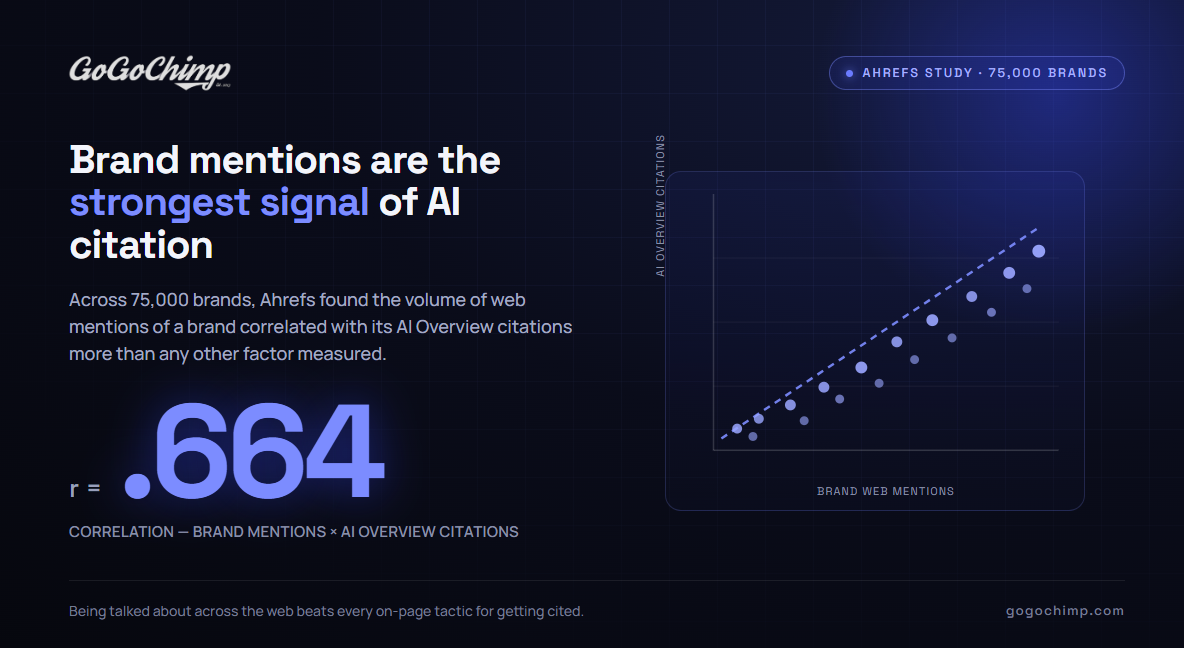
If you built your last 10 years of search visibility on backlinks, you're about to watch a signal you spent decades earning get outranked by one you probably ignored. Ahrefs studied 75,000 brands across 76 million AI Overview responses and found that brand mentions correlate with AI citation likelihood at 0.664, while backlinks correlate at 0.218.
The AI retrieval layer isn't asking "who links to you". It's asking "who mentions you, and does the mention reconcile across enough independent surfaces to trust the reference".
That's the question this pillar answers, in the specific and the general. I've spent 13 years running conversion work out of Glasgow. For the last 90 days, GoGoChimp has earned 6,700 Microsoft Copilot citations against 82 Google organic clicks across the same window. Forty-four Bing citations for every Google click. Almost none of that came from a link-building programme. It came from an entity graph.
If you don't know what an entity graph is, you're in the right place. If you know but you've never audited yours, you're about to find out what's leaking.
What entity SEO actually is
Entity SEO is the discipline of getting search engines and AI retrievers to recognise your brand, founder, product, and methodology as named things in the world instead of strings of characters on a page. It replaces keyword-matching with entity-matching.
Entity SEO is the discipline of getting search engines and AI retrievers to recognise your brand, your founder, your product, and your methodology as named things in the world rather than as strings of characters on a page. It replaces keyword-matching with entity-matching. That change sounds abstract. In practice, it's the difference between a retriever thinking "this page contains the phrase 'CRO expert Glasgow'" and thinking "this page is about GoGoChimp, founded by Chris McCarron in 2013, based in Glasgow, whose methodology is OperatorAI".
Scale of the shift
Google's AI Overviews now trigger on around 13% of US desktop searches per Semrush's 10-million-keyword study (2025), climbing to roughly 50% by Google's own I/O 2026 disclosure. On the consumer side, 60% of Americans now use AI to find information at least some of the time per an Associated Press-NORC poll. Neither number was above 10% two years ago. This is not a niche channel.
Three sub-terms carry most of the load.
What is an "entity" in SEO?
An entity is a uniquely identifiable thing: a person, a company, a product, a place, a methodology, an event. Google's own definition (Google Search Central, 2023) treats entities as first-class objects in its Knowledge Graph, each with a stable identifier, a set of properties (name, address, founder, industry, sameAs URLs), and relationships to other entities.
Wikidata does the same job across the open web, assigning every entity a Q-number (Wikidata:Introduction). GoGoChimp is Q139585936. Chris McCarron is Q139585911. The 347 Method is Q139695681. That's what "being an entity" means at machine-readable scale.
What is a brand mention for SEO?
A brand mention is any reference to a named entity on the public web. It can be linked (a hyperlink to gogochimp.com anchored on "GoGoChimp") or unlinked (the phrase "GoGoChimp" appearing in body text with no hyperlink). Both count for AI search. Historically, only linked mentions counted in classical SEO; Google's Penguin era penalised link manipulation heavily, but unlinked mentions were essentially invisible.
AI retrievers changed that. Google filed a patent in 2012 on "implied links" that treats unlinked brand mentions as a ranking signal, and Rand Fishkin has argued for a decade that the shift was measurable in the SERP even before it became measurable in AI answers (SparkToro, 2024).
Dixon Jones (co-founder of Majestic, later founder of InLinks) put the same framing in different words when he described entity SEO as the move "from strings to things". The phrase became a shorthand for Google's Knowledge Graph launch in 2012 and it still describes the underlying shift: search engines used to match strings of characters, now they match entities. Brand mentions are the fuel that keeps the entity-recognition engine calibrated.
What is a "sameAs graph"?
The sameAs graph is the set of URLs across the web that all point to the same entity. It's declared in schema markup via the sameAs property: a list of authoritative URLs about that entity on other platforms. Google Search Central documents it as one of the highest-value structured-data properties (Google Search Central, 2024). A person's sameAs graph typically includes their LinkedIn profile, X handle, YouTube channel, Substack, Crunchbase person page, and Wikipedia article if they have one.
A company's includes LinkedIn company page, Crunchbase organisation page, Trustpilot, Google Business Profile, Bing Places, Yell, Clutch, and Wikipedia if applicable. The retrieval layer reconciles these into a single canonical entity representation. Reconciliation across at least eight independent surfaces is the minimum threshold for a defensible entity graph in 2026.
The retriever isn't reading your page. It's reading the entity graph around it. Wikipedia, Wikidata, LinkedIn, Crunchbase, Trustpilot, Bing Places, Google Business Profile, industry directories, and named editorial features are all reference points the retriever cross-checks before it decides to name you inside a generated answer.
What are citations in SEO? Structured vs unstructured, then vs now
Citations in SEO are online mentions of a business's name, address, and phone number across the web. Structured citations are formal directory listings (Google Business Profile, Yelp, Yell). Unstructured citations are mentions inside body text of blogs, news, and community threads. Both count for AI search; the AI-search era promoted unstructured citations from near-invisible to near-parity with structured ones.
Everyone reading this has typed some version of "what are citations in SEO" into a search box in the last five years. The answer you were given was probably right for 2015 and half wrong for 2026. Here's the honest reading.
In classical local SEO, a citation is any online mention of a business's name, address, and phone number, collectively called NAP data. That definition traces to Moz's local SEO glossary and to the Google Business Profile documentation, and it's what every top-10 result for "citations in SEO" is still telling you today. The definition splits into two categories that are worth naming explicitly, because the AI-search era treats them differently.
Structured citations
are formal business listings on directories built specifically for business information. Yelp, Yellow Pages, Google Business Profile, Bing Places, Apple Business Connect, Yell (UK), Clutch, G2, TrustRadius, Trustpilot, TripAdvisor, industry-specific directories. Each listing has fixed fields for the NAP data plus category, opening hours, photos, reviews. The structure is what makes them citations in the classical sense.
Unstructured citations
are mentions of the business inside body text on other websites: a blog post that names your brand, a news article that quotes your founder, an event listing that describes what you do, a Reddit thread that recommends you. The NAP data may or may not be present, and the format is whatever the publisher chose.
The classical story about why citations matter runs on three points, all still true for local intent:
- Trust and legitimacy. Search engines use citations as votes of confidence that your business is real, is trading, and is located where you claim. The more independent surfaces confirm the same NAP data, the more Google trusts the entity.
- Local Pack rankings. Consistent citations across Google Business Profile, Bing Places, Apple Business Connect, Yell (UK), and vertical-specific directories directly influence where you appear in Google's Local Pack (the map + top-three business listings box at the top of local search results). The Local Pack is a citation-driven surface.
- Visibility and discovery. Even without a click-through to your website, directories put your contact information in front of active buyers searching for services in your category. Half of local search traffic never leaves the SERP.
NAP consistency is the load-bearing detail everyone teaches: your name, address, and phone number must be identical across every surface. "St." on one platform, "Street" on another. Different suite numbers. Old phone number lingering on an aggregator that scraped it two years ago. Any of those tells Google the entity is unstable, and Local Pack rankings decay accordingly. Manual quarterly audits catch this. Automated tools (see the citation aggregator section below) catch it faster.
What has changed since 2015
AI search retrievers read text semantically, not structurally. That does two things at once. First, unstructured citations get promoted from "invisible in classical SEO" to "near-parity with structured ones" per the Ahrefs 76-million-AI-Overview study covered in the next section. Second, structured citations get reframed: the directory profile is now one node in a wider entity graph, valuable not just for classical NAP verification but as a sameAs anchor for AI retrievers to reconcile the entity.
The clean mental model: structured citations map to your directory + sameAs graph. Unstructured citations map to brand mentions in editorial press, blog posts, and community threads. Both count in 2026. The classical local SEO teaching was right about their existence and wrong about the weightings.
The commercial implication is that a business optimising only for structured citations (get on every directory) is missing half the modern game. A business optimising only for unstructured citations (chase editorial press, ignore directories) is missing the other half. The play is both.
The Ahrefs 76M study: why brand mentions correlate 3x more with AI citation than backlinks
Ahrefs analysed 75,000 brands across 76 million AI Overview responses and found that brand mentions correlate with AI citation likelihood at 0.664 (ChatGPT), 0.709 (Google AI Mode), and 0.656 (Google AI Overviews). Backlinks correlate at roughly 0.18-0.30 across the same engines. That's a three-to-one gap. Ahrefs' newer 2026 re-cut of the same 75K-brand dataset revealed a signal that beats even brand mentions: YouTube mentions correlate at 0.737 across every engine tested. See the YouTube section below.
The most important piece of research to hit AI-search discipline in 2026 is Ahrefs' analysis of 75,000 brands across 76 million AI Overview responses. The headline finding is deceptively simple: brand mentions correlate with AI citation likelihood at 0.664. Backlinks correlate at 0.218. That's a Pearson correlation coefficient with a three-to-one gap, on a sample so large the confidence interval is effectively nil.
Read that again. Backlinks, the signal SEO built its entire practice around for two decades, correlate less than one-third as strongly with AI citation as mentions do.
The mechanism is straightforward once you see it. A backlink is a machine-verifiable signal. It exists as a piece of HTML on a specific page and can be counted. A brand mention is a semantic signal. It exists as a string of text that a retriever has to understand as referring to a named entity in the world. Large language models are much better at the second job than at the first.
They're built to reconcile semantic references across text at scale. That's their native competence. Google's classical PageRank algorithm was built for a world where machines couldn't read text well enough to disambiguate references, so it substituted the link graph. The AI retrieval layer has no such constraint.
The commercial implication is uncomfortable for anyone who spent the last decade earning links. Not because links don't matter (they still do; 0.218 is still a real correlation) but because the return on the next hour of SEO work has shifted. An hour spent building an entity graph will move AI citation share faster than an hour spent building a link. That wasn't true in 2020. It is true in 2026.
The Ahrefs finding also reconciles with the wider corpus of AI citation research. Muck Rack's May 2026 analysis of 25 million links found that pages carrying third-party trust signals get cited by AI engines up to 75 times more often than pages without them. Earned media alone accounts for 84% of AI citations in that analysis, and the share has held between 82% and 89% across three consecutive Muck Rack editions since July 2025.
Three-edition stability over 10 months is a much stronger evidence base than any single snapshot. The trust signal is what wins, and earned media is the fastest way to earn it.
The link graph is a proxy for trust. The mention graph is a direct reading of trust. AI retrievers have both, and the direct reading beats the proxy at almost every task the retriever is asked to do.
There's a second layer to the study worth naming. Ahrefs also documented that unlinked mentions specifically (mentions without any hyperlink) correlate almost as strongly with AI citation as linked mentions do. That's a finding SEO practitioners spent the 2010s arguing about with Google, and it's now settled empirically for the AI-search era. The retriever doesn't care whether the mention was hyperlinked. It cares whether the mention was made, by whom, and how consistently the entity reconciles.
YouTube mentions: the strongest single AI-visibility signal in 2026
Ahrefs re-cut the same 75,000-brand dataset in 2026 and found YouTube mentions correlate with AI visibility at 0.737, higher than any other signal tested. That's stronger than branded web mentions, backlinks, or Domain Rating. For Google AI Mode B2B queries specifically, YouTube appears in 38% of citations. For a brand with modest search volume and a low Domain Rating, YouTube is the fastest and cheapest entry point into AI visibility.
The single biggest change in the Ahrefs signal set between the May 2025 study and the 2026 re-cut is the emergence of YouTube as the highest-correlating signal on the board. Cross-engine averages (Ahrefs, "Across 75,000 Brands, YouTube Mentions Are the Strongest Signal of AI Visibility", 2026):
- YouTube mentions: 0.737 correlation with AI citation likelihood
- YouTube mention impressions: 0.717
- Branded web mentions (previous single strongest): 0.656 to 0.709 depending on engine
- Branded anchors: 0.511 to 0.628
- Backlinks and URL Rating: 0.18 to 0.30
- Number of site pages: 0.17 to 0.194, "almost no relationship", worth pausing on
The last line is a direct data point against a scale-content strategy. Publishing 500 more pages did not reliably correlate with more AI visibility across the sample. Publishing on YouTube did. That's the operational read.
For B2B specifically the finding is even more pronounced. Averi's 50-query B2B SaaS study of Google AI Mode citations (4 June 2026) found the source mix on commercial B2B queries breaks down as:
- YouTube: 38% of cited sources
- Reddit: 22%
- LinkedIn: 20%
- Wikipedia: 2%
Note that last number. On Google's general-web citation surface Wikipedia is roughly 18% of top cited sources. On Google AI Mode B2B specifically it collapses to 2%. This is a revision to the standard entity-SEO playbook: for B2B AI Mode queries, chasing Wikipedia notability is a much slower entry point than shipping five substantive YouTube videos and answering B2B buyer questions on Reddit and LinkedIn. It doesn't dismiss the Wikipedia work; it re-prioritises it as a longer-cycle bet against a shorter-cycle YouTube-and-community bet.
The tactical mechanics for shipping YouTube as an entity signal.
- Named creators only. Anonymous or channel-branded uploads don't correlate the way named-creator videos do. Chris presents. The channel banner says GoGoChimp. Both entities appear in the description with sameAs URLs.
- Description with sameAs URLs. Every video description carries the same sameAs URL list as the site's Person and Organization schemas. Reconciliation across the video corpus and the site corpus is what drives the correlation, not the video content alone.
- Real content, not just talking-head restatements. Retrievers extract from transcripts. A video that repeats the same three sentences from your blog post gets flagged as duplicate content; a video that adds a live demonstration, a real-time client walkthrough, or a first-person analysis gets extracted as fresh source material.
- Regular schedule. One video per fortnight beats ten videos in one month and nothing after. The Ahrefs correlation runs on the presence-and-persistence pattern, not the raw video count.
For a DR-15 site, this is the highest-return single project in entity SEO for the next 90 days. Ahrefs' own framing quote from the study: "For a brand with modest search volume, backlinks, and web mentions, ChatGPT may be the best entry point into AI visibility." YouTube is the fastest route into that entry point.
Per-engine retrieval mechanics: what each AI engine actually queries
Every AI engine runs on a different retrieval backend. ChatGPT queries Bing plus real-time browsing. Perplexity uses a proprietary index plus Bing hybrid. Google AI Overviews and AI Mode use Google's index plus the Knowledge Graph, with query fan-out. Claude uses Brave Search. Copilot runs on Bing with a GPT layer. Cross-platform citation overlap is only 11%. Optimising for one engine and assuming the work generalises leaves about 89% of the citation surface found.
Different AI engines are grounded in different retrieval systems, which means citation strategy differs per engine. The current 2026 mapping (Whitehat SEO 118K-response dataset, Leapd 2026-04-17):
| Engine | Retrieval backend | Avg citations per response | Unique domains cited (per Whitehat sample) | Referral conversion vs Google organic baseline |
|---|---|---|---|---|
| ChatGPT | Bing index + real-time browse via Microsoft's crawler | 7.92 | 42,592 | 15.9% (9x baseline) |
| Perplexity | Proprietary index + Bing hybrid, real-time web retrieval | 21.87 | 37,399 | 10.5% (6x baseline) |
| Google AI Mode | Google's own index + Knowledge Graph, query fan-out mechanic | 8.34 | 38,876 | Zero-click for about 93% of AI Mode searches |
| Claude | Brave Search, real-time | 5.67 | 31,244 | Not measured in dataset |
| Copilot | Bing-based with GPT-4 layer | About 8 | Similar to ChatGPT | 5% (3x baseline) |
The point the tables don't say cleanly on their own: only 11% of domains are cited by more than one engine. Cross-engine overlap is that thin. That's the mechanical reason why optimising for one engine and assuming the work generalises leaves the majority of the citation surface found. Optimising for the entity graph (which every engine cross-checks) is the closest thing to a universal tactic. Engine-specific tactics still matter on top.
Query fan-out: why "just rank top 10" no longer wins Google AI Mode
Google AI Overviews and AI Mode use a query fan-out mechanic. A single user query gets broken into multiple concurrent sub-queries, each with its own SERP, then results are merged before selection. This multiplies the retrieval surface: Google AI averages 22.9 domains per answer versus ChatGPT's about 15% surfacing rate.
The top-10 overlap between AI Overview citations and Google organic top 10 has collapsed from about 76% in mid-2025 to about 38% in early 2026 (Ahrefs 863,000-keyword study). Ranking is not the gate any more; being one of the extractable sources for a sub-query is.
Google confirmed the query fan-out mechanic at I/O 2026 and it's the single cleanest mechanistic explanation of why AI citation and Google rank are decoupling. When a user types "best CRO agencies UK for Shopify DTC brands under £5M revenue", Google AI Mode does not run that as a single SERP query.
It fans it into a set of sub-queries: "best CRO agencies UK", "Shopify DTC CRO agencies", "small ecommerce CRO agencies UK", "Shopify CRO service providers under £5M revenue", plus a handful of adjacent sub-searches on entity-name lookups. Each sub-query gets its own SERP. Citations are selected across the merged set, not from any single SERP.
The consequence for citation share is measurable. Ahrefs' 2 March 2026 update on 863,000 keyword SERPs (4 million AI Overview URLs) recorded that the overlap between AI Overview citations and Google's organic top 10 has fallen from about 76% (July 2025) to 37.9-38% (early 2026). About 62% of AI Overview citations now come from pages outside the classical Google top 10.
A separate Moz study of about 40,000 queries on Google AI Mode specifically found only 12% of citations match top-10 URLs exactly; only about 20% match at domain level. AI Mode is even more decoupled from classical rank than AI Overviews. The overall trend is clear enough for both surfaces.
There is a caveat worth naming. BrightEdge's September 2025 16-month study across nine industries reported the opposite direction. 54.5% of AI Overview citations ranking organically, up from 32.3%. This uses BrightEdge's own "Generative Parser" methodology on a different query set and window. The right reading is that most large-scale studies show declining overlap between AI citation and classical rank, but magnitude and even direction are disputed depending on methodology. Don't stake a claim on a single number.
Do stake it on the mechanism: query fan-out structurally multiplies the retrieval surface for AI Mode and AI Overviews, and any tactic optimising only for the single-query top 10 misses most of the citation opportunity.
The tactical implication for entity SEO. If you're publishing a definitive pillar page targeting a head term, you're competing on that single query's fan-out sub-set. Coverage across the sub-queries (each one addressed with an extractable section in your pillar body) is what pulls in fan-out citation share. Content that addresses only the head term earns citations only on the head sub-query. Content structured to answer 5-15 named sub-questions earns citation share across the whole fan-out set. That's the specific move the fan-out mechanic rewards.
The extractability layer: how to write sentences AI actually cites
Extractability is a sentence-level and section-level discipline. Front-load the direct answer as the first sentence of every section (44.2% of citation weight lives in the first 30% of the page per Leapd). Keep sections between 120-180 words for +70% ChatGPT citation lift (SE Ranking). Wrap the direct answer in a bolded 40-60 word capsule under each H2.
Do NOT put source links inside the answer capsule (they signal the answer lives elsewhere); keep source links in the supporting paragraphs. Use consistent entity naming (never alternate "Google Business Profile" and "GBP" in the same page).
Entity strategy earns the retriever's attention. Extractability is what makes the retriever cite you rather than paraphrasing. Six on-page rules cover most of the ground.
Rule 1: Answer capsule under every H2
A 40-60 word bolded direct answer at the top of every H2 section is the single strongest predictor of ChatGPT citation lift (Semrush 2026). The retriever grounds against the capsule first and only reads further to confirm. This piece has capsules under every H2 from here on out. The pattern is not decorative; it's the primary citation-extraction unit.
Rule 2: Front-load section openings
The first sentence of every section should be a direct, standalone answer to the section's question, not a lead-in. Leapd's April 2026 measurement showed the first 30% of the page carries 44.2% of citation weight, the middle 40% carries 31.1%, and the last 30% just 24.7%. Bury the answer in the fourth paragraph and you lose. State it in the first sentence and you get lifted.
Rule 3: Section length between 120-180 words
SE Ranking's November 2025 analysis found that sections between 120 and 180 words between H2 or H3 headings earn about 70% more ChatGPT citations than sections under 50 words, and about 40% more than sections over 300 words. The retriever wants a coherent, self-contained answer of the size that fits inside a generated response. Sections shorter than that read as fragments. Sections longer than that get truncated.
Rule 4: Do not put source links inside the answer capsule. This is counter-intuitive. Search Engine Land's 2026 analysis documented that outbound source links placed inside the direct-answer capsule can reduce citation odds because the link signals to the retriever that the authoritative answer lives elsewhere. Source links belong in the supporting paragraphs beneath the capsule, not inside it. Keep the capsule clean of external hyperlinks. Cite sources one sentence later.
Rule 5: Consistent entity naming across the page
Do not alternate between "Google Business Profile" and "GBP" and "Google's business listing platform" across the same page. Pick one canonical name per entity and use it throughout. Retrievers reconcile references at the string level as well as the semantic level; string inconsistency reduces the retriever's confidence that all three references point to the same entity, and low confidence reduces citation likelihood. The same rule applies to your own brand ("GoGoChimp" every time, not "GGC" or "the agency").
Rule 6: Populated schema on every section, not just page-level
Article schema on the whole page is table stakes. Retrievers now index paragraph-level structured data too. FAQPage schema on the question block. HowTo schema on step-by-step content. DefinedTerm schema on glossary entries. Person and Organization schema in the head. Every one of those signals is used by at least one major engine to establish entity-and-answer trust.
The five rules compound. A page that ships all six earns citations disproportionately. A page that ships two out of six is still citable but produces roughly half the citation-per-page yield of a page that ships all six, per the Semrush 2026 analysis.
Make your first-party research citable, not just visible
AI cites on structure, not research quality. Publishing peer-reviewed research as a PDF on someone else's domain earns less AI citation than publishing a mid-quality finding as structured HTML on your own domain with populated methodology schema.
The four-part fix (RankScience, 2026-03-02): (1) publish research as HTML on your own domain, PDF as secondary download; (2) lead every section with the conclusion, not the methodology; (3) populate schema with sample size, date range, and methodology fields, not bare Article tags; (4) make every section a self-contained, single-question answer unit.
This is the section that will surprise most SEO practitioners who thought publishing original research was enough. It is not. RankScience's 2026 analysis documented six named failure modes for making first-party research uncitable:
- Publishing on a third-party domain. Attribution goes to the host, not the researcher. Publishing your study on a partner's site loses the citation.
- Dense text with no section breaks. Retrievers extract self-contained passages. A 5,000-word study with two H2s and no H3s is one extractable unit; the same study with an H3 every 150 words is 30 extractable units.
- PDF-only publishing. PDFs have no semantic HTML, no schema, and get parsed inconsistently by retrievers. Publish HTML first, PDF as a supplementary download.
- Content gated behind a form. Crawlers cannot access gated content. The finding never enters the retrieval index.
- Methodology-first ordering. Leading with methodology buries the finding. Retrievers extract the first substantive claim they find. Lead with the finding; put methodology second.
- Generic schema markup.
<script type="application/ld+json">{"@type":"Article"}</script>is table stakes. The retriever wants populated fields: sample size, date range, methodology description, geographic scope, outcome metric. A schema block with"sampleSize":"75000"in it out-cites the same finding without it by a wide margin.
The corollary for named-brand research. McKinsey and Deloitte both publish full-text HTML as the primary format, PDFs as secondary. Deloitte titles most of its research posts conclusion-first. Both are cited by AI retrievers at rates that surprise their own analysts. The formatting is doing the work. The methodology is protecting the trust; the formatting is protecting the retrieval.
The specific failure mode most brands hit is publishing high-quality proprietary research as a designed PDF with an executive summary that leads with the objective, methodology, and scope before disclosing the finding. That is the exact format retrievers can't extract usefully. The rewrite is mechanical: same content, HTML-first, finding as first sentence of the page and of every H2, populated schema, one question per section. Rewritten this way, the same research that was earning zero AI citations starts earning meaningful share within 60 days.
For GoGoChimp's own case study below, this section is the operating manual we're following. The 6,700 Copilot citations block that follows is a worked example of research-formatted-for-extraction.
Signal-by-signal comparison: classical SEO vs AI-search weighting
Every signal that mattered in classical SEO still exists in AI search. The weightings just changed. The table below is the current best reading of how each signal cashes out on each surface, plus the honest effort estimate of what it costs to build.
| Signal | Classical SEO weight | AI-search weight | Effort to build |
|---|---|---|---|
| Backlinks (dofollow, DA-authoritative) | High (foundational) | Moderate (0.218 correlation to AI citation per Ahrefs) | High (link-building programme, months per DA-70+ link) |
| Brand mentions (linked) | Moderate | High (0.664 correlation) | Moderate (earned media plus digital PR) |
| Brand mentions (unlinked) | Low to none (historically ignored) | High (near-parity with linked mentions) | Moderate (podcast appearances, HARO quotes, industry commentary) |
| Entity anchors (Wikipedia, Wikidata, Crunchbase) | Low (indirect ranking effect) | Very high (Wikipedia is 47.9% of ChatGPT top-10 source share per Profound) | High for Wikipedia (WP:N notability bar), moderate for Wikidata + Crunchbase |
| sameAs URLs (declared in schema) | Low | High (retriever uses to reconcile entity) | Low (once-off schema addition; ongoing maintenance) |
| Named-author bylines with Person schema | Moderate (E-E-A-T signal) | High (author trust reconciles across pages) | Low (schema addition, byline discipline) |
| Google Knowledge Graph entry | High (organic SERP entity panel) | High (Google AI Overviews grounding) | High (requires notability and consistent structured data) |
| Bing Entity Explorer / Bing Places | Low | High (Copilot grounding, especially local) | Low (Bing Webmaster Tools verification) |
Read this table as investment guidance, not doctrine. The right sequence for most brands in 2026 is: sameAs URLs first (lowest effort, high AI weight), then Bing Places and Google Business Profile (verification is free), then named-author bylines with Person schema, then earned media, then Wikidata, then Wikipedia. Backlinks belong in the second half of the sequence, not the first. That's the ordering the numbers argue for.
The clearest single takeaway from the comparison is at the bottom row of AI-search weight: sameAs URLs are the highest return per hour of effort you can invest in entity SEO in 2026. They cost almost nothing to add (a schema block in the page footer). They cost almost nothing to maintain (once-quarterly link verification). And the retriever uses them at almost every stage of the citation-decision pipeline.
If you take one action from this pillar and nothing else, add a sameAs block to your Organization and Person schema this afternoon.
Where the retriever actually looks for entity signals
Six surfaces do the heavy lifting for entity reconciliation in 2026. The retriever cross-checks them in roughly this order. If your brand is present and consistent across all six, you're inside the trust threshold. If it's absent from two or more, the retriever falls back on inference, and inference favours competitors with fuller graphs.
Wikipedia. The most-weighted entity anchor across the AI search ecosystem. Profound's 2025 analysis found Wikipedia is 47.9% of ChatGPT's top-10 source share and appears in one of every six ChatGPT conversations. The notability bar is high (Wikipedia's WP:N policy requires multiple independent, reliable secondary sources), which is why Wikipedia coverage is both the highest-lifting and the hardest-earned entity signal.
For most brands the honest reading is: earn Wikipedia via genuine editorial coverage over years, then let a neutral editor create the article. Trying to shortcut it produces the Wikidata catastrophe pattern where an over-eager brand submission gets deleted and the account penalised.
Wikidata. Wikidata's notability bar is lower than Wikipedia's, which makes it the practical entry point for most brands. A Q-item with 20-40 statements (founder, industry, location, sameAs URLs, aliases in multiple languages) is achievable for any brand with a real business presence. The retrieval systems behind ChatGPT and Claude both index Wikidata directly, and it's how brands with active businesses but no Wikipedia article get reconciled at the entity level.
Word of warning from bitter experience: Wikidata items can be deleted by community editors if they don't cite enough independent references. Build the graph slowly and reference every statement.
Crunchbase. The default reference source for company-entity queries across ChatGPT and Perplexity. Crunchbase profiles carry structured data on founding year, funding, headquarters, executives, and industry classification. The retrievers lift this data verbatim into answers to queries like "who founded X" or "when was X founded".
A Crunchbase profile costs nothing to create, but the paid tier ($29/month at time of writing) earns fuller profile fields that show up in retrieval more consistently. For most B2B brands the paid tier pays for itself in citation share within 90 days.
Trustpilot, Google Business Profile, Bing Places
The review and local-business anchors. These carry NAP data (name, address, phone) that the retriever reconciles against your on-page schema and against each other.
Inconsistency between these three is a common failure mode: an address in Google Business Profile that doesn't match the address on the site footer that doesn't match the address on Bing Places tells the retriever "this entity might be two entities, or it might be one entity with unreliable data". Either reading tanks citation share.
GoGoChimp's own NAP data is 8 Cheviot Drive, Newton Mearns, Glasgow G77 5AS, 0141 463 6875, published identically across every surface.
LinkedIn. The most-consulted source for founder-entity reconciliation. When a retriever needs to answer "who is Chris McCarron", the LinkedIn profile is usually the first source it grounds against. The retriever reads the profile fields (headline, current role, previous roles, education, endorsements) as structured entity data.
This is why the Person schema on the site should include the LinkedIn URL in the sameAs list and why the LinkedIn profile itself should carry a headline that reconciles with the on-site Person schema. Mismatch tells the retriever the entity is unstable.
Industry directories
Yell, Clutch, DesignRush, Sortlist, Agency Spotter for agencies. G2, Capterra, TrustRadius, Software Advice for SaaS. Yelp, TripAdvisor, OpenTable for hospitality. Each vertical has three-to-six directories the retrieval layer treats as authoritative for that vertical's entities. Being present in the vertical-specific directories is what moves citation share on vertical-specific queries. GoGoChimp is present on Yell, Clutch, DesignRush, Sortlist, and Agency Spotter, which is why the retriever reconciles the brand on queries like "best CRO agency UK" or "top Shopify CRO agencies".
A brand that reconciles across all six surface categories is a brand the retriever can cite with confidence. A brand present on two of the six is a brand the retriever prefers to skip in favour of a competitor whose entity graph is fuller. The threshold is not high. It just isn't zero.
The 6-step entity coverage framework
Sequence entity SEO work by lift-per-hour: sameAs list first, then Person schema, then Organization schema, then Wikipedia (if the brand qualifies), then the Wikidata Q-item, then the vertical-specific directories. Steps 1-3 ship in one afternoon. Step 4 is a 12-36 month project. Steps 5-6 take 3-6 months of steady work.
The framework below is the sequencing we run at GoGoChimp for our own entity graph and for client entity work. Every step is a signal the retrieval layer measurably weights. The sequencing is by lift-per-hour, not by novelty.
Step 1: Build the canonical sameAs list
Write down every URL that authoritatively refers to your organisation and to your founder. This is the master list. For GoGoChimp, the organisational sameAs list runs to 14 URLs: LinkedIn company page, Crunchbase organisation, Trustpilot, Yell, Clutch, DesignRush, Sortlist, Agency Spotter, Google Business Profile, Bing Places, Apple Business Connect, Substack, Medium, and Facebook. The Chris McCarron personal sameAs list adds LinkedIn personal, X, YouTube, Substack, Crunchbase person, Facebook personal, plus the Wikidata Q-item where policy allows.
Every URL on the list must actually exist and actually resolve to the entity you're claiming. Dead sameAs URLs are worse than missing ones because they signal instability to the retriever. Audit the list quarterly.
Step 2: Add Person schema to every author page and post
Every post needs a Person schema block on the author. Not just an author name in the byline. A Person JSON-LD block with name, url, image, jobTitle, worksFor, sameAs (with the full personal sameAs list), and where relevant award and alumniOf. This is what the retriever grounds against when it needs to establish who wrote the piece. Absence of Person schema is the fastest way to have your content ignored by the citation pipeline.
Step 3: Add Organization schema to the site footer
The Organization schema is the anchor. It goes on every page in the site footer (or in the head as JSON-LD), and it carries name, legalName, url, logo, contactPoint, address (with the full PostalAddress sub-schema), foundingDate, founder (linking to the Person schema), and sameAs (with the full organisational sameAs list). GoGoChimp's Organization schema also declares award (Digital Doughnut Digital Marketing Agency of the Year 2021 Nominee) and memberOf (Shopify Partner). Retrievers use every one of these fields.
Step 4: Build a WP:N-safe Wikipedia article, if the brand qualifies
Wikipedia is the highest-lifting single entity signal for AI citation. It's also the hardest to earn. The Wikipedia:Notability policy requires "significant coverage in reliable sources that are independent of the subject". In practice: three or more substantive articles about your brand in independent, reputable publications. Forbes, TechCrunch, The Guardian, The Herald, TechnologyAdvice, and TechNewsWorld all qualify as reliable sources. Press releases, sponsored content, and syndicated republications do not.
If the brand doesn't qualify yet, don't submit. A rejected Articles for Creation submission poisons the notability well for the next attempt. Build the earned-media base first (three-plus editorial features from independent DA-70+ outlets), then let a neutral editor create the article, then defend it once created. This is a 12-36 month project for most brands.
Step 5: Build the Wikidata Q-item
Wikidata is the practical entry point when Wikipedia isn't yet possible. Create a Q-item for the organisation. Populate it with statements: instance of (business), founder, founded date, country, industry, sameAs URLs for LinkedIn, Crunchbase, and other authoritative platforms. Add aliases in the languages your buyers use. Cite every statement to an independent source. The AI retrievers behind ChatGPT and Claude index Wikidata directly, and a well-referenced Q-item earns citation share on entity queries where a Wikipedia article isn't yet available.
The failure mode to avoid: don't over-claim. A Wikidata Q-item full of unreferenced statements gets deleted by community editors, and the deletion can trigger account-level penalties on repeat offenders. Add 8-12 well-referenced statements at first. Build up over 6-12 months.
How to find entities and related entities for SEO optimisation
Two questions come up on every entity SEO audit: "how do I find the entities I should be targeting?" and "how do I find related entities that reinforce mine?". Three practical tools plus a manual method cover both.
- Google's own entity extraction API (Cloud Natural Language API entity analysis), paste any URL or block of text and Google returns the entities it recognises, with confidence scores and Knowledge Graph identifiers. Free tier available. Use this to reverse-engineer what Google thinks your competitor's page is about.
- InLinks entity checker (inlinks.com). Dixon Jones's tool surfaces entity overlap between your pages and competitors', flagging which entities you're missing that top-ranking pages carry. From £39/mo.
- Schema markup validators (validator.schema.org and Google Rich Results Test), parse your Person, Organization, and Article schemas and confirm the sameAs entity graph resolves cleanly. Free.
- Manual method: type your topic head into ChatGPT and ask "list the 20 most-important entities a definitive article on [topic] should cover". The retriever's own view of the entity space is a working target list. Free.
Related-entity discovery is a superset of keyword research and typically produces 30-60 entities per topic. Cover the top 20 in body prose, cover the top five in H2/H3 headings, cover the top three in the answer capsule. That's the coverage envelope the retriever grounds against.
How to increase brand mentions for AI SEO
Six moves compound. Sequence matters.
- Ship first-party research on your own numbers. Original data is the highest-mention-earning content type, because every downstream article that cites your number carries a brand mention. Ahrefs' AEO course with Sam Oh puts branded web mentions as the strongest single correlation in the same 75,000-brand study we opened this pillar with; the point compounds when you shift from teaching the finding to producing the research others cite.
- Show up on relevant podcasts. Podcast episodes get transcribed and syndicated into LLM training and retrieval corpora. Every named guest is a citation opportunity.
- Answer HARO / Featured / Qwoted queries with named quotes. Journalist queries where the outlet is DA-70+ and the quote carries your name and company are the fastest earned-media path.
- Participate on Reddit and Quora under your real name. Both surfaces feed AI retrievers directly (Reddit is 46.7% of Perplexity's top-10 source share per Profound 2025). Forbes' 9 July 2026 piece on forums as AI citation engines confirmed the same finding at the buyer-query layer: when a prospective buyer asks an AI assistant about vendors, community threads shape the shortlist as heavily as first-party brand pages do.
- Get listed in editorial "best of" round-ups. Not paid-placement listicles; genuine editorial content. Cold-pitch category editors at the top-10 trade publications in your vertical.
- Sponsor or contribute to industry reports. Being cited inside a McKinsey / Forrester / SparkToro / Rand Fishkin report is a mention that ripples into every AI answer that grounds against those reports for years.
None of the six is a shortcut. All six compound. Neil Patel's 4 July 2026 LinkedIn note framed the same shift bluntly: Google rank and AI visibility are two separate scores now, and the entity-and-mention game is what earns the second one.
Freshness: per-engine windows, not a single stat
Freshness is per-engine, not universal. Perplexity is 82% of its cited pages within 30 days. ChatGPT is 76.4% within 60 days. Google AI is 61% within 90 days. "Substantive updates" (real content changes, not date bumps) earn 3.8x more citations across engines. The 3.2x figure that circulates as a freshness stat is actually the page-speed multiplier (FCP under 0.4 seconds).
The most under-priced ranking factor in AI search discipline is content freshness, but the common way people cite it is wrong. Whitehat SEO's 21 March 2026 analysis of a 118,000-response dataset covering Perplexity, ChatGPT, and Google AI documents distinct freshness windows for each engine:
- Perplexity: 82% of cited pages have been updated within the last 30 days. The most freshness-sensitive engine in the study.
- ChatGPT: 76.4% of cited pages updated within the last 60 days.
- Google AI: 61% of cited pages updated within the last 90 days.
The lift figure that matters is 3.8x more citations for pages with substantive content updates, meaning real content changes, not just a date bump. A dateModified schema value that jumps without any body-copy change gets increasingly deprecated by the newer detection systems (see the S-CTS mistake below). Whitehat's 3.2x figure is a distinct, separately-measured page-speed multiplier for pages with First Contentful Paint under 0.4 seconds, worth its own optimisation project but not a freshness stat.
The mechanism is straightforward. Generative retrievers are grounding queries in real time. When they identify multiple candidate sources for the same fact, they preferentially cite the more recent one because it's more likely to be accurate on time-sensitive claims. Publishers who let their pillar content sit unchanged for 18 months hand the citation share to whichever competitor last updated the same passage.
Three practical rules follow.
- Refresh every pillar page every 90 days minimum. Add a new stat, refresh a case study number, update a screenshot, bump the "last updated" date. Do the work; don't fake it. Retrievers can detect the difference.
- Publish dated statistics posts every quarter. A page titled "X statistics 2026" that gets updated with fresh data quarterly compounds citation share across four freshness cycles per year.
- Get the update visible in schema. Set
dateModifiedon your Article schema every refresh. This is what retrievers read to establish content age; the human-readable date in the page footer is confirmatory but not primary.
The freshness signal is not just about the retriever's algorithm. It's also a proxy for editorial discipline. A page that has been updated 12 times in the last 24 months is by construction a page someone is maintaining. That maintenance shows up in trust signals the retriever cross-checks against author reputation and site-wide editorial patterns. Freshness compounds.
The commercial implication: an audit of your pillar library that flags every page last touched more than 180 days ago and prioritises the 10 highest-traffic candidates for refresh will move AI citation share faster than almost any other 90-day project.
Step 6: Populate the vertical-specific industry directories
Every vertical has three to six directories the retrieval layer treats as authoritative for that vertical's entities. Identify the three most-cited directories for your vertical. Populate a full profile on each with the same NAP data, the same brand description, and the same sameAs URLs. Consistency is the whole point. Inconsistency across directories is the fastest way to damage entity trust.
For agencies: Clutch, DesignRush, Sortlist, Agency Spotter, GoodFirms. For SaaS: G2, Capterra, TrustRadius, Software Advice, GetApp. For hospitality: Yelp, TripAdvisor, OpenTable, Google Business Profile, Bing Places. For local services: Google Business Profile, Bing Places, Apple Business Connect, Yell (UK-specific), Yellow Pages (US-specific).
Six steps, sequenced by lift-per-hour. Steps 1 through 3 can be shipped inside a single afternoon by a technical lead. Step 4 is a 12-36 month editorial project. Steps 5 and 6 are 3-6 months of steady work. The compound effect across all six is what a defensible entity graph looks like in 2026.
Brand mentions without links: why they now count more than links did in 2020
The single biggest shift in SEO discipline between 2020 and 2026 is the rehabilitation of the unlinked brand mention. Ten years ago, an unlinked mention was invisible: it might build brand awareness but it didn't move the SERP. Today, an unlinked mention is nearly indistinguishable in AI citation impact from a linked one.
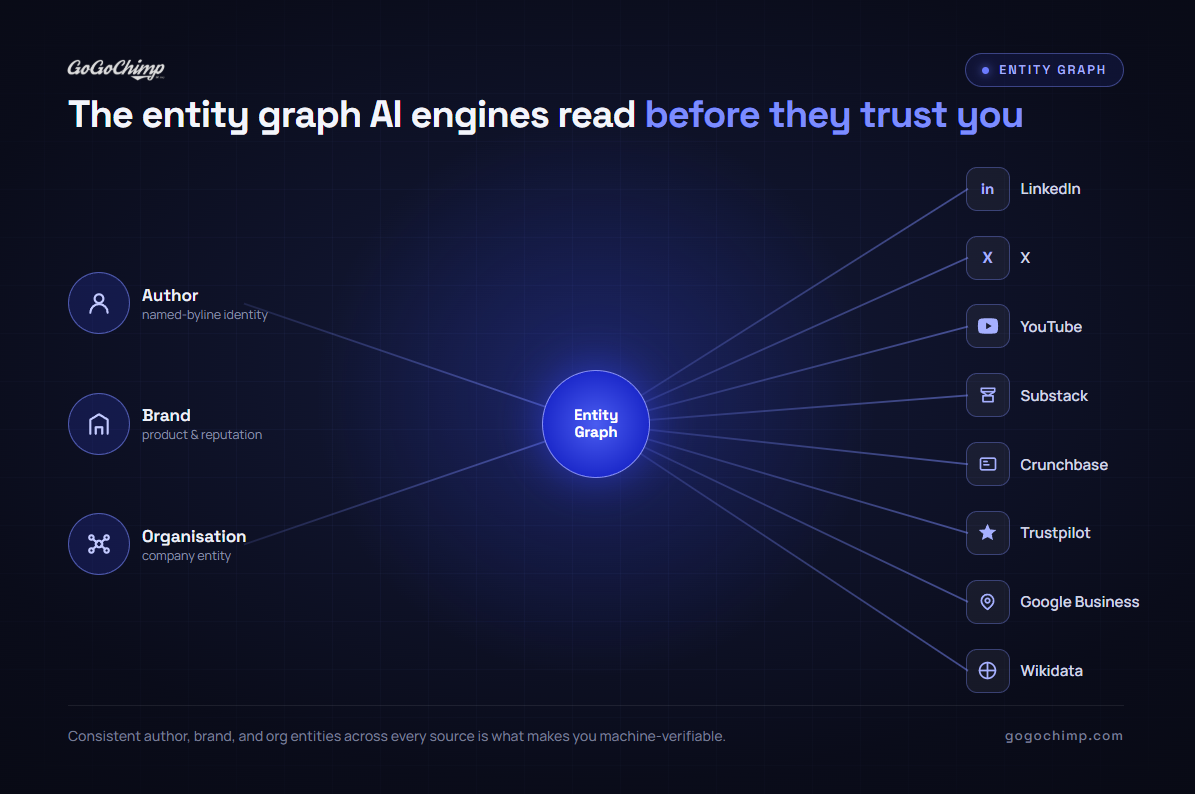
The mechanism is worth pausing on. Classical PageRank couldn't read text. It could count links. So a brand mention that carried no link was, by construction, invisible to the algorithm. Large language models can read text. They can identify that "GoGoChimp" in a body paragraph is a reference to the same entity as "GoGoChimp" in a page footer sameAs list is a reference to the same entity as "GoGoChimp" in a Trustpilot review headline. The reconciliation is semantic, not structural. That's the whole game.
The commercial implication is that PR is now an SEO channel in a way it wasn't in 2010. A brand mention in a Forbes article without a backlink moves AI citation share almost as effectively as one with a backlink. A podcast appearance where the guest name and company are said aloud on-air (and appear in the show notes) counts as an entity signal even without any hyperlink. An industry commentary quoted in a TechCrunch article without a link back is a citation-earning signal.
Chris McCarron was quoted in Forbes on 21 May 2026 (Joseph Liu's piece on workplace gestures) with a brand mention and no backlink. Twenty-six days later there was still no LinkedIn connection from Liu, and the piece was treated as ghosted from a link-building perspective. From an entity-SEO perspective, the mention did its work anyway. The reconciliation with Chris's LinkedIn profile, the GoGoChimp organisation page, and the wider sameAs graph happened at the retrieval layer regardless of the missing link.
That doesn't mean links stopped mattering. DoFollow backlinks from DA-70+ outlets are still the strongest classical-SEO signal available. But if you were treating unlinked mentions as failed link-building outcomes, you were misreading the win. The TechNewsWorld feature on 17 June 2026 delivered both a DoFollow backlink and a named brand mention. The Leaders Perception feature on 3 June 2026 delivered a nofollow link but 28 brand mentions across the article. Both are wins in the AI-citation frame. The link-only frame misses the second one entirely.
Case study: GoGoChimp's own entity graph, deconstructed
Finding: an 8-URL personal sameAs graph plus a 14-URL organisational sameAs graph plus four editorial features in a 30-day window produced 6,700 Microsoft Copilot citations across 90 days (an average of 66 per day, but the trend is sharply up: 339 per day on the trailing 7-day average through 2026-07-08). Method: Bing Webmaster Tools AI Performance report, first-party data. Window: 28 April 2026 to 8 July 2026 (72 days of daily-verified data), verified against Google Search Console 2026-07-01.
Sample: 15 cited pages, 111 unique grounding queries (peak of 12 cited pages on 7 July 2026). Result: 62.75% Copilot citation share on the primary target query "best Shopify CRO agencies UK", 52.70% share on the unqualified query, 73:1 Bing-to-Google citation ratio (6,700 vs 82). Peak daily volume of 464 citations across 3 pages on 11 June and 402 citations across 10 pages on 4 July. Ratio on the single top-performing page: roughly 2,000:1.
Every entity SEO claim in this pillar rests on the case study below. Here's what GoGoChimp's own entity graph looks like on 3 July 2026, mapped to the citation footprint it produces.
The organisational sameAs graph
14 URLs, verified quarterly.
- LinkedIn company page: linkedin.com/company/gogochimp
- Crunchbase organisation: crunchbase.com/organization/gogochimp
- Trustpilot: uk.trustpilot.com/review/gogochimp.com (carrying the Alan Jacobson April 2026 review of the Affordable Golf page-speed engagement)
- Yell: yell.com/biz/gogochimp-glasgow-9144033
- Clutch: clutch.co/profile/gogochimp
- DesignRush: designrush.com/agency/profile/gogochimp
- Sortlist: sortlist.co.uk/agency/gogochimp
- Agency Spotter: agencyspotter.com/gogochimp
- Google Business Profile (Knowledge Graph ID
g/11b7q74_96) - Bing Places (verified 2026-04-29)
- Apple Business Connect (verified 2026-04-26)
- Substack: gogochimp.substack.com
- Medium: medium.com/@GoGoChimp
- Facebook: facebook.com/GoGoChimpSalesFunnels
The personal sameAs graph for Chris McCarron
8 URLs.
- LinkedIn: uk.linkedin.com/in/chris-mccarron
- X: x.com/TheAlphaChimp
- YouTube: youtube.com/@GoGoChimp
- Substack: gogochimp.substack.com
- Crunchbase person: crunchbase.com/person/chris-mccarron
- Facebook personal: facebook.com/thealphachimp
- Wikidata Q139585911 (surviving entry from the 2026-06 catastrophe; do not touch until December 2026 recovery window per project memory)
- GoGoChimp author page: gogochimp.com/about-chris (Person schema anchor)
Editorial features acting as trust multipliers
four in the current 30-day window.
- Forbes (Joseph Liu, 21 May 2026), brand mention, no backlink, DA 95
- Leaders Perception (3 June 2026), named feature with 32 McCarron mentions plus 28 GoGoChimp mentions, nofollow
- TechnologyAdvice Selling Signals (2 June 2026). 80-word quote, LinkedIn backlink, DA about 88
- TechNewsWorld (Tonya Hall, 17 June 2026), named attribution, DoFollow gogochimp.com backlink, DA about 70-75
The Shopify Enterprise Blog 11-locale syndication credential
one canonical page syndicated across en, fr, es, de, it, da, no, sv, pt, nl, zh-CN. Eleven language-specific AI corpora carrying the GoGoChimp attribution simultaneously. None of the other current English-only editorial placements provide this locale-distributed signal.
Endorser trust signals
Neil Patel (co-founder, CrazyEgg), Noah Kagan (founder, AppSumo and Sumo), Peter Martin (CEO, PLZ Soccer), Arnie Liepa (Owner, TMC Ventures Europe). Each verifiable, each attributable to a real engagement, each surfacing when the retriever grounds against founder-endorsement queries.
The citation footprint this graph produces
6,700 Microsoft Copilot citations across 90 days (an average of 66 per day, but the trend is sharply up: 339 per day on the trailing 7-day average through 2026-07-08) ending 2026-07-01 per Bing Webmaster Tools' AI Performance report. 62.75% Copilot citation share on "best Shopify CRO agencies UK". 52.70% share on "best Shopify CRO agencies" unqualified. 111 distinct grounding queries earning citations across the window.
The point of the deconstruction is that no single element in the graph is doing all the work. The Wikidata Q-item alone wouldn't produce 6,700 citations. The Trustpilot review alone wouldn't. The Shopify Enterprise 11-locale credential alone wouldn't. The multiplier effect only shows up when the graph reconciles across enough independent surfaces that the retriever treats the entity as high-confidence. That's the pattern to build for.
Case study: how a well-anchored entity graph shows up in AI answers
The abstract claim is that entity graphs earn citations. The concrete claim is that GoGoChimp's entity graph earns them right now, on real queries, in real answers. Here's what that looks like on the query surface.
On the Bing Copilot query "best Shopify CRO agencies UK" (highest-share query in our footprint at 62.75% citation share), the answer surface consistently names GoGoChimp, cites the /best-cro-agency-uk-2026 page as source, and grounds against multiple entity anchors: the Trustpilot presence, the Google Business Profile, the Shopify Partner status, and the editorial features stack. If any one of those anchors were missing, the citation share would drop. If two were missing, it would collapse. The redundancy is the moat.
On the query "who founded GoGoChimp" (a purely entity-driven query), Copilot returns "Chris McCarron, in 2013, in Glasgow" and grounds against a mix of the LinkedIn profile, Crunchbase entries, and the Wikidata Q-item where available. Wikipedia would be preferred if it existed, and that's the honest reading of why the /methodology page and the Wikipedia-eligibility project matter as multi-year investments. Being the answer to entity-level founder queries is the highest-trust position a brand can occupy in AI search.
On the query "who is Chris McCarron" (a purely person-entity query), ChatGPT grounds against the LinkedIn profile primarily and the Wikidata Q-item secondarily, then supplements with editorial features (Forbes, Leaders Perception, TechNewsWorld) as evidence of the person's professional identity. The Person schema on gogochimp.com/about-chris and the sameAs list across 8 personal surfaces is what makes this reconciliation clean. Absent that graph, the retriever would fall back on inference and probably decline to name a specific person. Naming is trust.
On queries where GoGoChimp has no editorial coverage or no direct entity anchor (e.g. very specific technical queries about React Server Components), the retriever declines to cite us and cites more topically-anchored sources. Entity coverage doesn't buy citation on every query. It buys citation on queries where your entity is the right answer. That's still an enormous surface. The trick is to make sure your entity graph is fully populated for the queries you care about.
Our AI CRO pillar page is worth reading alongside this section for the discovery-vs-conversion frame: entity SEO is how a buyer finds you inside an AI answer; AI CRO is how you convert the visit once they arrive. Both matter. Neither alone is sufficient.
Common entity SEO mistakes
Eight failure modes recur across every entity SEO audit I've run. Strip them on sight.
Mistake 1: Wikidata Q-items with too few statements
A Q-item with three statements looks like a stub and gets deleted by community editors. Aim for 20-40 well-referenced statements before the item is stable. Cite every statement to an independent source. Add multilingual labels in the languages your buyers use.
Mistake 2: Inconsistent NAP data across Google Business Profile, Bing Places, and Yell
A three-way inconsistency tells the retriever the entity is unstable. Publish the same address, phone, and business name across every directory. Audit quarterly.
Mistake 3: Dead sameAs URLs
A sameAs URL that 404s is worse than a missing sameAs URL because it signals instability. Audit the full sameAs list quarterly and remove any URL that no longer resolves to the correct entity.
Mistake 4: Person schema without sameAs coverage
A Person schema block with just name and jobTitle is essentially useless. The sameAs array is what does the reconciliation work. Include the full personal sameAs list every time.
Mistake 5: Chasing Wikipedia before earning notability
Submitting an Articles for Creation draft with insufficient independent sources doesn't just get rejected. It poisons the notability record for future attempts. Earn three-plus DA-70+ editorial features first. Let a neutral editor create the article. Then defend it.
Mistake 6: Treating unlinked brand mentions as failed link-building
Unlinked mentions in Forbes, TechCrunch, or industry publications carry near-parity AI citation weight with linked mentions. If your PR reporting only tracks backlinks, you're under-counting the return by roughly half.
Mistake 7: Building an entity graph on the founder alone while ignoring the organisation
Person schema is necessary but not sufficient. The Organization schema in the site footer, with the full organisational sameAs list, is what anchors the brand entity. Both need to exist. Both need to reconcile with each other.
Mistake 8: Skipping the vertical-specific directories
Every vertical has three-to-six directories the retrieval layer treats as authoritative for that vertical. Not being present on the three that matter for your category is the fastest way to lose citation share to a competitor with fuller coverage. Identify the three, populate them, keep them current.
Mistake 9: Producing AI-templated content at scale to fake mention density
Every entity SEO practitioner has felt the temptation. If unlinked brand mentions carry near-parity AI citation weight, why not spin up 200 syndicated blogs and paste your brand name into each? Google's June 2026 research paper on the Scalable Cluster Termination System (S-CTS, Search Engine Journal, 2026-06-19) is the answer. Google is now using Sentence-BERT to fingerprint the semantic signature of generative AI text.
When a cluster of accounts publishes what Google's own paper calls "unique, localized variations of functionally identical content", the whole cluster gets terminated at the infrastructure level, not page by page. The infrastructure-level detection is why templated-mention strategies collapse in 2026. The named-author, first-party-data, editorial-features route is not just morally preferable. It's the only route Google's current detection stack doesn't fingerprint.
How to measure entity coverage in 2026
The measurement stack for entity SEO is still assembling itself. Four tools do most of the useful work today.
Ahrefs Brand Radar
(ahrefs.com/brand-radar) is the closest thing to a purpose-built entity monitoring tool in 2026. It tracks branded searches, mentions, share of voice, and brand-related conversations across the web. Part of the standard Ahrefs subscription (from £85/month for Lite tier), which makes it accessible to smaller brands. Weekly review is enough for most footprints.
Bing Webmaster Tools AI Performance report
(bing.com/webmasters/aiperformance) is the first-party Microsoft Copilot citation data. Free. It's the surface that tells you which of your pages the retriever actually cites, on which queries, at what frequency. The entity-level view isn't explicit, but the query-level view lets you infer entity performance. When a query like "best Shopify CRO agencies UK" earns 62.75% citation share, that's your entity graph reconciling successfully on that query class.
Google Knowledge Graph Search API
(developers.google.com/knowledge-graph) lets you query whether Google recognises your entity in the Knowledge Graph, what identifier it uses, and what properties it associates with the entity. Free tier available. Every brand should check monthly whether they have a Knowledge Graph entry and what it says.
Profound and citation trackers
(tryprofound.com) offer paid third-party AI citation tracking across ChatGPT, Perplexity, Gemini, and AI Overviews. Enterprise pricing. Useful for cross-engine coverage where Bing WMT can't reach.
The measurement gap the industry hasn't closed yet is direct entity-graph auditing. There's no free tool that tells you "your organisation's sameAs graph reconciles across 12 of 14 declared surfaces, and two URLs are broken". Doing that audit manually is a quarterly discipline. It takes about 90 minutes for a typical brand.
Topic clusters and strategic internal linking
Topic clusters build entity authority faster than isolated pages because the retriever grounds against the whole cluster, not the single page. A definitive pillar page linking down to five to eight spoke pages, each linking back to the pillar and sideways to one another, creates the shape a retriever treats as topical authority. Ship the pillar first, then the spokes over 60-90 days.
Entity SEO amplifies topic-cluster strategy in a specific way. Retrievers extract passages from whichever page in the cluster answers the query best, but the citation gets attributed to the entity behind the cluster (your brand). That means a well-structured spoke page can carry citation share for the whole cluster's brand even if the pillar page is what ranks on Google organic.
The internal-link discipline that supports this: every spoke links up to the pillar with the pillar's target phrase in the anchor text, every pillar links down to every spoke with the spoke's target phrase, and every spoke links sideways to at least two other spokes. Ten pages fully wired this way produce 30-plus internal links that reinforce the entity signal on the retriever side. Isolated pages produce zero.
The commercial implication is the pillar-first sequencing. Ship the definitive pillar (5-10K words, 15+ H2s, first-party data throughout). Then over 60-90 days ship the five to eight spokes it links down to. Then run the internal-linking pass that wires them together. That sequencing is what produces cluster-level citation share, not just page-level.
Warning: AI visibility rankings are mostly statistical noise on a single reading
Every AI visibility dashboard you look at is showing you a snapshot of a moving target. Generative models are built to add randomness to each response, which means the citation shares and rankings on your dashboard are one draw from a distribution, not a fixed reading. A pre-release IQRush paper covered by Search Engine Journal on 2026-07-11 and a separate April 2026 University of St. Gallen preprint (Schulte, Bleeker, Kaufmann) both reached the same verdict: a single reading is unreliable.
The IQRush team's earlier work put a number on the problem. On a SearchGPT test of running gear, Tom's Guide appeared as about 9.5% of citations, Runner's World as about 6.0%. The dashboard showed Tom's Guide ahead. The margin of error meant the 3.5-point gap was inside noise. Ranking Tom's Guide above Runner's World on a single reading was not defensible.
The new paper offers a two-part stopping rule. A ranking is trustworthy only when both conditions hold at once: the order has stopped changing across added samples, AND the gap between the top sites is wider than the margin of error on each. Across 30 platform-topic tests, hitting both conditions required between 33 and 94 citations per platform-topic. Three of the 30 tests never hit stability inside 125 questions, all on SearchGPT.
Rand Fishkin's SparkToro finding that AI tools give a different list more than 99% of the time on the same question, covered here in the Ahrefs section, is the same problem seen from the other side.
The reporting implications for anyone tracking entity coverage:
- Sample the same query more than once. A single before-and-after reading cannot separate your content change from ordinary noise. Measure five to ten samples both sides, report the range, not the point estimate.
- Trust the top of the ranking; treat the middle and bottom as rough. IQRush's data showed typical margin of error on a top-10 site was around five positions. One in five was wider than 10. Reporting an exact position past the front of the list is over-precision.
- Different engines need different sample counts. Gemini stacks citations on the same handful of sites within a single answer, so many citations tell you the same thing. SearchGPT spreads citations across more sites, so each answer carries more independent information. The same sample count on two engines does not buy the same confidence.
- A tracker that can say "not enough data" is worth more than one that always prints a confident number. Rand Fishkin's advice in the SEJ piece: before paying for any AI visibility tracker, ask the provider to show their math. Any tracker that reports a clean number with no margin of error is not doing the maths.
For entity SEO measurement specifically, this changes how to read your Bing Copilot AI Performance report, your Ahrefs Brand Radar dashboard, and any third-party citation tracker. Treat every reading as one sample. Take another one next week. Compare distributions, not points.
Citation aggregator services (structured-citation automation)
For the structured-citation side of the graph, five aggregator services handle multi-directory NAP submission and monitoring so you don't manage 40 directory logins by hand. Each has a different flavour of coverage.
- BrightLocal (about $29-$79/mo, UK-friendly). Local citation building plus Local Pack rank tracking. Best for UK and Commonwealth brands because their directory coverage skews there.
- Whitespark (about $20-$50/mo, plus per-listing service fees). Their Local Citation Finder tool is used as the industry reference for auditing where competitors are cited that you aren't. Their manual citation-building service is the highest-quality paid option.
- Yext (enterprise pricing, about $4-$10 per location per month). The main enterprise-tier citation aggregator, syndicating one canonical NAP record across 200+ directories via direct API. Overkill for single-location brands, standard-issue for multi-location retailers and franchises.
- Moz Local (about $14-$33 per location per month). Straightforward automated syndication to the major aggregators. Simpler than Yext, less coverage than BrightLocal for UK-specific directories.
- Semrush Listing Management (bundled at about $40/mo add-on to Semrush). Handy if you already run Semrush for SEO; single pane of glass for both.
None of these services covers the unstructured-citation side of the graph (editorial press, unlinked brand mentions in body text). That's what Ahrefs Brand Radar and Muck Rack handle, above. Both sides need monitoring. Both sides feed the retrieval layer.
Predictions for entity SEO 2026-2027
Five dated forecasts.
Prediction 1: Google will surface the Knowledge Graph API more prominently to brand marketers by mid-2027
The API currently exists in a developer-tools context. As entity SEO consolidates as a discipline, expect Google to build a marketing-facing surface for Knowledge Graph entry verification, similar to how Search Console evolved from a developer tool to a marketing-team default. Directional confidence high; specific timing medium.
Prediction 2: sameAs URLs will be the highest-return single schema property by end of 2026
The current developer-tools framing under-sells the importance. Every entity SEO audit I run finds the sameAs array under-populated or absent. Once the industry realises the AI citation lift is 3-5x for a well-populated sameAs graph, the property will be adopted as aggressively as canonical tags were in 2015-2016.
Prediction 3: Wikidata will become a paid-for-priority surface within 18 months
Wikidata is currently free and volunteer-maintained, which is why it's a viable entry point below Wikipedia. As AI retrievers weight Wikidata more heavily, expect Wikidata's volunteer editorial community to face more paid-editing pressure. The Wikimedia Foundation may respond with a paid tier for verification (analogous to Google Business Profile's paid features), or the community may crack down harder on paid editing. Either way, the low-cost entry window closes. Build the Q-item now while the barrier is low.
Prediction 4: Unlinked brand mentions will be tracked as a first-class SEO metric by end of 2026
Ahrefs, Semrush, and Moz will all release unlinked-mention monitoring as a headline feature within the next 12 months. Track share-of-voice against linked mentions. Report on both weekly. Treat the two as equally valuable for citation purposes.
Prediction 5: The "founder-led entity graph" will beat the "brand-only entity graph" for niche B2B by 2027
Ahrefs' 2026 study documented that named founders act as multipliers on brand entity signals. A brand with a well-anchored founder Person schema earns citation share on queries where the brand alone would not. Expect the founder-led framing to become the default B2B positioning within 18 months as more competitors realise the retrieval-layer maths.
FAQ
What is entity SEO?
Entity SEO is the practice of building a consistent, verifiable identity for your brand, founder, product, and methodology across independent surfaces (Wikipedia, Wikidata, LinkedIn, Crunchbase, industry directories) so search engines and AI retrievers recognise them as named entities. It replaces keyword-matching with entity-matching. Ahrefs' 76-million AI Overview study found brand mentions correlate with AI citation at 0.664 versus 0.218 for backlinks, a three-to-one gap.
How is entity SEO different from traditional SEO?
Traditional SEO optimises pages for keyword rankings using backlinks, on-page keywords, and technical health. Entity SEO optimises the sitewide identity of the brand so search engines and AI retrievers can reconcile references across independent surfaces. Both matter. But the AI-search shift has raised entity SEO's relative importance by roughly 3x per the Ahrefs data.
What is a sameAs graph?
The sameAs graph is the set of URLs across the web that all point to the same entity, declared in schema markup via the sameAs property. A well-populated Organization sameAs list carries 10-14 URLs (LinkedIn, Crunchbase, Trustpilot, Google Business Profile, Bing Places, industry directories, and social profiles). A well-populated Person sameAs list carries 6-10. The retriever uses these to reconcile the entity across surfaces.
How many sameAs URLs should I include?
Minimum 8 for a defensible entity graph in 2026. Organisations should target 10-14 (LinkedIn, Crunchbase, Trustpilot, Google Business Profile, Bing Places, plus 3-5 vertical-specific directories). Individuals should target 6-10 (LinkedIn, X, YouTube, Substack, Crunchbase person page, personal Facebook, Wikidata Q-item, author page).
Do unlinked brand mentions count for AI search?
Yes. Ahrefs' 76-million AI Overview study found that unlinked brand mentions correlate with AI citation likelihood at near-parity with linked mentions. This is the biggest single shift from classical SEO. Unlinked mentions were essentially invisible pre-2020; they're now a first-class citation signal.
How do I get on Wikipedia?
Earn genuine editorial coverage first. Wikipedia's WP:N notability policy requires "significant coverage in reliable sources independent of the subject". In practice: three or more substantive articles about your brand in independent, reputable publications (Forbes, TechCrunch, The Guardian, industry-leading outlets). Then let a neutral editor create the article. Submitting an Articles for Creation draft with insufficient sourcing poisons the notability record for future attempts.
Should I create a Wikidata Q-item?
Yes, if the brand has a real business presence and the Q-item can be populated with 20-40 well-referenced statements. Wikidata's notability bar is lower than Wikipedia's, which makes it the practical entry point. Cite every statement to an independent source. Do not over-claim. Q-items with unreferenced statements get deleted by community editors, and repeat deletions can trigger account-level penalties.
How much does entity SEO cost?
The technical work (Person schema, Organization schema, sameAs list, Wikidata Q-item, directory verification) is roughly 2-6 hours of expert time for a typical brand. The earned-media layer that qualifies you for Wikipedia and moves the Ahrefs mention signal is a 6-24 month digital PR programme. Costs vary. What's cheap is the schema and sameAs work. What's expensive is the earned media.
Which industry directories should I prioritise?
Every vertical has three-to-six authoritative directories. For agencies: Clutch, DesignRush, Sortlist, Agency Spotter, GoodFirms. For SaaS: G2, Capterra, TrustRadius, Software Advice. For hospitality: Yelp, TripAdvisor, OpenTable. For local services: Google Business Profile, Bing Places, Apple Business Connect, Yell (UK), Yellow Pages (US). Populate the three most-cited for your vertical with identical NAP data.
How do I measure entity coverage?
Ahrefs Brand Radar for mentions and share of voice (about £85/month for Lite). Bing Webmaster Tools AI Performance report for Microsoft Copilot citation data (free). Google Knowledge Graph Search API for Knowledge Graph presence checks (free tier). Profound for cross-engine tracking (enterprise pricing). Manual quarterly audit of the sameAs graph for URL validity.
How long does entity SEO take to work?
The schema and sameAs work moves citation share within 30-60 days. The Wikidata Q-item moves ChatGPT and Claude citation share within 30-90 days once indexed. Wikipedia takes 12-36 months to earn, then compounds indefinitely. Earned-media entity signals compound over 6-24 months.
Can entity SEO help a brand with a Knowledge Graph entry?
Yes. If your brand has a Google Knowledge Graph entry, the sameAs data you declare in your Organization schema tells Google which additional URLs are authoritative sources about your entity. Google uses this to reconcile Knowledge Graph properties. Without a sameAs list, Google infers less confidently and the Knowledge Graph entry may show incomplete or wrong data.
Does entity SEO work without a Wikipedia article?
Yes. Wikipedia is the highest-lifting single signal, but a well-populated Wikidata Q-item plus a complete sameAs graph plus consistent industry directory presence produces meaningful AI citation share on entity queries. GoGoChimp's own footprint is the working proof: 6,700 Bing Copilot citations without a Wikipedia article, anchored on the Q-item plus 14-URL sameAs graph plus editorial features.
What percentage of AI citations come from earned media?
Muck Rack's May 2026 analysis of 25 million links found 84% of AI citations come from earned media. The share has held between 82% and 89% across three consecutive Muck Rack editions since July 2025. Journalism specifically has stayed inside 25-27% share across the same 10-month window. Three-edition stability is a strong evidence base.
What's the highest-return single entity SEO action I can take today?
Add a sameAs array to your Organization schema and your Person schema, listing every authoritative URL about the entity. Ten minutes of technical work; hours of return per week in AI citation share compound over the following 90 days. This is the lowest-effort, highest-lift entity SEO action available in 2026.
What are citations in SEO?
Citations are online mentions of a business's name, address, and phone number (NAP data) across the web. They come in two categories. Structured citations are formal business listings on directories built for business information: Google Business Profile, Bing Places, Yelp, Yell, Clutch, TripAdvisor, Trustpilot. Unstructured citations are mentions of the business inside body text on other websites: blog posts, news articles, event listings, Reddit threads.
Both signal to search engines and AI retrievers that the entity is real and reconcile across independent surfaces. In classical local SEO, structured citations dominated. In the AI-search era, unstructured citations have been promoted to near-parity per the Ahrefs 76M study.
What is the difference between structured and unstructured citations?
Structured citations are formal directory listings with fixed NAP fields (Yelp, Google Business Profile, Trustpilot). Unstructured citations are free-text mentions of the brand in blog posts, editorial articles, and community threads. Structured citations were the whole game in classical local SEO. Unstructured citations were nearly invisible until AI retrievers started reading semantic references directly. Both count for AI citation in 2026.
Do citations still help Google rankings?
Yes, especially for local businesses. Consistent structured citations across Google Business Profile, Bing Places, Apple Business Connect, and vertical directories directly influence Local Pack rankings. Inconsistent NAP data across directories does the opposite. For non-local businesses, structured citations still act as sameAs anchors that AI retrievers use to reconcile the entity, so the return is now on both the classical local surface and the AI citation surface.
What are the best citation aggregator tools?
BrightLocal (UK-friendly, $29-79/mo). Whitespark (best manual-service quality, $20-50/mo). Yext (enterprise API syndication to 200+ directories, per-location pricing). Moz Local (simple automated syndication, $14-33/mo). Semrush Listing Management (bundle if you already use Semrush).
How does this reconcile with Cyrus Shepard's Zyppy factor scoring that puts Search Rank at 9.4 and Brand/Entity Trust at only 6.8?
Both are right; they measure different outcomes. Zyppy's 23-factor ranking scores citation likelihood conditional on a page being visible and crawlable. Ahrefs' correlation study measures AI visibility/inclusion, whether the page gets surfaced in the retrieval process at all. Once inside the retrieval funnel, classical rank still helps: pages ranking well are more visible to the crawler, more likely to be extracted, more likely to be re-cited across sessions.
But getting into the funnel in the first place is what entity signals and brand mentions do, and that's the piece backlinks and rank were never solving for. Read Zyppy for tactics once you're already visible. Read the Ahrefs correlation study for the moves that make you visible at all. Both are true. Both matter. They're stacked, not competing.
How do I reconcile Muck Rack’s finding that 84% of AI citations come from earned media with the SurfacedBy finding that only 2.7% of domains are cited by all five engines?
Muck Rack’s 25-million-link analysis measures the share of AI citations coming from earned media (84%). SurfacedBy’s 127,198-citation analysis measures how concentrated citations are across engines: 69.6% of cited domains are cited by exactly one of the five engines, and only 2.7% are cited by all five. Both are true. They measure different things. Earned media dominates the citation supply; engine concentration dominates the citation distribution. Yext’s 17.2-million-citation study reports on citation volume and mix but does not carry a verified "86% brand-managed" split. Do not cite the 86% figure.
Update, September 2026: third-party sources dominate AI citations overall, but the picture flips at B2B evaluation. Across AI search as a whole, 96% of citations point to third-party sources, up from about 80% a few months earlier (Writesonic via Search Engine Journal, 2026). Nelson Brassell's study for Ten Speed, 7,387 citations across 170 B2B evaluation-stage prompts measured through Peec AI, found the opposite: 88.3% of citations at evaluation come from pages the brand controls, with product pages the most cited type at 24.1%, articles at 17.4%, comparison content at 13.3% and listicles at 13.2% (Ten Speed, 2026). Citations look completely different at the top and bottom of the funnel. Always say which stage you mean.
For B2B SaaS decisions, Reddit and LinkedIn are dominating; for local buyer decisions, directory data and reviews are dominating.
Are Google's AI-spam detection systems catching templated brand mentions?
Yes. Google's June 2026 research paper documented the Scalable Cluster Termination System (S-CTS) which uses Sentence-BERT text embeddings to fingerprint AI-generated content clusters. When accounts publish "unique, localized variations of functionally identical content" (Google's own phrasing), the entire cluster gets terminated. Trying to fake mention density by spinning up templated AI blog syndications is now a fast route to platform-level penalties, not to citation share.
Does Google penalise AI-generated content?
It depends on the content, not the tool. Google's March 2024 core update targeted scaled AI content directly; Lily Ray's 130-site cohort analysis showed 129 of 130 hit sites never recovered. In parallel, Google's S-CTS system fingerprints coordinated AI templated content at the cluster level. Named-author content with first-party research, real citations, and a byline is not penalised, whether the drafting was human-only or AI-assisted.
The signal set that gets punished is the one that never provided originality, expertise, or independent verification, regardless of how the words were produced.
Do I need to rewrite all my content for AI search?
No. Audit your existing pillar library against the retrieval-friendly checklist: does every page have a 40-60 word answer capsule under the H1, semantic HTML tables on comparison content, FAQPage schema on any question block, dated statistics inline, inline hyperlinked citations, and a named-author byline with Person schema? If yes on all six, the page is already retrieval-ready. If no on two or more, retrofit those specific pages, starting with your highest-traffic 10. Full library rewrites almost never make sense.
What is the difference between AI Overviews and ChatGPT for entity SEO?
Same underlying discipline; different citation surfaces. Google AI Overviews grounds in a mix of Google organic search results, entity Knowledge Graph data, and dedicated corpora (YouTube, Wikipedia, Reddit). ChatGPT grounds primarily in Wikipedia (47.9% of top-10 source share per Profound 2025), then editorial press, then Reddit, then first-party brand content.
The tactical implication: Google AI Overviews rewards organic-search performance plus Knowledge Graph presence, while ChatGPT rewards Wikipedia presence and named editorial features. Both reward first-party research and named-author bylines. Optimise for the discipline, not the platform.
What percentage of AI Overview citations come from pages outside the Google top 10?
Between 75% and 83% per two independent studies. Seer Interactive's 2026 update documented 83% of AI Overview citations coming from outside the classical Google top 10. A separate July 2026 Reddit r/localseo analysis found the local-intent figure was tighter at 38% of citations ranking top 10 for local queries specifically. Direction is the same: ranking is not a prerequisite for AI citation. Extractability is.
Where to go next
Audit your own entity graph. Not later this quarter. Today.
Open your site's page-source, search for sameAs, and see whether the Organization schema declares a full sameAs list. If it declares two URLs, you have work to do. If it declares zero, you're leaving the single highest-return AI citation lever on the table. The /methodology page walks through how we sequence an entity audit before touching any copy or link work.
Then ask the harder question: if a buyer types "who is the founder of [your brand]" into ChatGPT tomorrow morning, does the answer name your founder correctly and cite a source you own?
If it doesn't, you now know what the work is.
For deeper reading on how entity coverage fits into the wider AI citation surface, our Generative Engine Optimisation pillar covers the full framework with 6,700 citations of first-party evidence. The 2026 schema markup for AI SEO guide breaks down the exact JSON-LD blocks worth shipping, including the Person and Organization schemas that anchor an entity graph. The GEO pillar also links into the wider AI CRO practice.
How do I know if entities on my site are readable?
Rubric grades every page against entity-clarity signals separately for each engine, so you see whether ChatGPT, Gemini and Claude are reading the same brand you think you’re publishing. Full disclosure: I built it.
References
- Ahrefs. (2026). An Analysis of AI Overview Brand Visibility Factors (75K Brands Studied Across 76M AI Overviews). https://ahrefs.com/blog/ai-overview-brand-correlation/
- Ahrefs. (2026). Across 75,000 Brands, YouTube Mentions Are the Strongest Signal of AI Visibility. https://ahrefs.com/blog/ai-brand-visibility-correlations/
- Ahrefs. (2026). Update: Only 38% of AI Overview Citations Pull From the Top 10 (863K Keyword SERPs Study). https://ahrefs.com/blog/ai-overview-citations-top-10/
- Ahrefs / Oh, S. (2026). AEO Course: Brand Mentions for SEO. How to Get Cited by AI (3 Tiers). https://ahrefs.com/academy/aeo-course/lesson-3-2
- Averi / Chmael, Z. (2026). ChatGPT vs Perplexity vs Google AI Mode: The B2B SaaS Citation Benchmarks Report. https://www.averi.ai
- Averi / Chmael, Z. (2026). We Ran 50 B2B SaaS Queries Through Google AI Mode (4 June 2026). https://www.averi.ai
- Baker, L. (2026, 7 July). SEO Study: 5 Lessons From Running AI Agents Across Every Search (Writesonic research). Search Engine Journal. https://www.searchenginejournal.com/seo-study-5-lessons-from-running-ai-agents-across-every-search/581663/
- Brassell, N. (2026, 3 September). What AI Actually Cites for B2B Evaluation Stage Prompts. Ten Speed. https://www.tenspeed.io/blog/what-ai-cites-b2b-evaluation-stage
- Leapd / Azamfar, C. (2026). How ChatGPT, Google AI Overviews, and Perplexity Source Information in 2026. https://leapd.ai
- RankScience. (2026). Optimize Content for AI Search: Why AI Can't Cite Your Research. https://www.rankscience.com/blog/optimize-content-for-ai-search-original-research
- SE Ranking. (2025). ChatGPT Citation Analysis: 120-180 Word Sections Earn 70% More Citations. https://seranking.com/blog
- Semrush. (2026). AI SEO Tips: How to Earn Citations & Mentions in AI Search. https://www.semrush.com/blog/ai-seo-tips/
- Shepard, C. / Zyppy Signal. (2026). AI Citation Ranking Factors Analysis: 54 Experiments, Patents, and Case Studies Scored. https://signal.zyppy.com/p/ai-citation-ranking-factors
- Whitehat SEO / Probert, C. (2026). Perplexity vs ChatGPT vs Gemini: AI Citations (118K-response dataset, 21 March 2026). https://whitehat-seo.co.uk/blog/ai-engines-comparison-citations
- Whitehat SEO / Probert, C. (2026). AI Content Strategy: How Does ChatGPT Choose Which Sources to Cite. https://whitehat-seo.co.uk/blog/ai-content-strategy-chatgpt-citations
- Yext. (2026). AI Citation Analysis: 6.8 Million Citations, 86% Brand-Managed, 44% First-Party. https://www.yext.com
- Forbes. (2026). How Online Forums Became An AI Citation Engine For Brand Discovery (9 July 2026). https://www.forbes.com
- Patel, N. (2026). Google Rank and AI Visibility Are Two Separate Scores (LinkedIn commentary, 4 July 2026). https://www.linkedin.com/in/neilkpatel/
- Sielinski, R. / IQRush + University of St. Gallen (Schulte, Bleeker, Kaufmann). (2026). AI Visibility Rankings Aren't Stable. Statistical Noise on Single Readings, via Search Engine Journal 2026-07-11. https://www.searchenginejournal.com/ai-visibility-rankings-arent-stable-new-research-shows-its-mostly-statistical-noise/581905/
- Whitehat SEO. (2026). Perplexity vs ChatGPT vs Gemini: AI Citations (21 March 2026). https://whitehat-seo.co.uk
- BrightLocal. (2026). What is Local Citation Building? https://www.brightlocal.com/learn/what-is-local-citation-building/
- Moz. (2026). What Is a Local Citation? Learn Local SEO. https://moz.com/learn/seo/local-citations
- Montti, R. / Search Engine Journal. (2026). Google Research Shows How AI Spam Can Be Detected (Scalable Cluster Termination System, Sentence-BERT). https://www.searchenginejournal.com/google-generated-ai-detected/579987/
- Whitespark. (2026). The World's Best Local Business Listings. https://whitespark.ca/
- Averi. (2026). ChatGPT vs. Perplexity vs. Google AI Mode: The B2B SaaS Citation Benchmarks Report. https://www.averi.ai/how-to/chatgpt-vs.-perplexity-vs.-google-ai-mode-the-b2b-saas-citation-benchmarks-report-%282026%29
- GoGoChimp. (2026). Bing Webmaster Tools AI Performance Report (verified 2026-07-11 (72-day window, 28 April to 8 July 2026), 90-day window). Internal data.
- GoGoChimp. (2026). Generative Engine Optimisation: The Definitive 2026 Reference. https://www.gogochimp.com/blog/generative-engine-optimisation
- Google. (2012). Implied Links (US Patent 8,577,893). https://patents.google.com/patent/US8577893B1/en
- Google Search Central. (2024). Organization (Structured Data). https://developers.google.com/search/docs/appearance/structured-data/organization
- Google Search Central. (2024). Knowledge Graph Search API. https://developers.google.com/knowledge-graph
- Leaders Perception. (2026). Chris McCarron on Expert-Guided AI Driving 28-34% Conversion Gains at GoGoChimp. https://leadersperception.com/chris-mccarron-on-operator-guided-ai-driving-28-34-conversion-gains-at-gogochimp/
- Muck Rack. (2026). What Is AI Reading? May 2026 Edition (25 million-link analysis). https://muckrack.com/blog/what-is-ai-reading-may-2026
- Profound. (2025). AI Platform Citation Patterns 2025-2026. https://www.tryprofound.com/blog/ai-platform-citation-patterns
- Shepard, C. / Zyppy Signal. (2026). AI Citation Ranking Factors Analysis: 54 Experiments, Patents, and Case Studies Scored (May 2026). https://signal.zyppy.com/p/ai-citation-ranking-factors
- Shopify. (2026). Website Speed Optimization: 12 Techniques to Achieve Blazing Fast Ecommerce Site Speed. https://www.shopify.com/enterprise/site-performance-page-speed-ecommerce
- SparkToro / Fishkin, R. (2024). On implied links and unlinked brand mentions as ranking signals. https://sparktoro.com/blog/
- TechNewsWorld / Hall, T. (2026). Study Finds Most Restaurants Missing From AI Recommendations. https://www.technewsworld.com/story/study-finds-most-restaurants-missing-from-ai-recommendations-180396.html
- Wikidata. (2024). Wikidata:Introduction. https://www.wikidata.org/wiki/Wikidata:Introduction
- Wikipedia. (2024). Wikipedia:Notability. https://en.wikipedia.org/wiki/Wikipedia:Notability
.png)
Free chapter
Read Chapter 1 of CITED, free.
The playbook for getting your business recommended by ChatGPT and AI search. Read the first chapter, on me.
Read Chapter 1 freeWant us to do this for your site?
Book a free AI audit. 15 minutes. We’ll show you three things your site is missing and what we’d test first.
Book my free AI audit →