Google AI Mode SEO: The 2026 Playbook for Ranking in Google's 1B-User AI Answer Engine
AI SEO

Our own gogochimp.com earned 87 Google clicks across 76 days on 556 queries generating 21,146 impressions (GSC first-party data, 2026-07-05). That's a 0.41% site-wide CTR. If your AI Mode impression segment in Google Search Console is climbing but your clicks aren't, you're being cited above your organic result and it's happening every single day.
Google confirmed at I/O 2026 that AI Mode has crossed one billion monthly users, with queries "more than doubling every quarter since launch". Google framed it as "the biggest upgrade to our Search box in over 25 years". The surface now runs Gemini 3.5 Flash by default.
I've been running conversion work out of Glasgow for 13 years. What's new in 2026 isn't the surface. It's the retrieval logic underneath. AI Mode isn't ranking pages against a query. It's aggregating what the internet already agrees on and citing the sources that carry the consensus. That's the mental model that changes what you do next.
This post covers what AI Mode is, why it behaves like a consensus engine, why YouTube pairing is Google's structural moat, the ranking factors that actually move citation share, the measurement stack, the 5-step tactical playbook, and 12 quantitative FAQs. If you want the broader engine-agnostic frame, our definitive 2026 GEO reference sits alongside this one.
The click-clawback happening on your site right now
Here's the receipt.
Between 19 April and 3 July 2026, gogochimp.com's page /blog/copywriting-frameworks ranked at position 8.73 for the query "emotional copywriting frameworks for facebook ads ecommerce". That query fired 698 impressions in the window. Clicks earned: zero. CTR: 0.0%.
That is not a ranking problem. Position 8.73 is on page one. The problem is that the AI Overview or AI Mode surface answered the query above our result and the searcher never scrolled to us. They didn't need to. The answer they came for was already served, cited from a handful of sources.
The same pattern shows up across the site. On /blog/page-speed-shopify-case-study, 2,440 GSC impressions delivered 2 clicks. That's a 0.08% CTR on a page that would have earned 2-4% two years ago on the same ranking position. On six named queries where we rank inside page one, we earned zero clicks across a combined 1,699 impressions.
The click didn't disappear. It got absorbed. And unless your page is inside the AI Mode citation panel serving that answer, the visitor never sees you. That is the whole reason AI Mode SEO matters commercially. You are not competing for a blue link any more. You are competing to be one of the seven cited sources beside the answer.
What Google AI Mode is in 2026
Google AI Mode is Google's dedicated conversational search surface. Users select AI Mode in place of the traditional ten-blue-links interface. Unlike AI Overviews, which appear inline above conventional results, AI Mode is not layered onto traditional search but is a separate mode built for complex, conversational, multi-step queries.
The I/O 2026 announcement confirmed AI Mode has crossed one billion monthly users, with "queries more than doubling every quarter since launch" (Google, 2026). That puts AI Mode among the largest AI-search surfaces by user count. This is not a niche channel. It's the emerging default.
How does AI Mode retrieve sources?

The load-bearing mechanic is query fan-out. Google says AI Mode breaks your question into subtopics and issues "a multitude of queries simultaneously" (it has published no fixed count), each retrieved against the live web plus Google's Knowledge Graph and Shopping Graph, then synthesised into one grounded answer. You are not trying to rank one URL for one query. You are trying to survive many parallel retrievals against many intent-refined sub-queries.
Per Aleyda Solis' technical breakdown, fan-out runs four sequential stages: query decomposition, parallel retrieval, multi-source expansion via Google's proprietary graphs, and intent-refinement synthesis. A query like "best lightweight laptops under £1,000 for video editing" decomposes into benchmark scores, weight thresholds, price filters, and video-editing performance sub-queries. Each sub-query hits the index in parallel, not sequentially.
Does AI Mode replace blue links?
Not yet. Google hasn't published what share of queries AI Mode handles, though it says AI Mode queries are more than doubling every quarter. Blue links aren't gone. They're the fallback when AI Mode doesn't fire, and that fallback shrinks quarter by quarter.
What model powers AI Mode?
Gemini 3.5 Flash is the default AI Mode model as of I/O 2026 (Google, 2026). It's a multi-modal model, meaning AI Mode processes text, images, video, audio, and PDF inputs through the same architecture.
What is Deep Search inside AI Mode?
Deep Search is a sub-mode of AI Mode that runs hundreds of parallel queries in the background before answering, then cites the research it pulled. Google positions it as the "research report" mode for complex queries. It sits alongside standard AI Mode and Multimodal Search inside the AI Mode interface (Google I/O 2026). For SEO impact: Deep Search's citation surface skews heavier toward long-form authoritative content (reports, studies, academic-shaped pieces) than standard AI Mode. If you rank for research-shaped queries in your category, Deep Search will amplify the citation. If you publish only skimmable how-tos, Deep Search will skip you.
Are AI Mode conversations personalised and multimodal?
Yes. AI Mode accepts text, voice, image, and PDF inputs (multimodal), and retains session context across follow-up questions inside the same conversation (personalised). Uploading a screenshot and asking “what tools like this are cheaper?” triggers the same query fan-out mechanism as a typed query but seeds it with the image's inferred category and features. This matters for SEO because it means visual assets on your pillar pages (screenshots, product images, diagrams) are now indexed content that AI Mode can retrieve against, not just decoration. Alt text, image filenames, and structured surrounding context all matter.
Is Google AI Mode Gemini?
Google AI Mode is powered by a custom version of Gemini, but it is not Gemini itself. Gemini is Google's standalone chatbot at gemini.google.com. AI Mode is the AI-first Search experience that lives inside google.com/search. Both use Gemini under the hood; AI Mode adds query fan-out, live web retrieval, Shopping Graph, and Knowledge Graph on top. Optimising for one does not guarantee the other.
How do I see AI Mode traffic in Search Console?
Search Console's Generative AI performance report shows AI Overviews and AI Mode impressions, and has covered all sites worldwide since 31 August 2026. It counts impressions only, and AI Mode clicks are grouped with organic web clicks with no separate breakdown. The workaround: filter GSC by search appearance = “AI Overviews and more,” cross-reference with GA4 landing-page traffic on the queries you know AI Mode cites you for, and confirm via manual query testing. Bing Webmaster Tools' AI Performance report is a free, first-party AI-citation dataset for Copilot, useful for cross-checking.
How does AI Mode affect local SEO?
AI Mode retrieves live business-listing data through the Knowledge Graph and Google Business Profile feeds, so local-intent queries return AI Mode answers built on GBP + Maps + review data. For local SEO, that means Google Business Profile completeness, review recency and volume, and consistent NAP citations across GBP-adjacent sources (Yelp, TripAdvisor, industry directories) are AI Mode ranking signals, not just local-pack signals. GoGoChimp holds the #2 GBP Map Pack slot for “CRO agency Glasgow” and AI Mode cites that Glasgow local presence on local-intent queries.
How AI Mode differs from AI Overviews
The two surfaces are frequently conflated. They behave differently on almost every axis that matters.
| Dimension | Traditional Search | AI Overviews | AI Mode |
|---|---|---|---|
| Trigger | User submits a query, sees 10 blue links | Pushed to user, above blue links | Pulled by user, dedicated interface |
| Query type | Short, keyword-shaped | Simple informational, short | Complex, conversational, multi-step |
| Response length | Snippet + 10 links; user reads the source | 1-3 short paragraphs | About 300 words average, up to long-form guides |
| Citations per response | 10 organic + rich results | About 3 unique domains | About 7 unique domains |
| Sidebar link rate | N/A (links are the result) | Sometimes | 92% of queries |
| Live signal retrieval | Pre-indexed Google crawl | Pre-indexed Gemini crawl | Live web + Shopping Graph + Knowledge Graph |
| Follow-up dialogue | New query each time | No | Yes, session context retained |
| Query decomposition | None (single query, single match) | Minimal | Query fan-out into hidden sub-queries |
| URL overlap with each other | AI Overviews and AI Mode share 13.7% of citations, 88% domain intersection | ||
Sources: Semrush AI Mode comparison study, Niara AI Overviews vs AI Mode analysis, Google I/O 2026 announcement.
Why does AI Mode cite more sources than AI Overviews?
Sidebar citation links appear in 92% of AI Mode queries with an average of 7 unique cited domains per answer (Semrush, 2026). AI Overviews averages 3. The wider citation surface reflects AI Mode's job: it's answering complex multi-part queries that decompose across many sub-queries, and each sub-query pulls its own source. AI Overviews answers simpler queries in one or two retrieval passes. If you're specifically optimising for the AI Overviews surface, our AI Overviews ranking playbook covers the format differences at length.
The strategic consequence for a brand: AI Mode has twice the citation surface per answer. Winning one of seven slots is a lower bar than winning one of three. And it means smaller brands with defensible authority on a narrow topic can win consistent citation share on AI Mode even at low Domain Rating, because the retrieval budget stretches to seven sources instead of three.
The consensus-engine thesis
Ahrefs analysed 75,000 brands in December 2025, measuring how often each was mentioned in ChatGPT, AI Mode and AI Overviews. For AI Mode, the correlations with brand visibility were:
| Signal | AI Mode correlation | 2026 tactic | Example | Payback timeline |
|---|---|---|---|---|
| YouTube mentions | 0.737 | Pair every pillar with a YouTube video, submit transcripts | GoGoChimp's Bee Friendly Skincare video paired with case-study post | 60-90 days |
| Branded web mentions | 0.709 | Earn unlinked press mentions via HARO, podcast, expert round-ups | Forbes brand mention May 2026 (no link, still cited) | 30-90 days |
| Branded anchors | 0.628 | Prioritise linked mentions on high-authority sites | TechNewsWorld DoFollow link June 2026 | 30-60 days |
| Branded search volume | 0.466 | Drive branded search via podcasts, guest posts, conference talks | Shopify Enterprise 11-locale syndication driving branded queries | 90-180 days |
| Domain Rating | 0.285 | Table stakes only, not a growth lever | DR 30-50 is sufficient with strong mentions | N/A (gate) |
| Backlinks | 0.244 | Don't stop link-building, but don't over-invest either | Standard PR link floor, not primary lever | N/A (gate) |
Source: Ahrefs, Top Brand Visibility Factors in ChatGPT, AI Mode, and AI Overviews (75K brands, 2025). Methodology: Spearman correlations, Domain Rating filter above 40, highest-volume keyword required 800+ monthly searches, about 74% of studied brands appeared in AI Overviews.
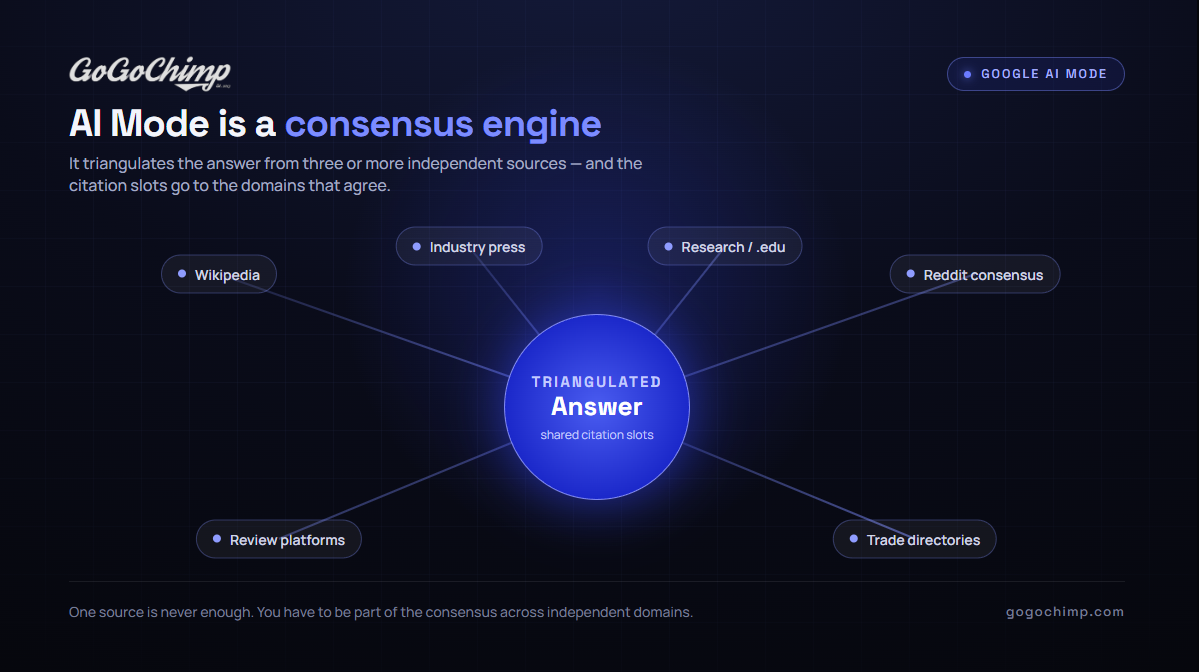
Ahrefs' own interpretation is that AI Mode acts as "a sort of consensus engine, recommending brands that most people already know". That framing is the load-bearing lens for the rest of this piece.
Picture AI Mode as the queue at a Michelin-starred restaurant that has 200 people vouching for one table and 5 for another. It doesn't recommend the table nobody has tried. It recommends the one where the consensus around it has already formed on the pavement outside. Your job as a brand isn't to be new to AI Mode.
Your job is to be the one 200 different sources on the pavement are already talking about. That's a different consensus signal from what Perplexity's Reddit-heavy citation model rewards, which is why cross-engine strategies fragment fast.
The three implications:
First, off-site brand signals outweigh technical SEO
The top four correlated signals are all off-site: mentions, anchors, branded search, YouTube. On-site work (structure, schema, speed, mobile UX) is table stakes for eligibility, not a growth lever.
Second, backlinks are undervalued as a link but overvalued as a signal. Backlinks correlate at 0.244 while branded web mentions correlate at 0.709. It is a correlation, not proof of cause, but it suggests digital PR that earns brand mentions, with or without links, beats link-building alone. That reframes what "PR budget" is for.
Third, YouTube is a category-defining channel for AI Mode specifically
At 0.737, YouTube dwarfs every other signal. This is why the next H2 exists.
YouTube as Google's structural moat
AI Mode cites YouTube at rates that no other AI engine matches. Per the Search Engine Land + Wellows 350,000-citation analysis, AI Mode and AI Overviews together draw more than half their social-media citations from YouTube. On ChatGPT and Perplexity, that slot goes to Reddit instead.
Why does YouTube dominate AI Mode citations?
Google owns YouTube. That means Google's retrieval pipeline has raw access to YouTube transcripts, chapter markers, video descriptions, and comment threads. ChatGPT and Perplexity don't. They have to scrape publicly indexed transcripts, which is slower, noisier, and often out of date. AI Mode's transcript feed is real-time and complete. When AI Mode decomposes a query into sub-queries, it can retrieve against YouTube video content as if the video were a text document, extracting the exact 30-second segment that answers the sub-query.
That's a proprietary retrieval advantage. It's also non-transferable. A tactic that lifts your AI Mode citation share by pairing pillars with YouTube videos won't lift your Perplexity or ChatGPT share to anywhere near the same degree.
How much of AI Mode's citation surface is YouTube?
Google publishes no YouTube share for AI Mode. On AI Overviews, YouTube is 18.8% of top-10 source share (Profound, 2025). That figure and the social-citation pattern above point to the same tactic.
What should a brand ship on YouTube for AI Mode?
Match your written pillar with a video that carries the same answer capsule, the same top-of-page stat, the same H2 structure. Publish it on YouTube. Submit a proper transcript. Chapter-mark the video so specific sub-queries land in specific timestamps. The retrieval layer treats the video as an indexable answer surface parallel to the blog post.
At GoGoChimp we have one canonical example: the Bee Friendly page-speed case study video at https://youtu.be/z2bjGvAkqn0 paired with the written case study. The video documents the same $48K/year to $1,447,225/year revenue lift the page describes, in the same order, with the same numbers. That's the pattern AI Mode's retrieval layer rewards.
Bee Friendly Skincare page-speed case study. The video pair for the written case study, structured to be retrievable as an AI Mode citation surface.
Ranking factors that shift AI Mode SEO outcomes
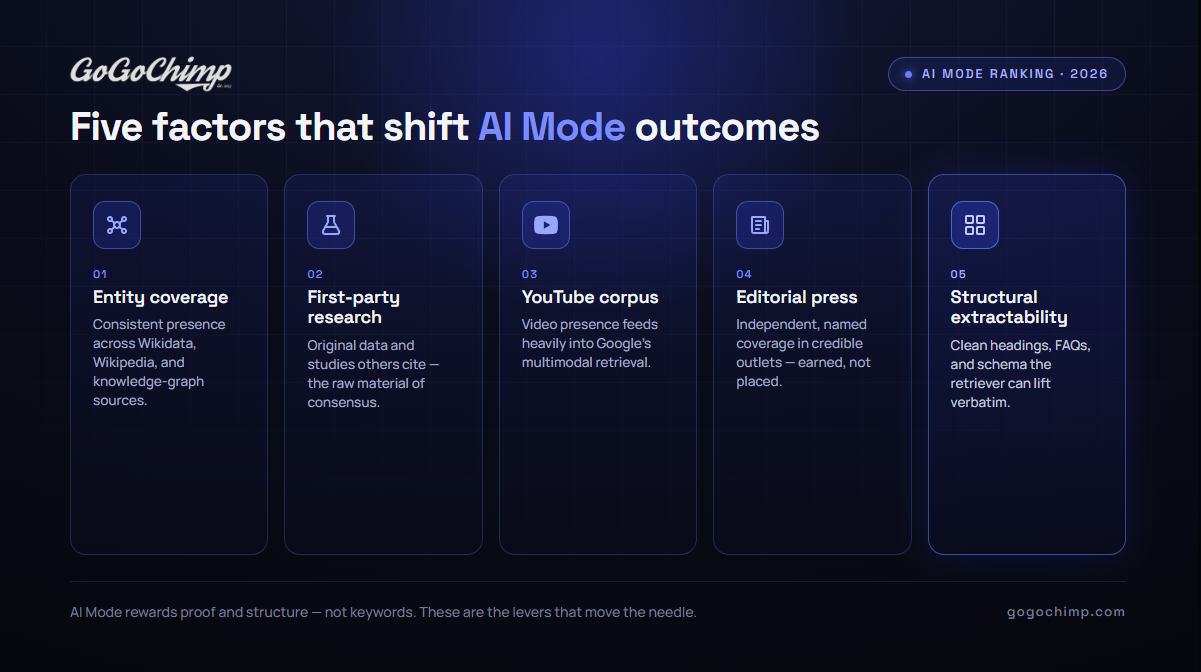
Six load-bearing factors, ranked by evidence weight.
1. Branded web mentions (correlation 0.709)
Not links. Mentions. In the Ahrefs study, branded web mentions correlate almost as strongly as YouTube mentions, and far more strongly than backlinks. Every earned press mention, podcast appearance, expert round-up quote, and named-source Q&A adds a mention count that AI Mode's retrieval layer aggregates as a consensus signal. GoGoChimp's Shopify Enterprise 11-locale syndication is the clearest recent example: one editorial piece, 11 language-specific brand mentions.
2. YouTube pairing (correlation 0.737)
Covered above. The single strongest signal in the Ahrefs study.
3. E-E-A-T signals
Per SEOvendor's ranking factors analysis, "Google's E-E-A-T framework is non-negotiable in AI Mode. The AI is trained to pull answers from sources that demonstrate real-world experience and deep knowledge". Named author bylines with credentials, first-party data, cited case studies, and disclosed methodology are recognised at retrieval time. Article schema with author.sameAs pointing to LinkedIn, X, and YouTube profiles compounds the signal.
4. Structured data and scannable formatting
The SEOcrawl analysis identifies five pillars for AI Mode ranking: topical authority, E-E-A-T, content comprehensiveness, structured formatting, and technical crawlability. Of these, structured formatting (H2/H3 hierarchy, semantic HTML tables, definition lists near the top) is the pillar most reliably operationalised as content pattern. Wikipedia-style writing wins because Wikipedia-shaped content is what the retrieval layer indexes cleanly.
5. Freshness and dated statistics
Google publishes no freshness weighting for AI Mode, and the evidence across AI search is mixed. Ahrefs found pages cited by AI assistants were 25.7% fresher on average than Google's organic results, but Google's top three AI Overview citations averaged 3.9 years old, the oldest of the engines it measured (Ahrefs, 2025). Date your evidence anyway: every stat in your body copy should carry a year, and every case study a date. Refresh pillar dates when you add material, not when you don't.
6. Passage-level clarity
AI Mode extracts passages, not pages. A page at position 15 with an unambiguously answered passage can be cited over a page at position 2 with buried information. Put the answer high. Answer capsules directly under the H1 and 40-60 word section openers immediately under each H2 are the two highest-leverage formats. In Kevin Indig's Growth Memo study of ChatGPT citations, 44.2% came from the first 30% of a text (Indig, 2026).
The Seer +120% click lift on cited brands
Being cited inside AI Mode isn't only a brand-visibility play. It's a click-clawback mechanism on the classic surface. The Seer Interactive April 2026 update analysed 5.47 million queries across 53 brands and measured this for AI Overviews.
On AI Mode, it's attribution, not position. You either get named by the answer engine, or you don't. There is no page 2. Seer's 120% figure, measured on AI Overviews, shows what attribution can pay back when you earn it.
Cited brands earn 120% more organic clicks per impression than when they aren't cited. But on informational queries, cited brands still get 38% fewer clicks than on searches with no AI Overview at all.
Seer's April 2026 update is the current figure. It's correlational, so Seer doesn't claim the citation causes the extra clicks.
The commercial logic follows. If AI Overviews are cutting your click-through the way they cut UK news publishers' (down 47.5% on desktop in Authoritas' study, Authoritas, 2025), earning a citation claws back part of that loss, though not all of it. That's why AI Mode SEO is a defensive-and-offensive move at once: it protects the traffic AI Mode is otherwise absorbing and it opens a citation surface that lifts click-through across the queries you also rank on.
Measurement stack: GSC, Bing WMT, Profound, Ahrefs
Measurement is the most contested area of AI SEO in 2026. There's no single source of truth. A three-layer pragmatic stack works.
Layer 1: First-party data (Search Console and Bing)
Our own click-clawback receipt fires here. Between 28 April and 30 June 2026, our Bing WMT reading showed 3,263 Microsoft Copilot citations. GSC for the same domain over a slightly longer window (19 April to 3 July) showed 87 total Google clicks. That's a 37.5:1 ratio of Bing AI citations to Google clicks. Same content. Same domain. Two completely different retrieval philosophies serving two completely different visibility outcomes.
The Copilot side of that reading is the subject of our Microsoft Copilot SEO playbook; this piece stays on the Google AI Mode side of the split.
Layer 2: Third-party AI visibility platforms
Per Nick Lafferty's 2026 platform ranking, the tools that specifically separate AI Mode from AI Overviews in their reporting are Profound, Peec AI, Semrush AI Visibility, AccuRanker, and AthenaHQ. Costs range from £200-£2,000/month depending on brand count and prompt volume. Four of them are in our best AI SEO monitoring tools comparison.
Layer 3: Manual sampling
Maintain a query bank of 20-50 target prompts. Run them weekly against AI Mode logged out. Record which sources are cited. Fragile as a standalone measurement, but essential for validating third-party dashboards and catching drift. The measurement caveat: seven in ten AI-cited sources are cited by only one of the five major engines, and just 2.7% are cited by all five.
Cross-engine share-of-voice is a noisy signal because the engines fundamentally disagree. Our Claude and Gemini SEO breakdown covers the two engines where sampling is currently the only reliable measurement path.
Building the AI Mode SEO stack manually is slow. See our best AI Mode SEO tool for the citation-tracking and content-optimiser software we've tested, including the winnable AI Mode SEO tool/tracker commercial cluster (Bing Webmaster Tools AI Performance report free, Ahrefs Brand Radar, Semrush AI Visibility Toolkit) at KD 10-15.
The 5-step AI Mode tactical playbook
Five moves, in sequence. Ship the whole sequence before you re-measure. Half-implemented, this doesn't shift the outcome.
Step 1: Query fan-out mapping
Take your target commercial query. Run it through a fan-out simulator (ChatGPT works with a fan-out prompt, or use Ekamoira's fan-out research). Extract the sub-queries it decomposes into. Draft H2 headings that each answer one sub-query. Every H2 becomes a retrievable passage for one branch of the fan-out.
Step 2: Answer capsule under H1
Directly under your H1, write a 40-60 word answer capsule (our house standard) in a paragraph of italicised text. That gives AI Mode a self-contained passage to lift. Include the target keyword, the load-bearing statistic, and a specific number or named entity. Don't restate the H1 in different words. Add information the H1 doesn't carry.
Step 3: Semantic HTML table in the first 40% of the page
Ship a <thead>/<tbody> semantic HTML table with 4-6 columns and one row per item. AI Mode's retrieval layer treats semantic tables as machine-readable data. The comparison-table div-grid pattern won't extract. The semantic <table> will. We treat it as mandatory on comparison and listicle content.
Step 4: YouTube pairing
For every pillar, ship a paired YouTube video carrying the same top-of-page answer, the same H2 structure, the same load-bearing statistic. Chapter-mark the video so specific sub-queries land in specific timestamps. Submit a clean transcript. AI Mode retrieves against the video transcript as if it were a text document, so the video counts as a second retrievable answer surface for the same query fan-out.
Step 5: Brand-mention farming
Prioritise digital PR that earns unlinked brand mentions on high-authority sites. Podcast appearances, expert round-ups, listicle inclusion, named-source Q&As. Mentions correlate far more strongly with AI Mode brand visibility than backlinks do. The economics of unlinked mentions are also better: publishers are more willing to name-drop than to hand out DoFollow links, so mention-farming has higher conversion per pitch.
Common AI Mode SEO mistakes to avoid
Six anti-patterns that lose citation share.
Optimising for AI Mode as if it were AI Overviews
They cite 3 versus 7 sources per answer, run on different retrieval philosophies (Gemini pre-indexed vs live web plus Shopping Graph), and share only 13.7% URL overlap. Different signals win each. Measure separately, optimise separately.
Chasing backlinks over mentions
Backlinks correlate 0.244 with AI Mode brand visibility versus 0.709 for branded web mentions. Digital PR budgets weighted 100% toward link-earning miss the stronger signal, so count mentions as wins too.
No YouTube pairing
If your pillar doesn't have a paired video with a clean transcript, you've conceded a 0.737 correlation signal to competitors who do. Every pillar needs a video.
Wikipedia-style writing left unlearned
Neutral tone, direct claims, inline citations, structured H2/H3 hierarchy. AI Mode's synthesis layer treats Wikipedia-shaped writing as high-confidence source material. Marketing-blog register loses.
No answer capsule under H1
In Kevin Indig's study of ChatGPT citations, 44.2% came from the first 30% of a page (Growth Memo, 2026). That's ChatGPT data, not AI Mode data, so treat it as a pointer: put the payoff early, not at the end.
Ignoring Merchant Center for ecommerce
Google's Shopping Graph has 50 billion product listings updated hundreds of millions of times per hour. Without a properly populated Google Merchant Center feed (GTINs, accurate titles, rich descriptions, multi-angle images, reviews), your products can't enter the Shopping Graph and can't appear in AI Mode commercial answers. This is an eligibility gate, not a growth lever.
AI Mode SEO predictions for 2027
Three predictions grounded in the deep-research data.
1. AI Mode queries will overtake traditional blue-link queries by 2027.
The doubling-every-quarter curve confirmed at I/O 2026 implies AI Mode volume will overtake classical Google SERP volume inside 18 months. On current trajectory, by Q4 2027, "Google Search" for most users means AI Mode by default. The strategic consequence: any SEO strategy that treats AI Mode as one of several equal surfaces is understating the leverage.
2. Ecommerce and local services will lose their current protection.
Ecommerce and local queries trigger AI Overviews far less often than informational ones today. We expect that protection to be temporary. As Shopping Graph integration deepens across 2026-2027, commercial-intent queries will move onto AI Mode at rates closer to those of informational queries. Ecommerce brands have a 6-12 month runway to build first-party citation assets before the surface migrates.
3. First-party AI citation data becomes the CMO metric of 2027.
Bing WMT AI Performance is the current best first-party signal. GSC's GenAI Performance report will improve quarterly. By late 2027, expect boardrooms to track "AI Mode citation share on target queries" the way they currently track keyword rankings. Brands that build the measurement discipline now will have 12+ months of trend data by the time the discipline is standard. The engine-agnostic frame for that discipline is our generative engine optimisation reference.
FAQ
How do I rank in Google AI Mode?
You don't rank; you get cited. AI Mode selects 7 sources per answer on average, drawn from a query fan-out that breaks each prompt into many sub-queries. Structure content so each H2 answers one sub-query, ship an answer capsule under the H1, pair the pillar with a YouTube video, and earn unlinked brand mentions on authority sites. Brand mentions correlate far more strongly with AI Mode brand visibility than backlinks do (Ahrefs, 2025).
What is query fan-out in AI Mode?
Query fan-out is Google's mechanism for decomposing a single user query into many parallel sub-queries, each retrieved against different sources and synthesised into one grounded answer (Search Engine Land, 2026). Google calls it "a multitude of queries" and has published no fixed count. A query like "best CRM for small consulting firms" decomposes into pricing sub-queries, feature sub-queries, review sub-queries, and integration sub-queries.
How many users does Google AI Mode have in 2026?
Google confirmed at I/O 2026 that AI Mode has crossed one billion monthly users, with queries "more than doubling every quarter since launch" (Google, 2026). That makes AI Mode one of the largest AI-search surfaces by user count.
Do backlinks matter for AI Mode SEO?
They matter, but less than most SEOs assume. Ahrefs' 75,000-brand study found backlinks correlate 0.244 with AI Mode brand visibility versus 0.709 for branded web mentions (Ahrefs, 2025). Links are table stakes for eligibility. Mentions are the growth lever.
Why does YouTube dominate AI Mode citations?
Google owns YouTube, so AI Mode has proprietary access to YouTube transcripts, chapter markers, and comment threads that other AI engines don't. YouTube mentions correlate about 0.737 with brand visibility in AI answers, the strongest signal in the Ahrefs study. On AI Overviews, YouTube is 18.8% of top-10 source share (Profound, 2025).
How is AI Mode different from AI Overviews?
AI Overviews is pushed to users above blue links; AI Mode is pulled by users as a dedicated chat interface. AI Overviews cites 3 domains per answer; AI Mode cites 7. AI Overviews summarises from Gemini's pre-indexed crawl; AI Mode retrieves live web plus Shopping Graph. The two share 13.7% URL overlap and 88% domain intersection (Semrush, 2026).
What's the click impact of being cited in AI Mode?
Brands cited in AI Overviews earn 120% more organic clicks per impression than when they aren't cited (per Seer Interactive's April 2026 5.47M-query study cited in the H2 above). Seer measured AI Overviews, not AI Mode. The context matters: in Authoritas' UK news-keyword study, publisher CTR dropped 47.5% on desktop and 37.7% on mobile when an AI Overview appeared, so citation is the mechanism that claws some of that traffic back.
How do I measure my AI Mode visibility?
Combine three layers: Google Search Console's GenAI Performance report (first-party but crude, launched June 2026), a third-party AI visibility platform (Profound, Peec AI, Semrush AI Visibility, or Ahrefs Brand Radar), and weekly manual sampling of a 20-50 query bank against AI Mode logged out. Bing Webmaster Tools' AI Performance report is the strongest confound-free proxy in the market (TurboAudit, 2026).
Does Google recommend any special AI Mode markup?
No. Google's official position is that AI Overviews and AI Mode require no special optimisation, no llms.txt file, no unique schema. Structured data, semantic HTML, and E-E-A-T signals from classic SEO carry over. The tactic set is content-shape and off-site trust signals, not new markup.
How long does an answer capsule need to be for AI Mode?
40-60 words is our house standard, not an engine rule. Google publishes no required length. Put it directly under the H1, in italicised paragraph form. It needs to contain the target keyword, the load-bearing statistic, and a specific number or named entity. It shouldn't restate the H1 in different words.
What content types earn AI Mode citations most reliably?
Best-of listicles, definitional pillars, dated statistics posts, FAQ pages, and comparison tables. Semrush's AI Mode study confirmed comparison-format content is over-cited relative to prose.
What's the biggest AI Mode mistake for ecommerce brands?
Neglecting Google Merchant Center. The Shopping Graph has 50 billion product listings updated hundreds of millions of times per hour, and Merchant Center feeds populate the graph. Sparse or malformed feeds block AI Mode from surfacing your products on commercial queries regardless of on-site SEO. This is an eligibility gate.
How do I know if my page will get cited?
Rubric predicts citability, it doesn't count citations. It scores every page, weights six AI engines including Google AI Overviews, and shows readiness for each on its Engines tab. AI Mode isn't one of the six, so check AI Mode answers by hand. The Action Plan ranks the fixes. Full disclosure: I built it.
References
- Google. (2026). Google Search's I/O 2026 updates: AI agents and more.
- Google. (2026). Generative AI performance report (Search Console Help).
- Ahrefs. (2025). Top Brand Visibility Factors in ChatGPT, AI Mode, and AI Overviews.
- Ahrefs. (2025). An Analysis of AI Overview Brand Visibility Factors (75,000 brands).
- Law, R. (2025, 28 July). New Study: AI Assistants Prefer to Cite "Fresher" Content (17 Million Citations Analyzed). Ahrefs.
- Semrush. (2026). How Google's AI Mode Compares to Traditional Search and Other LLMs.
- Semrush. (2026). 2026 AI Visibility Index (126 million prompts).
- Seer Interactive. (2026). AIO Impact on Google CTR: 2026 Update (5.47M queries, 53 brands).
- Wellows. (2026). Social Media in AI Citations 2026: Reddit and YouTube Dominate (350K citations).
- Search Engine Land. (2026). Query fan-out in AI search: what is it and how does it work?.
- Aleyda Solis. (2026). Google AI Mode's Query Fan-Out Technique.
- Indig, K. (2026, 16 February). The Science of How AI Pays Attention. Growth Memo.
- SEOcrawl. (2026). AI Overviews Ranking Factors: SEO Guide 2026.
- Niara. (2026). AI Mode vs AI Overviews: What's the Real Difference?.
- Shopify. (2026). Google AI Shopping Features: How to Maximize Your Visibility 2026.
- TurboAudit. (2026). AI Overviews Tracking: Monitor Google AIO + AI Mode 2026 Guide.
- Nick Lafferty. (2026). 9 AI Visibility Optimization Platforms Ranked by AEO Score 2026.
- SurfacedBy. (2026). We Analyzed 127,198 AI Citations Across 5 Engines.
- SEOvendor. (2026). SEO Ranking Factors 2026: What Google's AI Search Reveals.
- Ekamoira. (2026). Query Fan-Out: Original Research on How AI Search Multiplies Every Query.
- Google Search Central. AI features and your website.
- Search Engine Land. (2026). AI search engines cite Reddit, YouTube, and LinkedIn most (350K citations).
- Profound. (2025). AI Platform Citation Patterns: What the Data Shows.
- Press Gazette. (2026). Google AI Overviews publishers report clickthroughs down (Authoritas report).
.png)
Free chapter
Read Chapter 1 of CITED, free.
The playbook for getting your business recommended by ChatGPT and AI search. Read the first chapter, on me.
Read Chapter 1 freeWant us to do this for your site?
Book a free AI audit. 15 minutes. We’ll show you three things your site is missing and what we’d test first.
Book my free AI audit →