AI SEO in 2026: What It Is and the Strategy That Actually Works
AI SEO

AI SEO is the discipline of structuring content, entity signals, and third-party trust so ChatGPT, Perplexity, Gemini, AI Overviews, and Microsoft Copilot cite your brand inside their generated answers. GoGoChimp earned 5,967 first-party Copilot citations in 90 days using this three-pillar framework, verified 2026-07-09.
Two phrases share the same three letters and mean opposite things.
The first: using AI tools to do traditional SEO. Content generators, keyword clusters, meta-description drafters, the Jasper-Surfer-aiseo.ai stack. This one is a tool market, and it is enormous.
The second: getting your brand cited inside an AI-generated answer when a buyer asks the question that would have converted into a lead. This one is a discipline, and almost nobody is running it properly.
Almost every "AI SEO checklist" in circulation conflates the two. The checklist that conflates them cannot help you with either. This pillar is about the second version.
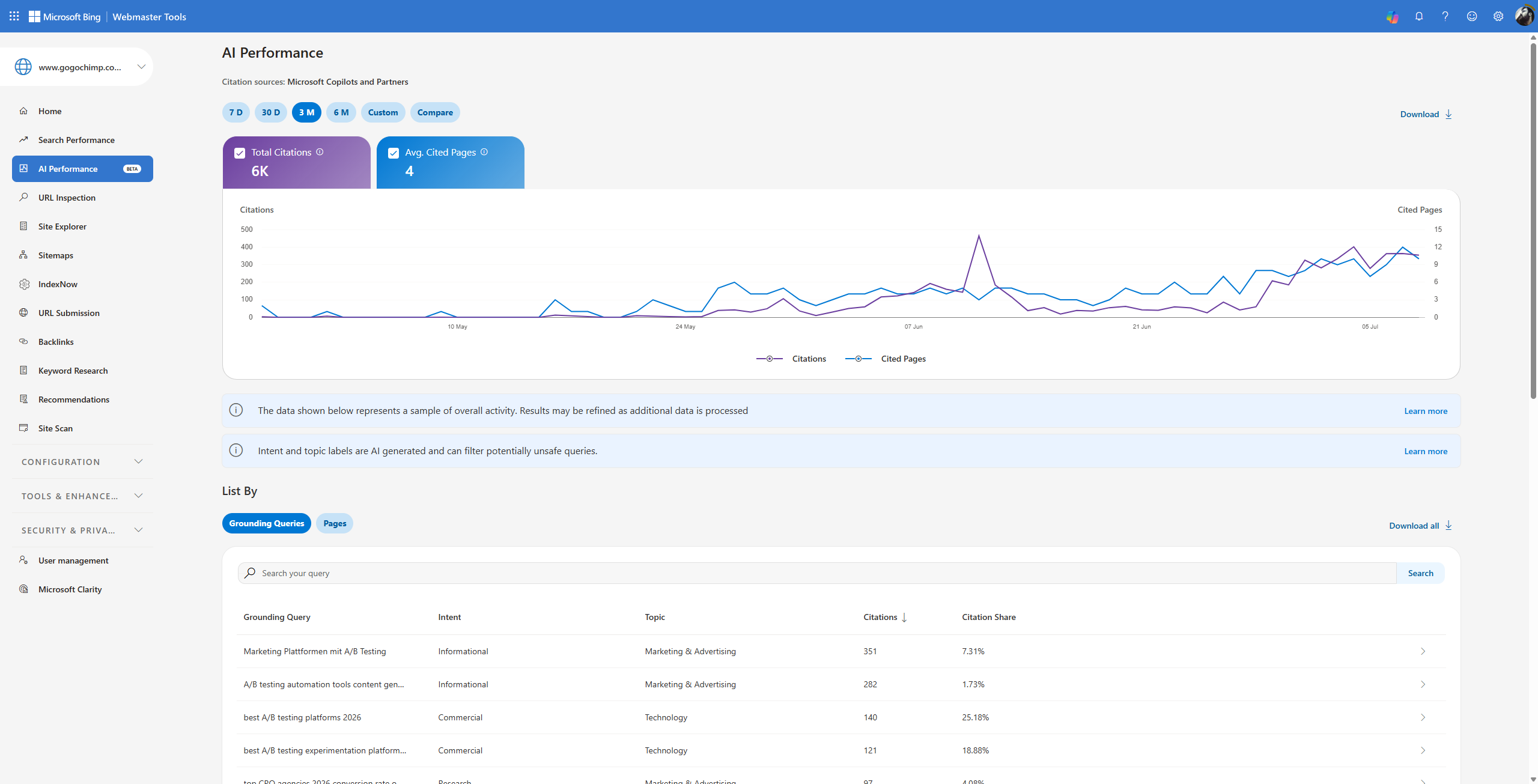
I have run conversion work for 13 years. For the last 24 months the fastest-growing source of qualified inbound to our site has not been Google's blue link. It has been AI answer engines citing our content to buyers researching a purchase. Our own Bing Webmaster Tools AI Performance report currently shows roughly 5,600 Microsoft Copilot citations across the past 3 months, and the pace is 364 citations per day and rising (verified 2026-07-09).
The 90-day snapshot on 2026-07-01 was 6,700 citations. Two months earlier, in early May, we were at roughly 10 citations per day site-wide. This is a 30-plus-fold growth curve, and it is still accelerating.
You are reading the article that describes the discipline that produced those numbers.
Most of what you will read below reads as counter-intuitive because most of the advice being sold at agency briefings is optimising for the first version of AI SEO from the intro, not the second. The strategy that works is not the one being sold. It's discipline, not tooling. Sequence, not spend. And there is no shortcut.
What AI SEO is (and what people call it)
AI SEO is the practice of getting your brand named as the source, or as the recommendation, inside an AI-generated answer. When someone types a research question into ChatGPT, Perplexity, Microsoft Copilot, Google's AI Overviews, or Gemini, and the answer includes your name, your quote, or a link to your page, that outcome is what the discipline optimises for.
You already understand why this matters. The chat interface has replaced part of the search results page for a growing share of your buyers. The citation slot inside the answer is now the visibility currency that replaced the top-ten ranking.
The discipline does not have a settled name yet
You will see it called several things. Practitioners mix these terms interchangeably, and the terminology probably will not settle for another twelve months.
- AI SEO. The term most buyers actually type into Google. What this pillar uses.
- GEO (generative engine optimisation). Coined by Princeton in 2024. The engine-side of the discipline.
- AEO (answer engine optimisation). The answer-shaped subset. Predates GEO as a working term.
- LLMO (large language model optimisation). The training-corpus layer specifically.
- AI search optimisation. The umbrella term some agencies use.
- AI search discipline. What senior practitioners are increasingly calling it in trade publications.
If you are searching for "what is SEO for AI called" or "what is AI SEO called" or "acronym for AI SEO" or "AI term for SEO", this section is your answer. The vocabulary is still forming. The acronym breakdown at GEO vs SEO vs AEO vs AIO covers how each term maps to a specific slice of the discipline.
The two-meaning problem
Do not confuse the discipline with the tool market. The generators, humanisers, and keyword clusterers badging themselves "AI SEO" are the first version from the intro. That market is real and profitable, and it is almost entirely orthogonal to whether your brand gets cited in ChatGPT tomorrow morning. When you read "AI SEO" for the rest of this piece, take it to mean the discipline of earning citation inside AI-generated answers.
The 3 pillars of AI SEO: Discovery, Retrieval, Citation
Almost every AI SEO decision you make falls under one of three pillars. Understanding which pillar a given tactic serves is the fastest way to sort real advice from noise.

Pillar 1: Discovery (does the engine know you exist?)
The engine has to know your brand exists. That means being present in the corpora AI engines draw from: Wikipedia, mainstream news, the Bing index, industry publications, high-trust review platforms, primary research.
If you are invisible to those corpora, no tactic on your own site can move the citation surface.
Discovery is the entity layer. Its levers are:
- Editorial features in mainstream publications
- Third-party mentions in industry-relevant coverage
- Wikipedia coverage where you can pass WP:N notability
- Wikidata entries (often easier than Wikipedia)
- Consistent sameAs URLs across at least 8 independent surfaces
- Named-author bylines with real credential surface
Third-party trust signals lift AI citation likelihood by roughly 75x per Muck Rack and Seer's 25 million-link study (Muck Rack + Seer, 2026). This is the layer nobody classifies as SEO. It is also the one every serious brand is now investing in.
Pillar 2: Retrieval (can the engine find your page?)
The engine has to find your specific page when it decomposes a user question. That means:
- Indexation. Especially Bing indexation, because ChatGPT Search runs on the Bing index and Copilot is Bing-native.
- Semantic structure. H2s written as claims or questions. 40-60 word answer capsules under each H2.
- Extractable formats. Semantic HTML tables (not markdown pipes, not CSS grids). FAQ blocks wrapped in FAQPage schema. Dated statistics inline.
- Topical coverage. Enough pages on your topic that the retriever treats your site as a topical authority.
Retrieval is the on-page layer. Most SEO teams already do this reasonably well. What needs adjusting is the emphasis: retrievers chunk documents into passages of roughly 400-600 tokens and rerank at the passage level (Firecrawl, 2026), so section-level clarity matters more than page-level polish.
Pillar 3: Citation (does the engine name you in the answer?)
Given that the engine knows your brand and found your page, it still has to decide to name you inside the answer. That decision hinges on citability signals:
- Density of hard numbers with hyperlinked sources
- Named-author credentials
- Freshness (last-updated dates that reflect real updates)
- Absence of promotional framing
Being retrieved is not the same as being cited. ChatGPT often cites nothing at all. In the US, 48% of ChatGPT answers carried no citation in March 2026, before citations rebounded in May (seoClarity, 2026). The citation layer is what turns a retrieved page into a named source, and it is where most sites lose.
Why the three pillars matter
Almost every AI SEO tactic that works serves one of these three pillars directly. Almost every tactic that fails is trying to substitute activity in one pillar for absence in another.
You cannot substitute more blog posts (retrieval) for a missing entity graph (discovery). You cannot substitute schema (retrieval) for uncited statistics (citation). The pillars compound. They do not trade.
Disciplines compared: SEO, AI SEO, GEO, AEO, LLMO, Local SEO
Practitioners lump these six disciplines together and treat them as variants of the same job. They are not. Each one targets a different retrieval surface, weights different signals, and rewards different content shapes.
If you cannot draw the map, you will optimise for the wrong surface and blame the tactic when the metric does not move.
At-a-glance comparison
| Discipline | Query surface | Primary signal source | Measurement | Reward |
|---|---|---|---|---|
| Classical SEO | Google and Bing ranked lists | Backlinks, on-page relevance, E-E-A-T | Rankings, impressions, clicks | The blue-link click |
| AI SEO | Every AI answer surface (ChatGPT, Perplexity, Copilot, AIO, Gemini) | Discovery + Retrieval + Citation (all three pillars) | Citation share of voice; Bing WMT AI Performance report | Your brand named inside the answer |
| GEO (Generative Engine Optimisation) | Generative answer surfaces on any engine | Extractable passages, entity coverage, statistics density | Per-engine citation share; cross-engine agreement | Citation inside the generated answer |
| AEO (Answer Engine Optimisation) | Answer-shaped surfaces: featured snippets, PAA, AIO, Copilot, Perplexity | Answer capsules, FAQPage schema, dated statistics | Snippet ownership; PAA presence | Extracted passage in the answer box |
| LLMO (Large Language Model Optimisation) | The model's cached knowledge (before retrieval fires) | Wikipedia, academic mentions, sameAs graph, high-DA earned media | Brand-mention rate on session-opener queries | The model recognises you from memory |
| Local SEO | Google Maps, GBP, Bing Places, local pack | NAP consistency, reviews, GBP completeness | Map pack ranking, GBP calls, driving-direction requests | Local-intent click or foot traffic |
Read the table with a specific bias. The disciplines share more mechanics at the on-page layer than at the entity layer. If your team already ships dated statistics, answer capsules, and FAQPage schema on pillars, you are half-way to AI SEO's retrieval requirements. The other half is the entity layer (discovery), which is where most SEO teams have never invested because classical SEO never required it.
The AI SEO strategy that works: 6 moves in the right order
There are hundreds of AI SEO tactics circulating. Most work in isolation. The order matters more than the total count.
Sequenced wrong, you can execute five expensive tactics without moving the citation curve. Sequenced right, three cheap tactics compound into a visible share-of-voice shift inside 60 days.
The order below is what our own footprint validated across the last twelve months.
Claim Bing Webmaster Tools today
Bing WMT's AI Performance report is free, first-party, and confound-free. It tells you which of your pages Microsoft Copilot cites, on which grounding queries, at what frequency, across a rolling 90-day window.
If you have never opened it, you are running the discipline blind.
Every hour spent inside Bing WMT is worth ten spent inside any third-party AI-search tracker. This is not a tactic; it is the instrument. Do not proceed without it.
Audit your top 10 pages for retrieval prerequisites
Every page needs:
- A 40-60 word answer capsule directly under the H1 and under every H2
- Semantic HTML tables on any comparison content (
<table>,<thead>,<tbody>,<th>,<td>, not markdown pipes, not decorative CSS grids) - Dated statistics inline in the answer capsule and throughout
- Inline hyperlinked citations for every numeric claim
- FAQPage schema on any question block
- Named-author byline with Person schema
- Article schema and BreadcrumbList site-wide
If any of these are absent on your top pages, retrieval quality collapses regardless of what else you do.
Publish one best-of listicle per quarter
Best-of listicles with semantic HTML comparison tables are the highest-cited format across our Bing WMT footprint. /blog/best-ab-testing-tools-2026 alone earns 1,500 Copilot citations across 90 days, and it does so on a table with 10 rows and 6 axes.
Pick a category you own. Publish the definitive listicle. Refresh it quarterly.
Publish one head-to-head comparison per quarter
"X versus Y" content is the second-most citation-earning format on our footprint. It also earns citation on your competitor's brand queries specifically, which is where a substantial share of AI Overview citations fire.
Ahrefs studied 76 million AI Overviews and found brand mentions correlate with AI citation at 0.664 versus backlinks at 0.218 (Ahrefs, 2026). That's a 3x gap in favour of mentions.
Head-to-head content is the fastest way to earn brand-mention density in your category.
Invest in earned media on a regular schedule
Third-party trust signals lift citation likelihood by roughly 75x, and earned media accounts for 84% of AI citations (Muck Rack + Seer, 2026).
This is not PR as a marketing extension. It is the trust layer AI SEO runs on.
- Prioritise Forbes, TechCrunch, TechNewsWorld, industry publications your buyers read
- Aim for named-expert bylines, not brand mentions
- Two placements per quarter beats 20 blog posts of the same word count
Ship a genuine entity graph
- Consistent Organization schema in the site footer with a real address, phone number, and sameAs list
- Person schema on every author
- Article schema on every post
- BreadcrumbList schema for navigation context
- Wikidata entry (often easier to secure than Wikipedia)
- Wikipedia article where you can pass WP:N notability
The schema markup for AI SEO guide covers the exact JSON-LD blocks worth shipping.
Read the six moves as an order of operations, not a menu. Move 1 is the instrument. Move 2 is the prerequisite. Moves 3-4 earn the citation volume. Moves 5-6 earn the sustained lift. Skipping ahead loses the compounding.
Content types that consistently win AI SEO citations
Five formats do most of the work across our footprint.
Best-of listicles with semantic HTML comparison tables
The dominant format. Three GoGoChimp listicle pillars account for 87.25% of our 5,600-citation footprint over 3 months. The retriever preferentially lifts comparison tables into answers almost verbatim, and Microsoft Copilot is especially aggressive about this pattern.
If your category has a "best X tools 2026" query, publish the definitive listicle with a real semantic table.
Definitional pillar guides
Long-form pieces answering "what is X" for a category-defining term. This pillar is one. The GEO pillar is another.
The retriever routes definitional queries to whichever page reads as the most extractable, statistically dense, third-party-cited definitional source. Length in the 2,500-4,000 word range hits the sweet spot for retriever format preferences.
Head-to-head comparison posts
"X vs Y" content is the second-most citation-earning format on our footprint. It also earns citation on both brands' queries simultaneously, which is why it appears more frequently than the raw traffic numbers suggest.
Dated statistics posts
Statistics posts that carry the year in the title, meta description, schema datePublished field, and answer capsule earn citations because retrievers weight recency heavily.
Content updated inside the last 30 days is cited at 71% frequency; content 1-2 years old drops to 18% (Presence AI, 2026). Regular refresh beats one-time depth.
FAQ pages
Pre-decomposed into query-answer pairs, which is exactly the shape retrievers want. Wrap the block in FAQPage schema. Every pillar page should carry 10-20 FAQ questions.
Technical foundations: schema, llms.txt, entity coverage
Three technical layers separate sites that get cited from sites that do not.
All three are cheap to ship if you have never done them, and all three compound over time.
Schema markup at scale
One page with Article schema is a novelty. A hundred pages with the full stack is a moat:
- Article schema on every post
- FAQPage schema on any question block
- HowTo schema on any step-by-step framework
- DefinedTerm schema on any glossary term
- Person schema on every author
- Organization schema in the footer
- BreadcrumbList schema for navigation
Ship the stack sitewide. Validate quarterly through Google's Rich Results Test. Retrievers pattern-match schema density as a professionalism signal.
llms.txt at the domain root
A plain-text file that tells LLM-based crawlers where your primary reference content lives and what to prioritise. View our's here: gogochimp.com/llms.txt.
This was novel in 2025. It is table stakes by end of 2026.
Keep it lean, refresh it quarterly, and do not treat it as a marketing document.
Entity coverage across surfaces
The retriever is not just reading your page. It is reading the entity graph around it.
Your sameAs list should link at least 8 independent surfaces:
- X (Twitter)
- YouTube
- Substack
- Trustpilot
- Google Business Profile
- Crunchbase
- Wikipedia or Wikidata anchor
When the retriever asks "who is [your founder]", the answer should reconcile across at least 8 independent surfaces. Below that threshold you are ambiguous. Above it you are recognisable.
Measurement: Bing WMT, GSC, Profound, and share of voice
Measurement is where AI SEO differs most sharply from classical SEO. Rankings and click counts are the wrong frame. Citation share of voice across many prompt runs is the right one.
Bing Webmaster Tools AI Performance report
Free. First-party. Confound-free. Shows which of your pages Microsoft Copilot cites, on which grounding queries, at what frequency, across a rolling 90-day window.
Because ChatGPT Search runs on the Bing index and Copilot is Bing-native, this single free tool covers the biggest share of the AI-search retrieval surface any brand can access.
Claim it today if you have not
Google Search Console
The AI Overviews impressions proxy. GSC does not yet cleanly distinguish AIO impressions from classical organic impressions, but the impressions curve on pages you have optimised for AI SEO is diagnostic.
Watch the curve. Rising impressions without rising rankings often signal AIO citation activity.
Profound and Ahrefs Brand Radar
Cross-engine tracking (ChatGPT, Perplexity, Gemini, AI Overviews) with enterprise or subscription pricing.
Trust the direction of movement more than the absolute numbers. No third-party tracker's methodology reconciles perfectly with any other's.
Manual share-of-voice sampling
Run your top 10-20 buyer queries through ChatGPT, Perplexity, and Copilot in fresh sessions once a fortnight. Log whether your brand is named.
Rand Fishkin's SparkToro study of 2,961 prompt runs across 600 volunteers found ChatGPT and Google AI Overviews return the same brand list less than 1% of the time on identical prompts (SparkToro, 2026).
One query on one day is noise. Share across many runs is signal.
The measurement gap is the opportunity
Semrush's 2026 AI Visibility Index found 45% of marketing leaders cannot measure their brand's visibility in AI-generated answers, and only 9% have the tools to track it across platforms (Semrush, 2026).
The measurement gap is also the largest single competitive advantage available to teams that close it. Instrument the stack early. The teams already running the discipline are already invisible to the teams still guessing.
AI SEO tools worth using in 2026
The tool market is loud. Most of what is being sold is a variant of a keyword generator badged as "AI SEO".
A short list of tools that actually serve one of the three pillars:
- Bing Webmaster Tools AI Performance report. Free. The primary measurement surface. If you use no other tool from this list, use this one.
- Google Search Console. Free. AIO impressions proxy.
- Profound. Third-party cross-engine tracker. Enterprise pricing.
- Ahrefs Brand Radar. Brand-mention tracking with an AI-search lens. Bundled into the Ahrefs subscription.
- Semrush AI Visibility Index. Category benchmarks across 126 million prompt runs.
- HubSpot AEO grader. Free content spot-check tool.
- G2 review corpus. Not a tool per se, but Perplexity draws heavily on G2 for buyer-research queries. Winning G2 is an AI SEO tactic even though nobody classifies it that way.
Do not confuse the tool market for the discipline. Every tool in the list above is measurement or diagnostic. None of them will write the content, ship the schema, or earn the editorial features. Those are still your job.
The AI SEO cluster: engine-specific and vertical guides
AI SEO in 2026 splits into engine-specific work and vertical-specific work. Below is the complete map of our AI SEO cluster, one section per engine and per vertical. Each entry is a self-contained playbook with first-party data, named frameworks, and concrete tactics you can ship this quarter.
Per-engine playbooks
Each generative engine runs a different retrieval index, weights different content types, and rewards different tactics. Winning one engine does not cover the others. Averi's 2026 analysis of 680 million citations found only 11% cross-engine domain overlap between ChatGPT and Perplexity: engines run largely disjoint corpora.
ChatGPT SEO
ChatGPT cites Wikipedia at 47.9% of top-10 source share (Profound, 2025) and takes 87.4% of AI referral traffic (Conductor, 2026). Trustpilot profile presence delivers a 75x citation lift (Seer 800K-response study). ChatGPT SEO is a trust-signal problem first, structural extractability second. See our full ChatGPT SEO playbook for the citation paradox, five-axis citation-driver framework, and the Bing-seeding mechanism that underpins ChatGPT Browse mode.
Perplexity SEO
Perplexity is an answer engine, not a search engine. It is built to cite, with numbered sources in its answers, and it leans 46.7% on Reddit for top-10 source share (Profound, 2025). In Superlines' tracking of one brand, Perplexity's citation rate was 13.05% against ChatGPT's 0.59% (Superlines, 2026). 92.78% of Perplexity-cited pages carry fewer than 10 backlinks (FelloAI 2026) , the 92.78 gate that makes Perplexity the single most winnable answer engine for a small site. See our full Perplexity SEO playbook for the Reddit playbook, 30-day freshness rule, and Sonar retrieval mechanics.
Google AI Mode SEO
Google AI Mode uses query fan-out: the query decomposes into hidden sub-questions, retrieves live web + Shopping Graph + Knowledge Graph signals, then cites the page that best answers the ensemble. YouTube mentions correlate 0.737 with AI Mode citation (Ahrefs 75,000-brand study 2026). Brand mentions correlate 0.709, backlinks only 0.218: mentions beat backlinks by 3x. See our full Google AI Mode SEO playbook for the ranking-factor correlation table, Deep Search coverage, and the fan-out sub-question capsule pattern.
Microsoft Copilot SEO
Copilot uses the Bing index directly and exposes first-party citation data through Bing Webmaster Tools' AI Performance report: the only free first-party AI-citation dataset in the market. GoGoChimp's own footprint shows a 44:1 Copilot-to-Google citation ratio on our category pillars, and 62.75% share of voice on our niche category query. Copilot SEO is essentially Bing SEO plus AI-search-specific tactics. See our full Microsoft Copilot SEO playbook for the Grounding Ladder, 10 ranking signals ranked by evidence, and the Bing WMT AI Performance report walkthrough.
Claude and Gemini SEO
Claude and Gemini are the emerging tier: Claude cites primary research and long-form analytical content at higher rates than any other engine; Gemini leans on YouTube (18.8% of top-10 source share on Google AI Overviews per Adweek 2026), Google-property signals (web.dev, Google Business Profile, Scholar), and structured data at higher rates than ChatGPT.
Superlines' March 2026 analysis measured 615x citation variance between the highest and lowest-citing engines for the same brand across the same queries. See our full Claude and Gemini SEO playbook for the invest-now-or-wait decision framework, per-engine lever tactics, and the multi-engine query how-to.
Vertical playbooks
AI SEO tactics vary meaningfully by vertical because each industry's AI-citation flywheel runs on different infrastructure. Two verticals with dedicated deep-dives:
GEO for B2B
73% of B2B buyers now use AI in vendor research (Gartner 2025). AI-referred B2B traffic converts at 14.2% versus 2.8% for Google organic (MADX 2026), a 5.1x advantage. GoGoChimp's own dataset shows 1,200 first-party AI citations tracked across 64 days, 62.75% Copilot share, and a 44:1 Bing-to-Google ratio: the 44:1 rule. See our full GEO for B2B pillar for the 15-point B2B GEO audit checklist, five B2B GEO myths, and the by-industry breakdown covering SaaS, manufacturing, and professional services.
GEO for SaaS
Only 36 global brands hold top-100 AI visibility across ChatGPT, Perplexity, Gemini, and Google AI Overviews (Semrush 2026 AI Visibility Index, 126M prompts). G2 supplies 55% of AI-cited SaaS references. Third-party review sites are the citation-decisive layer for B2B SaaS in 2026, not on-domain content. See our full GEO for SaaS pillar for the SaaS AI-citation lever framework, review-platform footprint audit, and the vertical breakdown covering HR, FinTech, and project-management SaaS.
The tools stack
Free tier: Bing Webmaster Tools' AI Performance report (first-party Copilot data), Google Search Console SGE report (impressions on AI Overviews), HubSpot AI Search Grader. Paid tier: Profound, Peec.ai, Semrush AI Visibility Toolkit, Ahrefs Brand Radar. See our full best AI SEO tools 2026 guide for the 13-tool comparison table, four category taxonomy, and the ARR-tier decision framework covering under 1M, 1M-10M, and 10M+ revenue tiers.
Every guide above links back to this pillar and cross-links to the sibling guides. Start with the engine your buyers use most (Copilot for B2B commercial, ChatGPT for consumer intent, Perplexity for small-site low-backlink situations, Google AI Mode for local + Shopping intent). Ship one engine at a time. Compound the wins.
Case study: what the discipline produced on our domain
The proof point for AI SEO discipline sits on the same domain you are reading this on.
The 3-month picture (verified 2026-07-09)
- About 5,600 total Microsoft Copilot citations across 3 months on Bing WMT AI Performance report
- 364 citations per day and rising (early July 2026 sustained pace)
- 87.25% concentrated in 3 listicle pillars (
/blog/best-ab-testing-tools-2026,/best-cro-agency-uk-2026,/blog/best-heatmap-tools-2026) - 111 unique grounding queries
- 32% buyer intent / 40% research intent / 24% informational intent
- 44 Bing Copilot citations for every Google organic click on the same content
The most concentrated example
/best-cro-agency-uk-2026 earns 1,200 Copilot citations at Google organic position 22.4. That is second-page organic ranking, deep. The retriever treats the page as the second-most-authoritative page on the entire site.
Position 22.4 is not the retriever's concern. Extractability, structural clarity, third-party citations, dated statistics, semantic HTML table, and named-author byline are the signals it weights. The page satisfies all of them. It earns citation share disproportionately regardless of what Google's ranking algorithm has decided about it.
The trajectory since April
- Early May 2026: roughly 10 Copilot citations per day site-wide
- Mid-June 2026: 100-200 per day, with a single-day peak of 464 on 11 June
- Early July 2026: 279-402 per day, averaging 331
- Now (2026-07-09): about 364 per day and rising
- Total since late April: about 5,600 citations, and the curve is still accelerating
The discipline that produced these numbers is the six-move sequence above, applied over 18 months. There is no shortcut. There is also no ceiling in sight.
Common AI SEO mistakes: the theatre versus the work
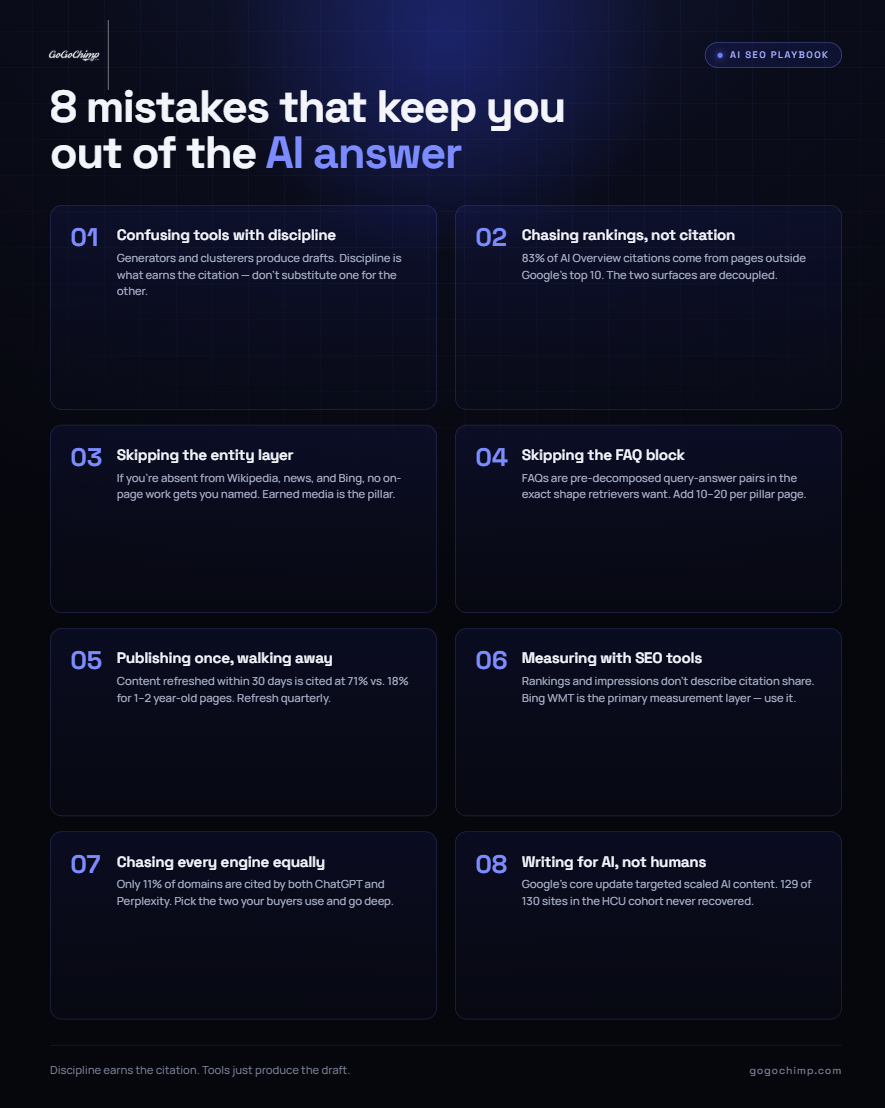
Eight patterns to strip on sight.
Mistake 1: Confusing tool-obsession with discipline
The people telling you AI SEO means installing a generator, a humaniser, or a keyword clusterer are selling the first version of AI SEO from the intro. Discipline is what earns the citation. Tools are what produce the drafts.
Do not substitute the second for the first.
Mistake 2: Chasing rankings when the surface is citation
83% of AI Overview citations come from pages outside the Google top 10 (Seer, 2026). The ranking surface and the citation surface are decoupled. Optimising ranking without also optimising citation misses the surface that is actually growing.
Mistake 3: Skipping the entity layer
Your content can be the retriever's source and still not be the answer's subject. The retriever names entities it recognises from the training corpus.
If your brand does not appear in Wikipedia, mainstream news, or the Bing index, no on-page work will get you named. Investing only in your own blog while ignoring earned media is optimising the wrong pillar.
Mistake 4: Skipping the FAQ block
FAQ blocks are pre-decomposed into query-answer pairs, wrap cleanly in FAQPage schema, and match the exact shape retrievers want.
Every pillar page should carry 10-20 FAQ questions. This is the cheapest single addition to any existing article.
Mistake 5: Publishing once and walking away
Content 1-2 years old is cited at 18% frequency versus 71% for content refreshed within 30 days (Presence AI, 2026).
Refresh dated statistics quarterly. Update the visible last-updated date to reflect real changes, not cosmetic ones.
Mistake 6: Measuring citation with SEO tools
Rankings and impressions describe the classical SERP. They do not describe citation share. Tracking "AI SEO performance" with position-tracking dashboards alone misses the entire retrieval surface.
Bing WMT is the primary measurement layer. Use it, or measure nothing.
Mistake 7: Chasing every engine equally
Only 11% of domains are cited by both ChatGPT and Perplexity (Averi, 2026). The engines have almost disjoint retrieval corpora.
Pick the two your buyers actually use and invest deeply there. Attempting equal coverage across five engines dilutes every one of them.
Mistake 8: Writing content for AI that no human reads
Google's March 2024 core update targeted scaled AI content directly. 129 of 130 sites in Lily Ray's Helpful Content Update cohort never recovered.
Retrievers weight named-author bylines, real credentials, and evidence of first-hand experience specifically because these signals correlate with human utility. Producing content that reads as machine-drafted is a citation-killer even when the output looks polished.
Predictions for AI SEO 2026-2027
Four dated forecasts. Judge each on evidence, not confidence.
Prediction 1: Bing WMT AI Performance becomes the industry citation dashboard by end of 2026
Free, first-party, growing weekly. Every serious agency will report client citation counts from it. Expect Microsoft to expand the report's granularity in response, and expect a small tool ecosystem to spring up around exporting and visualising the underlying data.
Prediction 2: Wikipedia notability defence becomes a paid service by end of 2027
As AI SEO discipline diffuses and brands realise Wikipedia is the highest-weighted trust surface, demand for legitimately-sourced Wikipedia coverage will spike.
Agencies will offer WP:N notability audits and edit-monitoring subscriptions. The market will quickly split between honest editorial approach and grey-hat guaranteed-placement operators. Choose the first.
Prediction 3: Cross-engine share-of-voice reporting consolidates to two or three primary tools
The fragmented tracker market (Profound, Ahrefs Brand Radar, Otterly, Peec AI, Semrush) will consolidate.
Expect Semrush or Ahrefs to acquire a specialist, or Google Search Console to add a first-party citation surface that reduces third-party tracker relevance for its part of the market.
Prediction 4: The term "AI SEO" declines in favour of GEO or a successor
The two-meaning split of the phrase (tool market versus discipline) is unsustainable for professional communication. Expect the discipline to reclaim its own name inside 18 months.
GEO is the most likely candidate. The tool market keeps "AI SEO" as its brand. Practitioners standardise on GEO.
This piece will get retitled if that happens.
llms.txt sits inside this discipline as a technical foundation for AI-search retrievers. For whether it actually moves the citation needle, the 8-part spec, a real working example, and the SE Ranking 300,000-domain finding that 97% of files receive zero requests, read our llms.txt explainer.
FAQ
What is AI SEO called?
AI SEO does not yet have a settled name. In the academic literature you will see "GEO" (generative engine optimisation). In the SEO trade press you will see "AEO" (answer engine optimisation). In consultancy briefings you will see "LLMO" (large language model optimisation). The discipline itself is described as "AI SEO", "AI search optimisation", "AI-search visibility", or increasingly "AI search discipline".
The term you use matters less than that everyone in the conversation is talking about the same second version described in the intro: the practice of earning citation inside AI-generated answers.
What is AI SEO?
AI SEO is the practice of earning citation inside AI-generated answers. When a buyer types a research question into ChatGPT, Perplexity, Microsoft Copilot, Google AI Overviews, or Gemini, and the answer names your brand, quotes your page, or links to you, that citation is what the discipline optimises for. It sits alongside classical SEO (the ranked list of blue links) but targets a different surface with different signals.
How is AI SEO different from regular SEO?
Classical SEO targets a ranked list of blue links and rewards backlinks, on-page relevance, technical health, and E-E-A-T signals. AI SEO targets the citation slot inside a generated answer and rewards discovery (entity coverage in the retrieval corpus), retrieval (extractable structure on your own pages), and citation (the density of hard numbers, sources, and named-author bylines that make the retriever comfortable citing you). Roughly 83% of AI Overview citations come from pages outside the Google top 10 (Seer, 2026), which is the clearest possible demonstration that the two surfaces are decoupled.
How is AI SEO different from GEO?
GEO (generative engine optimisation) is the engine-side subset of AI SEO. GEO concerns itself specifically with the retrieval mechanics of the AI engines (Wikipedia weight, Reddit weight, sub-query decomposition, passage reranking). AI SEO is the umbrella discipline that includes GEO plus the discovery layer (entity graph, earned media, Wikipedia) plus the citation layer (trust signals, statistics density, author credentials). Every GEO tactic is an AI SEO tactic. Not every AI SEO tactic is a GEO tactic.
Can AI replace SEO?
No. AI is changing which surface the visibility currency lives on, not eliminating the discipline of earning it. Classical SEO still drives roughly 60% of B2B and consumer research traffic, and being cited inside AI Overviews lifts downstream organic click-through by 35% (Seer, 2026). The two surfaces compound. What is being replaced is single-channel measurement (rankings only) and one-lever thinking (backlinks only). The discipline is expanding, not contracting.
Is SEO still relevant in 2026?
Yes, and more so than before, but the definition has widened. Organic clicks still convert, and AI Overview citations lift downstream organic click-through by 35%. The teams that decide "SEO is dead" and abandon it lose both the citation surface (which requires the on-page discipline SEO teaches) and the residual click volume. The teams that treat AI SEO as an extension of classical SEO, running both surfaces from one integrated team, report 81% traffic or lead lift from AI platforms versus 36% for teams managing them separately (Semrush, 2026).
Which AI engines matter most?
Prioritise by where your buyers actually research. For B2B and Microsoft-integrated territories, Copilot first (measurable via Bing WMT). For consumer research and shopping-adjacent queries, Google AI Overviews first. For technical, developer, and long-tail comparison queries, Perplexity. For general knowledge and definitional queries, ChatGPT. Copilot and Google AI Overviews share the Bing and Google indexes respectively, so the on-page work compounds across both surfaces.
How do I measure AI SEO performance?
Start with Bing Webmaster Tools' AI Performance report (free, first-party Copilot citation data). Add Google Search Console for the AI Overviews impressions proxy. Layer a cross-engine tracker (Profound or Ahrefs Brand Radar) once budget allows. Sample manually across ChatGPT, Perplexity, and Copilot fortnightly on your top 10-20 buyer queries. Measure share of voice across many runs, not single-query snapshots.
What content types win AI SEO citations most consistently?
Best-of listicles with semantic HTML comparison tables (highest citation volume on our footprint), definitional pillars (highest trust weight), head-to-head comparison posts, dated statistics posts, and FAQ pages. Nearly four in five pages cited by ChatGPT include at least one list, against 28.6% of Google's top results for the same queries (AirOps, 2025). Format is signal.
How long does AI SEO take to work?
Faster than classical SEO. First citations on a well-structured pillar often appear inside 30-60 days. Our own footprint went from roughly 10 Copilot citations per day site-wide in early May 2026 to averaging 364 per day by early July, a 36-fold increase across eight weeks. The trajectory is exponential once the entity layer and the on-page discipline are in place.
How much does AI SEO cost?
Zero direct spend on tools if you use only Bing WMT and GSC (both free). A subscription tier from around £85 per month for Ahrefs Brand Radar gets you cross-engine tracking. Enterprise Profound licensing runs mid-four figures monthly. The larger cost sits elsewhere: earned media investment (retainers or in-house PR), content refresh schedule, and the entity graph work (Wikipedia coverage, schema markup, author credentials). Budgeted honestly, AI SEO is a discipline investment in the low five figures monthly for a mid-market brand.
Can I do AI SEO in-house?
The discipline is teachable, but the entity layer is the harder half. On-page retrieval work (answer capsules, semantic tables, schema, FAQ) is within reach of any competent in-house SEO or content team once they understand the pattern. Earned media, Wikipedia notability, and cross-engine measurement generally benefit from specialist support, especially in the first six months. A hybrid model (in-house content and technical, external PR and Wikipedia) is the most common working shape.
What is the ROI of AI SEO?
Being cited inside an AI Overview lifts downstream organic click-through by 35% on the same query. Cited brands earn 120% more organic clicks per impression than uncited brands (Seer, 2026). Direct AI-referred traffic still runs at a fraction of Google organic for most brands but converts at a higher rate because buyers arriving from an AI answer have already done comparison research. Composite ROI is measurable but requires instrumenting the referrer stack (ChatGPT.com, copilot.microsoft.com, perplexity.ai, gemini.google.com) in GA4 and tracking downstream conversion rate by source.
Does length or freshness matter for AI SEO?
Both. Pages of 2,500-4,000 words are cited at 57-63% frequency in one 2026 benchmark, versus 3-4% for pages under 800 words. Content updated inside the last 30 days is cited at 71% frequency; content 1-2 years old drops to 18% (Presence AI, 2026). Long enough to be substantive, fresh enough to be current. Both together.
Is AI SEO delivering leads today or is it still speculative?
Directionally proven, precisely opaque. On our own footprint we see qualified inbound leads name AI-search queries in discovery calls. Semrush's 2026 index found 81% of teams integrating AI and classical SEO into one workflow report increased traffic or leads from AI platforms. Bing WMT does not yet expose downstream conversion, so precise attribution requires GA4 and CRM instrumentation. The direction of movement is clear; the exact per-lead attribution model is still being built.
Where to go next
If you run a Shopify store, a SaaS site, or a lead-generation business and none of your content is being cited by AI answer engines yet, the first move is diagnostic, not tactical. Open Bing Webmaster Tools' AI Performance report on your own domain. Count the citations. See which pages earn them and which do not.
Then read across the cluster:
- For the engine-side mechanics of AI SEO, our definitive GEO pillar covers the retrieval layer for all five major answer engines.
- For the answer-shaped subset, the answer engine optimisation guide is the working manual.
- For the ChatGPT-specific breakdown (the hardest single surface to earn citation on), the How to Get Cited by ChatGPT playbook covers the mechanics.
- For the four-acronym breakdown, see GEO vs SEO vs AEO vs AIO.
- For the wider multi-engine surface, see the AI search optimisation playbook.
- For the Google-specific playbook, see How to rank in Google AI Overviews.
- For the schema layer, our schema markup for AI SEO guide covers the JSON-LD blocks worth shipping.
- For the conversion layer that turns AI-search referrals into revenue, our AI CRO methodology is the operating manual.
Then ask the harder question: if a buyer in your category types their first question into ChatGPT tomorrow morning, whose brand does the answer name?
If it is not yours, you now know what the work is.
References
- Ahrefs. (2026). An Analysis of AI Overview Brand Visibility Factors (75K Brands Studied). https://ahrefs.com/blog/ai-overview-brand-correlation/
- AirOps. (2025). Why Ranking on Page One Isn't Enough. https://www.airops.com/report/structuring-content-for-llms
- Averi. (2026). ChatGPT vs. Perplexity vs. Google AI Mode: The B2B SaaS Citation Benchmarks Report. https://www.averi.ai/how-to/chatgpt-vs.-perplexity-vs.-google-ai-mode-the-b2b-saas-citation-benchmarks-report-%282026%29
- Conductor. (2026). The 2026 AEO / GEO Benchmarks Report. 13,770 domains, 3.3 billion sessions. https://www.conductor.com/academy/aeo-geo-benchmarks-report/
- Firecrawl. (2026). Best Chunking Strategies for RAG (and LLMs) in 2026. https://www.firecrawl.dev/blog/best-chunking-strategies-rag
- Gandhi, M. (2026, updated 19 June). Tracking the Volatility of ChatGPT's Citations: A Global Trend Analysis. seoClarity. https://www.seoclarity.net/chatgpt-citation-decline-analysis
- GoGoChimp. (2026). Bing Webmaster Tools AI Performance Report (verified 2026-07-09). Internal data. https://www.gogochimp.com
- Muck Rack. (2026). What Is AI Reading? May 2026 Edition (25 million-link analysis). https://muckrack.com/blog/what-is-ai-reading-may-2026
- Perplexity. (2026). Introducing the Perplexity Publishers' Program. https://www.perplexity.ai/hub/blog/introducing-the-perplexity-publishers-program
- Presence AI. (2026). 2026 GEO Benchmarks Report: AI Search Traffic Statistics & Trends. https://presenceai.app/blog/2026-geo-benchmarks-ai-search-traffic-statistics
- Princeton University. (2024). GEO: Generative Engine Optimization. https://arxiv.org/abs/2311.09735
- Profound. (2025). AI Platform Citation Patterns 2025-2026. https://www.tryprofound.com/blog/ai-platform-citation-patterns
- SE Ranking. (2026). LLMs.txt: Why Brands Rely On It and Why It Doesn't Work. https://seranking.com/blog/llms-txt/
- Seer Interactive. (2026). AIO Impact on Google CTR: 2026 Update. https://www.seerinteractive.com/insights/aio-impact-on-google-ctr-2026-update
- Semrush. (2026). Semrush Releases Expanded 2026 AI Visibility Index, Analyzing 126 Million AI Search Prompts. https://www.semrush.com/news/463141-semrush-releases-expanded-2026-ai-visibility-index-analyzing-126-million-ai-search-prompts/
- SparkToro. (2026). NEW Research: AIs are highly inconsistent when recommending brands or products. https://sparktoro.com/blog/new-research-ais-are-highly-inconsistent-when-recommending-brands-or-products-marketers-should-take-care-when-tracking-ai-visibility/
- Superlines. (2026). AI Search Statistics 2026: 60+ Data Points on Visibility, Citations, and Traffic. https://www.superlines.io/articles/ai-search-statistics/
.png)
Free chapter
Read Chapter 1 of CITED, free.
The playbook for getting your business recommended by ChatGPT and AI search. Read the first chapter, on me.
Read Chapter 1 freeWant us to do this for your site?
Book a free AI audit. 15 minutes. We’ll show you three things your site is missing and what we’d test first.
Book my free AI audit →