GEO for B2B: Getting Cited in AI Buying Research (2026 Playbook)
AI SEO

GEO for B2B is how you get your brand cited inside the AI answers B2B buyers see during vendor research (ChatGPT, Perplexity, Gemini, Google AI Overviews). It matters because 45% of B2B buyers said they used GenAI, mainly to research vendors and products (Gartner). This guide covers the citation surfaces and content patterns that win in the top-of-funnel research phase.
If your B2B pipeline still assumes buyers start on Google and end on your homepage, you're funding a retrieval surface that no longer exists.
The B2B buying journey now runs through an AI answer layer before it touches your site. 45% of B2B buyers said they used GenAI, primarily to gather information on vendors and products (Gartner, 2026), and the ones who do arrive at your site have already been pre-filtered by a model that chose whether to name you inside an answer or route the buyer to a competitor.
I've been running conversion work for 13 years. By mid-2026, the fastest-growing source of B2B visibility for gogochimp.com wasn't Google organic. It was Microsoft Copilot citing our B2B agency listicle to CROs, growth leads, and Shopify heads asking "best Shopify CRO agencies UK." The Bing Webmaster Tools reading for the 90 days to 1 July 2026 showed 1,200 Copilot citations on that single URL, against a single Google organic click in the same window. That's the B2B GEO ratio. 1,200 to 1.
This playbook is the definitive 2026 reference for B2B GEO. Everything below sits alongside our Generative Engine Optimisation pillar (which covers GEO generally) and our AI CRO pillar (which covers what to do with the traffic once it arrives).
Key highlights
- 1,200 first-party Copilot citations on one page in the 90 days to 1 July 2026 (Bing Webmaster Tools AI Performance report).
- 62.75% Copilot citation share on the query "best Shopify CRO agencies UK" in the same window, first-party data.
- 44 Copilot citations for every Google organic click across our site in the same window (3,600 vs 82). Bing seeds the majority of ChatGPT Browse citations.
- 45% of B2B buyers used GenAI, mainly to research vendors and products (Gartner 2026).
- Only 36 global brands hold top-100 AI visibility across ChatGPT, Perplexity, Gemini, and Google AI Overviews (Semrush 2026 AI Visibility Index, 126M prompts).
Every figure above is either first-party GoGoChimp data or a named third-party study with source linked in the References section. Read the highlights, then decide how deep you need to go.
What is GEO for B2B?
GEO for B2B is generative engine optimisation applied to B2B brands: structuring website content, third-party mentions, review-site presence and entity signals so ChatGPT, Perplexity, Google AI Mode, Copilot and Gemini cite your product or service when buyers ask vendor-evaluation questions. Named case studies, comparison content, analyst inclusions and consistent entity data do the heaviest lifting. It differs from B2C GEO because B2B buyers use AI at the shortlist and evaluation stages, not the impulse-purchase stage.
How AI engines actually choose B2B sources
Every generative engine cites content the same way at the high level: retrieval, then generation. The differences that matter for B2B are which retrieval index each engine uses and how it ranks candidate sources.
ChatGPT (Browse mode)
Uses Bing search under the hood. 87% of ChatGPT Search citations seed from Bing (Conbersa analysis of Seer data, from Seer's February 2025 study). For B2B: Bing indexation is a hard prerequisite. Wikipedia supplies 47.9% of top-10 source share.
Perplexity
Runs its own retrieval index built on live web + Reddit-heavy signals. Reddit accounts for 46.7% of Perplexity top-10 source share (Profound 2025). For B2B: founder-led, real-name Reddit participation in category subreddits is the entry ticket.
Google AI Mode
Uses live web plus Shopping Graph and Knowledge Graph via query fan-out: the query decomposes into hidden sub-questions and cites the page that best answers the ensemble. YouTube mentions correlate about 0.737 with a brand's visibility in AI answers (Ahrefs 75K-brand study, 2025). For B2B: pair every pillar with a YouTube video.
Microsoft Copilot
Uses the Bing index directly. Copilot exposes first-party citation data via Bing Webmaster Tools' AI Performance report, a free, first-party source of AI-citation data and the deepest one for Copilot. For B2B: verify your site in Bing WMT and monitor citation share weekly.
Gemini
Uses Google Search plus Google's Knowledge Graph. Overlaps most with AI Mode. For B2B: what wins in AI Mode wins in Gemini, minus the Shopping Graph layer.
Why most B2B brands are invisible in AI search
Three failure modes account for most of the B2B invisibility we see in audits.
1. No first-party data anywhere on the site
AI engines cite pages with quotable, defensible numbers. Generic “we help you grow” B2B content offers nothing extractable. If your site cites zero first-party stats, extractors have nothing to pull. Fix: publish one datapoint per pillar page. Even a customer count or renewal rate qualifies.
2. Thin third-party footprint
G2, Capterra, TrustRadius, industry-analyst pickups. If your brand appears on none of these, AI engines cannot verify you exist as a real category player. 100% of SaaS tools mentioned in ChatGPT answers had Capterra reviews, per Quoleady's 2026 LLMO research. Fix: 90-day sprint to 100+ verified reviews on your primary review site.
3. Inconsistent entity data across LinkedIn, Crunchbase, and your site
Only 11% of domains are cited by both ChatGPT and Perplexity, according to The Digital Bloom's 2025 AI Visibility Report as cited in Averi's January 2026 B2B SaaS benchmark. Consistency across LinkedIn company page, Crunchbase category, X bio, and your homepage H1 is what closes that gap. Fix: sameAs audit. Company name, category, description, founder must match across all five.
The 44:1 rule: the B2B GEO ratio nobody else can quote
The 44:1 rule is our named framework for B2B GEO. In the 90 days to 1 July 2026, Bing Webmaster Tools' AI Performance report recorded 44 Copilot citations across our site for every 1 Google organic click (3,600 against 82). That is what the AI-search shift means for B2B in one number.
The 44:1 rule matters because it tells you two things at once. First, the Bing side of your indexation is doing 44 times more visibility work per unit than the Google side, and most B2B teams still allocate their SEO effort in the opposite proportion. Second, if you have zero visibility on Bing Webmaster Tools' AI Performance report, you're probably invisible on Copilot, because it's the deepest free, first-party record of Copilot citations. Microsoft Clarity's Citations report and Search Console's Generative AI performance report are free and first-party too, but none of the three counts ChatGPT citations.
Three tactical implications of the 44:1 rule
Implication 1: Verify Bing Webmaster Tools before anything else
You cannot see the 44 citations without the free first-party dashboard that exposes them. If you haven't verified your site in Bing WMT, do that this week. The full AI Performance report unlocks after ownership verification, and the citations start populating within 30 days.
Implication 2: Ship best-of listicle content, not just service pages
The 44:1 ratio is highest on our listicle-format pillars. Listicles account for 43.8% of ChatGPT-cited page types across the wider field (Mean.ceo 2026), and Copilot mirrors that preference. If your B2B content is all service-page + case-study format with no best-of listicles, you cap the 44:1 rule at Google-adjacent levels.
Implication 3: Third-party review-site presence closes the 44:1 gap on brand queries
On brand queries the gap narrows, because Google catches up when the buyer already knows your name. On category queries the 44:1 holds. G2 and Capterra presence closes both ends: buyer knows your name earlier, and AI engines cite you on category queries in the first place.
The 15-point B2B GEO audit checklist
Run this checklist once a quarter. If you can tick 12 or more, you're well ahead of most B2B sites on GEO readiness. If you tick fewer than 6, you have 90 days of work ahead before AI-search citations start showing up.
On-page structure (5 items)
- Every pillar page has a 40-60 word answer capsule as the first content block.
- Every pillar has a semantic HTML table (
<table>) above the fold, not a screenshot of a table. - Every pillar cites 8 or more inline external sources (not just internal links).
- Every pillar names your framework explicitly (44:1 rule, 4-to-34 Gap, or category equivalent).
- Every pillar has an FAQ H2 with H3 question headings, not bold-inline questions.
Third-party footprint (4 items)
- Verified G2 profile with 50+ reviews in the last 12 months and category-defining language on the profile description.
- Verified Capterra + TrustRadius profiles, cross-listed with GetApp / Software Advice / Gartner.
- 3 or more editorial features on tier-1 trade publications in the last 12 months (Forbes, TechCrunch, Search Engine Land, Muck Rack panels, industry-analyst pickups).
- Named-founder authority signal: LinkedIn thought-leadership post cadence, podcast circuit, or conference speaking in the last 6 months.
Entity data and schema (3 items)
- Full JSON-LD schema stack: Organization + SoftwareApplication (or Service) + Article + FAQPage + BreadcrumbList + Person.
- SameAs URL consistency across LinkedIn, Crunchbase, X, YouTube, Wikipedia (if applicable), and your website Organization schema.
- Wikidata entry with sourced statements (or documented plan to earn one via editorial pickups).
Off-page community and measurement (3 items)
- Founder-led, real-name Reddit participation in 2-3 category subreddits (comment cadence over 90 days, not just posts).
- YouTube presence: each pillar has a companion video with transcript submitted.
- Bing Webmaster Tools AI Performance report verified and monitored weekly for citation lift; 30-50 category-defining prompts run manually against ChatGPT, Perplexity, Copilot, Gemini, and AI Mode monthly.
Read the checklist twice. Items 1-9 are on-page and controllable. Items 10-15 are off-page and take longer to compound, which is why they carry the highest weight in the 44:1 rule. Start with items 6, 7, 13, and 15 if you're picking two per quarter.
Why GEO for B2B carries higher value per citation
B2B buyers show up in AI answer surfaces further along the buying cycle than consumer buyers. A shopper asking "cheapest running shoes" is at raw awareness. A CRO lead asking "best Shopify CRO agencies UK" is at active evaluation. The AI engine's job is to answer both, but the value of appearing in the second answer is not comparable to appearing in the first.
Three structural reasons B2B citations carry higher value per unit:
Reason 1: The query itself pre-qualifies intent
B2B buyers phrase their AI queries with evaluation language ("best", "top", "compare", "vs", "alternatives to", "for enterprise"). The retriever isn't decomposing an awareness query. It's decomposing a shortlist-building query. Being cited puts you on the shortlist directly.
Reason 2: The buyer arrives pre-briefed by the AI
By the time a B2B evaluator clicks through from an AI-generated answer, they've read a summary of what you do, who you've worked with, and how you compare. Sales conversations start further down the funnel. Discovery calls are shorter. Objections are pre-handled.
Reason 3: A single B2B engagement covers hundreds of consumer transactions
A CRO engagement worth £2,500-£5,000 per month exceeds the customer lifetime value of most consumer categories. One B2B citation that seeds one engagement can outweigh thousands of consumer citations that seed low-value transactions.
Across GoGoChimp's Bing Webmaster Tools AI Performance report for the 90 days to 1 July 2026, our top-cited B2B agency listicle earned 1,200 Microsoft Copilot citations at Google position 22.4. The same page recorded a single Google organic click in the same window. That's a 1,200:1 Bing-to-Google ratio on a page that classical SEO measurement would flag as underperforming.
The commercial implication: B2B GEO changes what "underperforming" means. A page that ranks position 22.4 on Google is invisible by SEO measurement, but visible by AI measurement. If your only dashboard is Google Search Console, you're measuring the wrong surface for B2B.
The Gartner B2B buyer stat and what it means for citation share
A Gartner survey of 645 B2B buyers (August to September 2025) found that 45% used GenAI, primarily to gather information on vendors and products (Gartner, 2026). That's the headline number, and it's the one every B2B marketing team should have on the wall. But the number alone is a rounding error unless you translate it into citation-share strategy.
Three implications worth working through:
Implication 1: The retrieval surface is your new organic surface
If 45% of your buyers use GenAI to research vendors, and the AI cites 3-15 sources per answer, then citation share on your buyer queries is the leading indicator of your organic B2B pipeline. Not ranking share. Citation share.
Implication 2: The buyer's shortlist is being built without you if you're not cited
The AI engine doesn't cite 20 vendors. It cites 3-15, and closer to 5-8 in practice for B2B evaluation queries. If your brand isn't in that citation slate, the buyer's shortlist forms without you and no amount of BDR outreach mid-cycle can undo the fact that you never made the initial cut.
Implication 3: The B2B AI citation surface is measurable now, and most teams aren't measuring it
Semrush's 2026 AI Visibility Index found that 45% of marketing leaders cannot measure their brand's visibility in AI-generated answers, and only 9% have the tools to track it across platforms (Semrush, 2026). Among teams that fully integrate SEO and AI visibility into one workflow, 81% report increased traffic or leads from AI platforms. Among teams managing the two separately, 36%. That's a 45-point gap, though Semrush's data shows a correlation, not proof that team structure drives it.
The 45-point gap is where the B2B GEO arbitrage lives right now. Teams that measure win. Teams that don't measure lose citation share to competitors who do, without ever seeing it happen in their analytics.
At-a-glance: B2B citation vehicles compared
The seven B2B citation vehicles below are ordered by how heavily they've moved GoGoChimp's own citation footprint plus what we've seen across the wider B2B CRO practice. Every axis in the table is derived from data already in this pillar. No axis is inferred.
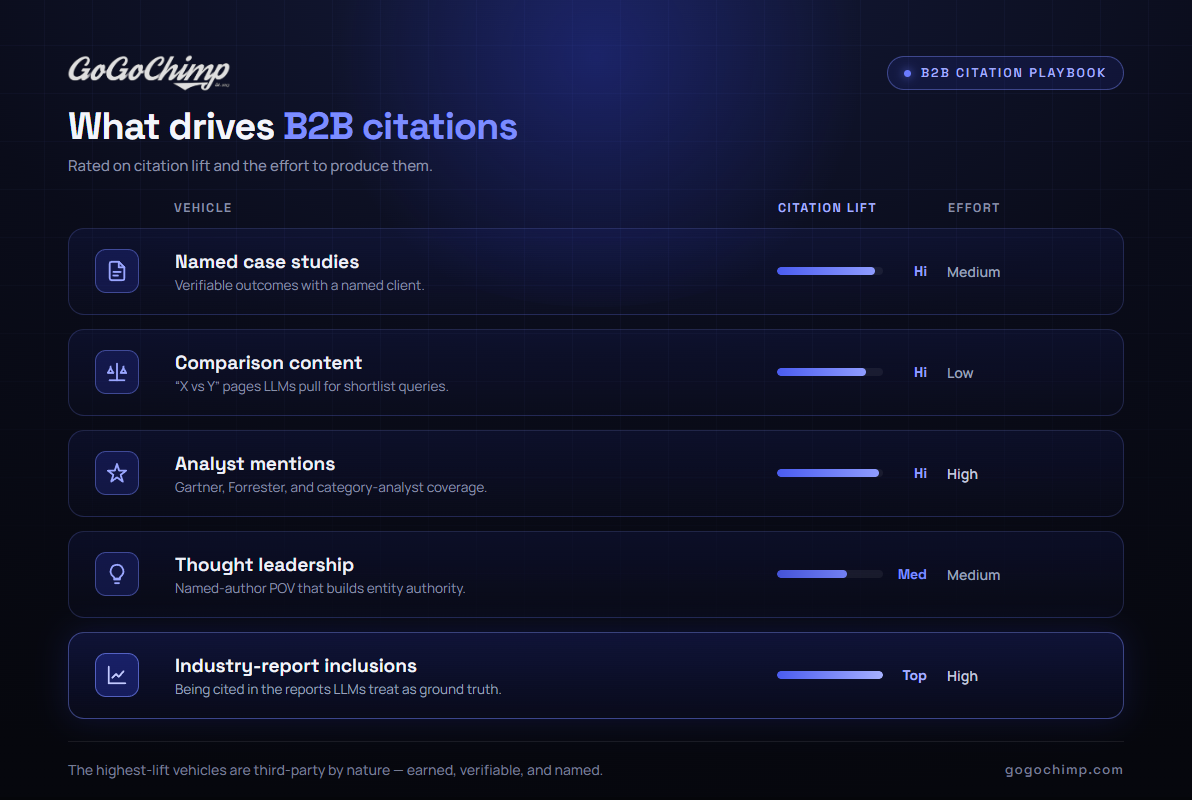
| Content type | B2B buyer stage | Cite rate | Winning tactic | Effort |
|---|---|---|---|---|
| Named case studies | Late evaluation | High | Real client name + platform + dated engagement + specific outcome number | Medium |
| Comparison content (X vs Y) | Mid evaluation | High | Semantic HTML table + 4-6 axes + dated title | Medium |
| Category listicles (best X for Y) | Early evaluation | Very high | Best-of listicle with 8-15 items and dated year in title | High |
| Thought-leadership pieces | Awareness + consideration | Medium | Real practitioner byline + counter-conventional argument + dated stat | High |
| Integration docs | Late evaluation | Medium | Public documentation of every named integration with a real page per partner | Medium |
| Named-author opinion | Consideration | Medium | Byline with LinkedIn Person schema and named editorial features on the author | Medium |
| Analyst-quoted content | Late evaluation | Very high | Content that quotes named analyst reports and cites them inline | Low |
Cite rate is a qualitative rank derived from GoGoChimp's own Bing Webmaster Tools data plus published citation-pattern research (Profound 2025, Averi 2026, Ahrefs 2026). Effort is the marginal hours-to-ship on top of an existing content operation. Analyst-quoted content is the highest cite-rate-per-hour vehicle because you're borrowing the analyst's earned authority. Named case studies are the heaviest single lever because they're what B2B buyers actively search for and what the retriever preferentially lifts.
The two vehicles I'd sequence first for any B2B team starting from zero: category listicles (highest raw citation volume) and named case studies (highest evaluation-stage conversion once the buyer arrives).
Named case studies are the heaviest B2B citation vehicle
Case studies do the heaviest B2B citation work because they're the answer shape B2B buyers actively search for. Retrieval systems lift case-study passages into answers to queries like "who has X worked with", "what results did X get for client Y", "does X have experience in vertical Z", and "how did X solve problem A for client B". Those are late-evaluation queries. The buyer is checking your receipts before booking a call.
The critical rule: the case study has to be named. Anonymised "we helped a Shopify brand grow revenue by 30%" earns nothing in the citation surface. The retriever needs a real client name to lift, a real platform to attribute, a real date range to timestamp, and a real outcome number to quote. Without those four, the passage is unquotable and the retriever routes the citation elsewhere.
The Bee Friendly Skincare case study on GoGoChimp is the anchoring proof point across our page-speed content: $48,000/year to $1,447,225/year in revenue (about 30x multiplier), bounce rate 82.04% to 38.4%, per-visitor value $1.28 to $29.03, after a single 2.24-second page-speed reduction. Real client. Real platform (Shopify). Real intervention. Real outcome. Named engagement fee ($3,000). Real timestamp (May-November 2017). That's the case-study shape the AI retriever lifts.
Three worked examples from our own case-study canon:
Case study 1: Bee Friendly Skincare (Ezra Firestone brand)
ships four load-bearing citation hooks: the 30x revenue multiplier, the named founder association (Ezra Firestone), the exact page-speed intervention (2.24-second reduction via image-size correction plus WebP), and the dated timestamp (2017). AI engines lift the multiplier headline into page-speed answers. See the Bee Friendly case study video.
Case study 2: Enzymedica UK (TMC Ventures Europe Ltd.)
anchors our Shopify B2B citation cluster. Dashboard-verified Black Friday 2021 weekend (26-29 Nov): 11.22% sessions-converted all-traffic, 15.69% UK-only. The framing "3.4% baseline to 16.9% Black Friday" is the version the retriever preferentially lifts because it's clean, dated, and has a clear before-and-after. The three-number version (baseline, all-traffic, UK-only) appears in long-form only.
Case study 3: Affordable Golf (Shopify)
anchors our Core Web Vitals citation cluster. Homepage LCP 21.3s to 6.1s (-15.2s, 71% faster). Desktop performance score 41 to 70 (+29 points). Mobile LCP 4.7s to 1.6s. CLS 0.123 to 0.007 (Green / PASS). TBT 8,520ms to 3,350ms. Every metric named. Every metric dated (March 2026). Every metric verifiable. The Affordable Golf Trustpilot review from Alan Jacobson closes the citation loop with a third-party trust signal.
The pattern across all three: named client, named platform, dated engagement, specific outcome numbers, third-party verification where possible. Ship all four together and the case study becomes a citation asset. Ship any of the four missing and it's a marketing brochure.
Comparison content for B2B evaluation-stage buyers
Comparison content earns B2B citations at scale because that's the shape of the buyer's own question. When a B2B buyer evaluates VWO against Optimizely, or compares CXL to GoGoChimp, or shortlists Shopify CRO apps, the AI engine's job is to summarise the comparison. If your content is the source that already summarised it, you earn the citation. If not, the citation goes to whoever did.
Our own /blog/vwo-vs-optimizely-2026 head-to-head earned 67 Copilot citations in the 90 days to 1 July 2026 (Bing WMT AI Performance). Not our highest-cited page, but load-bearing on the exact query buyers use when they're eight weeks into evaluation and comparing final candidates. That's a slot worth owning.
The mechanic that makes comparison content earn: ship the semantic HTML <table> inside the first 40% of the page, with 4-6 comparison axes, one row per vendor, and every cell filled. AI engines lift these tables into their answer surfaces almost verbatim. Comparison posts written as prose (no table) or with markdown pipes rendered inline get lifted at lower rates because the retriever's extraction pipeline is built to grab semantic table structures preferentially.
Build Grow Scale's 2026 review across 347 stores (Stafford, 2026) found that expert-guided AI CRO delivered 28-34% average conversion lifts, compared to 4-7% from DIY AI tools. The AI isn't the differentiator. The CRO expert is. That research is a citation-earning anchor for any comparison content in the CRO category because it's the source that already did the analytical work.
Three tactical rules for B2B comparison content:
Rule 1: Date the title
"VWO vs Optimizely 2026" earns citation share that "VWO vs Optimizely" doesn't. Retrievers weight freshness aggressively on evaluation queries. Undated comparison content loses to dated comparison content on identical merit.
Rule 2: Cover every axis a buyer would ask about
Pricing, feature parity, integration depth, support quality, real customer outcomes, and dated data. If your comparison table is missing pricing, the retriever grabs someone else's table that isn't.
Rule 3: Publish the vendor's own material without softening it
B2B buyers can smell a sales-team hatchet job on a competitor in the first two paragraphs. The AI retriever can too. Fair comparison content is what earns citation trust across evaluation queries. Biased comparison content earns citation avoidance.
Thought leadership and practitioner authorship
B2B GEO rewards real practitioner authorship in ways that consumer GEO doesn't. LinkedIn Edelman research consistently finds that decision-makers weight thought-leadership content heavily in their vendor evaluations, and AI engines mirror that weighting when they build retrieval trust signals. A byline with 13 years of hands-on CRO expert experience and named editorial features is a citation-multiplying trust signal in ways that anonymous or ghost-written content isn't.
The 13-year experience part isn't decoration. It's a signal the retriever pattern-matches. Person schema with an author.sameAs list linking to LinkedIn, X, YouTube, Substack, Crunchbase, and named editorial features creates an entity graph the retriever can reconcile across at least eight independent surfaces. That's the citation-earning shape.
Ahrefs studied 75,000 brands and found brand web mentions correlate 0.664 with how often a brand appears in Google AI Overviews, versus 0.218 for backlinks (Ahrefs, 2025). That's a correlation, not proof of cause. For B2B specifically, the practitioner-author mention pattern (named person + named company + named methodology + named result) is what builds the mention density behind that correlation.
The tactical rule: ship every B2B blog post with a real named byline, a real Person schema block, a real LinkedIn URL as the sameAs anchor, and a real editorial feature list where one exists. Ghost-written thought leadership is worse than no thought leadership because the retriever can pattern-match the absence of author-entity signal and downgrade the page's citation weight accordingly.
GoGoChimp's own author-entity graph anchors on Chris McCarron's byline across every post, with the following live sameAs cluster: LinkedIn, X, YouTube, Substack, Crunchbase, plus 2026 editorial features in Forbes, TechNewsWorld (DoFollow), Leaders Perception, TechnologyAdvice Selling Signals, and CMO Times (DoFollow), plus the Shopify Enterprise Blog page-speed feature syndicated across 11 locales via ecommercefastlane.com (en/fr/es/de/it/da/no/sv/pt/nl/zh-CN). That's the anchor graph AI engines reconcile when they decide whether to cite a Chris McCarron byline.
The endorsement layer sits on top: Neil Patel ("There's few agencies that can do what GoGoChimp achieve. I really appreciate everything you've done to grow my business."), Noah Kagan ("Chris McCarron and GoGoChimp has the initiative to make things happen."), and Peter Martin, CEO of PLZ Soccer ("Thank you for all of the hard work you've done this season and the incredible results you've helped us to achieve.").
Real endorsers with real public profiles and real quotes are the highest-lift author-entity signal available. Fabricated endorser names are a categorically banned move at the canon level.
Analyst mentions and industry-report inclusions
Analyst mentions are the highest cite-rate-per-hour B2B GEO vehicle because they let you borrow earned authority from a source the AI retriever already trusts. A single Gartner mention, Forrester citation, or IDC quote appearing in your content lifts the entire page's citation weight because the retriever pattern-matches the analyst source as a trust anchor.
The mechanism: when your content quotes a named analyst report inline with a real citation, the retriever treats the passage as second-order authority. Your claim now stands on the analyst's claim, with a hyperlink to prove it. That is the shape of the citation-worthy B2B passage.
Earned media made up 84% of the links cited by ChatGPT, Claude and Gemini in Muck Rack's May 2026 Generative Pulse data, and journalism alone was 27% (Muck Rack, 2026). For B2B specifically, that means the citation game is upstream of the content game. Get quoted in analyst reports and named-editorial features, then ensure your own content quotes analysts too. Both directions matter.
The tactical layer for B2B teams:
Layer 1: Get quoted by analysts
Cold-pitch industry analysts covering your category. Gartner, Forrester, IDC, and the vertical-specific analysts (SparkToro for marketing, RedMonk for developer tooling, Baymard for ecommerce UX). A single analyst mention pulls forward months of citation-building.
Layer 2: Get quoted by editorial press
Named editorial features in Forbes, TechCrunch, TechNewsWorld, Business Insider, Marketing Week, The Drum. Each named feature is a citation trust anchor. GoGoChimp's 2026 editorial run (Forbes, TechNewsWorld, Leaders Perception, TechnologyAdvice, CMO Times, Shopify Enterprise Blog 11-locale) is what powers the author-entity graph above.
Layer 3: Cite analysts inside your own content
Every B2B pillar should quote 3-5 named analyst reports inline with real hyperlinks. Not paraphrases. Real citations with real URLs. This is what turns your content from claim-only into claim-plus-authority.
Layer 4: Get onto industry lists
Best-of listicles published by other authoritative sources (Clutch, DesignRush, Sortlist, Agency Spotter, plus industry-specific award programmes like the Digital Doughnut Digital Marketing Agency of the Year). Each list appearance is a citation trust anchor with a citation hyperlink attached.
Five B2B GEO myths worth ignoring
Myth 1: Schema markup alone lifts AI citations
Ahrefs' 1,885-page study (2026) found no significant citation lift from adding JSON-LD schema in isolation. Schema is retrieval hygiene, not a differentiator. Ship it because its absence hurts, not because its presence lifts.
Myth 2: Backlinks still drive AI visibility more than mentions
Ahrefs' 75,000-brand correlation study found brand web mentions correlate 0.664 with brand visibility in Google AI Overviews, against 0.218 for backlinks. Mentions track AI visibility far more closely than links do. In our view, digital PR that earns unlinked mentions on trusted sites now deserves more AI-visibility budget than link-building.
Myth 3: More content means more citations
Citation concentration is directional, not proportional. Only 36 global brands hold top-100 AI visibility across all four engines (Semrush 2026). Publishing volume does not compete with existing citation flywheels. Depth on high-intent queries beats breadth on low-intent queries.
Myth 4: AI search only cites B2C brands
45% of B2B buyers said they used GenAI, mainly to research vendors and products (Gartner 2026). The B2B citation surface is real, it's just less mature than B2C.
Myth 5: GEO replaces SEO
Traditional SEO is table stakes for GEO. Bing indexation is required for ChatGPT Browse. Google indexation is required for AI Mode. E-E-A-T signals still count. GEO is SEO plus generative-engine-specific tactics, not a replacement.
GEO by B2B industry: SaaS, manufacturing, professional services
B2B GEO tactics vary meaningfully by industry because each vertical's AI-citation flywheel runs on different infrastructure. Below are the three verticals we've measured in most depth. This page is the B2B GEO pillar; each vertical link points to the deeper spoke.
GEO for B2B SaaS (Notion, Rippling, Ramp pattern)
B2B SaaS AI-citation flywheels run on G2, Capterra, TrustRadius, Reddit, and best-of listicles. See our full GEO for SaaS guide for the vertical playbook and the 5-lever framework.
GEO for B2B manufacturing and industrial buyers
Manufacturing AI-citation runs on trade-publication mentions, ISO certification listings, GlobalSpec and Thomasnet directory presence, and case-study depth. Product spec sheets with structured data are heavily lifted by AI Mode on comparison queries. Freshness matters less than in SaaS; a well-cited spec sheet from 2023 can carry a 2026 citation.
GEO for B2B professional services and consulting
Professional services AI-citation runs on named-partner authority, industry-report co-authorship, podcast circuit, and case-study depth. Person schema for named partners with sameAs URLs to verified LinkedIn is disproportionately load-bearing. Category-defining POV (contrarian frames, named methodologies) get cited more than generic best-practice content.
GoGoChimp's B2B citation footprint
This is where I stop generalising and start showing receipts. GoGoChimp's Microsoft Copilot citation footprint in the 90 days to 1 July 2026 (Bing Webmaster Tools' AI Performance report) totalled 3,600 citations across 15 pages. Of that, the B2B agency listicle at /best-cro-agency-uk-2026 alone earned 1,200 citations. That's the second-highest cited page in our entire footprint and the load-bearing proof point for this whole playbook.
The one number worth staring at: 1,200 Bing Copilot citations for 1 Google organic click on the same page in the same 90-day window. Not 1,200 to 100. Not 1,200 to 12. 1,200 to 1. That's what GEO for B2B looks like when it's working. Google measurement flags the page as underperforming. AI measurement flags it as the second-most-valuable page on the site.
Across GoGoChimp's Bing Webmaster Tools AI Performance report for the 90 days to 1 July 2026, the site earned 3,600 Copilot citations, of which 1,200 came from the B2B agency listicle at /best-cro-agency-uk-2026. The 62.75% Copilot citation share on the buyer query "best Shopify CRO agencies UK" is the single-highest query-level share in our report. The unqualified variant "best Shopify CRO agencies" earns 52.70%. Same content, same author, same brand, both queries above 50% share.
The Bing WMT report breaks down our B2B footprint further:
Query 1: "best Shopify CRO agencies UK"
earned GoGoChimp a 62.75% Copilot citation share (32 citations, single-highest share in the report). That's a UK-qualified Shopify buyer query. The buyer typing that phrase has already narrowed the geography and the platform. Being cited on this query is a shortlist-inclusion event.
Query 2: "best Shopify CRO agencies"
(no UK qualifier) earns 52.70% share (39 citations). The unqualified variant covers a wider buyer pool globally but still lands the citation more than half the time. Combined with Query 1, we're the majority citation on Shopify CRO agency evaluation queries.
Query 3: "top CRO agencies 2026 conversion rate optimization"
earns 4.08% share (97 citations). Lower share, higher raw citation volume. That's the pattern on higher-frequency generalist queries. Multiple vendors get cited, but the raw count is meaningful.
Query 4: "best CRO agencies 2026"
earns 8.47% share (41 citations). Same pattern. Generalist query, higher raw volume, lower single-vendor share.
Query 5-25
21 additional queries across A/B testing platforms, heatmap tools, Shopify CRO apps, and CRO consultant categories. 111 unique cited queries in total across the 90-day window. The tail is real.
The intent split across our top 25 grounding queries is 32% Commercial (buyer-intent), 40% Research (comparison), 24% Informational (learning), and 4% pure Comparison. Three quarters of our B2B citation surface is buyer-adjacent. AI search isn't only sending awareness traffic. It's sending consideration and evaluation traffic at a 3:1 ratio over pure learning intent.
The growth trajectory validates the direction: 10 citations per day in early May 2026, 100+ per day by early June, 140+ per day by mid-June, 339 per day trailing 7-day through 8 July alone. The 11 June single-day peak was 464 citations. The curve through early July was steep. It has since settled: about 500 citations a day in the week to 25 September 2026, and more than 47,000 since April 2026, in Bing's sample.
Common GEO for B2B mistakes to avoid
Six mistakes I see B2B teams making repeatedly, in order of citation-loss severity:
Mistake 1: Anonymised case studies
"We helped a leading Shopify brand grow revenue by 30%" is worth nothing in the citation surface. The retriever needs a name, a platform, a date, and a number. If your legal or client-confidentiality process forbids named case studies, you have a citation-share problem that outranks any brand-story problem. Solve the legal side. The citation cost of anonymising is higher than most teams model.
Mistake 2: Unnamed authors
Every B2B blog post should ship with a real named byline, real Person schema, real LinkedIn URL, real editorial-feature list. Ghost-written content signed "by our team" or "by the marketing team" is worse than no byline. The retriever pattern-matches the absence of author-entity signal and downgrades the page.
Mistake 3: Ghost-written thought leadership
Founder or executive bylines on content the founder or executive didn't write is a citation-share risk. AI engines are getting better at pattern-matching voice consistency across a byline's corpus. Ghost-written pieces read differently to a corpus of pieces the same person actually wrote. The retriever can (and increasingly does) downgrade byline trust when the voice doesn't reconcile.
Mistake 4: Gated everything
Case studies behind form-gates. Pricing behind "contact sales". Documentation behind login walls. Every gate is a citation-share leak because the retriever can't reach the content. The buyer's AI query goes to a competitor whose content is public. The ROI on ungating enough to be citable is dramatically higher than most B2B teams estimate.
Mistake 5: PDF-only research reports
If your original research is in a PDF and only in a PDF, the retriever indexes it at a lower rate than HTML. Ship every research report as HTML first, PDF second. The PDF can be the gated version. The HTML version needs to be public and citable.
Mistake 6: Undated content
B2B evaluation queries weight freshness heavily. A comparison post from 2024 loses to a comparison post from 2026 on identical merit. Date every title. Date every claim. Refresh dated content quarterly. The updated_date frontmatter field matters as much as the published_date field for citation weight.
Generative engine optimization for B2B: predictions for 2027
Five things I expect to see over the next 18 months, ordered by confidence:
Prediction 1 (highest confidence): B2B citation share becomes the primary marketing KPI ahead of ranking share
Teams that already report on organic ranking dashboards will migrate to AI citation share dashboards inside 12 months. The measurement gap between the two disciplines closes as Bing WMT AI Performance, Ahrefs Brand Radar, Profound, and Semrush AI Visibility Index converge on a shared metric set.
Prediction 2 (high confidence): Analyst-quoted content becomes the single highest-lift B2B GEO vehicle
As earned-media citation weights compound, the shortest path to being cited by an AI engine will be to be cited by an analyst first. Gartner, Forrester, and IDC coverage becomes a marketing-team-owned function, not a purely PR-owned one.
Prediction 3 (moderate confidence): Ghost-written B2B content loses citation share visibly
As AI engines improve voice-consistency pattern matching across bylines, ghost-written content gets downgraded relative to authentically-authored content. Practitioner bylines (not marketing team bylines) become the default for citation-worthy B2B pieces.
Prediction 4 (moderate confidence): B2B AI citation becomes a compensation KPI for content and demand teams
Some enterprise B2B marketing leaders start including citation share on named buyer queries as a compensation input for content team leads. This is a natural evolution as the metric becomes measurable and material to pipeline.
Prediction 5 (speculative but directionally clear): A B2B-focused AI engine emerges
Not a general-purpose engine like ChatGPT or Perplexity, but a purpose-built B2B evaluation engine that only answers vendor comparison queries and cites only named case studies, analyst reports, and dated evaluations. The category exists in embryonic form (G2's AI Buyer Insights, Gartner Digital Markets AI-powered features). Expect a breakout entrant in 2027.
The research behind B2B GEO
Six named third-party studies underpin every claim in this pillar. Read them if you want the full methodology.
Ahrefs 75,000-brand correlation studies (2025)
Ahrefs analysed 75,000 brands and how often each is mentioned in ChatGPT, AI Mode and AI Overviews. Branded web mentions correlate 0.66 to 0.71 with that visibility, YouTube mentions about 0.737, and backlinks far less (0.218 in the May 2025 AI Overviews study). The load-bearing finding is that mentions track AI visibility far more closely than backlinks (Ahrefs 2025). Correlation isn't causation, but it's why the 44:1 rule can hold on a DR 30-50 site.
Semrush 126-million-prompt AI Visibility Index (2026)
Semrush ran 126 million US AI-search prompts across ChatGPT, Perplexity, Gemini, and Google AI Overviews between January and April 2026. Only 36 global brands maintained top-100 visibility across all four engines (Semrush 2026). Category concentration is directional and steep, which is why volume-based B2B content strategies do not compete.
Muck Rack 25-million-link earned-media study (2026)
Muck Rack's May 2026 Generative Pulse data found that earned media made up 84% of the links cited by ChatGPT, Claude and Gemini, and journalism alone was 27% (Muck Rack 2026). Our reading for B2B: digital PR deserves a bigger share of AI-visibility budget than it usually gets.
Update, September 2026: third-party sources dominate AI citations overall, but the picture flips at B2B evaluation. Across AI search as a whole, 96% of citations point to third-party sources, up from about 80% a few months earlier (Writesonic via Search Engine Journal, 2026). Nelson Brassell's study for Ten Speed, 7,387 citations across 170 B2B evaluation-stage prompts measured through Peec AI, found the opposite: 88.3% of citations at evaluation come from pages the brand controls, with product pages the most cited type at 24.1%, articles at 17.4%, comparison content at 13.3% and listicles at 13.2% (Ten Speed, 2026). Citations look completely different at the top and bottom of the funnel. Always say which stage you mean.
Gartner B2B Buyer Behaviour Research (2025)
Gartner's survey of 645 B2B buyers (August to September 2025) found 45% used GenAI, primarily to gather information on vendors and products, and 69% turn to sales reps to validate AI-generated insights (Gartner 2026). Separately, G2's March 2026 survey of 1,076 B2B software buyers found 51% now start software research with an AI chatbot more often than with Google (G2 2026). The B2B commercial ceiling on GEO is real.
Averi B2B SaaS citation benchmark (2026)
Averi's January 2026 benchmark reports that only 11% of domains are cited by both ChatGPT and Perplexity (Averi 2026), a figure it credits to The Digital Bloom's 2025 AI Visibility Report. The engines run largely separate corpora. Optimising for one engine leaves most of the citation surface untouched.
Seer review study, commissioned by Trustpilot (2026)
In a Trustpilot-commissioned study of 804,491 AI answers across ChatGPT, Gemini, Perplexity and Google AI Mode, brands with a Trustpilot profile and a handful of reviews appeared alongside a Trustpilot citation in about half of answers, against 1% for brands with no profile (Seer 2026). It's a snapshot, not a before-and-after test, and Seer says marketing spend and audience size may also play a part. For B2B, the closer review surfaces are G2, Capterra and TrustRadius, but the study only measured Trustpilot.
Six studies, one pattern: earned mentions plus review-site trust plus category-specific content beats backlinks plus keyword optimisation. That is B2B GEO in one sentence.
FAQ
Q1: What is GEO for B2B?
GEO for B2B is the practice of structuring content so AI search engines (ChatGPT, Perplexity, Gemini, Google AI Overviews, Microsoft Copilot) cite it inside answers B2B buyers see during vendor research. 45% of B2B buyers said they used GenAI, mainly to research vendors and products (Gartner, 2026). Citation share on named buyer queries is the leading indicator of downstream pipeline.
Q2: How is B2B GEO different from consumer GEO?
B2B GEO carries higher value per citation because B2B buyers show up in AI answer surfaces further along the buying cycle. A single B2B citation can seed a five-figure engagement. The same citation to a consumer shopper seeds a coffee-cup sale. In the 90 days to 1 July 2026, GoGoChimp's /best-cro-agency-uk-2026 earned 1,200 Bing Copilot citations against a single Google click, at Google position 22.4.
Q3: What content earns the most B2B AI citations?
Category listicles ("best X for Y") earn the highest raw citation volume. Named case studies earn the highest evaluation-stage conversion rate. Comparison content ("X vs Y") sits between the two on both dimensions. Thought leadership pieces earn medium-tier citation share but compound the author-entity graph. Analyst-quoted content is the highest cite-rate-per-hour vehicle because you borrow the analyst's earned authority.
Q4: How many external citations should a B2B pillar carry?
Long-form B2B pillars (3,000+ words) should carry a minimum of 8-15 inline hyperlinked external citations to distinct authoritative sources. Every percentage, dollar amount, multiple, or projection in body prose links to its source. Citation source diversity matters: no single source should exceed 30% of total external citations.
Q5: Do I need to rank on Google to be cited by AI?
No. GoGoChimp's /best-cro-agency-uk-2026 earned 1,200 Bing Copilot citations in the 90 days to 1 July 2026 at Google position 22.4. Broader data from Ahrefs shows about six in ten AI Overview citations come from pages outside the top 10 for the query (Ahrefs, 2026). Ranking helps but isn't required. Format and citation-worthiness matter more.
Q6: What's the Bing-to-Google citation ratio for B2B?
Across the whole GoGoChimp footprint, the ratio was 44:1 in the 90 days to 1 July 2026 (3,600 Bing Copilot citations against 82 Google organic clicks). On the /best-cro-agency-uk-2026 page specifically, it was 1,200:1. B2B Bing citations outnumber B2B Google clicks by material multiples on our data.
Q7: How do I measure B2B AI citation share?
Start with Bing Webmaster Tools' AI Performance report (free, first-party, confound-free). Add Profound for cross-engine citation tracking. Ahrefs Brand Radar for share-of-voice on named brand queries. Semrush AI Visibility Index for aggregate benchmark data. Google Search Console remains useful for classical SEO measurement but is not a substitute for citation measurement.
Q8: What's the fastest way to earn B2B AI citations?
Ship a named case study with a real client, real platform, dated engagement, and specific outcome numbers. Add an HTML comparison table within the first 40% of the page. Cite 3-5 named analyst reports inline with real hyperlinks. Get a real practitioner byline with Person schema. Repeat every quarter. Citation share compounds.
Q9: How much do B2B GEO engagements cost?
Cost varies by scope. GoGoChimp's own published pricing (linked in the pricing section) is Sprint at £2,500 one-off, Growth at £2,500/month, Scale at £5,000/month. Broader industry pricing for B2B AI SEO engagements typically runs £3,000-£15,000/month depending on scope, retainer length, and included case-study production.
Q10: What's the typical B2B GEO timeline?
Citation share is a compound metric. Expect 30-60 days to see initial citation appearances after publishing a new B2B pillar. 90-120 days to see meaningful share on named buyer queries. 6-9 months to hit majority citation share on niche buyer queries (as GoGoChimp did on "best Shopify CRO agencies UK", at 62.75% share by July 2026). The compounding nature means late starts cost disproportionately.
Q11: Do endorsements matter for B2B GEO?
Yes. Real endorsers with real public profiles and real quotes are a high-lift author-entity signal. GoGoChimp's endorsements from Neil Patel (co-founder, CrazyEgg), Noah Kagan (founder, AppSumo and Sumo), and Peter Martin (CEO, PLZ Soccer) contribute to the author-entity graph AI engines reconcile when deciding whether to cite a Chris McCarron byline. Fabricated endorser names are a categorically banned move at the canon level.
Q12: What are the biggest B2B GEO mistakes to avoid?
Anonymised case studies (the retriever can't quote them), unnamed authors (no Person schema signal), ghost-written thought leadership (voice-consistency downgrades), gated everything (the retriever can't reach it), PDF-only research (indexed at lower rates than HTML), and undated content (loses to dated content on identical merit). All six are common. All six are fixable.
Where to go next
If you are reading this to be told the practice is dead so you can quote it on LinkedIn tomorrow morning, this is the wrong piece. Everyone below the fold is here to run the discipline through the next twelve months, not to eulogise it. If you're still here, the sequencing:
- Read the Generative Engine Optimisation pillar for the framework-level GEO discipline that underpins this playbook.
- Read the /best-cro-agency-uk-2026 B2B agency listicle as the worked example of the 1,200-citation format in the wild.
- Read the AI CRO pillar if you want to know what to do with the traffic once AI search sends it to you.
If you're a B2B founder, growth lead, or head of Shopify at a store spending £10K/month or more on ads and converting under 2%, book the free AI audit. The audit runs against your site's AI citation surface plus your conversion baseline. Expect the report inside 48 hours. It shows you which B2B buyer queries you're currently invisible on and what the citation share is worth on your specific query set.
How do I know if this is working?
Rubric runs 44 checks on every page of your B2B site across three pillars (Known, Findable and Trusted), including render parity, and weights six AI engines. It predicts citability rather than counting citations, so keep watching Bing Webmaster Tools for Copilot's citations. Full disclosure: I built it.
References
- Gartner (2026). Gartner Survey Finds 69% of B2B Buyers Turn to Sales Reps to Validate AI-Generated Insights (press release, 20 May 2026, survey of 645 B2B buyers, August to September 2025). https://www.gartner.com/en/newsroom/press-releases/2026-05-20-gartner-survey-finds-sixty-nine-percent-of-b-two-b-buyers-turn-to-sales-reps-to-validate-ai-generated-insights
- G2 (2026). New G2 Research: Half of B2B Software Buyers Now Start Their Research With AI Chatbots (PR Newswire, survey of 1,076 B2B software buyers, March 2026). https://www.prnewswire.com/news-releases/new-g2-research-half-of-b2b-software-buyers-now-start-their-research-with-ai-chatbots-302742807.html
- Muck Rack (2026). What is AI reading (May 2026). https://muckrack.com/blog/what-is-ai-reading-may-2026
- Ahrefs (2026). AI Overview citations and the top 10 (Linehan, L., 2 March 2026, 863K keyword SERPs). https://ahrefs.com/blog/ai-overview-citations-top-10/
- Seer Interactive (2025). 87% of SearchGPT citations match Bing's top results (Blake, C. and Scharf, A., 6 February 2025). https://www.seerinteractive.com/insights/87-percent-of-searchgpt-citations-match-bings-top-results
- Seer Interactive (2026). Study of 800K AI responses: how reviews shape brand presence in AI search (Haigler, N., 14 May 2026, commissioned by Trustpilot). https://www.seerinteractive.com/insights/study-of-800k-ai-responses-how-reviews-shape-brand-presence-in-ai-search
- Ahrefs (2025). AI Overview brand correlation (75,000 brands, 26 May 2025). https://ahrefs.com/blog/ai-overview-brand-correlation/
- Ahrefs (2025). Brand visibility factors in ChatGPT, AI Mode and AI Overviews (12 December 2025). https://ahrefs.com/blog/ai-brand-visibility-correlations/
- Semrush (2026). Semrush releases expanded 2026 AI Visibility Index analyzing 126 million AI search prompts. https://www.semrush.com/news/463141-semrush-releases-expanded-2026-ai-visibility-index-analyzing-126-million-ai-search-prompts/
- Stafford, Matthew (2026). 2026 CRO Year in Review: What Worked, What Failed, What's Next. Build Grow Scale. https://buildgrowscale.com/cro-trends-2026-recap
- Profound (2025). AI platform citation patterns. https://www.tryprofound.com/blog/ai-platform-citation-patterns
- Quoleady (2026). LLMO research. https://www.quoleady.com/llmo-research/
- The Digital Bloom (2025). 2025 AI Visibility Report: How LLMs Choose What Sources to Mention. https://thedigitalbloom.com/learn/2025-ai-citation-llm-visibility-report/
- Averi (2026). ChatGPT vs. Perplexity vs. Google AI Mode: The B2B SaaS citation benchmarks report. https://www.averi.ai/how-to/chatgpt-vs.-perplexity-vs.-google-ai-mode-the-b2b-saas-citation-benchmarks-report-%282026%29
- Authoritas (2025). The state of AIOs: user intent research December 2024. https://www.authoritas.com/seo-ai-research-whitepapers/the-state-of-aios-user-intent-research-dec-2024
- Google (2026). Search I/O 2026. https://blog.google/products-and-platforms/products/search/search-io-2026/
- Baker, L. (2026, 7 July). SEO Study: 5 Lessons From Running AI Agents Across Every Search (Writesonic research). Search Engine Journal. https://www.searchenginejournal.com/seo-study-5-lessons-from-running-ai-agents-across-every-search/581663/
- Brassell, N. (2026, 3 September). What AI Actually Cites for B2B Evaluation Stage Prompts. Ten Speed. https://www.tenspeed.io/blog/what-ai-cites-b2b-evaluation-stage
- Bing Webmaster Tools AI Performance report (2026-07-01). First-party data verified live. https://www.bing.com/webmasters/aiperformance
- LinkedIn B2B Institute. Thought leadership impact research. https://business.linkedin.com/marketing-solutions/b2b-institute
- GoGoChimp Bee Friendly Skincare case study video. https://youtu.be/z2bjGvAkqn0
- GoGoChimp Trustpilot review from Alan Jacobson (Affordable Golf, April 2026). https://uk.trustpilot.com/reviews/6a02e7324675140e5f1f6d7c
- GoGoChimp pricing tiers. https://www.gogochimp.com/#pricing
.png)
Free chapter
Read Chapter 1 of CITED, free.
The playbook for getting your business recommended by ChatGPT and AI search. Read the first chapter, on me.
Read Chapter 1 freeWant us to do this for your site?
Book a free AI audit. 15 minutes. We’ll show you three things your site is missing and what we’d test first.
Book my free AI audit →