How to Choose an AEO Agency: Check Its Own Website First (Data From 415 Agencies)
AI SEO


If you're about to hire an AEO agency, check its own website first. In our October 2026 crawl, 249 of 413 agency sites didn't name an author on most of their pages.
That's one of the first things an AEO agency should fix on your site. A named author tells an AI engine, and a buyer, who stands behind a claim.
The figures come from GoGoChimp's 2026 benchmark of agency websites. We scored each site with Rubric, our tool that rates how easy a page is for AI to quote.
GoGoChimp is a CRO agency and we make Rubric, so I'm not neutral about tools. I won't tell you which agency to hire.
What does an AEO agency actually do?
Whatever it calls itself, an AEO agency sells one outcome: your pages quoted in AI answers from ChatGPT, Google's AI Overviews, Microsoft Copilot, Perplexity and Claude. AEO (answer engine optimisation), GEO (generative engine optimisation) and AI SEO are three labels for mostly the same job. The bulk of it is good SEO done with AI readers in mind, plus reporting that ordinary SEO reports don't cover.
I've set out where the labels differ in GEO vs SEO vs AEO vs AIO. When you're hiring, the work matters more than the label.
What work should an AEO agency do for you?
Expect four kinds of work:
- Your pages: named authors, linked sources, a direct answer near the top, question-shaped headings, and structured data (schema) that tells an engine what each page is.
- Crawler access: making sure AI search crawlers can get past your robots.txt file and your firewall.
- Other sites: mentions, reviews and profiles elsewhere on the web that AI engines read about you.
- Measurement: which engines cite you, for which questions, and whether any of it turns into leads.
Our answer engine optimisation guide covers the method. I've also covered whether AI will replace SEO.
Do buyers really use AI to research suppliers?
Yes, for business purchases like hiring an agency.
In Gartner's survey of 645 B2B buyers, run in August and September 2025, 45% said they used generative AI during a recent purchase, mainly to gather information on vendors and products.
So an agency's own pages get read by AI long before anyone books a call. Yours do too.
Why check the agency's own website first?
An agency's own pages show you its standards before you pay for them. In our 6 October 2026 crawl of 415 agency websites, the median site scored 70 out of 100 on Rubric's AI quotability score. None reached 90. If the service page in front of you is unsigned and unsourced, that's the standard you'd be buying.
What did our crawl of 415 agency websites find?
Agency sites bunch in the middle, and trust is where they fall down. The middle half scored between 65 and 75 out of 100, and only 14.7% of agencies reached 70 on Rubric's trust score.
We crawled 484 SEO and digital agency websites on 6 October 2026, at up to 40 pages each, on Rubric scoring version 2026-10-01. We scored 415 of them (85.7%). The rest served our crawler a firewall challenge, failed to load or gave too few pages to score. None of our agency lists is a random sample.
Rubric reads each page much as an AI crawler would. Its score out of 100 is made up of three parts:
- Known: can AI tell what the page is and who's behind it?
- Findable: can AI lift a clean answer from it?
- Trusted: does the page give AI reasons to believe its claims?
Rubric estimates how quotable a page is and can't see whether any engine has cited it.
Trust was also the lowest of the three in our study of the North of England's top 50 digital agencies. The same goes for the 244 other websites in our state of AI citability benchmark.
| Measure | Agencies (n=415) |
|---|---|
| Median score | 70 |
| Middle half of agencies | 65 to 75 |
| Scoring 70 or more | 53.5% |
| Scoring 90 or more | 0 |
| Median Known score (what the page is, who's behind it) | 80 |
| Median Findable score (a clean answer to lift) | 71 |
| Median Trusted score (reasons to believe it) | 52 |
| Agencies under 50 on Trusted | 168 |
Why skip the agency's homepage?
The homepage is the page agencies polish most, so it flatters them. It beat the median inner page at 373 of 415 agency sites (89.9%), by a median of 12 points: 82 against 70.
A buyer's real questions get answered on the inner pages. "Can they do this for a business like mine?" is a service-page question. "Have they done it before?" is a case-study question. Only 14 of 646 service pages (2.2%) and 14 of 570 case studies (2.5%) had a named author and two or more external source links.
An AEO agency with unsigned, unsourced service pages is a locksmith whose own front door is held shut with a bungee cord.
The locksmith could still be good at the job. I'd just want to ask about the door.
What does a strong agency website look like?
The agencies at the top of our crawl show the basics are doable. The top scorer, firestarterseo.com, scored 87, with aztekweb.com on 86 and conquerradigital.com.au on 85. At conquerradigital.com.au, 34 of 38 applicable inner pages named an author and 36 of 38 linked two or more outside sources. At firestarterseo.com, 33 of 38 named an author and all 38 carried schema saying what the page was.
A high score shows an agency has done the basics on its own pages. We haven't assessed anyone's client work.
In GoGoChimp's 6 October 2026 crawl of 415 agency websites, the median Rubric score was 70 and no agency reached 90.
How do you check an agency's website in 20 minutes?
Open one service page and one case study, then run the nine checks below at about two minutes each. You only need a browser. The checks cover the basics an AEO agency would fix for you. The last column shows how many agencies in our crawl failed each one.
| # | Check | How to do it | Agencies failing in our crawl |
|---|---|---|---|
| 1 | Skip the homepage | Open a service page and a case study | Homepage beat the median inner page at 373 of 415 |
| 2 | A named author | Look for a real person's name, job title and profile link | 249 of 413 |
| 3 | Two or more sources | Count body-copy links to other websites | 224 of 415 |
| 4 | An answer up front | Do the first 70 words say what the service is and who it's for? | 200 of 413 |
| 5 | Question or claim headings | Read the headings on their own. Labels like "Our approach" fail | 205 of 413 |
| 6 | Schema naming the page type | Type view-source: before the address, search for application/ld+json and look for Service or Article | 208 of 415 |
| 7 | Content and schema in the raw HTML | In view-source, search for a sentence you can read on the page | At 44 of 415, schema appeared only after JavaScript ran on at least one page |
| 8 | AI search crawlers allowed | Open /robots.txt and look for OAI-SearchBot, Claude-SearchBot and PerplexityBot | 13 blocked an AI bot, 12 of them training crawlers only |
| 9 | A signed, dated, sourced case study | Look for who led the work, the dates and a link the client could confirm | Only 14 of 570 case studies were signed and sourced |
A site fails a check when it's bad on more than half the pages the check applies to (GoGoChimp crawl of 415 agency sites, 6 October 2026). Use the last two minutes to write one line per check.
A name gives an AI engine, and you, someone to credit for a claim. A source gives it something to check the claim against. For check 4, our guide to answer-first openings shows the pattern.
How do you see what an AI crawler sees on a page?
Type view-source: in front of the page address in Chrome. That shows the raw HTML the server sends before any JavaScript runs. Search it with Ctrl+F (Cmd+F on a Mac) for a sentence from the page, then for application/ld+json, the tag that holds schema.
If either is missing from the source, a crawler that doesn't run JavaScript won't see it. Vercel's December 2024 analysis of AI crawler logs found that "none of the major AI crawlers currently render JavaScript" (Vercel and MERJ, 2024). That includes OpenAI's and Anthropic's.
Schema won't win citations on its own. When Ahrefs tracked 1,885 pages that added it, "Adding schema produced no major uplift in citations on any platform" (Ahrefs, 2026). I still check it, because schema is the label on the tin. An agency that hasn't labelled its own pages is skipping a basic it would sell you.
What should an agency's robots.txt say about AI bots?
It should let the AI search crawlers in. Robots.txt is a public text file that tells bots what they may read. Each big AI company splits its bots into search crawlers and training crawlers.
OpenAI says "OAI-SearchBot is for search", and sites that block it won't appear in ChatGPT's search answers. GPTBot is its training crawler (OpenAI). Anthropic splits Claude-SearchBot from ClaudeBot the same way (Anthropic, 2026). Perplexity says PerplexityBot "is not used to crawl content for AI foundation models" (Perplexity).
Blocking a training crawler is a business decision. Blocking a search crawler takes you out of that engine's answers. Our ChatGPT SEO guide covers the split for OpenAI's bots, and our Claude and Gemini SEO guide covers it for Anthropic's.
The firewall was the bigger problem in our crawl. Of the 484 agency sites we tried, 25 (5.2%) served our crawler a security challenge page in place of their content. You can't see that from a browser. So ask the agency what GPTBot, ClaudeBot and PerplexityBot get from its site.
In GoGoChimp's 6 October 2026 crawl, 249 of 413 agency sites failed Rubric's named-author check on more than half their pages.
What should you ask an AEO agency on the sales call?
Ask questions that make the agency show its working: which engines it measures, with what data, over which dates, and what it won't promise. A good agency answers with specifics and tells you what it can't control. A weak one answers with confidence and a dashboard screenshot.
| Question | A good answer sounds like | A red flag sounds like |
|---|---|---|
| Which engines do you measure, and how? | Each engine on its own line with a source: Bing Webmaster Tools for Copilot, Search Console for Google, sampled answers for ChatGPT, Perplexity and Claude | "We track your AI visibility", with one number for every engine |
| Show me a client's citation data, with dates. | A dated report showing the window, the engines and how many answers were sampled. Anonymised is fine | A screenshot of one ChatGPT answer |
| What won't you promise? | Citations, a place in a particular AI answer, or a set amount of traffic | "Guaranteed placement in ChatGPT" |
| Who will write and sign our pages? | Named people with relevant experience, as on the agency's own service pages | "Our content team", and no names on their own site |
| How many answers do you sample per question? | Repeated runs per engine and topic, reported as ranges with dates | One check per prompt per month |
| What will you change in the first month? | A page list: authors, sources, schema, answer-first openers and crawler access | "An llms.txt file and a content calendar" |
| What will you do with our robots.txt and firewall? | Let the AI search crawlers in, leave training crawlers to you, and test what the firewall serves them | "Block all AI" or "allow everything", with no reason given |
| When are you the wrong fit? | Something specific, such as a sector, a budget or a team size they don't serve | "We work with everyone" |
Should an AEO agency guarantee citations?
No, because nobody outside the AI companies controls which sources an engine picks for an answer. Google's own guide to its generative AI features gives no guarantee that a page will be indexed or shown, even one that meets every requirement (Google Search Central, 2026). The same guide says Google Search ignores llms.txt files. If one turns up in a proposal as a deliverable, ask what it's meant to do.
An agency that guarantees you'll be cited by ChatGPT is either new to this or having you on.
A good agency promises the work: which pages it'll fix, what it'll report and when.
What if the agency's own website fails your check?
Ask about it, and give it some slack. An agency's own site tends to be the last job on its list. A good answer is specific and dated, such as "the service pages get bylines and sources this quarter". A shrug tells you how they'd treat the same gap on your site.
Google's guide to its generative AI features, last updated 10 July 2026, says Google Search ignores llms.txt files.
What should an AEO report include?
An honest AEO report shows each AI engine on its own line and says where every number comes from. Each figure carries a sample size and a date range. The report starts with free data from Microsoft's Bing Webmaster Tools and Google Search Console, and keeps citations apart from brand mentions. One blended "AI visibility score" with no method is the clearest red flag.
| What it shows | Where it comes from | What it can't tell you |
|---|---|---|
| Copilot and Bing AI citations, by page and by query | Bing Webmaster Tools, AI Performance report (free) | Clicks. Bing calls the data "a sample of overall citation activity" |
| Questions where other sites get cited and you don't | Bing's Topics Portfolio, in beta since 13 October 2026 (free) | Exact volumes. Bing shows ranges and calls them "directional signals" |
| How often Google showed your links in AI Overviews and AI Mode | Search Console, generative AI performance report (free) | Clicks. It reports impressions only |
| How often ChatGPT, Perplexity, Claude and Gemini cite or mention you | A prompt tracker that samples answers to a fixed set of questions (usually paid) | Anything firm from a single run |
| Why a page is or isn't easy to quote | An on-page citability audit, such as Rubric (ours) | Whether you've been cited |
| Leads and sales | Your CRM, plus a "How did you hear about us?" field on your forms | Influence that never turns into a visit |
Never add the Bing and Google rows together. Bing counts citations, Google counts impressions, and Google's AI figures already sit inside its main Web search report.
If you can't tell where a number in a report came from, treat it as decoration.
Which AI search data comes straight from the engines?
Only Microsoft and Google give site owners their own AI search data. Bing Webmaster Tools' AI Performance report shows how a site's content appears "across Microsoft Copilot, AI-generated summaries in Bing, and select partner integrations" (Bing, February 2026). Since 13 October 2026, its Topics Portfolio also lists opportunity queries, "the strongest queries across your whole portfolio where other sites appear and yours does not" (Bing, October 2026).
Google's version is the generative AI performance report in Search Console. It covers AI Overviews and AI Mode and counts impressions only. It's been open to all sites worldwide since 31 August 2026 (Google Search Console Help). Neither company reports ChatGPT, Perplexity or Claude, so every number for those engines is a tracker's sample.
When we pulled our own Topics Portfolio on 14 October 2026, it listed 50 opportunity queries for September. About 17 of them asked which AEO or AI SEO agency or service to choose. Copilot cited other sites for each of them and none of ours. That's why this guide exists. It's also the kind of dated finding a good agency report should put in front of you.
How many AI answers does a reliable reading need?
Dozens per engine and topic, going by one 2026 study. Ron Sielinski co-founded IQRush, which sells AI visibility measurement software. He ran 30 tests across Gemini, SearchGPT and Perplexity, each pairing one platform with one topic. Rankings needed 33 to 94 cited answers before they settled, and 3 of the 30 hadn't settled after 125 questions (Search Engine Journal, 2026). The paper is a preprint and hasn't been peer reviewed yet (Sielinski, 2026).
A report built on one run per prompt is reading tea leaves. Ask for repeated samples, a range around every number, and before-and-after readings taken more than once each.
Why should a report keep citations and brand mentions apart?
They measure different things. A citation links to your page as a source. A mention puts your brand's name in the answer. Kevin Indig analysed six months of Semrush data on ChatGPT answers across 1,094 US categories. Citations and brand mentions turned out to be "only weakly related, with a slightly negative correlation of -0.229". The most-cited domain in a category was the most-mentioned brand only 20.8% of the time (Search Engine Journal, 2026).
A report that adds the two together can show steady growth while ChatGPT recommends your competitor. Our guide to tracking AI visibility sets out a fixed bank of questions you can rerun each month. The AI SEO measurement stack covers the free set-up.
In a 2026 preprint by Ron Sielinski, AI visibility rankings needed 33 to 94 cited answers per platform and topic before they settled.
Should you use a self-serve AEO tool or a full-service agency?
Use a tool to find out what's wrong, and hire an agency when nobody on your team can fix it every week. A self-serve tool costs little and shows which pages fail and why. An agency costs more and does the work. I'd start with the diagnosis either way, because it tells you how big the job is before anyone quotes for it.
| Self-serve AEO tool | Full-service AEO agency | |
|---|---|---|
| What you get | A diagnosis: which pages fail which checks, and what to fix first | The fixes, the writing, the off-site work and the reporting |
| Who does the work | Your team | The agency, with your sign-off |
| Cost | Free consoles, then free tiers or subscriptions for trackers and auditors | A retainer or project fee. Get a written scope before you compare prices |
| Best when | Someone in-house can edit pages and templates | Nobody in-house can do the work every week |
| Watch out for | A headline score with no page-level detail | A retainer with no dated reporting |
What do self-serve AEO tools do?
They fall into three groups:
- Free consoles from the engines: Bing Webmaster Tools and Google Search Console. Start here.
- Prompt trackers, which ask AI engines a fixed set of questions on a schedule and log who gets cited or named. We compared several in our roundup of AI SEO monitoring tools.
- On-page citability auditors, which check whether your pages are easy for an engine to read, trust and quote. Rubric is one, and it's ours, so weigh my view with that in mind.
The tool makers don't keep tidier sites than the agencies. In the same October crawl, 47 SEO software vendors' own websites scored a median of 67, against 70 for the agencies.
When is an AEO agency worth paying for?
When the fixes need doing every week and nobody in-house has the hours or the skills. An agency earns its fee on the jobs a tool can't do. It rewrites service pages to answer the buyer's question and gets the right people to sign them. It earns mentions on other sites and keeps the reporting honest.
If someone on your team can edit templates and write plainly, start with a tool and a few hours a week.
In GoGoChimp's 6 October 2026 crawl, 47 SEO software vendors' own websites scored a median of 67 on Rubric, against 70 for 415 agencies.
Questions about choosing an AEO agency
How much does an AEO agency cost?
Pricing varies, and we don't have data for a fair range. Our crawl can't help either. Only 43 of 415 agency sites had a price in their structured data, the code that labels a page for search engines, on any page we crawled. Ask each agency for a written scope of pages, reports and dates, then compare like with like.
Can a normal SEO agency do AEO?
Yes, if it does the basics well and reports on AI separately. Most AEO work is SEO work: clear pages, named authors, sources, schema and crawler access. The difference is measurement. Ask whether the agency uses Bing Webmaster Tools' AI Performance report and Search Console's generative AI report. Then ask whether it tracks each AI engine on its own.
How do I evaluate an AEO agency's credibility?
Check its own site, then its evidence. Open a service page and a case study. Look for a named author, two or more linked sources and an answer in the first 70 words. Then ask for a client's citation data with dates and sample sizes. A credible agency shows its working and tells you what it can't promise.
Is AEO different from GEO?
Not in any way that changes how you hire. AEO (answer engine optimisation) and GEO (generative engine optimisation) both mean getting your pages found, trusted and quoted in AI answers from ChatGPT, Google, Copilot, Perplexity and Claude. People draw the line between them in different places. The hiring checks in this guide apply to both, and to AI SEO.
Do AEO agencies guarantee citations?
No honest one will, because no agency controls which sources an AI engine picks for an answer. Google's guide to its generative AI features says "Indexing and serving aren't guaranteed", even for pages that meet every requirement. A good agency promises the work, the reporting and the dates, and tells you plainly what it can't control.
Which agencies are best for AEO and SEO reporting?
The ones whose reports keep each engine separate and say where every number comes from. Look for Bing Webmaster Tools data for Copilot, Search Console's generative AI report for Google, and repeated prompt samples with ranges for ChatGPT, Perplexity and Claude. Citations and brand mentions should sit in separate rows, tied to leads where possible.
What should you do before the first call?
Run the 20-minute check on every agency on your shortlist and write one line per check. Take those lines into each call and ask about every gap. If you're down to two or three agencies that sound the same on the phone, their own pages are the quickest way to tell them apart.
If you'd rather not do it by hand, run any agency's site, or your own, through a free Rubric audit. Read the page-level results before the headline score. Rubric can't tell you who's been cited, so pair it with the questions above.
The data behind every check is in the full agency benchmark.
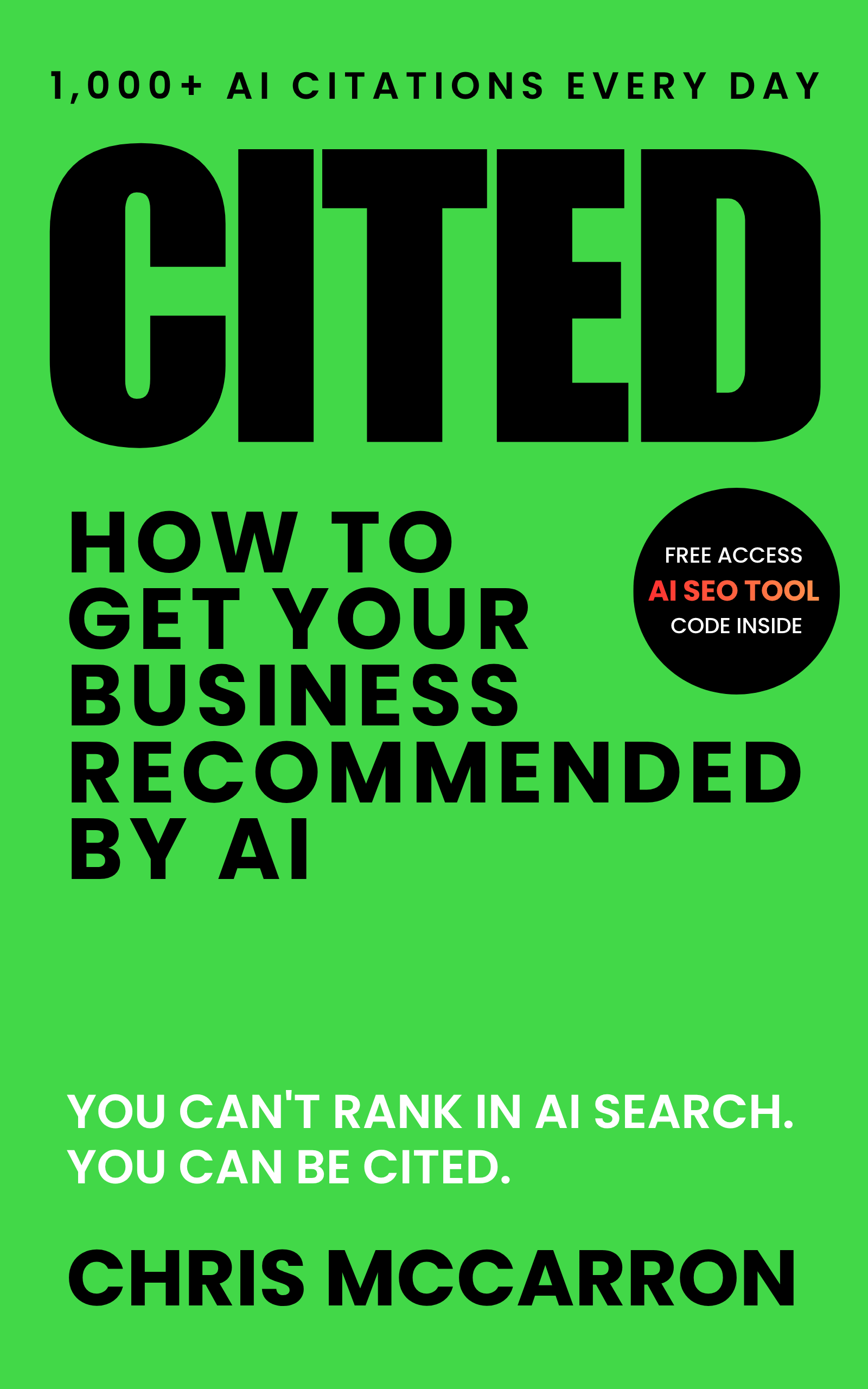
Chris McCarron is the founder of GoGoChimp, a Glasgow CRO agency, and a CRO expert with 13 years of hands-on testing. He wrote CITED, a book on getting cited by AI search, and builds Rubric, GoGoChimp's AI citability auditor.
References
- GoGoChimp. (2026, 6 October). Agency AI-citability benchmark: one-engine re-crawl of 484 agency sites, 415 scored, Rubric scoring version 2026-10-01, up to 40 pages per site. First-party. https://www.gogochimp.com/research/ai-citability-seo-agencies-2026
- Gartner. (2026, 20 May). Gartner Survey Finds 69% of B2B Buyers Turn to Sales Reps to Validate AI-Generated Insights (645 B2B buyers, surveyed August to September 2025). https://www.gartner.com/en/newsroom/press-releases/2026-05-20-gartner-survey-finds-sixty-nine-percent-of-b-two-b-buyers-turn-to-sales-reps-to-validate-ai-generated-insights
- Zecchini, G., Moore, A. A., Ubl, M., & Siddle, R. (2024, 17 December). The rise of the AI crawler (Vercel with MERJ, analysis of AI crawler server logs). Vercel. https://vercel.com/blog/the-rise-of-the-ai-crawler
- Linehan, L. (2026, 11 May). We Tracked 1,885 Pages Adding Schema. AI Citations Barely Moved. Ahrefs. https://ahrefs.com/blog/schema-ai-citations/
- OpenAI. (n.d., accessed 14 October 2026). Overview of OpenAI crawlers. OpenAI Developers. https://developers.openai.com/api/docs/bots
- Anthropic. (2026, 7 April). Does Anthropic crawl data from the web, and how can site owners block the crawler? Anthropic Help Center. https://support.claude.com/en/articles/8896518-does-anthropic-crawl-data-from-the-web-and-how-can-site-owners-block-the-crawler
- Perplexity. (n.d., accessed 14 October 2026). Perplexity crawlers. Perplexity Docs. https://docs.perplexity.ai/docs/resources/perplexity-crawlers
- Google. (2026, last updated 10 July). Google's guide to optimizing for generative AI features on Google Search. Google Search Central. https://developers.google.com/search/docs/fundamentals/ai-optimization-guide
- Madhavan, K., Merchant, M., Canel, F., & Nigam, S. (2026, 10 February). Introducing AI Performance in Bing Webmaster Tools (Public Preview). Bing Webmaster Blog. https://blogs.bing.com/webmaster/2026/2/Introducing-AI-Performance-in-Bing-Webmaster-Tools-Public-Preview/
- Madhavan, K., Nigam, S., & Jain, V. (2026, 13 October). Introducing Topics Portfolio (Beta) in AI Performance. Bing Webmaster Blog. https://blogs.bing.com/webmaster/2026/10/introducing-topics-portfolio-beta-in-ai-performance/
- Google. (n.d., accessed 14 October 2026). Generative AI performance report (Search). Search Console Help. https://support.google.com/webmasters/answer/16984139?hl=en
- Southern, M. G. (2026, 11 July). AI visibility rankings aren't stable: new research shows it's mostly statistical noise. Search Engine Journal. https://www.searchenginejournal.com/ai-visibility-rankings-arent-stable-new-research-shows-its-mostly-statistical-noise/581905/
- Sielinski, R. (2026, 11 July, revised 26 August). From Stochastic to Stable: Rank Stability and Structural Sufficiency in AI Visibility Measurement. arXiv preprint 2607.10341. https://arxiv.org/abs/2607.10341
- Jarboe, G. (2026, 29 July). 89% of AI search demand has no clear owner: use this before the window closes (reporting Kevin Indig's Growth Memo analysis of Semrush ChatGPT data, January to June 2026). Search Engine Journal. https://www.searchenginejournal.com/89-of-ai-search-demand-has-no-clear-owner-use-this-before-the-window-closes/583255/
Free chapter
Read Chapter 1 of CITED, free.
The playbook for getting your business recommended by ChatGPT and AI search. Read the first chapter, on me.
Read Chapter 1 freeWant us to do this for your site?
Book a free AI audit. 15 minutes. We’ll show you three things your site is missing and what we’d test first.
Book my free AI audit →