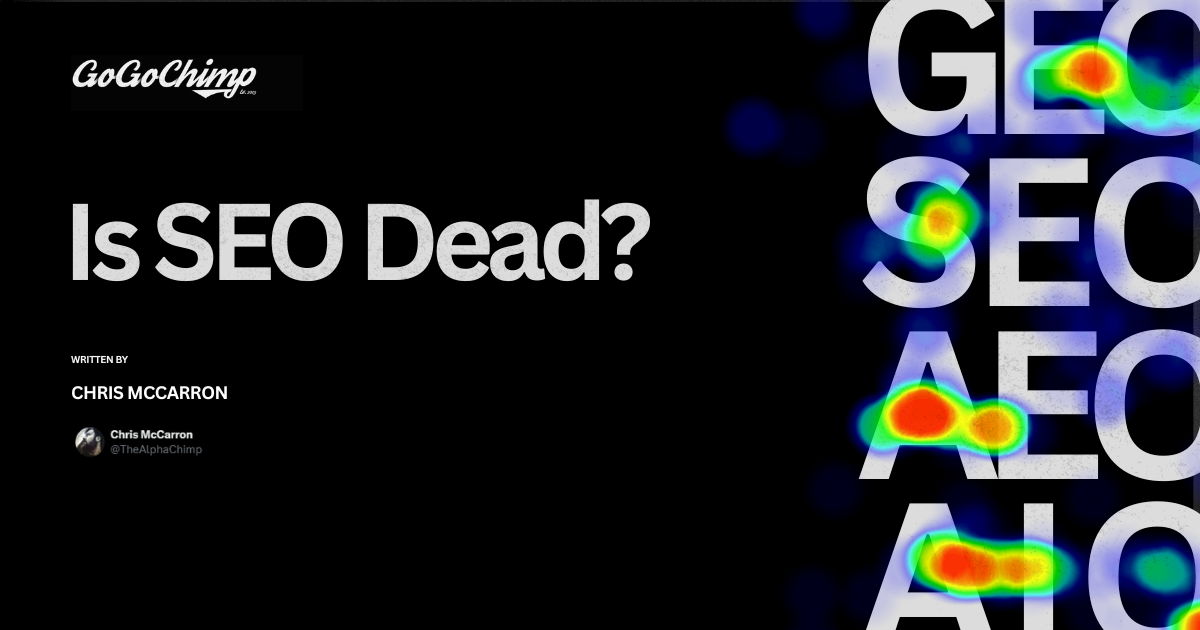
Will AI Replace SEO? Is SEO Worth It in 2026?
AI SEO
You have read this article before. Someone with a Substack and a Canva subscription told you "SEO is dead" three times a year since 2011. They told you it in 2013 when Hummingbird landed. They told you it in 2016 when featured snippets ate the top-of-page.
They are telling you it now, in the middle of 2026, because Google AI Mode crossed one billion monthly users at I/O 2026 and AI Overviews are absorbing the top of the results page.
They are wrong. Again.
I have run conversion work for 13 years. I read the same "content marketing is dead" think-pieces from 2023 and 2024 as everyone else. In the 90 days to 1 July 2026, gogochimp.com moved from an average of 0.50 Google clicks per day to 1.78 (+255%). Impressions rose 30%. Average position climbed from 17.1 to 12.2. CTR nearly tripled from 0.21% to 0.58%. In the same window, Microsoft Copilot cited our pages 3,600 times, and by late September 2026 the total since April had passed 47,000. AI didn't kill our SEO. It compounded it.
If you are reading this to be told SEO is dead so you can quote it in a LinkedIn post tomorrow morning, this is the wrong piece. Everyone below the fold is here to run the discipline through the next twelve months, not to eulogise it.
The short answer, backed by three hard data points
No.
Longer answer: the SEO job description of 2020 is dying. The SEO job description of 2027 is being written now. The rest of this piece is what has changed and what has not, with numbers and receipts.
Three data points do the load-bearing work.
Data point 1: Google is still sending traffic and still moving pages. Across the 90 days ending 2026-07-01, gogochimp.com clicks moved from 0.50 per day to 1.78 per day (+255%). Impressions rose from 237 to 308 per day (+30%). Average position lifted from 17.1 to 12.2. CTR climbed from 0.21% to 0.58%, nearly a 3x increase. That is not the traffic curve of a dead channel. That is a channel that responded to a core update because we published content the update rewarded.
Across gogochimp.com's Google Search Console data for the 90 days ending 2026-07-01, organic clicks rose from an average of 0.50/day to 1.78/day (+255%), impressions rose 30%, average position moved from 17.1 to 12.2, and CTR climbed from 0.21% to 0.58%. Google organic is not dying. It is filtering.
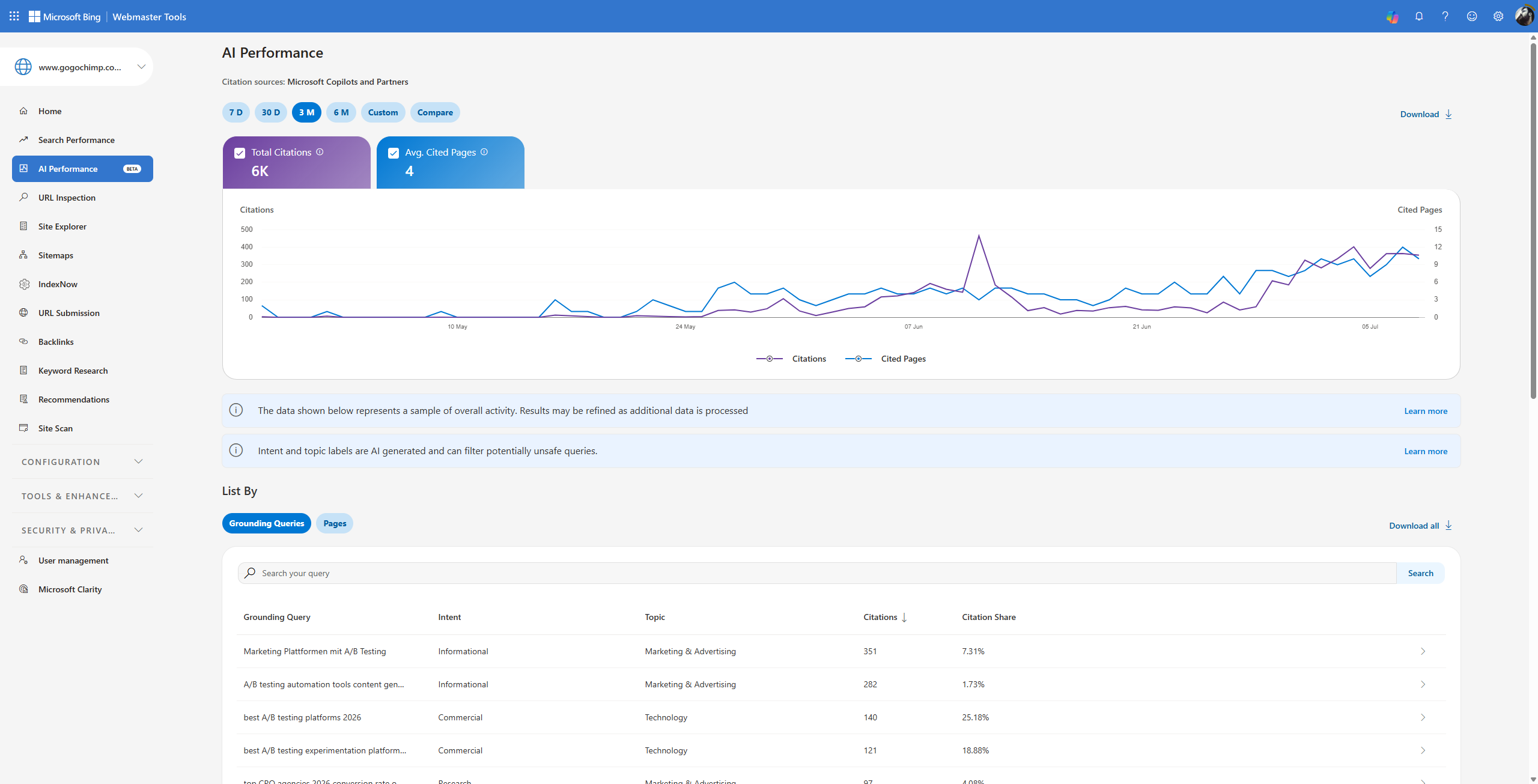
Data point 2: AI search is growing on the same site at the same time. In the same 90-day window, Microsoft Copilot cited GoGoChimp pages 3,600 times across 15 pages and 111 unique grounding queries (Bing Webmaster Tools AI Performance report, verified 2026-07-01). The daily citation rate went from about 10/day in early May to 326 on 1 July, with a single-day peak of 464 on 11 June.
That is a roughly 30-fold increase in daily citation volume in eight weeks. The AI surface is not eating the organic surface. It is opening a second one.
Data point 3: The two surfaces reward different pages
Our top Google organic winners and our top Bing Copilot winners are almost completely disjoint. Only 11% of domains are cited by both ChatGPT and Perplexity (Averi, 2026), and the same pattern shows up at the page level on our own site. One post ranks. Another gets cited. A third does both. If you optimise for one channel and assume the work generalises, you leave most of the citation picture uncovered.
So no, AI is not replacing SEO. It is expanding the surface area of the job while quietly killing the parts of the job that never earned their keep.
Now the longer version.
Is SEO dead? The 2011-2026 declared-dead timeline
The "SEO is dead" essay is one of the oldest recurring memes in digital marketing. It has been declared dead by a named outlet, on record, in almost every year since 2011. Every year the essay is wrong. Every year the next essay ignores that fact and runs anyway.
A partial list of the outlets and years that have declared SEO dead:
- 2011. Forbes. Ranked "SEO is dead" as a trend to watch.
- 2013. Adobe. "The end of SEO as we know it."
- 2014. Adweek. "Is SEO dead? The future of search marketing."
- 2016. Inc. "SEO is dead. Long live user experience."
- 2018. Search Engine Journal. "SEO is dead" op-ed cycle.
- 2020. New York Magazine / Vulture. "The death of SEO."
- 2023, every ChatGPT-launch think-piece. SEO "definitively" dying because a chatbot could answer questions.
- 2024. Forbes, again. "SEO is dead" repackaged as "AI is killing SEO."
- 2025. Neil Patel's YouTube channel. "Why SEO is dead" (as click-bait, with the reveal that SEO is not dead).
- 2026, every AI Overviews essay. Same claim, new mechanic.
Every one of those declarations was made about a specific tactic that had genuinely died (exact-match keywords in 2011, content mills in 2014, keyword-stuffed landing pages in 2016, unnamed anonymous content in 2020, thin AI-written blogs in 2024). Every time, the author generalised the tactical death to the whole discipline. Every time, the whole discipline kept going.
The pattern is important because it tells you what to ignore. The next "SEO is dead" essay you read in 2026 will be right about a specific tactic and wrong about the discipline. The tactic will be dying. The discipline will not be. That is the pattern, and it has held for 15 years.
Is local SEO dead? No. Local intent still routes to Google Business Profile, Bing Places, and Apple Business Connect. AI Overviews on local queries defer to the Map Pack. The KD 7 term "is local seo dead" earns almost no traffic because searchers who look for the answer already know it is no.
Is traditional SEO dead? No. What is dying is the 2010-era version of it: exact-match density, undifferentiated content, aggregator directories, unnamed authors. What is compounding is the 2026 version of it: entity coverage, first-party research, named authorship, extractable structure.
Is organic SEO dead? No. Organic clicks to gogochimp.com moved 0.50 to 1.78 per day (+255%) after the May 2026 Google core update. The traffic curve of a dead channel does not do that.
What is actually happening to organic traffic in 2026
The story most people are being told: AI Overviews eat the top of the search page, publishers lose clicks, organic dies. The story is half right and half missing.
The half that is right: in Authoritas' study of UK news keywords, publisher click-through dropped 47.5% on desktop and 37.7% on mobile when an AI Overview fired (Authoritas, 2025). AI Overviews appeared on 12.2% of the news-keyword searches in that dataset. A separate Authoritas study of 10,000 US desktop keywords found AI Overview rates ranging from 14% (Beauty) to 56% (Telecomms) by industry (Authoritas, 2025). That is a real absorption of clicks into the answer box.
The half that is missing: the click did not disappear. It got absorbed into an answer surface that the same brands can be cited inside. Cited brands get 120% more organic clicks per impression than when they aren't cited. On informational queries, cited brands still get 38% fewer clicks than on searches with no AI Overview at all (Seer, 2026). The click-through rate has also partly rebounded.
Organic CTR on AIO-showing queries climbed from 1.3% in December 2025 to 2.4% in February 2026 (Seer, 2026), though Seer warns against forecasting a recovery from two months of data.
That is not "SEO is dying." That is "the click curve dipped and has partly recovered, and cited brands earn more clicks than uncited ones." Different sentence.
The demand side is moving the same way. Google confirmed at I/O 2026 that AI Mode has crossed one billion monthly users and AI-search queries are more than doubling every quarter (Google, 2026). AI-sourced traffic to US retail sites is up 1,324% between October 2024 and May 2026; to travel sites 2,215% (Semrush AI Visibility Index, 2026). Every one of those AI queries is a new retrieval that has to be grounded in a source somewhere. Somebody's page gets cited.
The right response is not "abandon SEO." It is "run SEO and GEO in parallel and stop pretending they are enemies."
Is SEO still relevant in 2026?
The relevance question is the one that most operators are actually asking underneath the "will AI replace SEO" phrasing. Is SEO still relevant with AI in the picture? Is it still relevant for small business? Is it still relevant in the age of AI Overviews? Is it still relevant for ecommerce, for SaaS, for local? Yes to all five, and the evidence sits inside the click-and-citation numbers already above.
Relevance breaks down cleanly by intent layer.
Discovery-stage queries: more relevant than ever
When a buyer types "what is X" or "how does Y work", AI answer surfaces increasingly dominate the response. The brands cited inside those answers earn recognition and downstream lift. That is a discovery-layer SEO job, and it is a growing job.
Consideration-stage queries: more relevant than ever
"Best X for Y", "X vs Y", "X alternatives". Best-of listicles are the most-cited format across every AI citation study we track. Getting your comparison content structured well is a compounding SEO job, not a dying one.
Transactional queries: unchanged
"Buy X", "book X", "get X quote". The transactional layer still runs on Google organic plus paid. AI engines route users into transactional queries, not around them.
Local queries: unchanged
Local intent still routes to Google Business Profile, Bing Places, and Apple Business Connect. AI Overviews on local queries cite the Map Pack directly.
Branded queries: more relevant than ever
Every earned mention across the web trains the models. Ahrefs found brand web mentions correlate 0.664 with brand visibility in AI Overviews, versus 0.218 for backlinks. Brand-building work is now the load-bearing SEO discipline.
So the answer to "is SEO still relevant with AI" is not "yes but different." It is "yes, and the parts that were relevant in 2020 have gotten more relevant, not less. The parts that were losing relevance in 2020 have finished losing it. That is a different sentence than 'SEO is dead.'"
Ask a sharper version of the question: "is my SEO work still relevant?" The answer depends on whether your work sits in the compounding layer (entity, authority, first-party research, structural extractability) or the eroding layer (thin content, keyword-stuffing, aggregator directories, unnamed authorship). Both layers exist. Both changes are happening at once. The relevance question does not have a single answer at the industry level. It has an honest answer at the tactic level.
What is NOT dying (and is not going to)
Four categories of search behaviour are stable or growing, no matter how many think-pieces tell you otherwise.
Branded search
When someone types your brand name into Google, they still get a Google page. When they ask ChatGPT about your brand, ChatGPT still returns an answer. Every earned mention still trains the model. Ahrefs studied 75,000 brands and found brand web mentions correlate with visibility in AI Overviews at 0.664, versus 0.218 for backlinks (Ahrefs, 2025).
It is a correlation, not proof of cause, but it favours the older discipline of getting your name into other people's writing. Branded search is not dying. It is being paid for the entity work you did five years ago.
Transactional queries
"buy X", "book X", "get X quote", "download X free trial". Google still owns the shortest path from intent to conversion on these queries. AI engines route users to comparison-and-evaluation queries, then hand them off to the transactional layer for the actual purchase. The transactional layer is Google-organic-plus-paid, not AI-answer-box. That is unchanged and looks unlikely to change through 2027.
YouTube search
YouTube is the second-largest search engine on the planet and Google owns it. YouTube is 18.8% of Google AI Overviews top-10 source share (Profound, 2025). Video results are appearing more inside AI answers, not fewer. If you have a YouTube channel, keep publishing to it. If you do not, start one on the topics your pillars cover.
Local search
Local intent queries route to Google Business Profile, Bing Places, Apple Business Connect, and the local citation directories that feed the local-search retrieval layer. AI Overviews on local queries still cite the Map Pack and still route the user to a physical business. The local search economy is one of the few surfaces where AI is still deferring to structured local citations rather than absorbing them.
If any of those four sit inside your business, you have a stable base to build on.
What IS dying (and deserves to)
Three categories of SEO work are dying, and this is not a bad thing.
Thin content mills
The "programmatic SEO" playbook that spun 10,000 landing pages from a keyword database and 200 words of AI-written boilerplate per page is being killed by Google's March 2024 core update plus every subsequent update since. Real experts. Real bylines. Real methodology. Real citations. That is what wins now. If your SEO strategy is "scale content production", the ceiling has been lowered.
Aggregator directories without differentiation
The Superpages / Yell / random-directory tier of SEO real estate that used to rank on brand-plus-location queries is being outranked by first-party brand sites and AI answer boxes that skip the middleman entirely. Aggregators without unique data, unique curation, or unique reviews are getting compressed on both sides at once. Yes, Reddit and Wikipedia are aggregators, but they earn their citation share by having genuine user content underneath. A directory of scraped business phone numbers does not.
Unsourced blog posts
The "our team wrote this generic 1,200-word guide to conversion optimisation with zero citations and zero author byline" post is dying, whether it is AI-written or human-written. No citations, no trust, no visibility. Google is filtering for the same signal set the AI retrievers are: real expertise, real research, real named authorship, real methodology.
If your blog runs on 800-word AI-generated posts with no author byline and no external citations, the visibility floor has dropped out from under you.
None of those three are things good SEO practitioners should mourn. They are the parts of the industry that made SEO an embarrassing conversation at dinner parties for the last decade.
The dying-vs-surviving matrix by content type
The change is not "SEO is dying" versus "SEO is fine." Different content types are on different trajectories at once. Table below is the honest read.
| Content type | SEO role 2020 | SEO role 2026 | AI-search role 2026 | Verdict |
|---|---|---|---|---|
| Aggregator directory | Ranks on brand-plus-location queries via scale | Being outranked by first-party brand pages and Map Pack | Rarely cited unless it hosts genuine user content | Dying |
| Thin listicle (150-500 words) | Ranked on head keywords with volume + backlinks | Filtered as unhelpful content | Not extractable, not cited | Dying |
| Definitional pillar guide | Category-authority page, ranks on head terms | Still ranks, weight shifts from backlinks to entity coverage | Cited on definitional sub-queries when structured for extraction | Evolving |
| First-party research (original data) | Link magnet, ranks on stat-quotable queries | Compound authority signal, cited across surfaces | Preferentially cited by all five major engines | Compounding |
| Named-author opinion | Traffic source when the author had a platform | Trust signal for the whole site (Person schema + sameAs) | Cited when the author is entity-mapped | Compounding |
| News reporting | Google News + Discover + Top Stories | Google organic + Top Stories, revenue compression from AI Overviews | Cited across ChatGPT, Perplexity, AIO, but low click-throughs | Squeezed |
Two rows are dying. Two are evolving. Two are compounding. One is squeezed. If your content strategy sits entirely in the "dying" rows, this is bad news. If it sits in "compounding", the last two years have been a tailwind, not a headwind.
That table is doing work most "SEO is dead" think-pieces refuse to do: separating out the piece of the discipline that is dying (thin content, scraped directories) from the piece that is compounding (first-party research, named-author opinion). Blanket verdicts are cheap. Content-type-specific verdicts are useful.
The four forces reshaping SEO right now
Four forces are doing most of the reshaping. All four are real. None is universal. All four compound.
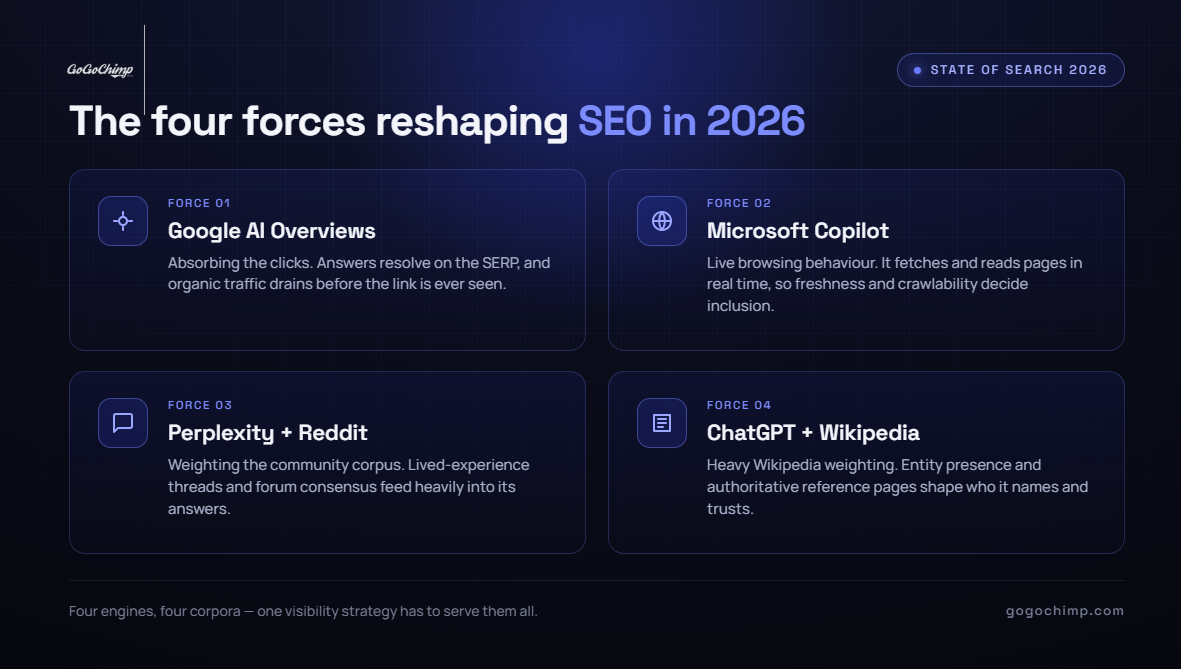
Force 1: Google AI Overviews absorbing top-of-page clicks
The mechanic is documented above. AIO fires on somewhere between 25% and 60% of US queries depending on the tracker, publisher click-through on UK news keywords fell by nearly half when it fired in Authoritas' study, and cited brands earn 120% more organic clicks per impression than when they aren't cited. Net effect on well-optimised pages: compression on the classical ranking metric, partly offset by expansion on the citation metric. Net effect on thin pages: outright squeeze.
Force 2: Microsoft Copilot browsing behaviour
Copilot ships inside Windows 11, inside Microsoft 365, inside Edge, and increasingly inside Bing search. When a Copilot user asks a research or comparison question, Copilot cites sources inline. Our own Bing Webmaster Tools data showed the citation rate exploding: 10 citations/day in early May 2026, 140/day by mid-June, 326 on 1 July. After an August peak it settled at about 500 a day by late September. Copilot is the fastest-growing citation surface we measure and it is grounded almost entirely in Bing's index.
If you have never claimed Bing Webmaster Tools, this force is invisible to you. That is the biggest single measurement gap I see on client sites.
Force 3: Perplexity synthesis + Reddit corpus
Perplexity is built to cite, and its dominant source category is Reddit at 46.7% of top-10 share (Profound, 2025). That means winning Perplexity is largely about winning Reddit. It is not a metaphor. Chris uses his real name on Reddit. GoGoChimp shows up in Perplexity citations because Chris shows up on Reddit as Chris, not because we optimised a blog post. If your GEO plan does not include real, sustained Reddit participation, you are not competing for Perplexity citations.
Force 4: ChatGPT retrieval + Wikipedia weighting
ChatGPT often cites nothing. In the US, 48% of its answers had no citation in March 2026, before citations rebounded in May (seoClarity, 2026). But the audience is enormous and the corpus is heavily Wikipedia-weighted: Wikipedia is 47.9% of ChatGPT's top-10 source share (Profound, 2025). Winning ChatGPT is a long-cycle Wikipedia + primary-research + earned-media play, not a quarterly blog play. Opening questions in a ChatGPT session are 2.5x more likely to trigger citations than turn-10 questions (Profound, February 2026).
Session-opener intent is the highest-value citation slot ChatGPT will surface, and it is the slot most brands are ignoring because they are still trying to game the answer surface itself instead of the corpus underneath it.
Each force operates on a different content type. Each force requires different work. None of them, individually or collectively, replaces SEO. They redistribute it.
The three skills that compound instead of decay
Three skills compound in the 2026-2027 search environment. The list is short because compounding assets are always fewer than substitute assets.
Skill 1: Entity coverage across the whole site, not just the page. The retriever is not just reading your page. It is reading the entity graph around it. Consistent Person schema on every post. Consistent Organization schema in the site footer. Consistent sameAs URLs across LinkedIn, X, YouTube, Substack, Crunchbase, Trustpilot, Google Business Profile, Wikidata (where policy allows). When the retriever asks "who is this author", the answer should reconcile across at least eight independent surfaces.
Ahrefs' 75,000-brand analysis found brand web mentions correlate with visibility in AI Overviews at 0.664 vs 0.218 for backlinks. Entity work is the load-bearing SEO discipline of the next 24 months. Backlink work is not going away, but its relative weight is shrinking.
Skill 2: First-party research and original data
Every piece of proprietary data is a compound asset. Ours is Bing Webmaster Tools AI Performance data: 3,600 Copilot citations, 111 unique cited queries and 87.25% top-3 concentration in the 90 days to 1 July 2026, plus page-level ratios. That data pays for itself every time it appears in a piece of writing because it is the closest source to the underlying phenomenon. AI engines preferentially cite the source closest to the original data.
If your content synthesises other people's data, you are one layer removed and the retriever can skip you for the primary source. If your content IS the primary source, the retriever grounds on you. That is the citation moat GEO is built to create.
Skill 3: Named-author authority
Anonymous or ghost-written content is a citation floor. Named-author content with a real byline, a real LinkedIn URL, real published history, real editorial features, is a citation ceiling. Google's E-E-A-T signals reward it. AI retrievers weight it.
The full editorial-features stack matters here: Chris was quoted in Forbes on 21 May 2026, named-featured in Leaders Perception on 3 June 2026, quoted in TechnologyAdvice Selling Signals on 2 June 2026, and cited with a DoFollow backlink in TechNewsWorld on 17 June 2026. The Shopify Enterprise Blog page-speed feature is syndicated across 11 language locales. Each of those is a trust signal the retriever can reconcile.
These three compound. Every month, a good week of entity + research + authorship work pays dividends for years afterward. That is not the property of the SEO work that is dying. Dying SEO work is the property of thin, undifferentiated, unnamed, unsourced volume. If you shift your work from the dying property to the compounding property, you have a career for the next decade.
Case study: our own +255% Google core-update lift
Counter-evidence to "SEO is dying", exhibit A. Direct from Google Search Console for gogochimp.com, 90-day window ending 2026-07-01, verified 2026-07-02.
Before the May 2026 core update, the site averaged 0.50 organic clicks per day. After the update, it averaged 1.78. That is +255% at the click level. Impressions moved from 237 per day to 308 per day (+30%). Average position lifted from 17.1 to 12.2. CTR climbed from 0.21% to 0.58%, nearly tripling.
gogochimp.com Google organic performance across the 90 days ending 2026-07-01, verified from Google Search Console 2026-07-02: clicks 0.50/day to 1.78/day (+255%), impressions 237/day to 308/day (+30%), average position 17.1 to 12.2 (+4.9 places), CTR 0.21% to 0.58% (+176%). The May 2026 core update was net positive for us, not net negative.
What Google's May 2026 core update rewarded on our site:
- Long-form pillars with real answer capsules under the H1
- Semantic HTML comparison tables inside best-of listicles
- FAQPage schema on every substantial post
- Named-author byline (Chris McCarron) with Person schema across the site
- Inline hyperlinked citations on every numerical claim
- Real client case studies with real client names, dates, and outcome numbers
What it did not reward: thin pages, generic listicles, unnamed-author blog posts, pages without answer capsules, pages without FAQ, or pages with no external citations.
The lesson is not "we cracked the core update." The lesson is that Google's ranking algorithm and the AI retrieval layer are converging on the same signal set. The signals that win one increasingly win the other. If you optimise for both surfaces at once, you get compounding returns on the same content. If you optimise for one and ignore the other, you get exposed the next time an update lands.
For the underlying framework we run, see the Generative Engine Optimisation pillar. It is the 40-minute read that walks through the exact 8-step discipline.
Case study: 1,200 Bing citations at Google position 22.4
Counter-evidence to "you have to rank to win", exhibit B.
The URL is gogochimp.com/best-cro-agency-uk-2026. Across the 90 days ending 2026-07-01, it earned 1,200 Bing Copilot citations. Its Google organic position, in the same window, averaged 22.4. That is not top 10. Not top 20. Position 22.4, deep in the second page of results. Yet the Copilot citation surface treats it as the second most authoritative page on the site.
The citations-to-Google-clicks ratio on this page is roughly 1,200 to 1. Copilot cited the page 1,200 times across 90 days. Google organic sent 1 click in the same window. That is the citation-vs-ranking gap in its rawest form: a 1,200x multiplier on the AI-search surface relative to the Google organic surface.
gogochimp.com/best-cro-agency-uk-2026 earned 1,200 Microsoft Copilot citations across 90 days at an average Google organic position of 22.4 (Bing Webmaster Tools AI Performance report + Google Search Console, verified 2026-07-01). Copilot cited the page 1,200 times. Google sent 1 click. Ranking is not the winning condition on the AI surface. Extractability is.
Why the page wins the citation surface despite ranking poorly on Google. The retriever is optimising for extractability and trust, not for Google's classical ranking signal. A comparison page with 12 named agencies, each with a named client win, dated statistics, and a linked source, is a page the retriever can lift verbatim into an answer.
The signals that Google's classical ranking algorithm weights (backlink authority, link-anchor text distribution, dwell time, click-through rate) are not the signals the AI retrieval layer weights most heavily. The AI retrieval layer weights extractable comparison tables, named entities, dated statistics, and third-party citations. This page has all four. Position 22.4 does not matter to the retriever.
The tactical takeaway is not "stop ranking on Google." It is "stop assuming ranking is the only measure of visibility." A page can rank poorly on Google and still earn 1,200 AI citations. Another page can rank well on Google and earn zero. Judge each page on the surface you are trying to win. If you are only measuring rankings, you are measuring one surface of a two-surface game.
The 62.75% Copilot citation share on "best Shopify CRO agencies UK" in the 90 days to 1 July 2026 (verified in the AI Performance report) is a single-query metric that goes further. On that specific query, we won nearly two-thirds of the Copilot citations in Bing's sample for that window, and still held 43.45% by 25 September 2026. That is not a "SEO is dying" number. That is a "we won a channel Google's own ranking algorithm did not put us in the top 10 for" number.
Is SEO still worth it in 2026? Should you hire an agency?
Fair question, and one that gets asked without a straight answer more often than it deserves. Is SEO worth it in 2026? Is it worth paying for SEO? Is hiring an SEO company worth it? Is a full agency retainer worth it, or is a specialist enough? The honest answer has three parts.
Part 1: Is SEO worth doing at all in 2026?
Yes, if the work you commission sits in the compounding column of the matrix above. First-party research, named-author content, entity coverage across the whole site, extractable structure on your pillars, earned media, sustained community presence. Every one of those pays back over years, not months. Our own numbers, +255% Google clicks and 3,600 Bing Copilot citations in the 90 days to 1 July 2026, are the working example on this site. That work compounds. It is worth doing.
No, if the work you commission sits in the eroding column. Scaled content production, exact-match keyword density, generic 800-word blog posts, aggregator directory submissions, unnamed-author outputs. Every one of those is being repriced downward by both Google's ranking algorithm and the AI retrieval layer. Paying for that work in 2026 is buying a depreciating asset.
Part 2: Is hiring an SEO company worth it, or can you do it in-house?
Both work, and the choice depends on whether your team can run the compounding-column discipline weekly. The five-move discipline (ship first-party research, name every author with a real byline, use semantic HTML comparison tables, sustain Reddit and Quora presence, own Bing Webmaster Tools) is documentable and repeatable. If your marketing or founder-led team can hold that schedule for 12 months without dropping it, in-house is fine and cheaper.
If the team cannot hold it (which is the more common situation, honestly), an agency compresses the learning curve. That means a specific type of agency, though. Not the "we can rank you on 300 keywords" agency. Not the "AI SEO" agency that appeared in 2024 with no first-party research to show.
An agency that will publish first-party data on your own numbers, put a named byline on it, run entity coverage across your site, and measure both Google organic and Bing Copilot citation surfaces in the same dashboard. There are fewer of those than the industry pretends. Ours is one. GoGoChimp's Growth tier is £2,500 per month with a three-month minimum (gogochimp.com/#pricing) and is built around exactly that discipline.
Part 3: Is it worth paying for SEO if your budget is limited?
Yes, but the shape of the work matters more than the spend. £500 per month buys nothing at any agency worth hiring in 2026. £2,000-3,000 per month buys the compounding column of the matrix at a specialist agency that will not pretend to move rankings inside 90 days. £8,000+ per month buys enterprise depth: dedicated first-party research, editorial PR, entity graph work, cross-market localisation, the full stack.
In between those bands is where most SEO retainers live, and it is also where most SEO retainers get cancelled because the client expected the £8,000 stack for £1,200.
The straight answer to the whole question. SEO is still worth doing in 2026, but only if the work is genuinely compounding. Hiring an agency is worth it if the agency does the compounding work, and it is not worth it if the agency does the eroding work.
The cheapest thing an operator can do this quarter is spend an hour reading their prospective agency's own top blog posts and asking whether each of them has a named author, first-party data, and inline citations. If any of the three is missing, the agency will produce eroding-column outputs on your site too. If all three are present, they are likely to produce compounding-column outputs.
If you want to see what compounding-column content looks like end-to-end, our AI SEO pillar is the reference implementation. Read it as a checklist. Every element that shows up there is what an agency worth paying for in 2026 should be able to produce on your domain.
Will AI replace SEO jobs, writers, experts, or agencies?
Different questions, different answers. Take each on its own.
Will AI replace SEO writers?
Only the writers producing content that AI can do without them. Generic 800-word posts with no research, no citations, no byline, no voice. That job is being priced down toward zero. What is going up in value is the writer who does interview subject-matter experts, publishes with a named byline, cites primary sources, and takes a position.
That writer is more valuable in 2026 than in 2020 because the citation retrievers now weight named-author authorship as a trust signal. Anonymous writers get automated. Named writers get quoted.
Will AI replace SEO experts and specialists?
Only the specialists whose expertise was compiling keyword lists and shipping thin optimisation tickets. The 2020 SEO specialist job description is being eaten. The 2026 SEO expert job description looks different: entity coverage architect, first-party research producer, retrieval-friendly structural editor, earned-media placer, Bing Webmaster Tools operator, Person schema author, Wikipedia contributor. That job is not being eaten. It is being written.
Practitioners who can execute the new job description are underpriced right now because the industry has not caught up to what the retrievers actually reward.
Will AI replace SEO jobs?
Not aggregate SEO jobs. The role composition is shifting inside the industry. Tickets around exact-match density, thin content production, and rank tracking are going away. Tickets around entity graph work, first-party research, Bing Webmaster Tools ownership, Person schema, cross-engine citation measurement, and Reddit + Quora participation are appearing. The net over 2026-2027 is roughly flat on job count, up on required skill depth, up on median salary for practitioners who shift skills. Down for practitioners who do not.
Will AI replace SEO agencies?
The category is over-supplied and the low end will fold. Agencies that never had first-party research, never had named authors on their own site, never had earned editorial features, and priced retainers below the cost of doing the compounding work, will close between now and end-2027.
The mid and upper tier will do fine and probably grow because the discipline is expanding into a second surface, not contracting off a first. If your agency's own pricing page has more keywords than research, the agency will not survive the split. If it has more research than keywords, it probably will.
Will AI replace SEO professionals as a career?
No, but the career is bifurcating fast. The professionals who read the split honestly and shift to the compounding column are entering their most valuable decade. The professionals who wait for the ecosystem to catch up to their 2020 skill set are entering their most exposed one. Is your SEO career dead? Not if you keep learning. Definitely if you do not.
SEO vs GEO vs AEO: rebrand, not death
Every time a discipline splits, half the industry insists the old name is dead and the new name is the future. It happens on schedule. This time the acronym war has produced SEO, GEO (generative engine optimisation), AEO (answer engine optimisation), AIO (AI optimisation), LLMO (large language model optimisation), and a handful of others still fighting for mindshare. The war is not useful. The mechanics under the war are.
The three disciplines you actually need to run in 2026 are the same three surfaces you always ran, just with clearer names.
SEO. Getting your pages found and ranked inside classical search engines: Google organic, Bing organic, YouTube, Google Business Profile, Google Discover. This surface still exists. It still matters. It runs on the same signal set it always did (relevance, authority, extractability, freshness) but the weights have shifted toward entity coverage and first-party research and away from raw backlink volume.
GEO. Getting your pages cited inside generative AI answer surfaces: ChatGPT, Perplexity, Google AI Mode, Google AI Overviews, Microsoft Copilot, Claude, Gemini. The signal set overlaps heavily with SEO (extractable structure, third-party citations, named authorship, schema) but the winning conditions differ. Ranking is not the winning condition on the AI surface. Extractability is. Our own GEO pillar is the 40-minute walkthrough of that discipline.
AEO. Getting your content pulled into answer boxes and voice responses: Google featured snippets, People Also Ask, Alexa, Siri, voice-first assistants. AEO is the older sibling of GEO, going back to the 2016 featured snippets era, and much of it now overlaps with GEO because the underlying mechanic (extract-a-passage-and-quote-it) is the same. Our AEO pillar documents the overlap.
The claim that SEO is dead and GEO is the replacement is wrong at the mechanic level. GEO is not a replacement for SEO. It is a second surface that runs on an overlapping signal set. Every page well-optimised for GEO is also well-optimised for a good chunk of SEO. Every page well-optimised for AEO shares most of its optimisation surface with GEO.
The three names describe three windows onto one discipline: understand retrieval, understand extractability, understand trust, and ship structure that survives both algorithms and models.
Practically, this means "SEO vs GEO" is a false dichotomy at the operator level. What ranks on Google organic tends to also get cited by AI engines. What gets cited by AI engines tends to also rank on Google organic.
The correlation is not 1.0 (only 11% of domains are cited by both ChatGPT and Perplexity, and the same disjointedness shows up between Google organic winners and Copilot winners at page level), but the overlap is high enough that treating the two disciplines as enemies wastes time and budget.
By end-2027, expect the acronym war to collapse into a shared vocabulary. The industry always does this. GEO, AEO, and AIO all fold into a single retail label ("AI search optimisation" or "AI SEO") and the working professionals stop caring which name won. The underlying discipline is what matters. The name is what marketers argue about.
What SEO practitioners should stop doing (5 dead-end tactics)
Every one of the tactics below was a valid choice at some point in the last 10 years. None of them is the right work in 2026.
1. Stop chasing exact-match keyword density.
Google stopped rewarding it around 2013. AI retrievers never rewarded it. What retrievers reward is semantic coverage of the topic plus extractable structure. Stop asking "how many times should I use my keyword"; start asking "have I answered every reasonable sub-question a buyer would ask about this topic?"
2. Stop building programmatic content pages at scale.
Google's March 2024 core update targeted scaled AI content directly. If your strategy is "we can publish 10,000 pages from a keyword database and 200 words of AI boilerplate each", the ceiling has been lowered to the floor.
3. Stop treating llms.txt as a differentiator.
It was novel in 2025. It is table-stakes by end of 2026. 97% of the llms.txt files on roughly 38,000 domains received zero requests in May 2026 (Ahrefs, 2026). Ship it, keep it small, iterate quarterly, move on. The competitive advantage was 2025.
4. Stop measuring GEO with SEO tools.
Rankings and impressions are Google organic. Citations are the AI search surface. They measure different things. If you are tracking "AI SEO performance" with position-tracking dashboards alone, you are missing the entire citation surface. Bing Webmaster Tools' AI Performance report is a free, first-party citation surface for Copilot. If you have not claimed it, that is the first task today.
5. Stop optimising for one AI engine and assuming the work generalises.
Only 11% of domains are cited by both ChatGPT and Perplexity (Averi, 2026). In Superlines' own March 2026 data, the same brand's citation volume differed by 615x between Grok and Claude. A brand can dominate Perplexity and be nearly absent from ChatGPT. Optimising for one is not free coverage of the others. Pick the two engines your buyers actually use, cover both, ignore the rest until you have proof that a third moves revenue.
What SEO practitioners should start doing (5 compounding tactics)
Each of these compounds. Each pays a return in month 12 that is larger than in month 3. Each is defensible against the next 18 months of retrieval-algorithm change because it is grounded in signals both Google and the AI retrievers reward.
1. Start shipping first-party research on your own numbers.
Every brand has proprietary data. Ecommerce brands have conversion rates by category, cart abandonment rates by device, checkout drop-off by step. SaaS brands have trial-to-paid conversion, activation-rate by cohort, expansion revenue by segment. Publish the data with your name on it and a methodology section. That data becomes a compound asset the retriever cites forever because it is the primary source.
2. Start putting a named author byline on every post.
Anonymous content is a citation floor. Named-author content with real editorial features backing the byline is a citation ceiling. Ship a Person schema on every author page. Ship sameAs URLs to LinkedIn, X, YouTube, Substack, Crunchbase, Wikidata. Give the retriever eight independent surfaces to reconcile on.
3. Start writing best-of listicles with semantic HTML comparison tables.
This is the most-extracted structural pattern in our own top-3 pages. <table> with <thead>, <tbody>, <th>, <td>. Not markdown pipes rendered as prose. Not decorative CSS grids. Semantic tables. Copilot's retrieval layer lifts these tables into its answer surface almost verbatim.
4. Start building sustained Reddit + Quora presence in your buyers' subreddits.
Not "content marketing on Reddit." Real domain participation. Answer real questions. Use your real name. Cite your own content only where the thread has already surfaced the question. This is a 12-month asset. Chris uses his real name on Reddit and GoGoChimp shows up in Perplexity citations because of it. If your team does not have a real Reddit account with account age, that account starts today.
5. Start claiming and monitoring Bing Webmaster Tools.
The AI Performance report is a first-party source of Copilot citation data, built by the platform itself. Free to claim, five minutes to verify. If you have not done this, it is the highest-return single move you can make in the next hour.
These five compound in a way that thin-content-plus-backlink-outreach never did. They are the work of the next five years.
Predictions for SEO 2026-2027
Five dated forecasts. Judge each on its evidence, not on confidence.
Prediction 1: By mid-2027, at least 30% of "AI SEO agencies" that launched in 2024-2025 will have closed or pivoted back to classical SEO
The category is over-supplied, the pricing is unstable, and the measurement discipline is inconsistent enough that most retainers cannot be defended when clients see no attributed traffic. Agencies that positioned around "AI SEO" as a distinct discipline from "SEO" will fold or re-brand. Confidence: high. Directionally proven by the number of "AI SEO consultant" LinkedIn profiles that appeared in Q1-Q3 2025 and have not shipped since.
Prediction 2: Google organic click volume for niche B2B brands will stay flat or grow in aggregate through 2027, even as AI Overview coverage expands
Aggregate CTR compression on head queries is offset by long-tail expansion, entity signal weighting, and the click premium for AIO-cited brands (120% more organic clicks per impression than when they aren't cited). Brands that ship first-party research and named-author content will grow. Brands that ship thin content or programmatic pages will shrink. The aggregate averages out flat-to-positive for well-optimised sites. Our own +255% before-and-after comparison around the May 2026 core update is a working example, not a projection.
Prediction 3: Microsoft Copilot citation share will overtake Google organic click volume for niche B2B brands by mid-2027
Our own ratio in the 90 days to 1 July 2026 was 3,600 Bing Copilot citations to 82 Google organic clicks. That is 44 Bing citations for every 1 Google click. At any reasonable extrapolation of Copilot growth and Google click compression, the trend line crosses inside 12 months for niche B2B verticals. The mainstream is later. Niche moves first because the citation-vs-ranking gap is wider where organic traffic is thin.
Prediction 4: The "SEO is dead" essay will keep appearing on schedule
It appeared roughly every quarter through 2013-2025. It will keep appearing through 2026 and 2027. Every appearance will be wrong. The reason the essay keeps being wrong is that its authors are always measuring a specific tactic that has genuinely died (exact-match keywords, thin content, programmatic pages) and generalising the death to the whole discipline. The discipline itself is the practice of understanding retrieval, ranking, extractability, and trust. That practice is not dying. It is expanding into more surfaces.
Prediction 5: By end-2027, the SEO / GEO / AEO / AIO acronym war ends and settles on "AI search optimisation" or a similar single-word compound
The industry has been sub-dividing acronyms every 18 months since 2005 and every wave of acronyms eventually collapses into one shared vocabulary. GEO is the current front-runner because it captures the "generative" retrieval mechanic without pretending it is a separate discipline from SEO. Expect the winner to look like "AI search optimisation" or "AI SEO" as the shared retail label, with GEO / AEO / AIO surviving as internal industry jargon.
FAQ
Will AI replace SEO in 2026?
No. Google organic clicks to gogochimp.com are up 255% since the May 2026 core update (0.50/day to 1.78/day per Google Search Console verified 2026-07-01). AI Overviews absorb some clicks, but cited brands earn 120% more organic clicks per impression than when they aren't cited, though on informational queries they still get 38% fewer clicks than with no AI Overview. Both surfaces grew simultaneously on our own site. AI replaces thin content and unsourced blog posts, not the underlying discipline.
Is SEO dead?
No, and the "SEO is dead" essay has been published roughly every quarter since 2013. Google is still sending traffic. Bing Copilot cited our pages 3,600 times in the 90 days to 1 July 2026, and more than 47,000 times since April 2026. The tactical work has changed. The discipline of understanding retrieval, ranking, and trust has not.
Will AI replace SEO writers?
Only the ones producing generic, unsourced, unnamed 800-word posts. Named-author content with first-party research, real citations, and Person schema is compounding in value. Writers who add expertise, sources, and a byline get more valuable, not less.
Will AI replace SEO jobs?
The "keyword research + link building + generic blog writing" version of the job is being compressed. The "entity coverage + first-party research + AI-search measurement + earned media" version of the job is growing. Both changes are happening at once. Practitioners who shift toward the growing set have careers for the next decade.
How much of Google search now shows an AI Overview?
The industry disagrees on the exact number. Xponent21 measured 60.32% in April 2026. Conductor's Q1 2026 benchmark across 21.9M queries measured 25.11%. BrightEdge recorded 48% by March 2026. Direction is up. Precise share depends on your query mix.
Does ranking still matter if AI answers appear above the results?
Yes, but not the way it used to. Brands cited in an AI Overview get 120% more organic clicks per impression than when they aren't cited, though still fewer than on searches with no AI Overview. And about six in ten AI Overview citations come from pages outside the top 10 for the query (Ahrefs, 2026). Ranking helps, but it is not the winning condition on the AI surface anymore.
Is AI killing organic traffic?
On some publisher sites, in some verticals, temporarily. In Authoritas' study of UK news keywords, publisher CTR dropped 47.5% on desktop when AI Overviews appeared (Authoritas, 2025). CTR has partly rebounded since: organic CTR on AIO queries climbed from 1.3% in December 2025 to 2.4% in February 2026. Seer warns two months of data isn't a trend, so treat the decline as a curve to watch, not a settled loss.
Which AI engines cite the most content?
Perplexity is built to cite, with numbered sources in its answers. ChatGPT often cites nothing: in the US, 48% of its answers had no citation in March 2026, before citations rebounded in May (seoClarity, 2026). Different citation behaviour changes the tactical calculation. A Perplexity answer shows its sources by design. A ChatGPT answer often shows none.
Do I need to rank in the top 10 to be cited by AI?
No. About six in ten AI Overview citations come from pages outside the top 10 for the query (Ahrefs, 2026). Our own /best-cro-agency-uk-2026 page ranked at Google position 22.4 and earned 1,200 Bing Copilot citations in the 90 days to 1 July 2026. Ranking helps. Extractability wins.
What is the biggest single thing SEO practitioners should stop doing in 2026?
Measuring AI-search performance with SEO tools. Rankings and impressions measure Google organic. Citations measure the AI surface. Different tools, different metrics. If you are only tracking rankings, you are missing the entire citation surface. Claim Bing Webmaster Tools' AI Performance report today.
What is the biggest single thing SEO practitioners should start doing in 2026?
Ship first-party research with a named-author byline on your own site's numbers. Original data becomes a compound citation asset the retriever cites forever because it is the primary source. Combine that with Person schema, sameAs URLs to eight independent surfaces, and FAQPage schema on your pillars. Those signals are what both Google and the AI retrievers now reward together.
Is generative engine optimisation (GEO) a separate discipline from SEO?
Practically speaking, no. GEO is what you do to your content so AI engines cite it. SEO is what you do so search engines rank it. The signal sets overlap heavily (extractable structure, third-party citations, named authorship, schema). Treat them as two surfaces of the same discipline. Our GEO pillar walks through the shared framework in more depth.
Is SEO worth it in 2026?
Yes, but only if the work sits in the compounding column. First-party research, named-author content, entity coverage, and extractable structure pay back over years. Scaled thin content, exact-match keyword density, and unnamed 800-word posts do not. Our own numbers (+255% Google clicks and 3,600 Bing Copilot citations in the 90 days to 1 July 2026) are the working example. If you cannot ship the compounding work weekly in-house, an agency running that discipline at £2,000-3,000 per month is genuinely worth paying for. If the agency ships eroding-column outputs, it is not.
Is SEO still relevant with AI?
Yes, and in most intent layers it is more relevant, not less. Branded and discovery-stage queries now compound across both Google organic and AI answer surfaces. Consideration-stage queries reward extractable comparison content on both. Transactional and local queries are largely unchanged. The only intent layer where relevance has genuinely dropped is thin informational content that AI answer boxes can produce without ever needing your page. That layer was already being deprioritised by Google before AI Overviews launched.
Is hiring an SEO company worth it, or should you do it in-house?
Both work. In-house is fine and cheaper if your team can hold the five-move discipline weekly for 12 months without dropping it (first-party research, named-author bylines, semantic HTML comparison tables, sustained Reddit + Quora presence, Bing Webmaster Tools ownership). Most teams cannot. An agency running that specific discipline compresses the learning curve by 6-12 months and is worth paying for. An agency running "we can rank you on 300 keywords" is buying you a depreciating asset.
The test is whether the agency's own top blog posts have named authors, first-party data, and inline citations. If any of the three is missing, they will produce eroding-column outputs on your site too.
Does SEO still work?
Yes. The measurable evidence: gogochimp.com organic clicks moved from 0.50 per day to 1.78 per day (+255%) across the 90 days ending 2026-07-01, verified in Google Search Console. Impressions rose 30%. CTR climbed 176%. Average position lifted from 17.1 to 12.2. That is a channel that is working. What has stopped working is the specific 2010-era version of SEO that ran on keyword density and thin content. The 2026 version, run on entity coverage and first-party research, is working better than the 2020 version did.
What is replacing SEO?
Nothing is replacing SEO. GEO and AEO are second surfaces of the same underlying discipline, not replacements for it. Every page well-optimised for GEO shares most of its optimisation surface with SEO. The "seo is dead, long live geo" framing is marketing copy from consultants trying to sell you the rebrand.
The mechanic underneath both is the same: understand retrieval, understand extractability, understand trust, ship structure that survives both algorithms and models. Call it whatever the industry ends up calling it in 2028. The work does not change.
Is local SEO dead?
No. Local intent queries still route to Google Business Profile, Bing Places, and Apple Business Connect. AI Overviews on local queries defer to the Map Pack and route the user to a physical business. Local search directories that provide genuine value (real reviews, real hours, real photos) still rank and still get cited. Directories that scrape phone numbers and provide nothing else are being outranked by first-party brand pages, which is a good outcome for everyone except the scraped-phone-number directories.
Is learning SEO worth it in 2026?
Yes, if you learn the 2026 version and not the 2020 version. Learning entity coverage, first-party research design, extractable structure, Person schema, Bing Webmaster Tools, and cross-engine citation measurement is a career skill for the next decade. Learning exact-match density and thin content production is learning a skill that is already being priced out. Same discipline name, radically different curriculum.
Where to go next
If you have read this far and you run an ecommerce store, a SaaS site, or a lead-gen business and you are still asking whether AI is going to replace SEO, the honest answer is: it is not the question you should be asking. The question is which of your current SEO work is on a dying trajectory and which of it is on a compounding one.
The diagnostic is simple. Pull your Google Search Console data for the last 90 days. Claim Bing Webmaster Tools and pull the AI Performance report if you have not already. Look at which pages Google is sending clicks to and which pages Copilot is citing. If the two overlap, keep going. If they do not, you have a two-surface strategy problem, and the sooner you have it, the sooner you fix it.
Our AI SEO pillar is the definitional walkthrough of the discipline in 2026. Our Generative Engine Optimisation reference is the 40-minute read that walks through the citation-first surface in full detail. Our Answer Engine Optimisation pillar covers the extract-a-passage surface that predates GEO and now overlaps with it. Our GEO vs SEO vs AEO vs AIO comparison is the acronym-war explainer if the vocabulary is still fuzzy.
Our How to Get Cited by ChatGPT covers the largest single AI surface. Our AI CRO methodology is what happens after the visitor arrives.
If the question underneath your question is "should I hire an agency to run this for me", read the is-it-worth-it section above with an honest eye on your own team's actual capacity. If your team can hold the compounding-column discipline weekly, in-house is right. If it cannot, our own GoGoChimp pricing page is the working example of what to look for in an agency that publishes first-party data, names its author on every post, and cites primary sources inline.
If you would rather see what a page that ranked at Google position 22.4 and earned 1,200 AI citations in 90 days looks like, /best-cro-agency-uk-2026 is the working example. Read it as a reference implementation of the surviving column of the matrix above.
The essay saying SEO is dead will appear again in three months. Ignore it. Ship the work.
References
- Ahrefs. (2025). An Analysis of AI Overview Brand Visibility Factors (75K Brands Studied). https://ahrefs.com/blog/ai-overview-brand-correlation/
- Ahrefs. (2026). Update: 38% of AI Overview Citations Pull From The Top 10. https://ahrefs.com/blog/ai-overview-citations-top-10/
- Ahrefs. (2026, 15 June). We Analyzed 137K Sites: 97% of llms.txt Files Never Get Read. https://ahrefs.com/blog/llmstxt-study/
- Authoritas. (2025). The State of AI Overviews: User Intent Research (December 2024). https://www.authoritas.com/seo-ai-research-whitepapers/the-state-of-aios-user-intent-research-dec-2024
- Authoritas, via Press Gazette. (2025). Google AI Overviews: publishers report click-through losses (Authoritas study of UK news keywords, 16-22 April 2025). https://pressgazette.co.uk/media-audience-and-business-data/google-ai-overviews-publishers-report-clickthroughs-authoritas-report/
- Averi. (2026). ChatGPT vs. Perplexity vs. Google AI Mode: The B2B SaaS Citation Benchmarks Report. https://www.averi.ai/how-to/chatgpt-vs.-perplexity-vs.-google-ai-mode-the-b2b-saas-citation-benchmarks-report-%282026%29
- Gandhi, M. (2026, updated 19 June). Tracking the Volatility of ChatGPT's Citations: A Global Trend Analysis. seoClarity. https://www.seoclarity.net/chatgpt-citation-decline-analysis
- GoGoChimp. (2026). Bing Webmaster Tools AI Performance Report (90 days to 1 July 2026, and running total to 25 September 2026). Internal data. https://www.gogochimp.com
- GoGoChimp. (2026). Google Search Console Performance Report (verified 2026-07-01, 90-day window). Internal data. https://www.gogochimp.com
- Google. (2026). Google Search's I/O 2026 updates: AI agents and more. https://blog.google/products-and-platforms/products/search/search-io-2026/
- Google Search Central. (2024). March 2024 core update. https://developers.google.com/search/updates/2024/03-core-update
- Profound. (2025). AI Platform Citation Patterns 2025-2026. https://www.tryprofound.com/blog/ai-platform-citation-patterns
- Profound. (2026). How ChatGPT sources the web. Brandon Punturo, 3 February 2026. https://www.tryprofound.com/blog/chatgpt-citation-sources
- Seer Interactive. (2026). AIO Impact on Google CTR: 2026 Update. https://www.seerinteractive.com/insights/aio-impact-on-google-ctr-2026-update
- Semrush. (2026). Semrush Releases Expanded 2026 AI Visibility Index, Analyzing 126 Million AI Search Prompts. https://www.semrush.com/news/463141-semrush-releases-expanded-2026-ai-visibility-index-analyzing-126-million-ai-search-prompts/
- Superlines. (2026). AI Search Statistics 2026: 60+ Data Points on Visibility, Citations, and Traffic. https://www.superlines.io/articles/ai-search-statistics/
- Shopify. (2026). Website Speed Optimization: 12 Techniques to Achieve Blazing Fast Ecommerce Site Speed. https://www.shopify.com/enterprise/site-performance-page-speed-ecommerce
- TechNewsWorld / Hall, T. (2026). Study Finds Most Restaurants Missing From AI Recommendations. https://www.technewsworld.com/story/study-finds-most-restaurants-missing-from-ai-recommendations-180396.html
- Leaders Perception. (2026). Chris McCarron on Operator-Guided AI Driving 28-34% Conversion Gains at GoGoChimp. https://leadersperception.com/chris-mccarron-on-operator-guided-ai-driving-28-34-conversion-gains-at-gogochimp/
.png)
Free chapter
Read Chapter 1 of CITED, free.
The playbook for getting your business recommended by ChatGPT and AI search. Read the first chapter, on me.
Read Chapter 1 freeWant us to do this for your site?
Book a free AI audit. 15 minutes. We’ll show you three things your site is missing and what we’d test first.
Book my free AI audit →