The First 50 Words: How to Write an Answer-First Opening for AI Search
AI SEO

Microsoft Copilot cited GoGoChimp 44,677 times in the 90 days to 25 September 2026, and I can't prove one of those citations came from an opening paragraph.
Bing's export counts citations by day, page and grounding query, never by paragraph.
Three studies put cited text near the top of the page, and most pages spend that space clearing their throat, like a best man stalling because he left his speech in the taxi.
The opener's the cheapest fix in AI search optimisation, and the easiest to oversell.
Cited text bunches near the top of pages, but no study measures the first 50 words
Three datasets on ChatGPT and Google's AI Overviews find cited text concentrated near the top of pages. All three are correlational and page-level, and none isolates the first 30-50 words. An answer-first opener is a cheap, well-supported bet on where engines look first.
Does the opener matter if your page isn't retrieved?
No. An engine can't quote a page its search step didn't return. In AirOps data analysed by Kevin Indig, ChatGPT cited 58% of pages at search position 0 and 14% at position 10 (Indig/AirOps, 2026).
So the opener is a tiebreaker. Retrieval writes the guest list, and your first paragraph only counts once you're through the door. More on that in which sources ChatGPT actually cites.
Where on the page do AI engines quote from?
More often from the top of the page than anywhere else.
Kevin Indig traced 18,012 ChatGPT citations to their position on the source page. The first 30% of the text supplied 44.2% of them, and the final third still supplied 24.7%. Within paragraphs, 53% came from the middle sentences (Indig, 2026).
For AI Overviews, CXL found 55% of a 100-citation sample in the first 30% of the page (Reslan, 2026). Surfer, which sells an intro-scoring feature, found 38% of 100,000 citation placements in the first 100 words (Kaleta, 2026).
None of these studies moved an answer up a page and measured the change, and intros tend to hold the most relevant text anyway, so you can't pull position and relevance apart.
Why would position matter to a retrieval system?
Retrieval systems work on chunks, and a chunk cut from mid-page can lose its subject. Anthropic's example of a failing chunk: "The company's revenue grew by 3% over the previous quarter." Adding context to each chunk cut retrieval failures by 35% to 67% in its lab tests (Anthropic, 2024).
Claude's web search quotes "Up to 150 characters" per citation (Anthropic docs), so a lifted line has to stand alone.
The strongest controlled test cuts the other way: across 252,000 trials with the full page in the model's context, formatting "had no impact" on which source was cited (Vishwakarma et al., 2026). So the case for answer-first rests on retrieval and chunking.
40-60 words is our house standard, borrowed from featured snippets
Our 40-60 word range is a house standard: it's long enough to answer on its own and short enough to lift whole. Rubric's Answer-first opener check allows up to 70. No one's measured an optimal opener length for AI citations.
Where does the 40-60 word rule come from?
From featured snippets. A 2018 Semrush study of 10 million mobile keywords recommended "succinct paragraphs in the 40 to 60-word range", but didn't publish the length data behind it (Ghergich, 2018). Portent later measured 7,854 featured snippets and found no paragraph snippet over 324 characters (Hall, 2021).
| Figure | What it measures | Source |
|---|---|---|
| 40-60 words | Advice for featured-snippet paragraphs | Semrush, 2018 |
| 1-2 sentences | Microsoft's advice for AI answers | Madhavan, 2025 (quoted below) |
| 67 words (median) | Google's whole AI summary, Pew's March 2025 sample | Pew, 2025 |
| 254 words (mean) | Google's whole AI Overview, April 2025 | SE Ranking, 2025 |
| 40-70 words | Rubric's Answer-first opener check | Rubric |
Should an opener match the length of a Google AI summary?
No. In Pew's March 2025 sample, the median Google AI summary ran to 67 words (Chapekis and Lieb, 2025), and SE Ranking found a 254-word mean in April 2025 (Postol, 2025). Both measure Google's whole answer, drawn from several sources, so neither sets an opener length.
Google doesn't ask for answer-first openers, and Microsoft comes closest
Google doesn't tell sites to put the answer first. Its July 2026 AI guide says "You don't need to write in a specific way just for generative AI search" and there's "no requirement to break your content into tiny pieces" (Google Search Central, 2026).
Microsoft goes further. Krishna Madhavan, a principal product manager at Microsoft Bing (the index behind Copilot), recommends "One- to two-sentence responses that directly address a question" and warns "Don't hide important answers in tabs or expandable menus" (Madhavan, 2025).
I don't see a contradiction: readers from any engine want the answer first, and that writing survives chunking too. It's the principle behind answer engine optimisation.
Find it with Rubric: six opener checks and the Quotable passages view
Rubric, our AI-search auditing tool, checks each crawled page for six opener signals and scores every text block for quotability. Rubric predicts citability, it doesn't count citations. Run a crawl on a free account, then open the Overview's "What your SEO crawler can't see" panel and Quotable passages.
Which Rubric checks cover the opening?
- Answer-first opener (40-70 words): a direct answer to the H1's implied question before any preamble, in any shape.
- Definitional opener ([X] is ...): an "[X] is a..." sentence for "what is X" pages. In one ChatGPT dataset, cited intros were almost twice as likely to use definitive language, 36.2% against 20.2% (Indig, 2026).
- Answer in the first third of the page: it's the best-supported check, backed by all three position studies.
- Headings paired with a liftable answer: a self-contained answer under each H2 and H3.
- Sections open with a direct answer: no opening on "it", "this" or a wind-up.
- Answer inside the no-JS read window: the answer sits in server-rendered HTML near the top. In Vercel's 2024 analysis, OpenAI's, Anthropic's and Perplexity's crawlers didn't run JavaScript (Vercel, 2024).

The opener checks on our own report's Overview, 26 September 2026.
What does a weak opener look like in the report?
Rubric's 26 September 2026 audit of gogochimp.com scored 12,878 text blocks across 298 pages, at an average of 55. A block on our Super Area Rugs case study scored 19, flagged "no data: add a sourced statistic".
That block's heading reads "216.29% revenue increase from existing traffic in 37 days", but the paragraph under it says "There was no additional ad spend and no new audience." Lifted alone, it doesn't prove a thing. Our "What is conversion copywriting?" block, which opens with a plain definition, scored 90.
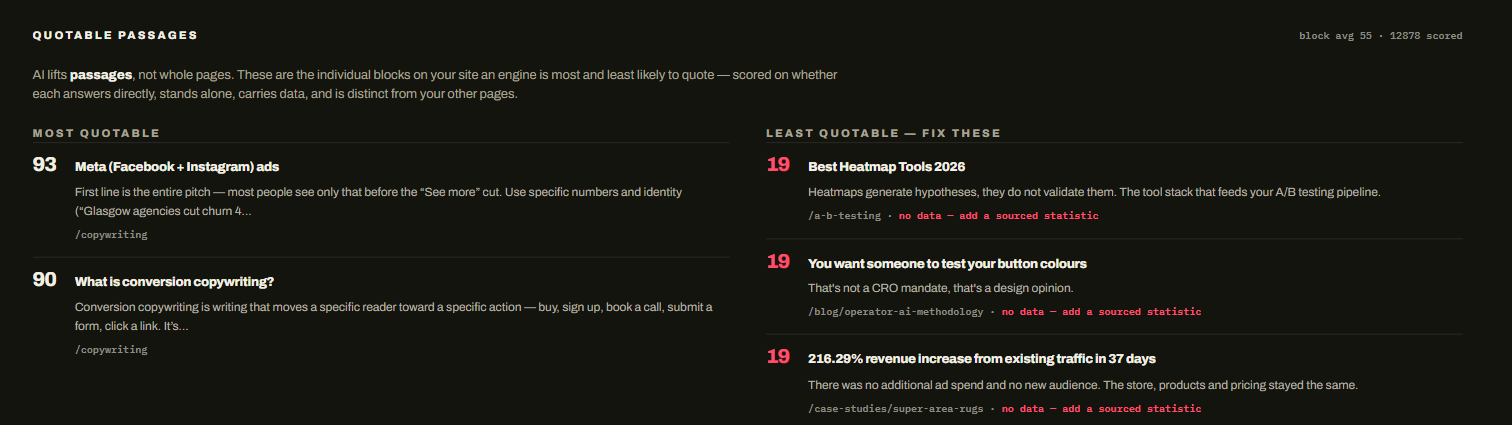
Quotable passages on our own report, cropped to the top two blocks and three low scorers.

The Definitional opener card from our Action Plan.
Find it with Claude and the Rubric MCP: every weak opener, listed by URL
Rubric's hosted MCP server lets Claude read your audit and list every page failing the Answer-first opener check, with what's there now against what the check expects. Claude drafts the replacements, and a person approves each one before it goes live.
How do I connect Claude to Rubric?
Create an API key on Rubric's MCP page. It's shown once, so copy it before you leave. The same page gives you a one-line Claude Code command with your key already filled in. Run it in a terminal.
It works on a free account. Reads are free, and crawls and draft checks run a live audit of your site.
What should I ask Claude to run?
Use the Rubric tools on my latest audit.
1. Run get_action_plan, then get_affected_pages for "Answer-first
   opener (40-70 words)": URL, current opener, expected.
2. Draft 40-60 word openers for the first ten pages: the answer, one
   sourced fact from the page, any caveat. Publish nothing.
3. Run check_draft on each page's full text with its new opener in
   place, and show me the results.
get_action_plan also takes an engine name, such as ChatGPT, to re-rank the plan, and the /mcp__rubric__fix prompt runs the whole loop. I check every draft against the page before it ships, because a fluent rewrite can still invent a fact.
Fix it: answer first, then evidence, then nuance
Answer the H1's question in one or two sentences. Add one fact and its source, then the caveat a careful reader would raise. Stay within 40-60 words, and check the block still makes sense when it's quoted alone, with no "this" or "it" pointing backwards.
What does a good answer-first rewrite look like?
They're both illustrations I wrote, not client pages.
Illustration 1, a "what is" page. H1: What is an answer capsule?
Before: "Content marketing has changed a lot in recent years. In this post we'll unpack an idea that keeps coming up."
After: "An answer capsule is a short, self-contained answer placed directly under a page title or question heading. In one 15-site audit, 72.4% of blog posts that earned ChatGPT referrals had one (Gnuse, 2025), though that audit had no uncited comparison group."
Illustration 2, a product FAQ page. H1: Do you ship to Ireland?
Before: "We started with a simple belief: great products deserve to travel."
After: "Yes. We ship to the Republic of Ireland and Northern Ireland, with duties and taxes included at checkout, so there's nothing to pay on delivery. Large items such as furniture ship separately and take longer."
How do I fix openers across a whole CMS template?
If a template carries one static intro, every page built from it opens with the same words. Add a capsule field and bind it to a paragraph under the H1.
- Webflow: add a plain-text field to the collection and bind a paragraph under the H1 on the template page to it.
- Shopify: output the article excerpt under the title in the article template. For products and collections, create a metafield definition (Settings, then Custom data) and connect it to a text block above the description.
- WordPress: use the excerpt or a custom field. Block themes can add the Post Excerpt block under Post Title in the single-post template, and classic themes can print it above
the_content()insingle.php.
All three render these fields in the page's HTML by default. Don't inject the capsule with a script or hide it in a tab, where AI crawlers can miss it.
What happened when we fixed our own case studies?
Until 25 September 2026, every case study on our site opened with the same generic capsule, from one static paragraph on the Webflow template. We added a capsule field and wrote an answer-first capsule for each client.
That didn't touch the Super Area Rugs block flagged above. It needs the number in the paragraph itself:
Super Area Rugs grew revenue 216.29% in 37 days from existing traffic, with no additional ad spend.
Confirm it: re-crawl and compare before you call it fixed
Publish the new openers, then re-crawl. start_crawl begins a fresh audit, crawl_status tells you when it's finished and compare_audits shows what changed between the two audits. Check the edited pages now pass the Answer-first opener check and nothing else has slipped.
A pass means the page looks citable to Rubric. Real citations show up in your AI SEO measurement stack: Bing Webmaster Tools' AI Performance report for Copilot, and your target questions run through ChatGPT and Claude by hand.
Our Bing Webmaster Tools export shows 44,677 Microsoft Copilot citations of gogochimp.com in the 90 days to 25 September 2026, counted by day, page and grounding query. It can't show which paragraph earned any of them.
If pages that already earn AI citations open with a warm-up, start there: they're already on the guest list. Run the answer-first checks on a free Rubric account and fix the first ten pages they list. The wider method is in our guide to optimising for AI search engines.
Questions about answer-first openings
How long should the first paragraph be for AI search?
Our house standard is 40-60 words, and Rubric's Answer-first opener check accepts up to 70. Neither is a measured optimum. The range comes from featured-snippet advice, and we use it because it's long enough to answer alone and short enough to be quoted whole.
Does Google recommend putting the answer first for AI Overviews?
No. Google's AI guide says you don't need to write in a specific way for generative AI search. It's still worth putting the answer first, because readers want it quickly and a self-contained opening survives when an engine lifts it out of the page.
Should every paragraph start with the answer?
No. The position studies are page-level, and Kevin Indig's ChatGPT data found more citations in the middle of paragraphs than in first sentences. Put the page's main answer near the top and open each section directly, but don't force every paragraph into a formula.
Do question headings help AI engines quote a page?
Only when the heading matches the question people actually ask and a real answer follows it. A question heading that leads into a wind-up doesn't give an engine anything to lift. Write the heading in the reader's words and answer it in the first sentence underneath.
Will a better opener get my page cited by ChatGPT?
Not on its own. ChatGPT won't quote a page it hasn't retrieved, and its search rank matters more than anything on the page. Among retrieved pages, a clear opener gives the engine a clean passage to quote, which can break a tie.
What's the difference between an answer-first opener and a definitional opener?
An answer-first opener answers whatever question the H1 implies, in any shape: a yes, a number or a recommendation. A definitional opener is one shape, an "[X] is a..." sentence, suited to "what is X" pages. Rubric checks for both.
References
- Anthropic. (2024, 19 September). Introducing Contextual Retrieval. https://www.anthropic.com/news/contextual-retrieval
- Anthropic. (n.d.). Web search tool. Claude Developer Platform documentation. https://platform.claude.com/docs/en/agents-and-tools/tool-use/web-search-tool
- Chapekis, A., & Lieb, A. (2025, 22 July). Pew Research Center analysis of Google searches by 900 US adults in March 2025, covering AI summaries and link clicks. Pew Research Center. https://www.pewresearch.org/short-reads/2025/07/22/google-users-are-less-likely-to-click-on-links-when-an-ai-summary-appears-in-the-results/
- Ghergich, A. J. (2018, 14 May). Semrush and Ghergich & Co. study of featured snippets across 10 million mobile keywords. Semrush. https://www.semrush.com/blog/how-to-earn-google-featured-snippets-mobile-study/
- Gnuse, A. (2025, 19 November). Search Engine Land contributor study of the content traits of blog posts that earned ChatGPT referrals (15 sites, September 2025). Search Engine Land. https://searchengineland.com/how-to-get-cited-by-chatgpt-the-content-traits-llms-quote-most-464868
- GoGoChimp. (2026, 26 September). Rubric audit of gogochimp.com: 298 pages crawled, 12,878 text blocks scored in Quotable passages. First-party.
- GoGoChimp. (2026, 28 September). Bing Webmaster Tools AI Performance export for gogochimp.com, data through 25 September 2026. First-party, unpublished.
- GoGoChimp. (n.d.). Super Area Rugs case study. https://www.gogochimp.com/case-studies/super-area-rugs
- Google Search Central. (2026, updated 10 July). Optimizing your website for generative AI features on Google Search. https://developers.google.com/search/docs/fundamentals/ai-optimization-guide
- Hall, E. (2021, 3 June). Portent study of featured snippet display lengths (7,854 desktop featured snippets from 30,000 keywords). Portent. https://portent.com/blog/seo/featured-snippet-display-lengths-study-portent.htm
- Indig, K. (2026, 17 February). The Science Of How AI Pays Attention. Search Engine Journal. https://www.searchenginejournal.com/the-science-of-how-ai-pays-attention/567597/
- Indig, K. (2026, 14 April). Shorter, Focused Content Wins In ChatGPT (data: AirOps). Search Engine Journal. https://www.searchenginejournal.com/shorter-focused-content-wins-in-chatgpt/571857/
- Kaleta, P. (2026, updated 17 September). Surfer study of where AI Overview citations sit in the source article (100,000 citation placements from 10,000 AI Overviews responses). Surfer. https://surferseo.com/blog/ai-citations-first-100-words/
- Madhavan, K. (2025, 8 October). Optimizing Your Content for Inclusion in AI Search Answers. Microsoft Advertising blog. https://about.ads.microsoft.com/en/blog/post/october-2025/optimizing-your-content-for-inclusion-in-ai-search-answers
- Postol, A. (2025, 9 May). SE Ranking study of AI Overview responses across five US states (100,013 keywords, April 2025). SE Ranking. https://seranking.com/blog/ai-overviews-us-states-comparison-research/
- Reslan, T. (2026, 6 March; updated 17 September). CXL study of where Google AI Overview citations sit on the source page (100-citation sample). CXL. https://cxl.com/blog/google-ai-overview-citation-sources/
- Vishwakarma, R., Kumar, S., & Jamidar, R. (2026, 25 May). What Gets Cited: Competitive GEO in AI Answer Engines. arXiv. https://arxiv.org/abs/2605.25517
- Zecchini, G., Moore, A. A., Ubl, M., & Siddle, R. (2024, 17 December). The rise of the AI crawler. Vercel. https://vercel.com/blog/the-rise-of-the-ai-crawler
.png)
Free chapter
Read Chapter 1 of CITED, free.
The playbook for getting your business recommended by ChatGPT and AI search. Read the first chapter, on me.
Read Chapter 1 freeWant us to do this for your site?
Book a free AI audit. 15 minutes. We’ll show you three things your site is missing and what we’d test first.
Book my free AI audit →