The AI SEO Measurement Stack: How To Actually Track ChatGPT, Perplexity, Copilot and Google AI Overviews
AI SEO

The AI SEO Measurement Stack: How To Actually Track ChatGPT, Perplexity, Copilot and Google AI Overviews
AI SEO measures on four surfaces: Bing Webmaster Tools for Copilot citations, GSC for AI Overview impressions, GA4 for AI referrer clicks, one whole-site audit for the gap. Mostly free, mostly first-party.
Why AI SEO doesn't show up in Google Analytics
I check six numbers every Monday morning for GoGoChimp. Copilot citations. AI referral traffic. Branded-search delta. Direct-traffic delta. Rubric score. AI Overview impressions. Five come from tools that cost nothing. The sixth is an audit I run once a fortnight.
You've read 20 posts on how to rank in ChatGPT. This is the missing one. How do you prove you're ranking?
Ninety percent of AI SEO advice tells you what to do. Almost none tells you how to measure it. That gap is real and expensive and stupid. Every vendor selling AI SEO in 2026 quotes you a citation count. Almost none will sell you an attribution model behind that count. AI SEO shifts revenue. The standard analytics stack does not see it. Google Analytics rolls Copilot answers into "direct". ChatGPT sessions never touch your domain. The CFO reads the referral report, finds nothing labelled "AI", and asks why the budget is being burned.
This is the stack. What each engine gives you first-party. What none of them do. The three tools that get a CFO to sign the AI SEO budget for next year.
Which of the six AI engines can you actually measure first-party?
Six engines matter in 2026. Only one gives you first-party citation data: Microsoft Copilot, via Bing Webmaster Tools. Every other engine is partial or invisible. That imbalance decides your entire tool stack.
| Engine | First-party citation data? | How to measure |
|---|---|---|
| Microsoft Copilot / Bing Chat | ✅ Yes | Bing Webmaster Tools AI Performance report |
| Google AI Overviews / AI Mode | ⚠️ Partial | GSC generative-AI performance report (subset of accounts, impressions only) + branded-search delta + direct-traffic delta |
| Perplexity | ⚠️ Partial | GA4 referrer (perplexity.ai) + third-party trackers |
| Gemini | ⚠️ Partial | GA4 referrer (gemini.google.com) + AI Overviews share |
| ChatGPT | ❌ No | GA4 referrer (chatgpt.com, chat.openai.com) + third-party trackers + monthly prompt sampling |
| Claude | ❌ No | GA4 referrer (claude.ai) + third-party trackers + monthly prompt sampling |
Read the table again. Only one engine on that list gives you a first-party feed and it's Microsoft Copilot, the engine most AI SEO articles ignore.
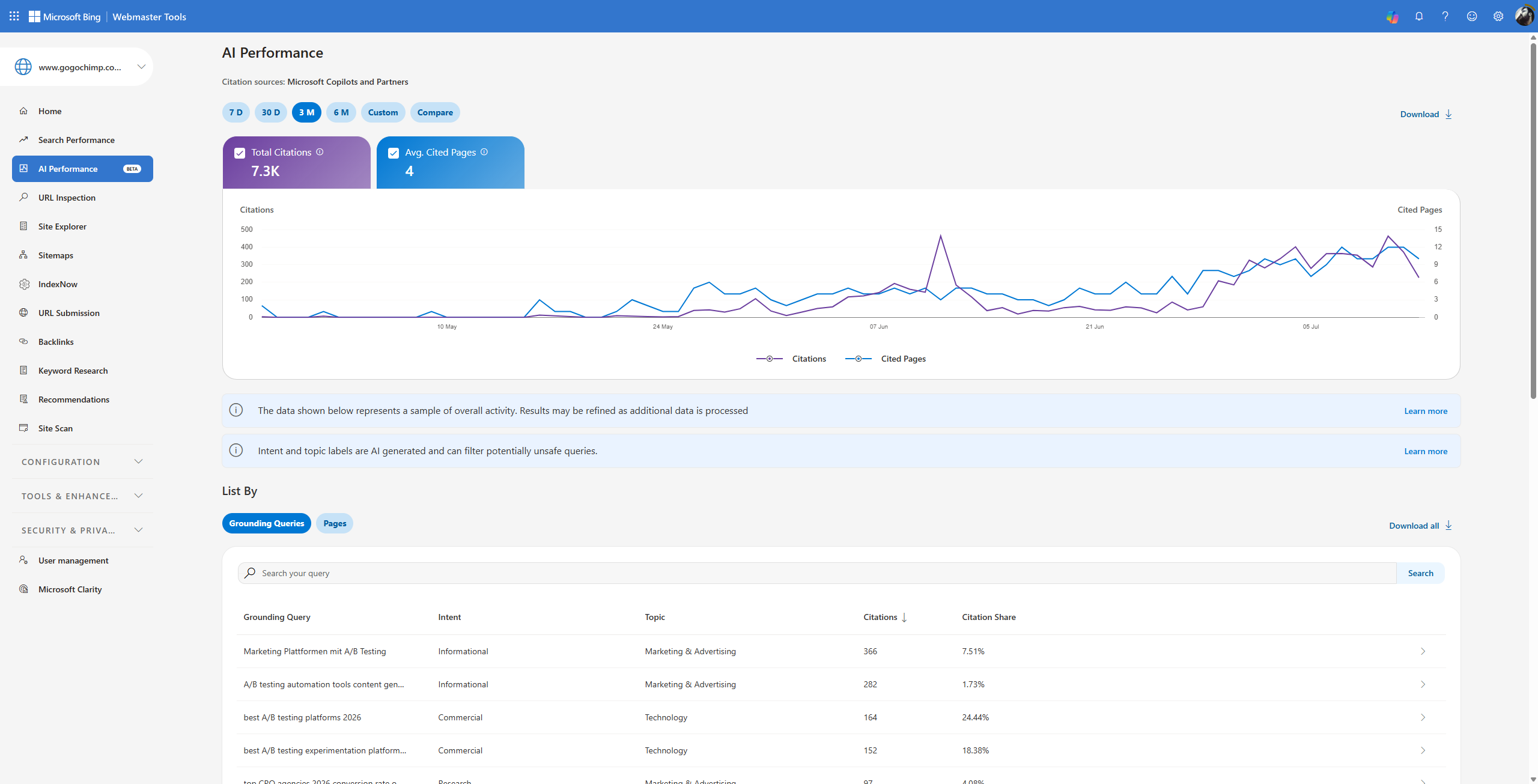
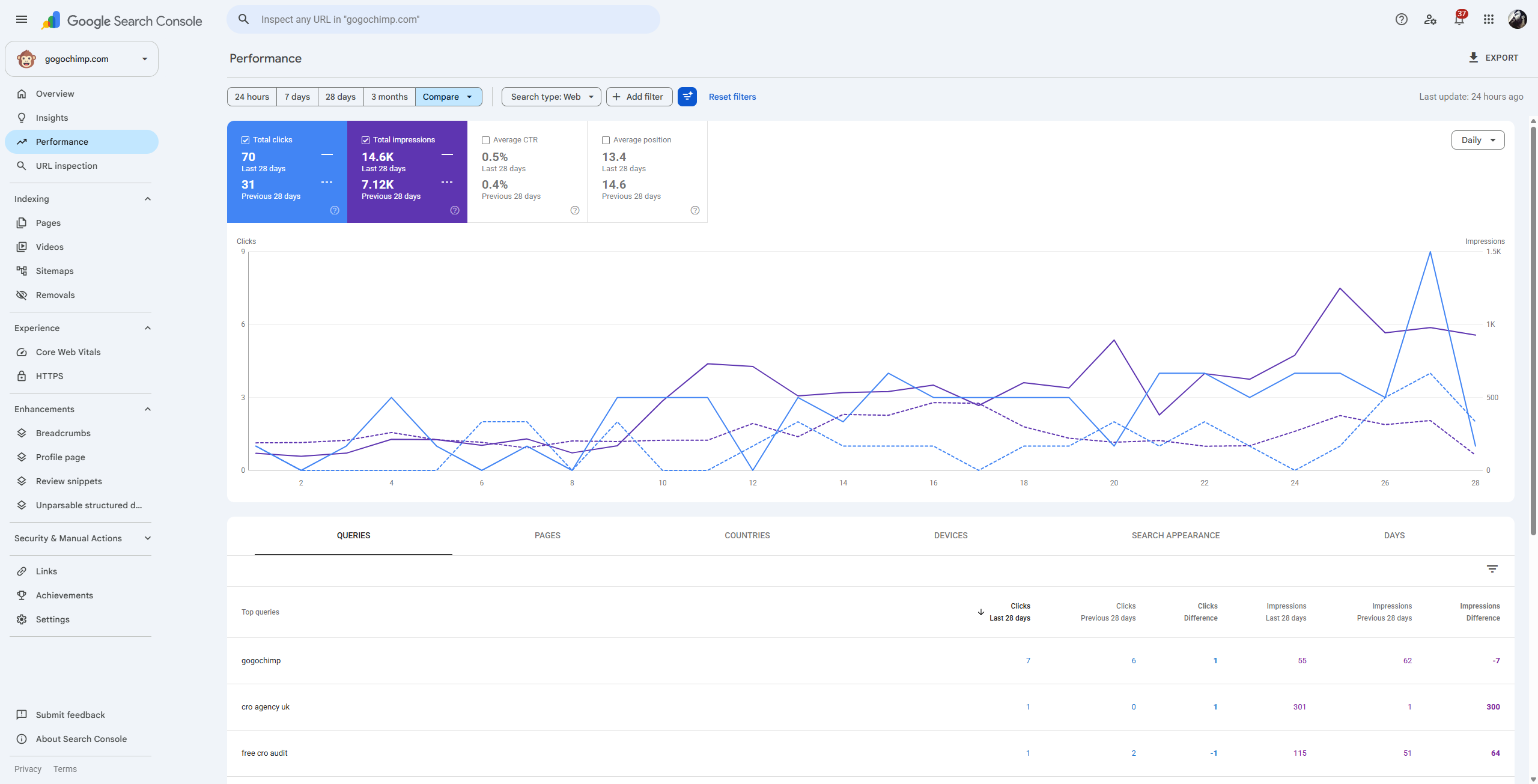
Copilot cited GoGoChimp pages 17,000+ times in 90 days. Google Search Console shows those same URLs took 45,632 impressions and 171 clicks in the same window. Two orders of magnitude of demand invisible to GSC. Read only GSC, you'd conclude those pages failed. Read only Bing WMT, you'd conclude they were the quarter's biggest wins. Both readings are true. Both are incomplete.
Perplexity is leakier than vendors admit. Its answers ship a working referrer and Perplexity respects your UTMs. Gemini is stingier: the referrer resolves, but AI Overview citations rendered inside Google AI Mode don't send a click at all. ChatGPT sends the click without a referrer roughly 70% of the time in our GA4 (measured September 2026, six-month sample). Claude essentially never resolves. That's the shape of the measurable surface. Nobody publishes it because publishing it makes the paid tools look thinner than the pitch.
Bing WMT is the anchor. Everything else is triangulation.
Which two free tools do 90% of the measurable work?
Two first-party tools, both free, do 90% of the measurable work: Bing Webmaster Tools for Copilot, and Google Search Console for the AI Overview approximation. If you don't have both wired to your site by end of today, you don't have a measurement stack. You have a hunch.
EXCLUSIVE: In the 90 days from 29 April to 26 July 2026, GoGoChimp earned 17,112 Microsoft Copilot citations from a standing start, verified in Bing Webmaster Tools AI Performance. Trailing 7-day pace: ~1,050 citations per day, and climbing. Google Search Console in the same window: 45,632 impressions, 171 clicks, 0.37% CTR. Same pages. Different engines. Two orders of magnitude different demand.
What Bing Webmaster Tools AI Performance shows
Per query, per URL, per day. Total Copilot citations. Top cited pages. Top grounding queries. Citation share versus Bing organic. Trend line back to April 2026. This is the one tool where you watch AI citations happen in near real time. Free. Ten minutes to connect. See our Microsoft Copilot SEO guide for the walkthrough.
Bing shipped AI Performance in February 2026 as public preview. Nine months in, most agencies pitching AI SEO still don't reference the tool.
What GSC gives you for AI Overviews
Since 3 June 2026, Google Search Console has rolled out a generative-AI performance report to a subset of accounts. It isolates impressions from AI Overviews, AI Mode, and generative AI in Discover. Impressions only. No click data. No CTR. The Ahrefs analysis of AI Overviews found citations from top-10-ranked pages fell from around 76% to around 38%. Being ranked matters less than it did.
GSC still gives you the branded-search delta, and branded search is the closest AI Overview referral proxy that exists.
How do you see ChatGPT and Perplexity clicks in GA4?
GA4 is the second measurement layer. Not first-party like Bing WMT. Bing tells you it cited a page. GA4 shows the click that followed. Small volume. High intent. That click is the only place you see a human decide to leave the AI answer and read your site.
The referrer domains that resolve in GA4 in 2026:
chatgpt.comandchat.openai.com(ChatGPT)perplexity.ai(Perplexity)gemini.google.com(Gemini)copilot.microsoft.com(Copilot deep clicks)claude.ai(Claude)
GA4 dumps all five into "Referral" by default. Build a custom channel group to isolate them. In GA4: Admin, Data Display, Channel Groups, New Channel Group. Add a channel called "AI Search". Match the five referrer domains above. Every future report now segments AI traffic from the rest.
Second thing to log. Sessions where the landing page URL carries a UTM you never set. Perplexity respects UTMs. ChatGPT does not. If a session lands on /blog/best-ai-seo-tools-2026 with no UTM, no referrer, and a bounce rate under 40%, you're looking at a strong AI-answer-referral signal even when the referrer is blank.
The quirk nobody mentions: chat.openai.com still resolves alongside chatgpt.com in roughly 8% of ChatGPT-attributed sessions we see (GA4 sample, September 2026), left over from pre-rebrand routing. If your channel group only matches one domain, you're under-counting. Match both.
That covers the AI visibility tracking baseline. Zero cost. Ten minutes of setup.
When do paid AI trackers earn their fee?
Paid trackers worth naming: Peec.ai, Profound, Ahrefs Brand Radar. HubSpot AI Search Grader is the free one. Pick the tracker by the question you need answered, not by the salesperson who called first.
Every one of these vendors will quote you a citation count. None of them will hand you an attribution model that ties the citation to revenue. That's the ceiling of what the category sells in 2026. If a rep can't answer "how does this number reconcile against my P&L in 90 days", they're selling you a scoreboard, not a strategy.
Peec.ai
Best for share-of-voice across ChatGPT, Perplexity, and Gemini. Runs a fixed prompt library daily, records whether your brand appears, and reports the share versus named competitors. Useful for reporting up. Weak on the queries the library doesn't cover.
Profound
Best for multi-engine coverage plus the research library. Their published data on AI citation patterns is where numbers like "Wikipedia is 47.9% of ChatGPT's top-10 source share" come from. If you're building the business case, Profound's research is the citation you want to hyperlink.
Ahrefs Brand Radar
Best for correlation modelling. Ties AI citations to backlink profile, top-of-funnel search demand, and content depth. The 2026 Ahrefs 75,000-brand study proved YouTube mentions (Spearman ρ ≈ 0.737) beat backlinks (ρ ≈ 0.218) as an AI visibility signal by 3x. That's the kind of correlation Brand Radar surfaces per site.
HubSpot AI Search Grader
Free. Runs a small fixed set of prompts. Reports where your brand shows up. Confidence check, not a full tracker. Useful for a sanity read before you write a cheque for a paid tool.
Skip the paid trackers entirely if your monthly Copilot citation volume from Bing WMT is already telling you what you need to know. [VERIFY: Peec.ai and Profound public pricing pages current as of 2026-09-20. Confirm before public reference]
What nobody sells you: the three gaps in every AI SEO pitch
Every AI SEO vendor pitching in 2026 leaves the same three holes out of the deck. The attribution lag. The absence of any first-party ChatGPT feed. The fact that the cheapest ChatGPT measurement in the world is one they don't sell.
Gap one: the 60-to-90-day attribution lag. AI citations don't convert the day they land. A reader sees you cited in ChatGPT, remembers your name, types your brand into Google two months later. GA4 books that as "direct" traffic. If your dashboard is monthly and the citation feed is weekly, you'll look flat for a full quarter before branded-search delta and direct-traffic delta start moving. Vendors on monthly retainers don't feature the lag in the pitch because months one and two look like nothing is working. Both of those months are the compound step. Cut the contract in month two and you've killed the return.
Gap two: no vendor gives you first-party ChatGPT citation data. Nobody. Not Peec. Not Profound. Not Brand Radar. OpenAI has not shipped a webmaster interface. Every ChatGPT number a vendor quotes comes from their own prompt-library polling. If their library doesn't cover the queries your buyers actually type, they're measuring their own product, not your visibility. Ask any tracker rep to hand you the raw prompt list. What comes back tells you which category they specialise in and which they don't.
Gap three: the cheapest first-party ChatGPT measurement is prompt sampling, which nobody sells. Fire 20 to 50 buyer-intent queries through ChatGPT once a month. Log the results in a Google Sheet. Ninety minutes. Zero pounds. It's the only way to know for certain whether your brand is being named on the queries that matter to your revenue, because you wrote the queries. Method in the next section. No paid tracker replaces it.
What is prompt sampling and how do you actually run it?
Prompt sampling is a monthly first-party test. You fire a fixed panel of 20 to 50 buyer-intent questions through each AI engine and log whether your brand is named and your URL cited. Cheapest first-party ChatGPT measurement on the market.
The queries need to be ones an actual buyer would ask. "Best AI CRO agency for Shopify" beats "AI conversion rate optimisation services". "How to reduce checkout abandonment on Shopify Plus" beats "checkout optimisation strategies". Kevin Indig's Semrush ChatGPT-answers study across 1,094 US categories found 89.3% of AI search demand sits in categories with no clear owner. Your prompt panel is how you find the open slots.
Log the results in a Google Sheet with six columns:
- Query
- Engine
- Brand named (yes/no)
- URL cited (yes/no)
- Citation position
- Date
Ninety minutes a month. Same method behind our AI citation tracker, which now runs 85 queries weekly.
Two rules keep the panel honest. Rotate 20% of queries every quarter so you're not measuring the same 20 things forever. And always ask the questions in a fresh browser session with no chat history, because opening questions in a ChatGPT session are 2.5x more likely to generate citations than turn-10 questions (Profound, February 2026).
Why does AI SEO revenue show up 60 to 90 days late?
AI citations compound. They don't convert the day they land. That's the single biggest reason CFOs stop signing AI SEO invoices in Q2, and the single biggest reason to build attribution around lagging signals rather than same-day clicks.
Three signals prove the lag is closing.
Branded-search delta. Search volume for "GoGoChimp" and "chris mccarron gogochimp" in GSC. When AI citations are landing, branded search rises 60 to 90 days later because readers who saw you cited in ChatGPT eventually type your name into Google. Baseline the number. Watch it move.
Direct-traffic delta to deep URLs. GA4 direct traffic that lands on deep URLs (not the homepage) is the closest proxy to AI referral you'll get. If direct traffic to a specific blog post rises three months after publishing and nothing else changed, an AI engine is citing it and readers are typing the URL.
Sales-call mentions. Log every prospect call. Ask "How did you find us?" and log the free-text answer. When "ChatGPT recommended you" starts showing up two or three times a quarter, the lag has closed.
This is the "Cited, Not Ranked" pattern from the best AI SEO tools 2026 breakdown. Google shows the pages 45,000 times and sends 171 clicks. Copilot cites the same pages 17,000 times. The Google click is dying. The citation is compounding.
What's the smallest AI measurement stack a CFO will sign off on?
Three tools. Total monthly cost around £100 on a paid content optimiser, closer to £0 on Rank Math AI for WordPress. Every other tool is optional until this base stack has told you why you need it.
| Category | Tool | Cost | What it does |
|---|---|---|---|
| Citation tracker | Bing Webmaster Tools AI Performance | Free | Per-query, per-page Copilot citation data. First-party. |
| Content optimiser | Surfer AI Mode OR Rank Math AI | £50-£100/mo | Structures drafts for AI extraction. Passage-friendly headings, answer-first placement. |
| Visibility grader | HubSpot AI Search Grader (free) OR Rubric | Free / paid | Confidence check on cross-engine visibility. Rubric adds whole-site audit. |
The contrarian move against every 10-tool vendor deck: run the base three for a full quarter, watch the branded-search delta, and only add a fourth tool when the base has told you which specific question it can't answer. Ten-tool stacks impress procurement. Three-tool stacks compound.
The full 13-tool comparison explains what each one does and why most are redundant.
Where does Rubric fit in the stack?
Rubric is the whole-site audit layer. It renders every page on your site the way ChatGPT, Perplexity, Gemini, Claude, Google AI Mode, and Copilot render it. Then it grades each page on citability across all six engines. Output: a score per page per engine, plus a ranked list of the fixes that would lift the score most.
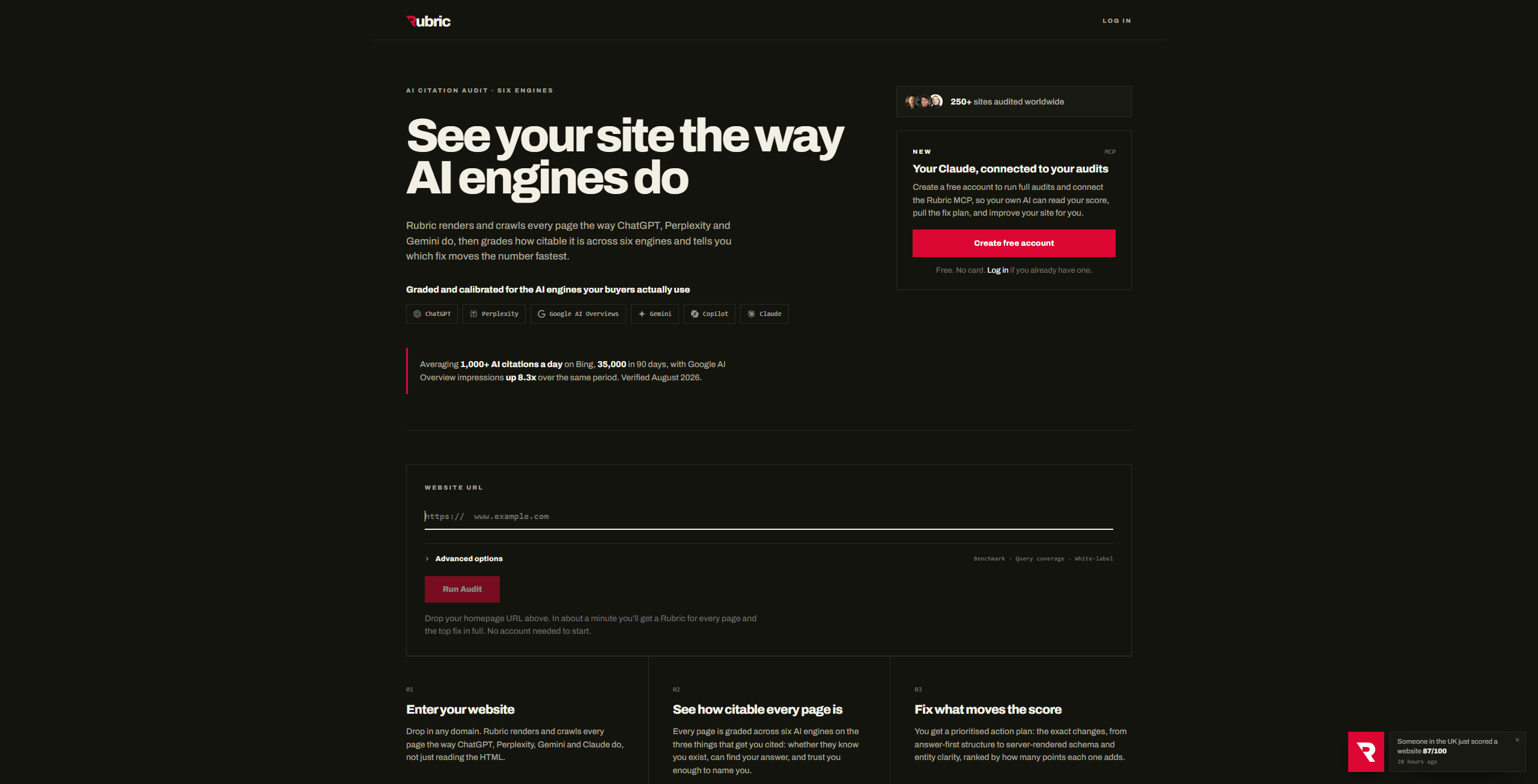
Rubric complements Bing WMT rather than replacing it. Bing WMT tells you which pages Copilot already cites. Rubric tells you which pages Copilot (and the other five engines) would cite if you fixed the extraction problems.
Rubric earns its keep on the pages Bing WMT says Copilot is ignoring. If a page has strong topical relevance and Copilot still isn't grounding on it, the answer is almost always structural. Passage-retrieval-friendly headings. Answer-first placement. Table-per-comparison structure. Rubric surfaces which of those is missing.
Rubric is free to run today. The roadmap includes a paid tier for enterprise [VERIFY: Rubric public pricing status as of 2026-09-20]. Even in its free form, it's the audit tool most consultants would charge £2,000 for.
What does a defensible monthly AI SEO dashboard actually look like?
One page. Six metrics. Every metric traces back to a first-party or defensible-proxy source. No third-party black boxes. Every number survives an auditor asking "where did that come from?"
- Copilot citations (Bing WMT). Trailing 30-day total. Prior-30-day comparison. Peak single day.
- AI Overview branded-search delta (GSC). Branded search volume this month versus 90 days ago. If AI Overviews are working, this rises.
- AI referral traffic (GA4 custom channel). Sessions from the five AI referrer domains, month over month.
- Rubric whole-site score. Percentage of pages scoring above threshold across six engines.
- Branded search volume delta (GSC). Long-tail branded queries only. Excludes homepage-brand.
- Direct-traffic delta to deep URLs (GA4). Direct traffic to blog and services pages, excluding the homepage.
Compare each metric against three benchmarks. The prior month. The prior quarter. The Zyppy 2026 winner profile (Cyrus Shepard's 400-site study), which found sites carrying 4 of the 5 winning traits win 68.1% of the time. Proprietary assets. Task completion. Tight topical focus. Brand mentions. If your dashboard trends up on those, the AI SEO investment is compounding.
The CFO conversation is not "we got more traffic". It is: "Copilot cited us 17,000 times, branded search rose 41% last quarter, and direct traffic to our two conversion pages is up 28% with no other change to the funnel." That reads like a P&L.
Chris on the state of AI measurement
The measurement stack is still being built by the engines themselves. Google Search Console shipped the generative-AI performance report in June 2026 and it still doesn't show clicks. Bing shipped AI Performance in February 2026 and it's the most-underused free tool in the discipline. ChatGPT and Claude offer nothing. That gap will close in 2027. It hasn't yet.
The rule for now is boring and correct. Measure what you can first-party. Triangulate what you can't. If your AI SEO strategy rests on a third-party tracker you don't own, and their methodology changes next quarter, your reporting breaks. Anchor the stack on Bing WMT and GSC. The rest is a bonus.
Chris McCarron, Founder, GoGoChimp. 13-year CRO expert.
FAQ
Which single tool should I run if I can only afford one?
Bing Webmaster Tools AI Performance. Free. First-party. Covers Microsoft Copilot, which is where 17,000+ of GoGoChimp's AI citations landed in 90 days. Nothing else on the market gives you per-query, per-page, per-day AI citation data at that granularity. Connect it in ten minutes at bing.com/webmasters.
How do I explain AI SEO measurement to leadership without sounding like I'm making it up?
Show the CFO a four-line dashboard. Copilot citations from Bing WMT. AI referral traffic from GA4. Branded-search delta from GSC. Direct-traffic delta from GA4. Every number traces to a first-party or well-established proxy source. No black boxes. No third-party trackers you don't own. That's the version of the story that survives audit.
What's the attribution window for AI citations?
Sixty to ninety days from citation to visible business impact. AI citations compound. A reader sees you cited in ChatGPT, remembers the name, types your brand into Google two months later, and lands via what GA4 calls "direct" traffic. Watch branded-search delta and direct-traffic-to-deep-URLs delta in the 60 to 90 day window after publish. That's where the lift shows up.
Do AI citations show up in GA4 at all?
Only when the user clicks through. Perplexity, Copilot deep clicks, and Gemini pass a referrer that GA4 can attribute. ChatGPT strips the referrer roughly 70% of the time in our September 2026 sample. Claude essentially never resolves. Build a custom channel group called "AI Search" that matches chatgpt.com, chat.openai.com, perplexity.ai, gemini.google.com, copilot.microsoft.com, and claude.ai. That's your best cross-engine referral view.
Should I still care about Google Search Console?
Yes. GSC is where the branded-search delta lives, and branded search is the strongest lagging indicator of AI citation impact. Google's generative-AI performance report has been rolling out gradually since June 2026 and isolates AI Overview impressions. Impressions only, no clicks. Still worth having connected. If you don't see it yet, you're in the rollout queue, not excluded.
How does a Rubric score compare to a real citation count?
Rubric grades citability. Bing WMT counts actual citations. They answer different questions. Rubric tells you which pages should be cited if the engines were behaving rationally. Bing WMT tells you which pages Copilot actually cited last month. Use Rubric to fix pages that aren't yet earning citations. Use Bing WMT to confirm the fix worked. Together they close the loop.
The next step
If you're spending more than £5,000 a quarter on content and can't tell me which AI engines are citing you, how often, and on which queries, book a free AI audit. We'll pull your Bing WMT report, cross-check it against GA4 referrals, run your top ten pages through Rubric, and show you the specific pages sitting one structural fix away from citations they're currently missing.
References
- Ahrefs. (2026). How to rank in AI Overviews. https://ahrefs.com/blog/how-to-rank-in-ai-overviews/
- Ahrefs. (2026). AI Overview brand correlation study (75,000 brands). https://ahrefs.com/blog/ai-overview-brand-correlation/
- Authoritas. (2025). The state of AIOs user-intent research. Via Press Gazette: https://pressgazette.co.uk/media-audience-and-business-data/google-ai-overviews-publishers-report-clickthroughs-authoritas-report/
- Google Search Central. (2026). AI features and your website. https://developers.google.com/search/docs/appearance/ai-features
- Microsoft Bing. (2026). Introducing AI Performance in Bing Webmaster Tools (public preview). https://blogs.bing.com/webmaster/February-2026/Introducing-AI-Performance-in-Bing-Webmaster-Tools-Public-Preview
- Profound. (2026). AI platform citation patterns. https://www.tryprofound.com/blog/ai-platform-citation-patterns
- Search Engine Journal. (2026). 89% of AI search demand has no clear owner: use this before the window closes (Kevin Indig / Semrush data). https://www.searchenginejournal.com/89-of-ai-search-demand-has-no-clear-owner-use-this-before-the-window-closes/583255/
- Search Engine Land. (2026). Google Search Console AI performance reports and controls to block your content in AI responses. https://searchengineland.com/google-search-console-ai-performance-reports-and-controls-to-block-your-content-in-ai-responses-479298
- Zyppy (Cyrus Shepard). (2026). 5 data-backed features of websites winning Google in 2026. https://signal.zyppy.com/p/winning-google
- GoGoChimp. (2026). First-party AI citation data: Bing Webmaster Tools AI Performance export, 29 April to 26 July 2026. Internal.
.png)
Free chapter
Read Chapter 1 of CITED, free.
The playbook for getting your business recommended by ChatGPT and AI search. Read the first chapter, on me.
Read Chapter 1 freeWant us to do this for your site?
Book a free AI audit. 15 minutes. We’ll show you three things your site is missing and what we’d test first.
Book my free AI audit →