AI Search Sends Almost No Traffic. Why Getting Cited Still Matters
AI SEO


The biggest misconception about AI search? That being cited sends you a ridiculous amount of traffic. It doesn't.
Microsoft's Copilot cited GoGoChimp 5,527 times in 7 days. AI tools sent me 19 visits.
Both numbers come from Microsoft Clarity's AI Visibility report for my site, the 7 days to 26 October. The citations are from Copilot and its partners. That's about 290 citations for every visit.
On the surface, that sounds horrible.
But being quoted is still marketing. Every citation puts your name and brand in front of someone.
In the week to 22 October, three AI search traffic studies did the rounds and practitioners pushed back. Both camps are right, because they measured different things: the studies counted clicks, and a citation count records whether your page was the source of the answer. If you're weighing up generative engine optimisation (GEO), you need both numbers.
What did the three AI search traffic studies find?
All three found that AI assistants send a small fraction of the traffic Google sends. Haynes put ChatGPT at 0.62% of Google organic sessions. SEO Works found organic search delivered 39 times more traffic than AI assistants. Indig couldn't find hidden AI traffic in 12 sites' data.
Each study used GA4, which records a visit only when someone arrives. None of them could see an answer that quoted a site and sent nobody.
A newer figure points the same way. In Ahrefs' referral tracker, which covers 118,671 sites using its free Web Analytics tool, ChatGPT sent 0.36% of tracked traffic in October 2026 and Google sent 24.74% (Search Engine Journal, 2026).
| Study | Sample | Headline finding | Caveat |
|---|---|---|---|
| Marie Haynes, 21 October 2026 | 100 sites, 12 months of GA4, over 145 million sessions | ChatGPT sessions were 0.62% of Google organic volume, or 0.73% with all other LLMs | Conversion rates come from the 55 sites that track conversions |
| SEO Works, data September 2025 to August 2026 | 95 sites' GA4 properties | "Organic search delivered 39 times more traffic than AI assistants" | AI visits identified by referring domain. Conversions compared on 63 sites. Page undated |
| Kevin Indig, Growth Memo, 19 October 2026 | 12 sites, mostly B2B, mostly US | Could not yet detect "hidden" AI traffic without self-reported attribution | Small sample, and he says "yet" |
What did Marie Haynes find?
Haynes titled her piece "GEO is a distraction" (Haynes, 2026). On the 55 sites that track conversions, ChatGPT visitors converted at 13.8%, against 3.02% for Google organic, and Google still drove 96.5% of all conversions. The few people who click through from ChatGPT are worth having. There just aren't many of them.
What did SEO Works find?
SEO Works counted AI visits by referring domain, such as chatgpt.com and claude.ai (SEO Works, n.d.). Counting by referrer misses any visit that arrives without one.
What did Kevin Indig find?
Indig tested the idea that AI traffic hides inside Direct and branded search. Across 12 sites he wrote that he "could not yet detect 'hidden' AI traffic without self-reported attribution" (Indig, 2026). "AI traffic is secretly huge" is the lazy rebuttal to Haynes, and Indig went looking for it without success. I won't make that argument either.
Search Engine Roundtable rounded up the studies on 22 October, alongside Rand Fishkin's whiteboard video "Is AI visibility a waste of time?" (Search Engine Roundtable, 2026). The same day Fishkin wrote on SparkToro that AI "is more like a brand channel, a digital billboard if you will", a line he credits to Mike King (SparkToro, 2026).
Why do practitioners say the studies miss the point?
The practitioners pushing back say traffic is the wrong yardstick for GEO. JH Scherck, founder of the B2B SEO agency Growth Plays, argued that 100 sites is the wrong sample for judging it. He pointed to Vercel's ChatGPT signups and showed ChatGPT building vendor scorecards for buyers. A shortlist built inside the answer needs no click.
Is 100 sites the wrong sample?
On 22 October Scherck wrote that looking at "100 random sites" for an AI traffic effect "isn't a good signal" of whether GEO is worth doing (Scherck, 22 October 2026).
A broad sample puts a B2B software company in the same average as a plumber, which tells you about the typical site and much less about yours. Haynes' data answers the broad question well. Scherck is asking about companies whose buyers shortlist inside AI answers, and a 100-site traffic study wasn't built for that.
What does Vercel's 10% of signups tell you?
Scherck's evidence was a post by Guillermo Rauch, Vercel's CEO, on 9 April 2025: "ChatGPT now refers 10% of new Vercel signups, which have also accelerated" (Rauch, 2025).
Treat it as one developer-tool company's own figure, 18 months old. I'd expect developers to ask ChatGPT for recommendations more than most buyers, so I wouldn't project 10% onto a garden centre. It does show AI answers can be a real way in for some businesses.
What are AI vendor scorecards?
On 23 October Scherck posted that ChatGPT is now creating "interactive vendor scorecards" for buyers choosing software (Scherck, 23 October 2026). In the thread under that post, ChatGPT is described asking a few multiple-choice questions, then picking the comparison criteria itself. Back on 24 June he'd noticed ChatGPT responses "now may proactively say what solutions to avoid" (Scherck, 24 June 2026).
The buyer builds the shortlist, scores the vendors and hears the warnings inside the answer, and a click study sees none of it. The studies measured visits, and Scherck is describing a decision made before any visit.
What does our own Copilot data show?
Copilot and its partners cite gogochimp.com thousands of times a week, and AI tools send us a handful of visits. Microsoft Clarity counted 5,527 citations by Copilot and its partners in the 7 days to 26 October, against 19 AI-referred sessions.
| Clarity reading | Window | Citations by Copilot and its partners | Share of authority | AI-referred sessions |
|---|---|---|---|---|
| 20 October 2026 | 7 days to 20 October | 4,468 | 17.33% | 9 (1.62% of sessions) |
| 23 October 2026 | 7 days to 22 October | 2,803 | 15.03% | 17 (2.95% of sessions) |
| 26 October 2026 | 7 days to 26 October | 5,527 | 14.81% | 19 (1.93% of sessions) |
The windows overlap, so don't add them together. None of the queries behind those citations named GoGoChimp: Clarity's "Share of authority by query type" shows Branded at 0% in all three readings.
Which pages does Copilot cite most?
Four pages took most of the 26 October citations:
- best-ab-testing-tools-2026: 2,204
- best-ai-seo-tools-2026: 1,382
- ai-visibility-tracking: 883
- how-to-optimize-for-ai-search-engines: 763
That's 5,232 of the 5,527 on four URLs: two "best tools" comparisons and two guides, including our guide to tracking AI visibility. Our Copilot SEO playbook covers how those citations are earned.
What can Clarity see, and what can't it?
Clarity labels the data source "Microsoft Copilot and partners" without saying who the partners are. The 19 sessions come from any AI platform, so the ratio compares one family's citations with every AI tool's visits.
It's rough, and it still moved from about 500 citations per visit on 20 October to about 165 on 23 October and about 290 on 26 October. Clarity can't see who read the answer or what they did next.
What does a citation without a click mean?
Being cited 5,527 times for 19 visits is a bit like having your name read out at a Glasgow awards dinner while you're at home in your slippers. Everyone in the room heard it. Nineteen of them came round to the house afterwards.
Whether that's worth anything depends on who was in the room. If they were buyers drawing up a shortlist, hearing your name was the point. If they were students doing homework, it wasn't.
In the 7 days to 26 October 2026, Copilot and its partners cited gogochimp.com 5,527 times and AI tools sent us 19 visits. That's about 290 citations for every visit.
Who should care about being cited, and who shouldn't yet?
Care most if your buyers shortlist in an AI answer before they visit anyone: B2B software, agencies and high-ticket ecommerce. An answer can describe you badly, or warn buyers off, without a single click. If your company is brand new, get relevant first. In the one count we have, older brands dominate.
Which businesses lose most when an answer gets them wrong?
Businesses that sell considered purchases, from software to a £3,000 sofa, lose most. Gartner found 45% of 645 B2B buyers used generative AI during a recent purchase (Gartner, 2026).
If the answer gets your pricing wrong or tells those buyers to avoid you, you can lose the deal without ever knowing you were in the running. For a £12 impulse buy, the traffic studies are the right guide.
Do established brands get cited more often?
In the one count I've seen, yes. On 20 August Scherck reported that 95% of the agencies in ChatGPT's fan-outs (the searches it runs behind an answer) for B2B SEO agency prompts were over 10 years old. His verdict: "this is not a channel for brand new companies" (Scherck, 20 August 2026).
That's a single observation from one engine on one type of prompt. It matches our own 13-year-old site, which Copilot and its partners cite thousands of times a week. Neither is proof, but it's enough for me to work on brand mentions on other sites alongside the pages themselves.
What should an early-stage company do first?
Scherck's advice to early-stage companies, on 14 August, was to "work on getting relevant and the rest will follow" (Scherck, 14 August 2026). I agree. If nobody has written about you yet, perfect schema won't put you on a shortlist. Win customers and get them writing about you, in reviews and on other sites. Then build pages that answer the questions your buyers ask.
How do you get cited by AI when the click never comes?
Fix what stops an engine quoting your page, then check what the answers say about you. Rubric by GoGoChimp scored 244 sites in a crawl on 7 October 2026. Their six commonest failures ran from a missing named author, on 82% of sites, to unclear entity markup, on 49.6%.
Rubric estimates how citable a page is. It doesn't count citations. Its 244 sites come from its own benchmark index, so nobody picked them at random, which is Scherck's objection turned back on us. A site fails a check when it fails on more than half the pages where it applies. The median site scored 66, and 189 of 244 (77%) scored below 70.
An independent study points the same way. SISTRIX compared 96,418 URLs, pairing each page cited in ChatGPT, AI Mode or AI Overviews with an uncited page from the same domain, so brand strength can't explain the gap. Pages with an author box and photo were cited 1.4 times as often, pages with a question as an H2 1.4 times, and pages with a visible last-updated date or ten or more external links 1.3 times. llms.txt made no measurable difference. SISTRIX calls these correlations, and the data covers German-speaking markets in the second quarter of 2026 (SISTRIX, 2026).
| Check | Sites failing on most pages | The fix in one line |
|---|---|---|
| Named author | 198 of 242 (82%) | A real byline, an author page and Person schema |
| Answer-first opener | 197 of 242 (81%) | Answer the page's question in the first 40 to 60 words |
| Question or claim-shaped headings | 181 of 242 (75%) | Rewrite topic labels as the question a buyer types |
| Content-type schema | 171 of 243 (70%) | Article, Product or Service JSON-LD in the page source |
| Two or more external source links | 138 of 244 (57%) | Link the primary source for every number |
| Entity clarity | 121 of 244 (49.6%) | Organization or Person schema with sameAs links |
Whether you do this yourself or hire an AEO agency, the work is the same. Our guide on how to get cited by AI goes further on ChatGPT, and a free Rubric audit runs these checks on your own pages.
How do you add a named author that AI can read?
Put a real person's name on every article and guide, and back it up with a page and schema. A byline that reads "Admin" tells a buyer, and an engine, that nobody wanted their name on it.
- Add a visible byline with the author's full name near the top.
- Link it to an author page that says who they are and what they've done.
- Add Person schema with jobTitle, worksFor and sameAs links to their LinkedIn, and name that person as the page's author.
- Spell the name the same way everywhere.
How do you write an answer-first opening?
Answer the question your title asks in the first 40 to 60 words, before any scene-setting. It was the second commonest failure, at 197 of 242 sites (81%). The 40 to 60 range is our house standard. It isn't an engine rule, and Google's own guide says "You don't need to write in a specific way just for generative AI search" (Google Search Central, 2026). I do it anyway, because a reader arriving from an AI answer wants the answer straight away.
- Write the question your page answers as one sentence.
- Answer it in the first paragraph, with one number or named source.
- Cut any opening sentence whose only job is to introduce the next.
- Don't open with a made-up scene. On 29 June Scherck called a hypothetical scenario in the intro "the biggest tell that a post is AI generated" (Scherck, 29 June 2026), and I'd say the same.
Our guide to the first 50 words has more.
Why should headings be questions or claims?
A heading tells an engine, and a reader who skims, what the next passage answers. "Overview" tells them nothing. "How long should an A/B test run?" tells them exactly what comes next. 181 of 242 sites (75%) failed the headings check on most of their pages.
- List your H2s and H3s, and mark every topic label.
- Rewrite each as the question a buyer would type, or a claim the section proves.
- Answer it in the first sentence or two beneath.
Generic headings are one of the habits covered in why AI won't quote your page, alongside hedged claims and unbacked superlatives.
Does schema markup get you cited?
Not on its own. Ahrefs ran a matched test on 1,885 pages that added JSON-LD and found "no major uplift in citations on any platform", and for Google AI Overviews the figure was minus 4.6% (Ahrefs, 2026). SISTRIX found pages with Article schema were cited 1.6 times as often as other pages on the same domain (SISTRIX, 2026). That compares different pages. Ahrefs measured the same pages before and after they added schema, which is the better test of cause. Schema can make a page eligible for some search features, so I treat it as a cheap fix with no citation promise attached. 171 of 243 sites (70%) failed the content-type schema check.
- Pick the type that matches the page: Article for posts and guides, Product or Service for commercial pages.
- Fill only the fields the page backs up, such as headline, author, dates and price.
- Put the JSON-LD in the page source, where a crawler that doesn't run JavaScript can still read it.
Our schema guide for AI SEO covers which types are worth adding.
How many external sources should a page link to?
At least two, and one for every number you quote. 138 of 244 sites (57%) had fewer than two external source links on most of their pages. I won't tell you links get you cited, because I haven't seen good evidence that they do on their own. I add them so anyone, human or AI, can check the claim. A page of unsourced numbers reads like a brochure.
- Find every number on the page.
- Link each one to its primary source, the study itself or the company's own page.
- Swap secondary blogs for the original wherever you can.
How do you make your brand a clear entity?
Declare who you are in the page source, and link that declaration to profiles that already describe you. 121 of 244 sites (49.6%) failed entity clarity, which Rubric checks as Organization or Person schema with sameAs links.
- Add Organization schema to your homepage and About page, or Person schema if you trade under your own name.
- Give it a stable @id and reuse it on every page.
- Fill sameAs with real, current profiles, such as LinkedIn and Crunchbase. Add Wikidata or Wikipedia only if you meet their notability rules.
- Use one version of your company name in titles, schema and copy.
On PLZ Soccer's Shopify shop we took sameAs links from 0 to 9 and added Person schema for 21 footballers across 88 of 89 products. With every product page rewritten that week, its Rubric score rose from 75 to 81. We didn't measure citations. The product-page side of that work is in our guide to the facts AI needs before it recommends a product page. If an AI answer already mixes you up with someone else, run the entity check first.
How do you check how AI describes your business?
Ask the assistants your buyers use about your category and about you, and write down what they say.
Scherck wrote on 22 July that "'Visibility' is one of the most misleading metrics in AEO" unless you also check how the product is described and when it's cautioned against (Scherck, 22 July 2026). I agree, and none of the free first-party reports does that check for you.
- Pick five to ten questions buyers ask before shortlisting, such as "best CRO agency in Glasgow" or "What does GoGoChimp do?".
- Ask each one in ChatGPT, Claude, Google AI Mode, Perplexity and Copilot.
- Run each question more than once, because answers change between runs.
- Note how each answer describes you, and flag every caution or wrong fact.
- Open the source behind any wrong fact, and correct it wherever you control the page.
Do it by hand once a month to start. It's a bit of a faff, but reading the answers yourself is how you catch the wrong price or the quiet warning that a citation count misses. Our comparison of trackers and auditors explains when a tracker earns its keep.
In Rubric's 7 October 2026 crawl of 244 sites, 198 of 242 failed the named-author check on most of their pages. It was the commonest failure we found, and it's the cheapest to fix.
How should you measure being cited?
Count citations where the engines report them, and keep referral traffic as a separate number. Bing Webmaster Tools and Microsoft Clarity count Copilot citations. Search Console counts impressions in AI Overviews and AI Mode. None of the three counts ChatGPT citations, so for ChatGPT you check the answers yourself.
What do Bing Webmaster Tools and Clarity count?
Bing Webmaster Tools' AI Performance report shows which of your pages Copilot and Bing's AI summaries cited, and how often. Microsoft's help page says citations aren't clicks and warns that "very low or infrequent citation activity may not surface" (Bing Webmaster Tools Help). The same page describes the data as "a sample of overall citation activity".
Microsoft Clarity's AI Visibility report has been generally available since 13 May 2026, under the name Citations. It shows citations and share of authority beside AI referral traffic, combining Bing Webmaster Tools signals with Clarity's own tracking (Microsoft Clarity, 2026).
What does Search Console's generative AI report show?
It shows how often links to your site appeared in AI Overviews and AI Mode. Google announced it on 3 June 2026 and says it reached "all websites worldwide" on 31 August 2026 (Google Search Central, 2026). It counts impressions only, with no clicks and no queries.
Why doesn't GA4 show the whole picture?
GA4 only knows a visit came from an AI assistant when it arrives with a referrer or a tag GA4 recognises. Anything else gets filed under Direct, so all three studies undercount AI visits by an amount nobody has measured. Scherck's verdict back in June was that GA4's AI Assistant channel classification "is all jacked up" (Scherck, 23 June 2026).
In October, ChatGPT's own tags went missing for about a week. After the GPT-6 rollout (7 October on paid plans, 8 October on Free and Go), ChatGPT stopped adding utm_source=chatgpt.com to the links inside its answers, so those visits could show as Direct in GA4. Sources-panel and shopping links kept the tag.
Profound saw answers with at least one tagged link fall from about 98% on 8 October to 66% by 14 October. Adobe's Huesler said OpenAI confirmed a bug on 14 October and a fix began rolling out on 15 October. OpenAI itself has made no official statement (Search Engine Journal, 2026).
Don't read either point as hidden traffic. I report what GA4 shows, call it a floor, and don't put a bigger number on it. Our AI SEO measurement stack sets up a GA4 channel group for AI referrers, and our roundup of AI SEO monitoring tools compares paid trackers that sample ChatGPT.
Questions about AI search traffic and citations
Does AI search send traffic?
Some, but not much. SEO Works found organic search delivered 39 times more traffic than AI assistants across 95 sites. In the 7 days to 26 October, AI tools sent gogochimp.com 19 visits. Visitors who do arrive can convert well: Haynes measured 13.8% for ChatGPT against 3.02% for Google organic, on 55 sites.
Is GEO a distraction?
For traffic, mostly yes. Marie Haynes found ChatGPT sent 0.62% of the sessions Google organic did across 100 sites, and Google drove 96.5% of conversions. For being the source a buyer reads, no. If your buyers shortlist inside AI answers, what those answers say about you matters without a click.
How do I know if ChatGPT cites my site?
Ask ChatGPT yourself, because none of the free first-party reports counts its citations. Bing Webmaster Tools and Clarity cover Copilot, and Search Console covers Google. Run your buyers' questions in ChatGPT more than once and open the sources it lists. A paid prompt tracker can automate the asking.
Can a new company get cited by AI?
Yes, but it's harder. Older brands dominated the one count I've seen, JH Scherck's August look at the agencies ChatGPT found for B2B SEO agency prompts. Get relevant first, with customers and mentions on other sites, then make your pages quotable.
How long does it take to get cited by AI?
Nobody can give you a reliable timeline. Our Bing Webmaster Tools exports show more than 47,000 Microsoft Copilot citations of gogochimp.com since April 2026, from effectively zero before, with about 12,000 in the 30 days to 25 September. That's one 13-year-old site with years of content behind it, so don't read it as a forecast for yours.
Is being mentioned the same as being cited?
No. A mention is when an answer names your brand. A citation is when it links your page as a source. You can be mentioned without a citation when the answer leans on other sites that talk about you. Bing Webmaster Tools and Clarity count citations, and prompt trackers record both.
Is getting cited by AI worth it without the clicks?
What makes AI a superpower is knowledge. Whenever you type, or use your voice to ask a question, it instantly gives you the best possible answer from the perspective of an expert.
That expert, be it helping you to book a flight or fact-checking a friend, cites sources within its answers. It might even cite you.
Some citations count for more. Our "Best CRO Agency UK" page was cited 54 times in the same 7 days. That's small, but the people searching for it signal buyer intent.
What makes this so powerful is that when the AI suggests your business, it does the pre-selling for you. If your business isn't listed, you're not on the shortlist. Those 19 visits are people who read an AI answer and still clicked through.
So the question becomes: how do you get cited by AI? You don't need to fix everything at once. I'd start with two checks on your five most important pages. Does the page say who wrote it? Does it answer the question in its first two lines? They're the two commonest failures in the table above.
If you want to see which of the six checks your own pages fail, a free Rubric audit shows you page by page. The rest of our guides on being cited are in the AI SEO hub.
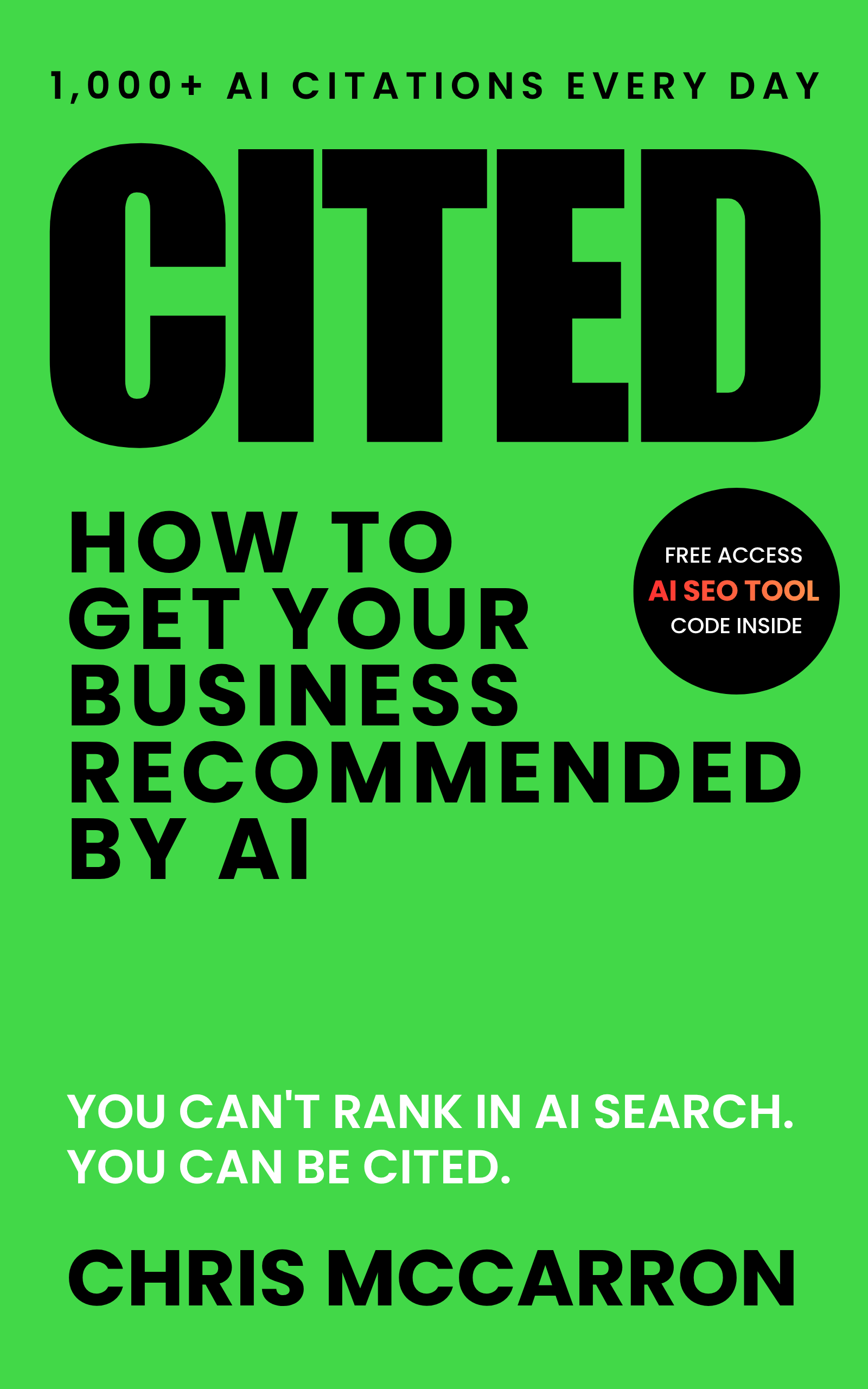
Chris McCarron is the founder of GoGoChimp, a Glasgow CRO agency, with 13 years of hands-on testing. He wrote CITED, a book on getting recommended by ChatGPT and AI search, and builds Rubric, GoGoChimp's AI citability auditor.
References
- Ahrefs. (2026). Matched difference-in-differences test of 1,885 pages that added JSON-LD: "no major uplift in citations on any platform" (AI Overviews minus 4.6%). https://ahrefs.com/blog/schema-ai-citations/
- SISTRIX (Beus, J., Weissbach, J., and the SISTRIX Content Team). (2026, 22 October). Citation-worthiness study: 96,418 URLs from 17,380 domains, cited vs uncited pages on the same domain, DACH region, Q2 2026. Correlations. https://www.sistrix.com/blog/citation-worthiness-study/
- Fishkin, R. (2026, 22 October). Is AI visibility a marketing boondoggle? SparkToro. https://sparktoro.com/blog/is-ai-visibility-a-marketing-boondoggle/
- Gartner. (2026, 20 May). Press release on a survey of 645 B2B buyers (fieldwork August to September 2025): 45% used GenAI during a recent purchase. https://www.gartner.com/en/newsroom/press-releases/2026-05-20-gartner-survey-finds-sixty-nine-percent-of-b-two-b-buyers-turn-to-sales-reps-to-validate-ai-generated-insights
- GoGoChimp. (2026, 20, 23 and 26 October). Microsoft Clarity AI Visibility readings for gogochimp.com, window "Last 7 days", data source "Microsoft Copilot and partners". First-party, read in Clarity.
- GoGoChimp. (2026, 28 September). Bing Webmaster Tools AI Performance export for gogochimp.com, data 29 April to 25 September 2026. First-party, unpublished.
- GoGoChimp. (2026, 7 October). Rubric benchmark corpus, one-engine re-crawl: 244 of 299 sites scored, scoring version 2026-10-01, up to 40 pages per site, GoGoChimp's own sites excluded. First-party.
- GoGoChimp. (2026, September). PLZ Soccer shop Rubric work log, 12 to 14 September 2026. First-party.
- Google. (2026). AI optimization guide (Google Search Central). https://developers.google.com/search/docs/fundamentals/ai-optimization-guide
- Google (Maoz, H., & Samet, M.). (2026, 3 June, with a rollout note added for 31 August 2026). Google Search Central Blog post introducing the Search generative AI performance reports. https://developers.google.com/search/blog/2026/06/gen-ai-performance-reports
- Haynes, M. (2026, 21 October). GEO is a distraction. Marie Haynes Consulting. https://www.mariehaynes.com/geo-is-a-distraction/
- Indig, K. (2026, 19 October). Growth Memo issue on whether AI drives direct and branded traffic (12 sites, GA4). https://www.growth-memo.com/p/does-ai-drive-more-direct-traffic
- Microsoft. (2026). Bing Webmaster Tools Help: AI Performance. https://www.bing.com/webmasters/help/ai-performance-9f8e7d6c
- Microsoft Clarity (Rizk, I.). (2026, 13 May). Clarity blog post announcing that Citations is generally available. https://clarity.microsoft.com/blog/citations-now-generally-available/
- Rauch, G. (2025, 9 April). Post on X: "ChatGPT now refers 10% of new Vercel signups, which have also accelerated". https://x.com/rauchg/status/1910093634445422639
- Scherck, J. H. (2026, 23 June). Post on X: GA4's AI Assistant channel classification "is all jacked up". https://x.com/JHTScherck/status/2069456968809582791
- Scherck, J. H. (2026, 24 June). Post on X: ChatGPT responses "now may proactively say what solutions to avoid". https://x.com/JHTScherck/status/2069922780175565037
- Scherck, J. H. (2026, 29 June). Post on X: a hypothetical scenario in the intro is "the biggest tell that a post is AI generated". https://x.com/JHTScherck/status/2071391462236021040
- Scherck, J. H. (2026, 22 July). Post on X: "'Visibility' is one of the most misleading metrics in AEO". https://x.com/JHTScherck/status/2079990729770995892
- Scherck, J. H. (2026, 14 August). Post on X advising early-stage companies to "work on getting relevant and the rest will follow". https://x.com/JHTScherck/status/2088407975216238889
- Scherck, J. H. (2026, 20 August). Post on X: 95% of the agencies in ChatGPT's fan-outs for B2B SEO agency prompts were over 10 years old. https://x.com/JHTScherck/status/2090542548578443396
- Scherck, J. H. (2026, 22 October). Post on X on judging GEO from "100 random sites". https://x.com/JHTScherck/status/2113353086974751185
- Scherck, J. H. (2026, 23 October). Post on X on ChatGPT's "interactive vendor scorecards". https://x.com/JHTScherck/status/2113439002342920315
- Search Engine Journal (Southern, M. G.). (2026, 15 October). Report on the ChatGPT referral drop as a tracking problem: utm_source=chatgpt.com missing from inline answer links after the GPT-6 rollout, Profound's tagged-link figures and Adobe's account of the fix. https://www.searchenginejournal.com/chatgpt-traffic-drop-appears-to-be-a-tracking-problem/593157/
- Search Engine Roundtable. (2026, 22 October). Roundup of the AI search traffic studies, with Rand Fishkin's "Is AI visibility a waste of time?" video. https://www.seroundtable.com/ai-search-studies-42359.html
- Southern, M. G. (2026, November). Search Engine Journal report on Google's search volume versus ChatGPT's, citing Ahrefs' referral tracker (118,671 sites, 3 November update). https://www.searchenginejournal.com/googles-search-volume-is-about-5x-chatgpts-openai-says/595817/
- SEO Works. (n.d., data September 2025 to August 2026). AI referral traffic benchmark (95 sites, GA4). https://www.seoworks.co.uk/downloads/ai-referral-traffic-benchmark/
Free chapter
Read Chapter 1 of CITED, free.
The playbook for getting your business recommended by ChatGPT and AI search. Read the first chapter, on me.
Read Chapter 1 freeWant us to do this for your site?
Book a free AI audit. 15 minutes. We’ll show you three things your site is missing and what we’d test first.
Book my free AI audit →