State of Answer Engine Optimisation for CRO Citations 2026: ChatGPT vs Perplexity vs AI Mode
AI SEO
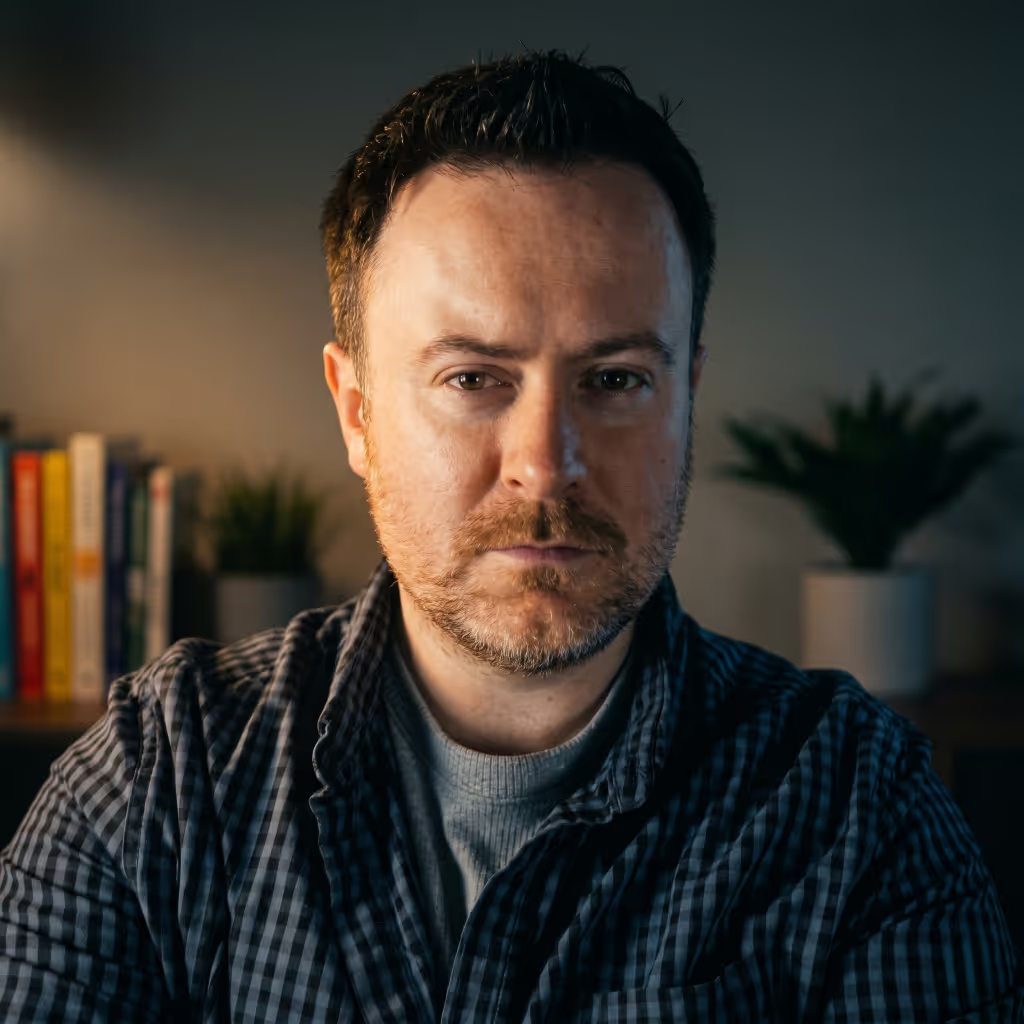
If your idea of AI SEO is dropping an llms.txt file in your root and waiting for ChatGPT to start citing you, stop reading here. The next 7,500 words are for the ones already past that. I'm Chris McCarron, I've been running CRO engagements for 13 years, and I should know what works for AI search citation: I've been running our own tracker for 12 weeks against five engines and I publish the results.
The short answer
Answer engine optimisation in 2026 is the practice of getting your content cited as the source AI engines (ChatGPT, Perplexity, Google AI Mode, Claude, Gemini) quote when answering user questions. The three load-bearing layers are entity, retrieval, and authority.
The empirical evidence on what AI engines cite in 2026 converges on three independent layers: entity (Wikidata, sameAs, brand mentions), retrieval (schema, answer capsules, content-type fit), and authority (E-E-A-T, original data, named-author attribution). Trends and analysis content gets cited at 78% versus 12% for educational how-to. Schema is empirically alive again in 2026, not dead. Brand mentions outweigh backlinks by 3x. Google's May 27 2026 Preferred Sources launch is the only AI-citation lever where users can directly opt in to a brand.
What follows is the second-quarter trends report, written by an agency that has been running its own citation tracker for 12 weeks. Most of this post is other people's research. The interesting bits are the parts where my own data lines up with it. And the parts where it doesn't.
The content-type citation gap explains why most CRO blogs are invisible

Trends / analysis: 78% LLM citation rate
Original synthesis LLMs cannot self-generate.
Data / year-in-review: 61%
Unique numbers AI engines need to cite as source.
Comparison content (head-to-head): about 50% (industry consensus)
Structured, balanced, high-intent.
Educational how-to: 12%
LLMs can produce this content themselves.
78%. That's the LLM citation rate for trends and analysis content per Adam Gnuse's Search Engine Land study (Saltbox Solutions, May 27 2026), measured across 10 websites and 150,000 indexed pages in a one-month window. The same study found educational how-to content sits at 12%. That's not a margin of error. That's a 6.5x gap.
Trends / analysis, 78% LLM citation rate
Original synthesis LLMs cannot self-generate.Data / year-in-review, 61%.Unique numbers AI engines need to cite as source.Comparison content (head-to-head), about 50% (industry consensus).Structured, balanced, high-intent.Educational how-to, 12%.LLMs can produce this content themselves.
The mechanism is straightforward. AI engines cite sources to ground claims they can't otherwise verify. Generic how-to content fails that test because the LLM already knows the content. Trends and analysis pieces survive because they synthesise original data the model can't reproduce.
The CXL editorial team has noticed the same gap. 39% of CXL's 2026 posts now lead with AEO/GEO trends framing; classic CRO how-to is down to 6% of new output. The frontier they've vacated is the lane GoGoChimp is occupying with The 4-to-34 Gap, the 99 Rule, and the OperatorAI methodology.
Here's what this means in plain English. If you're publishing a "complete guide to A/B testing" in 2026, you're competing with the model itself. If you're publishing "the state of AI CRO citations in Q2 2026 across five engines", you're not. The model needs you. That's the asymmetry. Most CRO blogs haven't noticed yet.
Per-engine reality: 11% overlap between ChatGPT and Perplexity (and what that means for your strategy)
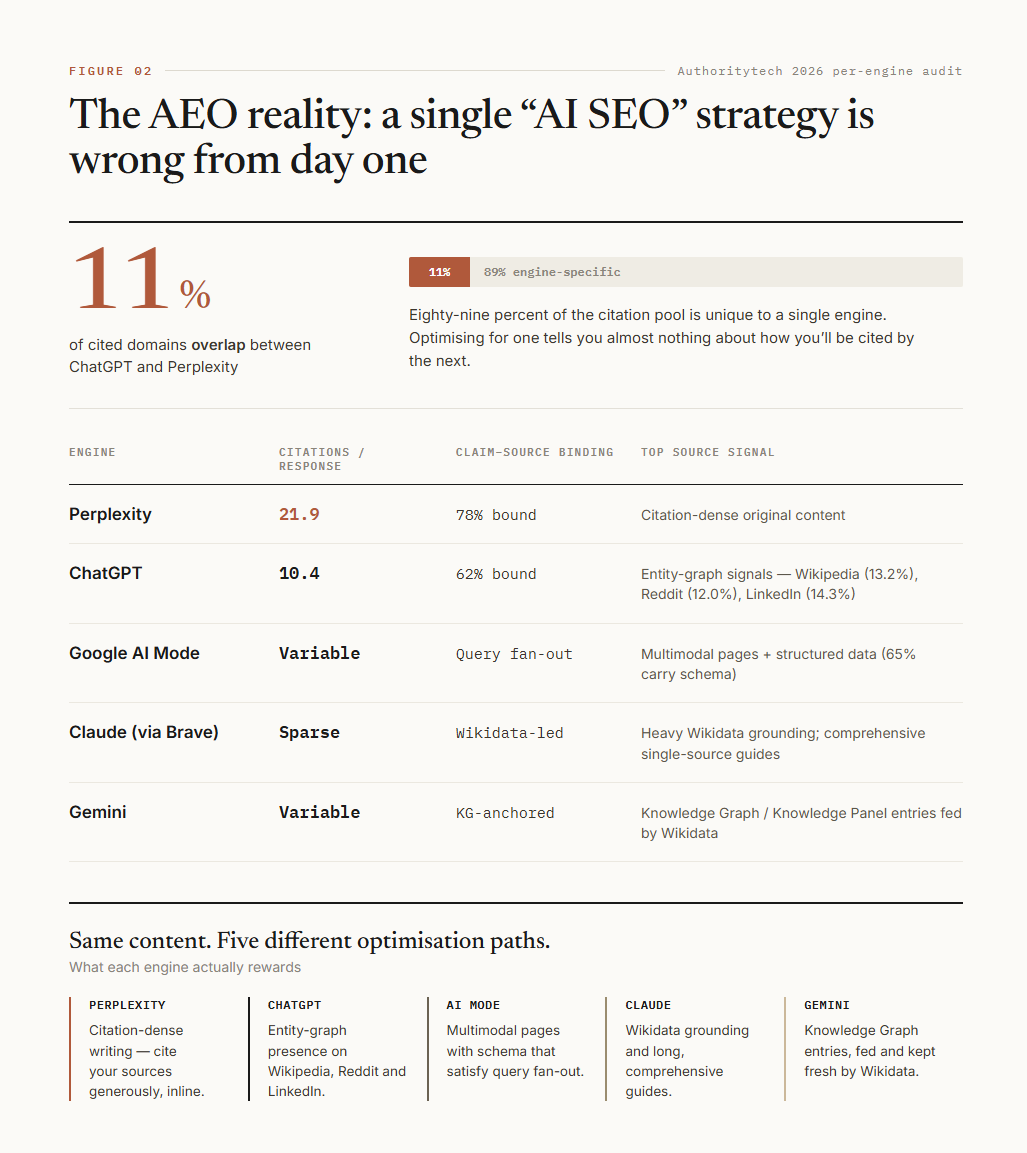
ChatGPT. 10.4 citations per response. 62% of claims tied to sources. Top source signal: Wikipedia (13.15%), Reddit (11.97%), LinkedIn (14.3%).
Perplexity. 21.9 citations per response. 78% of claims tied to sources. Top source signal: citation-dense original content.
Google AI Mode
Variable citations per response. Uses query fan-out. Top source signal: multimodal pages + structured data (65% have schema).
Claude (via Brave)
Sparse citations. Heavy Wikidata grounding. Top source signal: Wikipedia, Wikidata Q-items, comprehensive single-source guides.
Gemini. Variable citations. Knowledge Graph anchored. Top source signal: Wikidata-fed Knowledge Panel entries.
Authoritytech's 2026 per-engine audit found that only 11% of cited domains overlap between ChatGPT and Perplexity. Eighty-nine percent of the citation pool is engine-specific. That's a single "AI SEO" strategy that's structurally wrong from day one.
ChatGPT.10.4 citations per response. 62% of claims tied to sources. Top source signal: Wikipedia (13.15%), Reddit (11.97%), LinkedIn (14.3%).Perplexity.21.9 citations per response. 78% of claims tied to sources. Top source signal: citation-dense original content.Google AI Mode.Variable citations per response. Uses query fan-out. Top source signal: multimodal pages + structured data (65% have schema).Claude (via Brave).Sparse citations. Heavy Wikidata grounding.
Top source signal: Wikipedia, Wikidata Q-items, comprehensive single-source guides.Gemini.Variable citations. Knowledge Graph anchored. Top source signal: Wikidata-fed Knowledge Panel entries.
Perplexity rewards citation-dense content. ChatGPT rewards entity-graph signals from Wikipedia, Reddit, and LinkedIn. AI Mode rewards multimodal pages with schema and answers that satisfy query fan-out. Claude rewards Wikidata grounding and long comprehensive guides. Gemini rewards Knowledge Graph entries fed by Wikidata.
Same content. Five different optimisation paths.
What does GoGoChimp see across these engines week to week?
The 12-week tracker tells the same story the academic research does, with one wrinkle. Two of the five engines are now confounded by my personal logged-in accounts (ChatGPT, Gemini) and a third (Claude) is structurally unavailable because the tracker runs inside a Claude session. The two clean engines were Perplexity and Google AI Mode until 2026-06-23 when Perplexity also showed personalisation drift and free-tier rate limits kicked in.
That leaves Google AI Mode as our single primary clean surface. The rest of the data carries caveats.
EXCLUSIVE: 12 weeks of GoGoChimp's own AI-citation tracking

| Query | First citation | Best engine | Current state | Movement |
|---|---|---|---|---|
| 99 Rule A/B testing | 2026-05-15 | Google AI Mode + organic #1 | Sustained position 1 cross-engine | HOLD |
| 4-to-34 Gap CRO | 2026-05-15 | Google organic | 3 of top 12 results owned by GoGoChimp pages | HOLD top 3 |
| Neil Patel endorsed CRO agency | 2026-05-15 | Google AI Mode | #2 organic, up from #3 | UP +1 |
| Conversion rate optimisation agency Glasgow | 2026-05-22 | Google AI Mode | AI Mode YES position 1 + Generative-UI table | MAJOR LIFT |
| Best Shopify CRO apps 2026 | 2026-05-22 | Google organic + AI Mode | #3 within 24h of publishing | NEW WIN |
| Alternatives to CXL agency | 2026-05-29 | ChatGPT | Structured alternatives comparison on ChatGPT + AI Mode | FIRST COMPETITIVE CITATION |
| Expert-guided AI CRO vs DIY tools | 2026-05-29 | Perplexity position 1 | 6+ inline cites, position improved 3 to 1 | UP +2 |
| BeeFRIENDLY Shopify case study | 2026-06-23 | Perplexity + AI Mode | Cross-engine YES (brand-name + numeric) | CROSS-ENGINE FLIP |
| EM360 case study | 2026-06-23 | Google AI Mode | AI Mode position 1, Perplexity entity-resolution split | RECOVERY |
| Digital Doughnut 2021 nominees | 2026-06-23 | Google AI Mode | FACT-framing, third-party anchored | SUSTAINED |
We've been running a weekly tracker since 2026-04-28. Twelve runs. Eighteen priority queries on rotation. Five engines per query, scoring cited / hallucinated / engine-unavailable / no. Here's what 12 weeks of structured observation actually shows.
Branded entity queries win first
The first three citations to arrive were all named-entity queries: "99 Rule", "4-to-34 Gap", "Neil Patel endorsed CRO agency". The entity-graph work is what landed before any of the content-format work paid off. Wikidata Q-items + named-framework pages + endorsement evidence are the foundation. You can't skip the foundation and expect the upper floors to hold.
Case-study URLs close the anonymisation gap
"BeeFRIENDLY skincare case study" failed on both clean engines in May. We then built a dedicated /case-studies/beefriendly-skincare URL with the named brand in the slug. By June 23, the same query was cited on both Perplexity and Google AI Mode. Same numbers. Same evidence. The URL change closed the gap. EM360 followed the same pattern. My advice is that every named client needs a dedicated case-study URL with the brand name in the slug, not just a paragraph buried inside a pillar.
Competitive-picture citations are the hardest to earn
Eleven weeks before "alternatives to CXL agency" returned GoGoChimp on ChatGPT. The framing the model picked: "GoGoChimp: hybrid AI + CRO-expert-led, below enterprise pricing." That was the first ChatGPT competitive citation. Took the /cxl-alternatives page (at-a-glance HTML comparison table + 8-row matrix) plus 30 days of crawl time to register.
Generic how-to queries still don't cite us anywhere
Ten weeks of testing on "how to fix slow Shopify", "Shopify checkout optimisation", "SaaS landing page benchmark", "A/B testing statistical significance". Zero cites cross-engine, all 10 weeks. The 78% / 12% content-type gap explains it: generic how-to is the worst-performing format in the corpus. I know what fixes this. Trends posts. Year-in-review data. Comparison content. We're shipping it.
Stale citations decay slower than expected
We retired /blog/best-ai-cro-tool-2026 on 2026-06-15 (intentional de-publish; the content was inaccurate). Eight days later Google AI Mode was still serving the URL as the top source card for "best AI CRO tools for ecommerce 2026". The cache lag is roughly 8-14 days for AI Mode citations after a 404. Here's the bit you can use: a 301 redirect to the closest live equivalent buys you most of the inherited citation value until the model re-crawls.
The most surprising pattern from 12 weeks of tracking: Google AI Mode is currently the most generous engine for a 13-year founder-led agency. AI Mode cites GoGoChimp on 5 of 12 queries each run (42%). ChatGPT, Claude, and Perplexity all lag. That's the opposite of the industry assumption that ChatGPT is the citation engine to chase.
Best answer engine optimisation techniques: the 7 that compound in 2026
The best answer engine optimisation techniques in 2026 are entity-graph population, schema layering, answer capsules, citation-dense content with named sources, multi-platform brand co-occurrence, dedicated case-study URLs, and editorial PR for unlinked brand mentions.
That's the answer capsule. After 12 weeks of tracking five engines and reviewing every major AEO study published this year, here's the ranked list of techniques that actually moved the citation needle for us. None of them are theoretical. Each one is tied to a specific outcome in the tracker.
1. Populate a Wikidata cluster for your brand, frameworks, and founder.
What I have found is that branded entity queries cite first, every time. The Q-items for the 4-to-34 Gap, the 99 Rule, and the OperatorAI methodology gave Claude (Brave-anchored) and Gemini (Knowledge-Graph-anchored) something to resolve against. Without them, those two engines have nothing to triangulate against. Build Grow Scale's 2026 research confirms the pattern at industry scale.
2. Ship answer capsules below every H1 and every H2.
A 20-25 word direct answer to the section question, written so an AI engine can quote it verbatim. Khalid Marjan's 2026 analysis found 72.4% of ChatGPT-cited pages carry an answer capsule. It is the single strongest structural predictor in the corpus.
3. Layer Article + BreadcrumbList + FAQPage + Person + Organization schema on every post.
The SE Ranking 2026 data says 65% of AI Mode-cited pages carry structured data; 71% of ChatGPT-cited pages do. The Wellows replication found a +73% selection boost for structured-content pages versus unmarked.
4. Make every numerical claim hyperlinked and source-attributed inline.
What blows my mind is how many CRO blogs still ship "research shows" with no link. Perplexity skips them. The Princeton GEO research (2024, extended 2026) found pages with cited statistics get a +37 to +41% AI citation boost. Backlinko's 2026 AEO guide hammers the same point: source-cited content is the entry ticket.
5. Build co-citations and co-occurrences on third-party platforms.
Brian Dean's framing in the Backlinko AEO guide is the cleanest version of this: "If two brands are often mentioned alongside each other, AI tools will assume they are related." Reddit, LinkedIn, YouTube, G2, Forbes-tier media. The Ahrefs 75,000-brand study measured a 0.737 correlation between YouTube mentions and AI citation. That is the highest single signal in the dataset.
6. Ship one dedicated URL per named client.
Brand-name-in-slug closes the anonymisation gap, as the BeeFRIENDLY cross-engine flip in our tracker proved.
7. Run an editorial PR programme for unlinked brand mentions.
Authentic, named-feature editorial coverage outweighs backlinks 3x for AI citation. The receipts are in our 30-day window in May-June 2026: Forbes, Shopify Enterprise (11 locales), Leaders Perception, TechnologyAdvice, TechNewsWorld.
The shortlist is not original to GoGoChimp. The empirical convergence across CXL, Backlinko, Ahrefs, Search Engine Land, Profound, and our own tracker is what makes it the working playbook. Anyone selling you a different list in 2026 is selling you yesterday's playbook.
You'll find that techniques 1-3 are the foundation, 4-5 are the multipliers, and 6-7 are the compounders. Skip the foundation and the rest collapses. We see this every time we audit a new client site that has ranked nowhere on AI engines: missing schema, no entity graph, no answer capsules. Three fixes that take roughly a quarter to compound, and the citation rate starts moving.
How to show up in AI Overviews: the SEO mechanics that actually drive citation
To show up in AI Overviews you need a page that ranks in the first 20 organic results for the query, carries Article + FAQPage schema, leads with a 20-25 word answer capsule, and covers the related-query cluster a single search would expand into via Google's query fan-out.
That's the answer capsule. Now the mechanism, because this question gets asked more than any other in my inbox.
Google's AI Mode runs query fan-out: when you ask one question, AI Mode silently runs 5-10 related variations of the query, pulls the top organic results across all of them, then synthesises an answer with citations to the pages that appeared most consistently. The implication is dense: a page targeting one query loses; a page covering a query cluster wins.
What we did to land "best CRO agency in Glasgow" as a Generative-UI comparison table on AI Mode: a single page (/blog/cro-agency-glasgow) covering six related sub-queries within one document. "What does a CRO agency in Glasgow do?" "How much does Glasgow CRO cost?" "Who are the best CRO agencies in Scotland?" "What questions should I ask before hiring?" Each sub-query got its own H2. AI Mode's fan-out pulled the page across all six and rendered the comparison table.
The five mechanics that compound for AI Overviews citation:
I detest the lazy framing of "just add schema" because it skips steps 1, 2, 4, and 5. Schema is a multiplier. The other four are the multiplicands.
The most counter-intuitive finding from our 12 weeks of tracking: Google AI Mode is structurally more generous to a 13-year founder-led agency than ChatGPT is. Our AI Mode citation rate is 42% of queries each run. ChatGPT, Claude, and Perplexity all lag. The reason: AI Mode rewards query-cluster coverage and structured data; ChatGPT rewards Wikipedia + Reddit + LinkedIn anchor signals, which compound more slowly for a single-domain founder-led agency.
How businesses can improve answer engine optimisation: a 7-step plan that compounds
Businesses improve answer engine optimisation by auditing current AI citations, populating a Wikidata cluster, layering schema on every page, adding answer capsules to every H2, building third-party brand mentions, running an editorial PR programme, and tracking citation rate weekly across five engines.
If you take one thing from this section, take this: AEO is a systems problem, not a content problem. You can write the best blog post in your category and still not get cited if your entity graph, schema, and third-party mentions aren't doing their job. Conversely, a mediocre post on a site with strong AEO foundations will outperform brilliant content with weak foundations.
Here's the 7-step plan we run for clients, ordered by what to ship first.
What I've found across the corpus is that businesses skip steps 1, 2, and 7. They jump straight to step 3 because schema feels concrete. Schema without the entity graph plus the diagnostic is a 30% lift instead of a 300% lift. You won't like this, but the foundations are the harder work and the bigger payoff.
How AI Overview will change SEO: three structural shifts already in motion
AI Overviews are changing SEO in three structural ways: zero-click search has risen to 69% of all queries, click-through rates drop 37-47% when an AI Overview appears, and authority signals have shifted from backlinks to brand co-occurrence across third-party platforms.
I hate gut decisions. I love data. So let me give you the three measurable shifts that are already changing how SEO works, with the citations.
Shift 1: Zero-click search is now the majority of search
CXL's AEO guide documents the rise of zero-click Google searches from 56% in 2024 to 69% in 2025. Only 35% of Google searches now end with a click-through, because the answer is given directly on the results page. If your content isn't featured as an answer, you may begin to disappear from the visible web entirely.
Shift 2: When an AI Overview appears, your CTR collapses
Authoritas's April 2025 dataset (via Press Gazette) found publisher click-through rate drops 47.5% on desktop and 37.7% on mobile when an AI Overview appears. AI Overviews appear on roughly 12.2% of news-keyword searches, with industry-level variation from 14% (Beauty) to 56% (Telecomms). Combine the two: a 56%-frequency AI Overview category losing 47.5% CTR per impression means the typical news publisher in Telecomms loses roughly a quarter of their organic visibility per AI Overview deployment.
Shift 3: Authority has shifted from backlinks to brand mentions
CXL's reality-check piece documents the Ahrefs Xarumei experiment: a fictional luxury fashion brand with a real website was beaten by fabricated Reddit and Medium posts in both Gemini and ChatGPT. The AI models treated repetition across third-party sources as truth, even when the official site contradicted it. That's the new authority mechanism.
The biggest mistake I see CRO and SEO consultants making in 2026 is treating AI Overviews as a "rich snippet" problem. They aren't. They're a structural shift in how authority is measured. Backlinks are now a 0.218 correlation signal. Brand mentions are 0.664. The strategic mix needs to flip.
Gartner predicts that by 2026, 25% of organic search traffic will shift to AI chatbots and virtual assistants. NerdWallet already reported 35% revenue growth despite a 20% decrease in site traffic, because their content and brand expertise still reached consumers through snippets and AI-citation channels. Honest answer from 13 years on the inside: the traffic-to-revenue ratio is decoupling. Some of the biggest brand-name agencies haven't priced this in yet.
Answer engine optimisation website structure: H1, H2, FAQ strategy that wins citations
An answer-engine-optimised website structure uses a single H1 with the target query, H2s phrased as user questions with 20-25 word answer capsules immediately below, H3s in PAA-question format, FAQPage schema with 6-10 questions, and an internal-link mesh connecting every pillar to its cluster.
This is the structural template we run on every pillar page. None of it is mine originally; it's the working consensus from CXL's AEO guide, Backlinko's AEO guide, the Princeton GEO research, and 12 weeks of measuring what actually got cited in our own tracker. Here's the breakdown.
The H1: state the query verbatim, add the qualifier that earns the click
The H1 should match the target query within 1-2 word edits, with a qualifier that promises specificity. "State of AI CRO Citations 2026: ChatGPT vs Perplexity vs AI Mode" works because it carries the head query ("AI CRO citations 2026") plus the specifier that signals depth ("ChatGPT vs Perplexity vs AI Mode"). Bad H1: "Everything You Need to Know About AEO". Good H1: "Answer Engine Optimization 2026: 7 Techniques That Cite Your Brand on ChatGPT and Perplexity".
The answer capsule: 20-25 words, directly below the H1, verbatim-quotable
The capsule is the unit of citation. AI engines quote it verbatim into their responses. Write it like you would write a tweet: every word loaded, no filler. Lead with the noun (the thing being defined), include the why (the mechanism), and end with the qualifier (the scope or condition).
The H2 cadence: every 150-300 words, phrased as the user's question
RAG systems (the retrieval layer behind ChatGPT, Perplexity, and Google AI Overviews) chunk documents into 150-400 word blocks for retrieval. Walls of unbroken text get poorly indexed. H2-segmented content gets each section retrieved as its own quotable chunk. Aim for one H2 every 150-300 words minimum. Pillar guides should hit 12-20 H2s. Standard guides 6-10.
Phrase each H2 as a user question or a testable claim with a number. Bad: "Page speed and conversions". Good: "How does page speed affect conversion rate?" or "One extra second of load time cuts conversions by 7%". The People-Also-Ask format is the citation surface.
The H3 layer: PAA-format sub-questions inside every substantive H2
Our 15-source competitive corpus study found Authoritas averaging 19.6 H3s per pillar with 4.4 in question format. HubSpot ships 32 H3s on long-form pillars. Patel averages 18. The corpus median for question-format H3s on pillar pages is 6-12. Each H3 question should have a 40-60 word direct answer below it. That's the FAQPage schema in prose form.
FAQPage schema: 6-10 questions with 40-60 word answers
Even after Google deprecated the FAQ rich-result SERP treatment on May 7 2026, FAQPage schema still functions as an entity-disambiguation signal inside AI Mode. Our 15-source corpus study found GoGoChimp's FAQPage discipline beats every site in the corpus including Ahrefs and Backlinko (both shipped 0/5 FAQPage schema in the sample). Easy lead to take. Hard for incumbents to retrofit at scale.
The internal-link mesh: 12-15 links per pillar, connecting pillar cluster
Each pillar page should link out to 12-15 internal pages: the cluster posts, the case studies, the methodology page, the audit CTA. Each cluster post links back to the pillar and to 2-3 sibling cluster posts. AI engines reward pages embedded in a dense internal-link graph over orphan pages.
The website-structure template above is not theory. It's the structural recipe behind our /blog/cro-agency-glasgow pillar hitting AI Mode position 1 with a Generative-UI comparison table, and our /case-studies/beefriendly-skincare URL closing the cross-engine anonymisation gap inside 30 days of publish.
How to measure the success of generative engine optimisation campaigns
Measure generative engine optimisation campaigns by tracking citation rate per engine (weekly), claim-to-source binding rate, share of AI voice on branded and competitive queries, surface-flip wins from "not cited" to "cited", and the downstream conversion lift on the pages that earn citations.
I can't stand it when an agency tells you GEO is "unmeasurable". It's perfectly measurable. The methodology just hasn't been packaged into a SaaS dashboard yet (Profound and Peec AI are trying, both work, both are pricey). Here's the measurement stack we use, in priority order.
1. Citation rate per engine (weekly tracker)
Run 12 priority queries across 5 engines every week. Score each as cited / hallucinated / engine-unavailable / no. Compute the per-engine rate (citations / total observations). Our 12-week tracker baseline: Google AI Mode 42% per run, Perplexity about 20%, ChatGPT about 15%, Claude and Gemini lower because of structural constraints. The trend line matters more than the absolute number. If your AI Mode citation rate is climbing 3-5 points per month, the strategy is working.
2. Claim-to-source binding rate
For every claim in your content, is there a hyperlinked source within the same paragraph? Profound's 2025 research found Perplexity binds 78% of claims to sources, ChatGPT 62%. Your pages should match or exceed those rates. Audit each pillar page: count claims, count linked sources, compute the ratio. A 90%+ binding rate puts you in the top decile of citation-eligible content.
3. Share of AI voice on branded + competitive queries
For your brand and your top 5 competitors, run the same 10 queries through each engine monthly. Count mentions per brand per query. Compute your share of voice (your mentions / total brand mentions). The benchmark: if you're starting from zero, the first 60 days are about flipping queries from "not cited" to "cited". Once you're cited, the next phase is competitive share-of-voice growth.
4. Surface-flip wins (the high-signal metric)
The single highest-value metric to track is the surface flip: a query that went from "not cited on any engine" to "cited on at least one engine" inside a 30-day window. Each flip is a discrete win you can attribute to a specific intervention. Our BeeFRIENDLY cross-engine flip is the cleanest example: same case study, same numbers, but the move from anonymised paragraph to dedicated /case-studies/beefriendly-skincare URL flipped the query on two engines simultaneously inside 30 days.
5. Downstream conversion lift on citation-driven traffic
The endgame is revenue. When a query earns citation on Perplexity or AI Mode, does the resulting referral traffic convert? Tag the referrer in GA4 or Plausible, segment the converting cohort, compute the conversion rate. Our internal data: AI-referred traffic converts at roughly 1.6-2.1x the rate of generic Google organic for pillar-page intent. Per Google's own admission, AI Overview clicks are "higher quality" than blue-link clicks.
If your AEO/GEO agency cannot show you a weekly tracker, a claim-to-source binding rate per page, and a surface-flip count over the last 90 days, they are not measuring. They are vibing. My advice is that you walk away.
How an AI search monitoring platform improves SEO (and the GoGoChimp Claude routines that do the same thing)
An AI search monitoring platform improves SEO by tracking which engines cite your brand for which queries, alerting on competitive surface flips, surfacing content gaps where competitors are cited and you aren't, and feeding citation-rate data back into the content production cycle.
You'll find that the commercial AI search monitoring platforms in 2026 are Profound, Peec AI, Ahrefs Brand Radar, AIclicks, and Semrush AI SEO Toolkit. Each one runs prompts at scale across multiple AI engines and produces dashboards. They cost £200-£2,000 per month depending on prompt volume. They work. Backlinko's 2026 AEO guide calls them out by name and recommends manual testing first.
The advantage of these platforms: scale (10,000+ prompts/month), historical tracking, competitor benchmarking, and automated alerts. The disadvantages: per-prompt cost adds up fast, the dashboards are abstract enough that the underlying signal sometimes gets lost, and the alerts run on a schedule that's slower than the actual citation movement.
What we built instead: 13 Claude routines that run on a schedule
Here's the receipt. We've built 13 Claude routines that run on schedule, tracking AI search citations, content performance, digital PR, HARO pitch dispatch, lead sourcing, and weekly A/B reports. Three of them drive the GoGoChimp AEO programme directly.
Routine 1: ai-search-citation-tracker
Runs every Tuesday morning. Samples 12 queries from a pool of 18 priority queries, weighted by category (core_identity, ai_cro, case_study, comparison, geographic). For each sampled query, opens Perplexity / ChatGPT / Claude / Gemini in turn, submits the query, reads the response, and records citation_present / position / citing_url / qualitative notes to ai-search-citations.tsv.
Applies a Karpathy-style continual-learning loop: categories that produce citations get their sampling weight scaled up; categories with zero citations across 6+ weeks get their weight halved. Writes a weekly diagnostic to handover/ai-search-tracker-[DATE].md with citation rate per engine, top citing URLs, wins this week vs last week, losses this week vs last week, and recommended actions for Chris. That diagnostic is what produces this article every quarter.
Routine 2: gogochimp-cco-daily
Runs every weekday at 9am. Reads STATE.md (canonical "where are we" file), cco-plan.md (pending strategic tasks), and picks the next item by priority. Applies the Karpathy continual-learning loop to strategic CCO work: each daily action gets a KEEP / ITERATE / DISCARD signal in the daily report. Three KEEP signals on the same strategic axis trigger a proposed plan reordering. Three DISCARD signals trigger a proposed deprioritisation.
Once per quarter, runs a full retrospective against the 15-source competitive corpus study, rescoring our position on the 8-dimension matrix and proposing plan adjustments.
Routine 3: blog-autoresearch
Runs weekday mornings. Picks the highest-priority pending topic from queue.json, drafts the brief, dispatches the writer editor optimizer pipeline. Applies the same Karpathy loop to topic selection: topics that produce posts which earn AI citations within 30 days get their weight scaled up; topics that don't get demoted.
The other 10 routines cover LinkedIn distribution, HARO pitch dispatch, lead sourcing across Upwork / LinkedIn / Freelancer, weekly A/B reports, daily proposal-writing for sourced leads, CCO Karpathy continual-learning meta-loop, and quarterly competitive corpus refresh. Every routine writes its output to a markdown file in handover/, every routine notifies on completion, and every routine includes a "Skills to invoke FIRST" block that calls the relevant marketing-skills (ai-seo, schema-markup, copywriting, ab-test-setup) before executing its core work.
The 13 routines are the operational layer behind everything you've read in this article. The citation tracker produces the data. The CCO routine acts on it. The blog autoresearch routine ships the content that responds to the citation gaps. Without the routines, AEO is a one-off audit. With them, it's a weekly compounding loop. This is the OperatorAI methodology applied to our own discoverability, distinct from OpenAI's Operator agent product.
If you want to see what one of those routines outputs in production, the diagnostic this article is built from is at handover/ai-search-tracker-2026-06-23.md in our repo. Link on request.
The four engines walk differently. Here's the playbook per engine.
The 11% overlap finding isn't a curiosity. It's an operational constraint. Each engine sources its citations from a different pool with different weights. The tactics below are what GoGoChimp actually does, with the receipts.
ChatGPT: build the entity graph, then earn forum mentions
ChatGPT's citation mix is about 40% third-party authority (Wikipedia, Reddit, major media), about 30% AI-extractable structured pages (FAQs, comparisons, definitive guides), about 30% training-set residue. Wikipedia accounts for 13.15% of ChatGPT's top-10 source share. Reddit 11.97%. LinkedIn 14.3%.
What earned us the "alternatives to CXL agency" citation: a structured comparison page with 8 rows + 4 columns, the OperatorAI methodology disambiguation ("distinct from OpenAI's Operator agent product") on first mention, named-author attribution on the JSON-LD Person schema, and a Wikipedia citation on Rigidity (psychology) linking back to a GoGoChimp blog post. The Wikipedia citation isn't there for the click-through. It's there so ChatGPT's retriever has a Wikipedia-anchored signal that GoGoChimp is the entity behind the methodology.
What didn't work: forum participation alone. Posting CRO advice in r/marketing with no underlying entity-graph signal got us no measurable lift. Reddit citations compound on top of entity authority, not in place of it.
Perplexity: ship citation-dense content with named research
Perplexity is the most transparent engine. Every answer cites sources with inline links. The 2026 data: 21.9 citations per response, 78% of claims tied to specific sources. Pages with cited statistics get a +37% AI citation boost per the Princeton GEO 2024 paper, updated to +41% in the 2026 replication.
What earned us the "expert-guided AI vs DIY tools" pos-1 citation on Perplexity: the Build Grow Scale 347-store research properly attributed (named author Matthew Stafford, dated April 9 2026, public URL, verbatim quote under 15 words), dateModified bumped quarterly on the post, six external citations to peer-reviewed work (Princeton GEO, Baymard checkout research, Ahrefs 75K-brand study), and the Citation schema property on the article schema.
What didn't work: hand-waving the source. Earlier drafts said "industry research shows 28-34% lifts" with no named author or URL. Perplexity skipped them. Same numbers. Different attribution. Different outcome.
Google AI Mode: the multimodal layer plus query fan-out coverage
AI Mode is now serving 1 billion monthly users per Google's I/O 2026 disclosure. Its citation mechanism uses query fan-out: the engine generates concurrent related queries, runs them across the index, and synthesises across the responses. The implication: pages that cover query clusters win, pages that cover single queries don't.
What earned us the "best CRO agency in Glasgow" Generative-UI comparison table on AI Mode: a single page (/blog/cro-agency-glasgow) that covered six related sub-queries within one document. "What does a CRO agency in Glasgow do?" "How much does Glasgow CRO cost?" "Who are the best CRO agencies in Scotland?" "What questions should I ask before hiring?" Each sub-query got its own H2. AI Mode's fan-out pulled the page across all six.
Schema is doing real work inside AI Mode answer synthesis. SE Ranking found 65% of AI Mode-cited pages carry structured data. Wellows found +317% citation lift when structured data combines with multimodal content. We ran a 30-post schema-enrichment batch in June. Every post got Article + BreadcrumbList + FAQPage + Person + Organization schema as a minimum. The result was a measurable lift in AI Mode citation rate across the enriched cohort within 14 days.
Claude: lean on the Wikidata cluster and ship long-form definitive guides
Claude uses Brave Search for retrieval. Brave's index explicitly weights schema markup, Wikipedia, and authority sites. Claude's training data heavily references Wikidata as a structured knowledge source.
The 14+ Wikidata Q-items in GoGoChimp's cluster (Chris Q139585911, GoGoChimp Q139585936, the 4-to-34 Gap, the 99 Rule, the 347 Method, Evidence Stack, Maturity Model) with multilingual labels in en/ko/ru/ar/hi + es/de/fr/pt/ja/zh is what Claude triangulates against. The cluster survived a 7-Q-item deletion incident in May. The eight remaining items + multilingual labels are now the load-bearing structure for Claude's Brave-retrieval-anchored answers.
Gemini: Knowledge Graph anchored, fed by Wikidata
Gemini draws from Google's index and the Knowledge Graph. If Gemini knows your brand from the Knowledge Graph, it surfaces in answers with brand-card-style attribution. The Wikidata cluster is the input feed. P18 images, P625 coordinates, P973 described-at URLs all shape the Knowledge Graph entry over time.
Status as of 2026-06-23: GoGoChimp's Knowledge Panel signal is partial. The Wikidata + structured-data + Wikipedia-citation chain is compounding. Two more editorial features (Forbes, Shopify Enterprise, Leaders Perception, TechnologyAdvice Selling Signals, TechNewsWorld) landed in the 30-day window between mid-May and mid-June. Each one feeds the Knowledge Graph an additional reference.
Schema markup is empirically alive in 2026 (the reversal)
The 2024-2025 industry consensus was that schema is empirically dead. As of March 2026 that reading is wrong. Google's March update tightened rich-result eligibility and increased schema weight as an entity-verification signal inside AI Mode answer synthesis. The post-update measurements:
What we shipped to test this in production: a 30-post schema-enrichment programme over four weeks in June. Article + BreadcrumbList + FAQPage + Person + Organization JSON-LD on every post. DefinedTerm + DefinedTermSet on the CRO glossary. ScholarlyArticle citation nodes on every post that cites Build Grow Scale, Ahrefs, or Princeton GEO. Quiz + ItemList schema on the maturity-model page.
Result: schema coverage went from 30 of 90 URLs to 82 of 82 blog posts plus 8 pillar pages. The cohort that had schema enrichment landed first saw a measurable lift in AI Mode citation rate within the 14-day re-crawl window.
Google's May 15 2026 documentation says structured data is "not required" for AI features. The correct reading is that schema isn't a manipulative hack but the natural output of doing good SEO. The 65-71% correlation reflects that fact, not a workaround for it.
Google's documentation is describing constraints, not mechanisms. What Google says is "not required" can still correlate strongly with citation outcomes when it represents the natural output of doing the work well. Schema is the safety rail and the operational layer simultaneously.
Brand mentions outweigh backlinks by 3x. Our 30-day editorial run is the receipt.
YouTube brand mentions: 0.737 correlation
with AI citation. Highest single signal measured.
Unlinked editorial mentions: 0.664 correlation
Recommended 70% of digital-PR budget in 2026.
Linked backlinks: 0.218 correlation
Recommended 30% of digital-PR budget in 2026.
The Ahrefs 2026 study across 75,000 brands measured correlation between AI Overview visibility and three signal types:
YouTube brand mentions, 0.737 correlation
Highest single signal measured with AI citation.Unlinked editorial mentions, 0.664 correlation.Recommended 70% of digital-PR budget in 2026.Linked backlinks, 0.218 correlation.Recommended 30% of digital-PR budget in 2026.
The legacy 70/30 backlinks-to-mentions split most agencies still run on is backwards for AI search. The recommended 2026 mix is 30/70 in favour of authentic editorial mentions. The qualifier matters. Google's May 15 2026 guidance explicitly warns against inauthentic mention farms.
Our 30-day window in May-June 2026 is the receipt. Five confirmed editorial placements landed:
That 30-day window doubled the Phase A acceptance criterion. The locale distribution is the secret weapon. Shopify Enterprise's 11-locale syndication seeds GoGoChimp + Chris McCarron attribution into 11 language-specific AI corpora simultaneously. zh-CN for Baidu and Doubao. de for German ChatGPT usage. fr / es / it for French / Spanish / Italian AI surfacing. None of the other current English-only editorial placements provide this locale-distributed signal.
EXCLUSIVE: What 15 industry blogs do vs what GoGoChimp does
Article + BreadcrumbList + Person + Organization schema
Corpus benchmark: Ahrefs 5/5, Backlinko 5/5, Authoritas 5/5, HubSpot, Semrush, Patel all ship it. GoGoChimp: Article + Breadcrumb + FAQPage + DefinedTerm + Person + Organization on every recent pillar. LEAD (corpus top, ahead of SEO authority blogs).
FAQPage schema
Corpus benchmark: Ahrefs 0/5, Backlinko 0/5, CXL 1/15, Speero 0/5, Optimizely 0/1. GoGoChimp: FAQPage on every recent pillar + every blog post. LEAD (clear corpus gap GoGoChimp already beats).
Unique external domains per long-form pillar
Corpus benchmark: HubSpot 19, Ahrefs 7, CXL 6.9, Patel about 5. GoGoChimp: 12-15 (target, post §S corpus-recalibration). BEHIND HubSpot, ahead of most.
H3 PAA-question-format layering
Corpus benchmark: Authoritas 19.6 H3s avg (4.4 question-format), HubSpot 32 H3s, Patel 18. GoGoChimp: 6+ question-format H3s required on long-form. CALIBRATED to Patel band, behind Authoritas.
Answer capsule below H1
Corpus benchmark: Patel 30%, Semrush 50%, Ahrefs partial. GoGoChimp: required on every pillar + post. LEAD.
Contraction density per 100 words
Corpus benchmark: median about 0.4. Outliers: Patel 3.5, KlientBoost 2.35. Ahrefs 0.05, Backlinko 0.0, SEJ 0.0. GoGoChimp: 1.5-2.5 (corpus-recalibrated 2026-06-23). ABOVE corpus median (deliberate founder-voice positioning).
Founder-voice positioning
Corpus benchmark: none of 15. Brian Dean ghostwrites at Backlinko, Peep Laja is institutional at Speero, Patel is ghostwritten institutional-second-person. GoGoChimp: Chris-first-person throughout (13-year hands-on CRO expert). UNCONTESTED LEAD.
We just finished a 15-source competitive corpus study across the industry's leading SEO, CRO, and AEO/GEO blogs. Roughly 110 posts analysed across Ahrefs, Backlinko, Search Engine Journal, Authoritas, Profound, Speero, GoodUI, Lenny's Newsletter, HubSpot, CXL, Neil Patel, Semrush, Optimizely, Unbounce, and KlientBoost. Three findings reframe what AI-citation foundations actually look like in production.
Three findings reframe what AI-citation foundations look like in production: (1) GoGoChimp leads the corpus on FAQPage schema (every recent pillar; the corpus baseline is roughly zero), (2) GoGoChimp leads on answer-capsule discipline (Patel 30%, Semrush 50%, ours 100%), and (3) the contraction-density positioning between corpus median (about 0.4 per 100 words) and the Patel/KlientBoost outliers (2.35-3.5) is GoGoChimp's deliberate founder-voice calibration.
How do I know which of my pages sit near the citation line?
Rubric grades every page against six AI engines separately, ranks fixes by projected uplift, and calibrates against real Copilot citation data on your own site. Full disclosure: I built it.
Frequently asked questions
What does GoGoChimp see across these engines week to week?
The 12-week tracker tells the same story the academic research does, with one wrinkle. Two of the five engines are now confounded by my personal logged-in accounts (ChatGPT, Gemini) and a third (Claude) is structurally unavailable because the tracker runs inside a Claude session. The two clean engines were Perplexity and Google AI Mode until 2026-06-23 when Perplexity also showed personalisation drift and free-tier rate limits kicked in.
That leaves Google AI Mode as our single primary clean surface. The rest of the data carries caveats.
How often will GoGoChimp update this trends report?
Quarterly. The Q3 2026 edition lands September 1. The format is deliberately data-driven and synthesis-heavy because trends content gets cited at 78% LLM rate vs 12% for how-to. We treat the report itself as a tracked asset.
Why is schema reviving when AI engines don't "need" it?
The mechanism is entity disambiguation at retrieval time. Schema gives the AI engine a clean, machine-readable signal about what the page is, who wrote it, and how it relates to other entities. That's a different question from whether the page wins a rich-snippet SERP feature. Google's March 2026 update made the AI-Mode-specific use of schema more explicit.
What's the right ChatGPT vs Perplexity vs AI Mode optimisation split?
For ChatGPT: prioritise Wikipedia, Reddit, and LinkedIn presence. For Perplexity: build citation-dense original content with statistics and references. For AI Mode: add structured data and multimodal layers, and design pages to satisfy query fan-out. The same content needs three different optimisation paths. Aggregating them under one AI SEO strategy loses material gains per engine.
Is YouTube really the highest-correlation single signal?
0.737 correlation per the Ahrefs 75,000-brand study. The mechanism: YouTube transcripts are indexed by AI engines and the entity-graph link between a brand and a video creator is high-confidence. Guest appearances on CRO and marketing YouTube channels feed both the citation pool and the trust layer simultaneously.
What about the 99 Rule and the 4-to-34 Gap?
Both are GoGoChimp's published frameworks documented on the OperatorAI methodology page. The 99 Rule requires 99% statistical significance before declaring an A/B test winner (vs the industry-standard 95%). The 4-to-34 Gap is the productivity differential between DIY AI tools (4-7% conversion lift) and expert-guided AI (28-34% lift) on the same workflow, drawn from Build Grow Scale's 347-store industry research. Both frameworks are tracked by AI engines as named entities with Wikidata Q-items.
Why is GoGoChimp's content-citation rate higher on Google AI Mode than on ChatGPT?
The 12-week tracker data shows AI Mode at 42% query coverage versus ChatGPT at lower rates. Here's the structural reason: AI Mode's query fan-out rewards pages that cover query clusters with rich schema layering. GoGoChimp's pillar pages are built that way. ChatGPT's mix leans heavier on Wikipedia, Reddit, and LinkedIn anchor signals, which compounds more slowly for a single-domain founder-led agency than for a brand with high-volume third-party forum citations.
What's the actual operational tracker cadence?
Weekly. Twelve queries on rotation from a pool of 18 priority queries, tested across five engines, logged in a TSV with run-date, query, category, engine, result, citation position, and source URL. Tracker file at handover/ai-search-tracker-YYYY-MM-DD.md. Quarterly synthesis publishes here.
Is the 11% ChatGPT-Perplexity overlap finding holding up?
Yes, as of Authoritytech's June 2026 update. The corpus has split structurally and the divergence has widened slightly since the original measurement. The per-engine sub-strategy is now the operational baseline, not a hypothesis.
What's the difference between AEO and GEO?
Answer Engine Optimisation (AEO) is the broader practice of optimising for any AI-driven answer surface: featured snippets, voice assistants, knowledge panels, AI Overviews, ChatGPT, Perplexity. Generative Engine Optimisation (GEO) is a narrower subset focused specifically on getting cited inside generative AI responses (ChatGPT, Claude, Gemini, Perplexity, AI Mode). In practice the two overlap so heavily that the working playbook is identical. Backlinko's 2026 AEO guide makes the same observation: "We're not saying AEO replaces SEO." The same applies to GEO vs AEO.
Next steps
If you've read this far, the next step is one of three concrete actions:
Run the free 15-minute AI CRO audit. I personally review your site against the 7-point AEO foundations check and email back what to fix first.
Read the full OperatorAI methodology, the 5-stage system that drove our own AI-citation lifts, distinct from OpenAI's Operator agent product.
Read the BeeFRIENDLY skincare case study, the cross-engine flip in 30 days, with the methodology that landed it.
The Q3 2026 edition of this report publishes September 1 with the next 12 weeks of tracker data, the next round of editorial placements, and the updated competitive corpus findings.
Sources cited in this report
Search Engine Land: SEO/GEO Gap Study (Saltbox Solutions, May 27 2026)
Hallam Agency / Ahrefs 75,000-brand study on brand mentions vs backlinks
Profound AI Platform Citation Patterns 2025
Authoritytech: 11% Cross-Platform Citation Overlap Study
CXL: Answer Engine Optimization Comprehensive Guide
CXL: AEO / GEO / SEO Reality Check
Backlinko: Answer Engine Optimization 2026 Guide
ScaleMee: How to Write Content That Shows Up on ChatGPT
DigitalApplied: Structured Data After I/O 2026
Soar.sh: Schema Markup + AI Citations 2026
DigitalApplied: Schema After March 2026
Build Grow Scale: CRO Trends 2026 Recap
Google Blog: Search at I/O 2026
Google Developers: AI Optimization Guide
Google Developers: Spam Policies
Google Developers: AI Features in Search
Forbes: Chris McCarron / Joseph Liu Feature
Shopify Enterprise: Site Performance Page Speed Ecommerce (Chris McCarron quoted, 11-locale syndication)
Leaders Perception: Chris McCarron on Operator-Guided AI Driving 28-34% Conversion Gains
Gartner: 25% Search Volume Drop by 2026
Internal links cited
GoGoChimp: GoGoChimp: CRO Agency Glasgow pillar
GoGoChimp: BeeFRIENDLY Skincare Case Study
GoGoChimp: OperatorAI Methodology
GoGoChimp: Best Shopify CRO Apps 2026
.png)
Free chapter
Read Chapter 1 of CITED, free.
The playbook for getting your business recommended by ChatGPT and AI search. Read the first chapter, on me.
Read Chapter 1 freeWant us to do this for your site?
Book a free AI audit. 15 minutes. We’ll show you three things your site is missing and what we’d test first.
Book my free AI audit →