Conversion Psychology: The Complete 2026 Handbook
AI CRO


Conversion psychology explains why one web page persuades a visitor and another loses them. Visitors judge a page in a fraction of a second and mostly without conscious thought, so small details decide whether they trust it. Six principles cover most of it: cognitive fluency, schema match, mental sets, mere exposure and priming, white space, and micro-commitment.
What is conversion psychology?
Conversion psychology is the applied study of how a visitor's brain reads a web page and decides whether to act on it. It draws on cognitive psychology and behavioural economics. Conversion rate optimisation is the testing, and conversion psychology tells you what to test and why a change worked.
The core idea is simple. Every visitor arrives expecting your page to work like others of its kind. When it matches, the page feels easy and trustworthy. When it doesn't, the visitor has to work harder, and effort feels like risk.
Most of this happens below conscious thought. Harvard Business School professor Gerald Zaltman says 95% of purchase decision-making takes place in the subconscious mind (HBS Working Knowledge, 2003). It's his estimate, so treat it as a direction. The practical point holds: a layout that matches what visitors expect does more work than a button-colour test. If a term here is new to you, the CRO glossary defines it.
What are the six principles of conversion psychology?
The six principles are cognitive fluency, schema match, mental sets, mere exposure and priming, white space, and micro-commitment. The table gives each one in plain English with the first thing to try on your own site.
| Principle | What it means | First thing to try |
|---|---|---|
| 1. Cognitive fluency | Pages that are easy to read feel more believable | Rewrite any headline a stranger can't follow on one read |
| 2. Schema match | Visitors expect your site to look like others in your industry | Put trust signals where your competitors put them |
| 3. Mental sets | Habits send visitors to where things usually are | Keep old paths working when you redesign |
| 4. Mere exposure and priming | Familiar things feel safer, and first images set the mood | Use a hero image that shows the outcome the customer wants |
| 5. White space | Fewer things on screen means each one gets seen | Remove anything in the first screen that doesn't help the main action |
| 6. Micro-commitment | Small yeses make the main click feel like the next step | Test what the button says before you test its colour |
1. Cognitive fluency: easy-to-read pages feel more trustworthy
Cognitive fluency (also called processing fluency) is how easily the brain takes in what it sees. The easier a page is to read, the more believable it feels, and that judgement forms before the visitor has consciously read much at all.
The lab evidence is strong. In Reber and Schwarz's study, people judged the same statements true more often when they were printed in colours that were easier to read against the background (Reber and Schwarz, 1999). Song and Schwarz found that people given exercise instructions in a hard-to-read font expected the routine to take longer and were less willing to do it (Song and Schwarz, 2008). On a website, an offer that is hard to read feels like an offer that is hard to take up.
Why do all-caps headlines slow visitors down?
Capitals remove word shape. In mixed case, the letters that rise and drop below the line give each word an outline the eye recognises at a glance. In all caps, every word becomes a similar rectangle, so the eye has less to go on.
"BUY THIS 52-INCH PANASONIC TELEVISION FOR $299.99" stops the eye but slows the reader. "Buy this 52-inch Panasonic TV for $299.99" reads faster. Britain's motorway signs use mixed case for the same reason: when Jock Kinneir and Margaret Calvert designed them from 1957, they concluded that upper and lower case letters would be more legible than capitals (Design Museum).
What is message match?
Message match means the page a visitor lands on repeats the promise that made them click. If your ad says "Same-day boiler repair in Glasgow" and the landing page headline says "Welcome to our website", the visitor has to work out whether they're in the right place. That moment of effort is where paid traffic leaks.
It's one of the cheapest fixes in paid media, because it only takes rewriting. The A/B testing foundations guide covers how to test it properly.
How do you make a page easier to process?
- Read every headline, button and form label aloud. If it takes two passes to understand, rewrite it.
- Put each ad next to the landing page it sends people to. The landing page headline should repeat the ad's main promise in the same words.
- Change all-caps headlines, buttons and product titles to sentence case.
- Use the words customers use when they describe their problem. These copywriting frameworks help you structure headlines that read in one pass.
- Run a five-second test: show the page to people who don't know your business for five seconds, hide it, then ask what the company does and what they'd click.
2. Schema match: visitors trust pages that look the way they expect
A schema is the mental template a visitor uses to predict how a type of site works. When someone buys flowers online, they expect a product grid, clear prices and a basket in the top corner. Pages that match the template feel right straight away, and pages that try to be different make the visitor stop and work them out.
Google's researchers measured how fast this happens. People formed a judgement of a website's look in 17 to 50 milliseconds, and the sites they found most appealing were visually simple and looked typical of their category (Google Research, 2012, and Tuch et al., 2012). The first impression is a schema check, and familiar layouts pass it.

Packaging works the same way. Heinz has changed the shape of its ketchup bottle many times, but the red and the keystone label stay, so every new bottle still matches what shoppers expect Heinz to look like.
Does page speed shape the first impression?
A slow page makes its first impression before any content appears. Aberdeen Group's 2008 research on web application response times found that one extra second of delay meant 7% fewer conversions (Aberdeen Group, 2008). It's an old rule of thumb measured on web applications, so use it as a direction. My guide to page speed and conversion rate covers newer studies.
How do you match what visitors expect?
- Screenshot your main competitors' pages before you redesign yours. A first-time visitor should know where everything is without looking for it.
- Put trust signals where visitors look for them: a physical address, a phone number, reviews and a named founder, visible in the first screen.
- Fix load time before you change the design. A fast page that looks familiar beats a slow page that looks clever.
- Keep the layout conventional and save your originality for your voice and your offer. Creative layouts help brand recognition over time and cost you on a first visit.
For the order I build these elements in, see how to build a high-converting landing page.
3. Mental sets: visitors repeat the habits they already have
A mental set is the brain's habit of solving a problem the way it solved it last time. Once visitors have learned where things usually are on a website, they look there first and resist a new layout, even when the new one is better.
Abraham Luchins showed the effect in 1942 with water-jar puzzles. People who had solved several problems with one long method kept using it on a problem that had a much simpler answer, while people without that practice found the simple answer (Luchins, 1942).
That's why visitors hunt for the menu icon, skip a hero video to find the headline and look for a single-column sign-up form. Behavioural rigidity is the long-term version: the longer someone has done something one way, the harder it is for them to change. Your regular customers and power users have the strongest habits, which is why they complain most about redesigns.
How do you change a site without breaking visitors' habits?
- Keep old paths working alongside new features on any product people already pay for.
- Design for the returning visitor as well as the first-timer. Make the tenth visit as quick as the first was clear.
- Run redesign tests for at least two full weeks against a control. Results often dip while people relearn the page and can recover once the new habit forms, so calling a test after three days can kill a winner.
- If a change has to break a habit, show a short tooltip or overlay the first time each user meets it.
4. Mere exposure and priming: what works in "subliminal" persuasion?
Mere exposure and priming are the real effects behind most talk of subliminal persuasion. Familiar things feel safer, and what a visitor sees first shapes how they read everything after it. Neither needs hidden messages, because both work in plain sight.
Was the Coca-Cola cinema experiment real?
Its results weren't real. James Vicary announced in 1957 that flashing "Eat popcorn" and "Drink Coca-Cola" on a cinema screen had lifted sales. In a 1962 interview with Advertising Age, he admitted the study was a gimmick with too little data to mean anything (Pratkanis, 1992).
Hidden messages aren't completely powerless in the lab. Karremans and colleagues found that a subliminal brand name nudged drink choice, but only among people who were already thirsty (Karremans et al., 2006). That's a narrow effect under controlled conditions, and no website should rely on it.
What is the mere exposure effect?
The mere exposure effect is the finding that people tend to like things more the more often they've seen them. Robert Zajonc set it out in 1968 (Zajonc, 1968), and it's one reason retargeting ads and consistent branding work. A logo you've seen every week for years feels safe before you've thought about it.
How does priming change the way a page is read?
Priming means what a visitor sees first changes how they read what comes next. A photo of a family on a travel-insurance page brings "people I need to protect" to mind, which makes the cover feel more relevant than a beach photo would.
A related effect, affective conditioning, works over time. Pair your product often enough with something people already feel good about, such as a friendly face or a warm colour scheme, and some of that feeling passes to the product.
How do you use familiarity and priming on your site?
- Budget for retargeting. Repeated, low-key exposure builds familiarity with people who have already visited.
- Choose a hero image that shows the feeling the purchase delivers. Travel insurance sells protection, so show the people being protected.
- Keep your colours and tone of voice the same everywhere a customer meets you, so every touch adds to the same familiarity.
The ecommerce psychology levers post applies these effects to online shops.
5. White space: less on the screen gets more attention
White space is the empty space around your content. It helps conversions because the brain has fewer things to process at once, so the main message and the main button get seen. Google's 2012 study points the same way: visually complex sites were rated less appealing even when the design was familiar (Google Research, 2012).
In my own client work over 13 years, the pages that lift most consistently are the ones where we removed content until the hero had room to breathe. A typical first screen I see has six badges, three buttons, a headline, a subheading, a testimonial carousel, a product shot and a menu. The fix is usually to remove four badges, two buttons and the carousel, and to add nothing.
How do you add white space without losing information?
- Count the clickable items in the first screen, then remove anything that doesn't help the visitor take the main action. Move supporting detail further down the page.
- Make every testimonial, badge and extra element earn its place in a test. If you've never tested it, you don't know whether it helps.
- Use a heatmap tool to see which elements nobody clicks or scrolls to.
- Treat padding as a conversion setting. The space around a button is part of the button.
6. Micro-commitment: small yeses make the main click easier
Every conversion ends in a click, and the click comes more easily when the visitor has already said a few small yeses. Reading a headline that describes their situation, seeing a review from someone like them or answering a one-click question all count. By the time they reach the main button, clicking feels like the next step.
The pattern goes back to Freedman and Fraser's "foot-in-the-door" study, where people who first agreed to a small request were more likely to agree to a much larger one later (Freedman and Fraser, 1966).
Does button colour matter?
Contrast matters more than any particular colour. The best button colour is the one that stands out most from the page around it, so an orange button stands out on a blue-and-white page and disappears on an orange one. There is no single highest-converting colour.
What should a button say?
A button should say what the visitor gets. "Submit" asks the visitor to do something for you, while "Get my free quote" tells them what they receive. Use a verb plus the specific outcome. The conversion copywriting handbook covers button and headline copy in more depth, and our conversion copywriting service does it for you.
How do you get more clicks on the main button?
- Test the button's words before its colour. In my client work, wording changes have moved results more often than colour changes.
- Place your main call to action in three places: in the first screen for visitors who've already decided, after your strongest testimonial, and at the end of the page for thorough readers.
- Use one primary button colour per page. A second "primary" button competes with the first.
- Add a small yes before the big one, such as a short quiz or a one-click choice.
What do GoGoChimp client results show?
Three client results show what applied conversion psychology can produce. Each came from a full client project with several changes, so no single result isolates one principle. Treat them as illustrations of the size of result that's possible.
Enzymedica UK converted 11.22% of sessions over Black Friday weekend
Over Black Friday weekend 2021 (26 to 29 November), the Enzymedica UK Shopify store converted 11.22% of sessions across all traffic. That's about 4.3 times the 2.58% e-commerce average for 2020. On UK-only traffic, with non-UK sessions filtered out, the rate was 15.69%. The numbers are in the Enzymedica case study.
Bee Friendly Skincare grew from $48,000 to $1,447,225 a year after a page-speed fix
Bee Friendly Skincare, Ezra Firestone's skincare brand, went from $48,000 a year to $1,447,225 a year in revenue after we cut its average page download time by 2.24 seconds, from 12.48 seconds. Bounce rate fell from 82.04% to 38.4%, and value per visitor rose from $1.28 to $29.03. The work was theme-code changes to serve correctly sized images, plus image compression and WebP. The numbers held for at least six months.
It illustrates principle 2. A slow page makes a poor first impression before any content appears, and the pages were still far from instant after the fix, which shows how much a large cut in waiting time can matter. The details are in the Bee Friendly Skincare case study, the full page-speed story and the anonymised case-study video.
Donate For Charity received 494.64% more donations in 30 days
Donate For Charity, a nonprofit, received 494.64% more donations in 30 days. The Donate For Charity case study covers the work behind it. The way we sequence testing on each client project is set out in our methodology.
How strong is the evidence behind conversion psychology?
The evidence is strong for the underlying effects and thinner for any single website. Fluency, mere exposure, mental sets and foot-in-the-door have decades of lab evidence, and Google's research links first impressions to simple, familiar layouts. A lab effect still won't transfer one to one to your site, so treat every principle here as a hypothesis to test.
Neuromarketing research supports the broader idea that much of buying happens below conscious awareness. A July 2025 PRISMA systematic review in Frontiers in Neuroergonomics brings together EEG, fMRI and eye-tracking studies across the buying stages, from recognising a need to after the purchase. Bansal et al. review 208 SCOPUS-indexed publications on neuromarketing and the marketing mix (Bansal et al., 2025). Neither review tests the six principles one by one. The studies cited under each principle do that.
How you test matters as much as what you test. Build Grow Scale's 2026 review of 347 stores found that expert-guided AI testing delivered average conversion lifts of 28-34%, compared to 4-7% from DIY AI tools (Build Grow Scale, 2026). That finding is about who runs the testing, and it doesn't measure any principle in this guide. I explain the gap in why AI CRO tools deliver 4-7% without a CRO expert, and the local maximum problem explains why small tweaks alone can leave you stuck.
Which conversion psychology fixes should you make first?
Start with the fixes that take the least time. The list is ranked by effort, quickest first, using how long each usually takes on a small-business site in my client work. Effort is the only basis for the order, because how much each fix lifts your conversion rate is what your own tests will show.
- Change all-caps headlines, buttons and product titles to sentence case (cognitive fluency). About 15 minutes.
- Rewrite button text as a verb plus the outcome (micro-commitment). About 30 minutes.
- Match each landing page headline to the ad that sends traffic to it (cognitive fluency). About 30 minutes.
- Clear the first screen of anything that doesn't help the main action (white space). About a day.
- Bring your layout and trust signals in line with what visitors expect in your industry (schema match). Two to three days.
- Test a hero image that shows the outcome the customer wants (priming). Two to four days.
- Set up retargeting so past visitors keep seeing your brand (mere exposure). About a week of setup.
- Protect existing habits in every redesign (mental sets). It takes no extra time, because it is a rule you apply to every change.
Run each change as a test with a control. Our roundup of the best A/B testing tools covers the software.
Questions about conversion psychology
What is the difference between conversion psychology and CRO?
Conversion rate optimisation (CRO) is the practice of testing changes to a website so more visitors act. Conversion psychology is the theory that explains why some of those changes work. Good CRO uses conversion psychology to decide what to test, then lets the test decide what stays. Without it, testing turns into guessing at button colours and layouts.
What are some examples of conversion psychology on a website?
Common examples include matching a landing page headline to the ad that sent the visitor, putting reviews and contact details where visitors expect them, and using a hero image that shows the outcome the customer wants. Others are removing clutter around the main button and writing button text that says what the visitor gets. Each one applies a principle from this guide.
Does subliminal advertising really work?
Not in the way the famous cinema story claims. James Vicary's "Eat popcorn, drink Coca-Cola" experiment was a gimmick he later admitted to. Lab studies have found small subliminal effects in narrow conditions, such as a drink brand name working only on people who were already thirsty. What works on a website is visible: mere exposure, priming and consistent branding.
Is cognitive fluency just making things simple?
Simplicity is only part of it. Cognitive fluency comes from making a page predictable as well as simple: matching what visitors expect, cutting the effort needed to read it and removing ambiguity. A sparse page can still feel wrong if sites in your industry are usually full of detail. A busy page can still be fluent if it matches its category, as dense news sites do.
How can I test whether my website is easy to understand?
Run a five-second test. Show your page to people who don't know your business for five seconds, hide it, then ask what the company does, who it's for and what the main action is. Tools such as Lyssna, Maze and UserTesting can run these tests for you. If several testers can't answer clearly, your page has a fluency problem.
Should I avoid animation on my website?
Avoid decorative animation and keep purposeful animation. Purposeful animation confirms what the visitor just did, such as a button changing on hover, a form field expanding when selected or a progress bar during checkout. Decorative animation, such as parallax scrolling, floating icons and auto-playing video, gives the visitor more to process and slows them down.
Why do regular customers complain about every redesign?
A redesign breaks their mental set. Regular customers have learned where everything is, and a new layout makes them slow at something they used to do without thinking. Introduce changes gradually, keep old paths working where you can, and run redesign tests for at least two full weeks before deciding a new version has lost.
References
1. Mahoney, Manda. "The Subconscious Mind of the Consumer (And How To Reach It)." Interview with Gerald Zaltman on his book How Customers Think (Harvard Business School Press, 2003). Harvard Business School Working Knowledge, 13 January 2003. library.hbs.edu/working-knowledge/the-subconscious-mind-of-the-consumer-and-how-to-reach-it
2. Reber, Rolf and Schwarz, Norbert. "Effects of Perceptual Fluency on Judgments of Truth." Consciousness and Cognition, 8(3), 338-342, 1999. doi.org/10.1006/ccog.1999.0386
3. Song, Hyunjin and Schwarz, Norbert. "If It's Hard to Read, It's Hard to Do." Psychological Science, 19(10), 986-988, 2008. doi.org/10.1111/j.1467-9280.2008.02189.x
4. Design Museum. "Jock Kinneir and Margaret Calvert." designmuseum.org/designers/jock-kinneir-and-margaret-calvert
5. Bargas-Avila, Javier. "Users love simple and familiar designs: Why websites need to make a great first impression." Google Research blog, 29 August 2012. research.google/blog/users-love-simple-and-familiar-designs-why-websites-need-to-make-a-great-first-impression
6. Tuch, Alexandre N., Presslaber, Eva E., Stöcklin, Markus, Opwis, Klaus and Bargas-Avila, Javier A. "The role of visual complexity and prototypicality regarding first impression of websites: Working towards understanding aesthetic judgments." International Journal of Human-Computer Studies, 70(11), 794-811, 2012. doi.org/10.1016/j.ijhcs.2012.06.003
7. Aberdeen Group. "The Performance of Web Applications: Customers Are Won or Lost in One Second." Press release, 10 December 2008. globenewswire.com
8. Luchins, Abraham S. "Mechanization in problem solving: The effect of Einstellung." Psychological Monographs, 54(6), 1942. doi.org/10.1037/h0093502
9. Pratkanis, Anthony R. "The Cargo-Cult Science of Subliminal Persuasion." Skeptical Inquirer, 16(3), Spring 1992. skepticalinquirer.org/1992/04/the-cargo-cult-science-of-subliminal-persuasion
10. Karremans, Johan C., Stroebe, Wolfgang and Claus, Jasper. "Beyond Vicary's fantasies: The impact of subliminal priming and brand choice." Journal of Experimental Social Psychology, 42(6), 792-798, 2006. doi.org/10.1016/j.jesp.2005.12.002
11. Zajonc, Robert B. "Attitudinal effects of mere exposure." Journal of Personality and Social Psychology, 9(2, Pt. 2), 1-27, 1968. doi.org/10.1037/h0025848
12. Freedman, Jonathan L. and Fraser, Scott C. "Compliance without pressure: The foot-in-the-door technique." Journal of Personality and Social Psychology, 4(2), 195-202, 1966. doi.org/10.1037/h0023552
13. Frontiers in Neuroergonomics. "Neuro-insights: a systematic review of neuromarketing perspectives across consumer buying stages," July 2025. frontiersin.org/journals/neuroergonomics/articles/10.3389/fnrgo.2025.1542847/full
14. Bansal et al. "Neuromarketing and the Marketing Mix: An Integrative Review and Future Research Agenda Using the TMC Approach." International Journal of Consumer Studies, Wiley, 2025. onlinelibrary.wiley.com/doi/10.1111/ijcs.70072
15. Stafford, Matthew. "2026 CRO Year in Review: What Worked, What Failed, What's Next." Build Grow Scale, 9 April 2026. buildgrowscale.com/cro-trends-2026-recap
Where does this guide fit in the OperatorAI methodology?
This article sits under The Evidence Stack, one of the three named frameworks inside our OperatorAI methodology (GoGoChimp's CRO methodology, distinct from OpenAI's Operator agent product). The Evidence Stack is GoGoChimp's four-layer testing discipline: CRO-expert-set hypothesis, sample-size discipline, The 99 Rule, and failure-as-information.
For where this work sits in our operating-model maturity classification, see The OperatorAI Maturity Model, the five-tier framework from Ad-hoc through CRO-expert-Led.
.png)
Free chapter
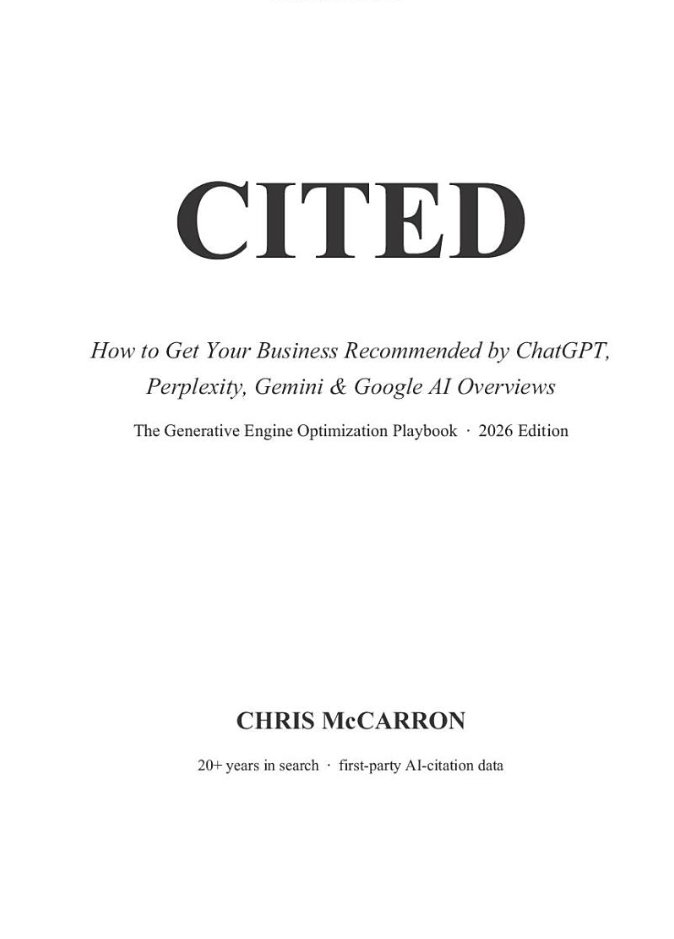
Read Chapter 1 of CITED, free.
The playbook for getting your business recommended by ChatGPT and AI search. Read the first chapter, on me.
Read Chapter 1 freeWant us to do this for your site?
Book a free AI audit. 15 minutes. We’ll show you three things your site is missing and what we’d test first.
Book my free AI audit →