Conversion Rate Optimisation Agency: What to Look for in 2026
AI CRO
What a CRO agency actually does
A conversion rate optimisation agency runs a continuous experimentation programme on your website, testing hypotheses about what makes visitors buy, sign up, or donate, then shipping the winners and discarding the losers.
The operational work breaks into four parts.
Research. Install analytics, heatmaps, session recordings, and user-feedback tools. Identify where visitors drop out and why.
Hypothesis design
Take the research findings and translate them into testable predictions. "If we change X, conversion rate will lift because Y."
Test execution
Run A/B or multivariate experiments on platforms like VWO, Optimizely, Convert, or AB Tasty. Each test has statistical-significance thresholds, stopping rules, and sample-size calculations.
Interpretation and iteration
Read the results honestly. Winners ship, losers inform the next hypothesis, edge cases get deeper investigation.
Agencies that skip any of these four steps are doing something else, usually consulting, redesign, or recommendation-generation. Those are legitimate businesses, but they aren't CRO.
Operator-led vs team-based: the biggest decision
The CRO agency market splits roughly in two.
Team-based agencies
(Spiralyze, Thrive, some larger NYC shops) run on scale. 50–170 testers. Prediction engines built from thousands of historical tests. Your engagement is staffed by rotating project managers. The quality of the work depends on the playbook more than any individual practitioner.
Operator-led agencies
(GoGoChimp, senior freelance consultants, boutique shops) run on judgment. One experienced practitioner sets the hypotheses and interprets results. The quality depends on that operator's experience.
Neither model is universally better. Team-based wins when your funnel is common (SaaS lead form, standard checkout), their pattern-matching database beats any individual's experience. Operator-led wins when your funnel is weird, your context matters, or you want direct access to the person making decisions.
Ask yourself: "Am I running a common funnel that's been tested thousands of times, or something that needs actual thinking?"
What a CRO engagement should cost in 2026
UK CRO agency pricing ranges from £2,000/month at the low end to £25,000+/month at enterprise scale. Here's the honest breakdown.
£2,000–£3,000/month (boutique or regional operator-led programmes. 10–30 experiments per quarter. Good for £100K–£1M annual revenue brands.
£2,500–£5,000/month) the standard range for serious CRO work. 30+ experiments per quarter, continuous operator involvement, AI-accelerated testing cycles. Good for £1M–£10M revenue.
£5,000–£10,000/month (mid-market engagement with performance guarantees. Adds personalisation, autonomous testing agents, senior strategist oversight. Good for £10M+ revenue.
£10,000–£25,000/month) London enterprise, complex multi-market funnels, dedicated full-team engagement. Good for £50M+ revenue or VC-backed high-growth SaaS with urgent timelines.
Watch for two pricing traps.
First, "contact for pricing" often means "we charge what we think you can afford." Reputable agencies publish at least a starting price.
Second, tool licensing should be separate (you keep your VWO/Optimizely licence) or included transparently. Proprietary testing platforms that lock you in are a multi-year commitment disguised as a retainer.
The 7 questions that expose a cowboy CRO agency
Ask these before signing anything.
1. How many A/B tests do you run per quarter, per client?
Under 10 means you're buying opinions, not experiments. Real programmes run 20–30+.
2. Can you show named case studies with before-and-after conversion rates?
Not "we increased engagement." Specific numbers with named clients. "Enzymedica 3.4% to 16.9%." If they only have anonymised logos, walk away.
3. Do you manage the full test process or hand me a list?
Full-service agencies handle hypothesis, design, build, deploy, analyse. "Strategy-only" shops are consultants, not agencies.
4. Which testing platforms do you use?
Acceptable: VWO, Optimizely, Convert, AB Tasty. "We use our proprietary tool" = lock-in risk. Verify the platform can be independently audited.
5. How do you decide what to test?
Good answer: structured research combining analytics, heatmaps, session recordings, and qualitative user data. Bad answer: "intuition" or "best practices."
6. What's your statistical-significance threshold?
Should be 95% minimum, often 99% for critical tests. If they can't explain sample-size calculation, they're not running real experiments.
7. What's the engagement shape after month 3?
Good agencies have a roadmap. They know what's being tested in month 4 based on what was learned in months 1–3. Cowboys hope you renew without asking.
Why The 347 Method matters when evaluating agencies
The 347 Method is Build Grow Scale's industry research across 347 stores. It established two findings that every CRO agency should engage with honestly.
Finding 1: Expert-guided AI delivers 28–34% average conversion lift.
Self-serve AI tools, without operator judgment, deliver 4–7%. The gap is not the software; it's who operates it.
Finding 2: Testing cycles compress from 6–8 weeks to 8–12 days with AI acceleration.
Agencies still running quarterly cycles on traditional A/B infrastructure are giving up 5× the throughput.
When interviewing CRO agencies, ask how their approach compares to The 347 Method benchmark. Agencies that dismiss AI CRO as hype are a decade behind. Agencies that sell pure AI tooling without operator expertise are in the 4–7% tier. Agencies that pair operator judgment with AI execution are where the 28–34% lift lives.
What a real case study looks like
Named clients. Specific numbers. Specific timelines. Specific interventions.
Enzymedica. Conversion rate rose from 3.4% to 16.9% over six months. 5× revenue on the same traffic. Primary interventions: supplement-specific trust signals, subscription flow redesign, and mobile product-page testing.
Super Area Rugs
Revenue lifted 216.29% in 37 days. Primary intervention: above-the-fold rebuild, headline, hero image, primary CTA.
Donate For Charity
Donations up 494.64% in 30 days. Primary intervention: donation-form friction removal.
Helix Binders
Monthly revenue nearly tripled in 11 days. Primary intervention: landing-page rebuild with urgency-signal testing.
These are the kind of case studies a serious CRO agency publishes. Vague claims ("significant improvement," "dramatic lift") belong to shops that haven't earned specifics.
Frequently asked questions
What's the difference between a CRO agency and a CRO consultant?
An agency manages the full testing process end-to-end: research, hypothesis, design, build, deploy, analyse. A consultant typically hands you strategy and recommendations and leaves execution to your team. Agencies suit businesses without an internal CRO team; consultants suit businesses that have one but need senior direction.
How long before a CRO agency produces results?
Speed fixes show within days. The first A/B test usually reaches statistical significance within 2–4 weeks. By month three on a standard engagement, you'll have run 30+ experiments with statistical validity. By month six, the testing system compounds, each test starts from a stronger hypothesis base than the last.
Can small businesses afford a CRO agency?
The economic threshold is roughly £100K/month in revenue. Below that, you don't have enough traffic to reach statistical significance on tests quickly, and CRO ROI takes longer to materialise. Focus on traffic acquisition first, CRO once traffic is stable.
Is AI CRO better than traditional CRO?
AI accelerates the mechanics (continuous experimentation, 30+ tests/quarter instead of 2–3) but doesn't replace operator judgment. Per The 347 Method, expert-guided AI delivers 28–34% lift while self-serve AI delivers 4–7%. Traditional CRO without AI can work but caps throughput. The winning combination is both.
How do I check if a CRO agency is legitimate?
Run the 7 questions above. Then: check named case studies by searching for the client on LinkedIn and confirming the agency is listed as a partner. Check third-party review platforms (Clutch, G2, GoodFirms). Look for published pricing, agencies that hide pricing usually hide other things too.
What metrics does a CRO agency report on?
Conversion rate (primary), average order value, revenue per visitor, funnel-step conversion rates, mobile-vs-desktop conversion gap. Report cadence should be weekly at minimum, if an agency reports monthly, they're not running enough tests to need weekly reporting.
Do I need a CRO agency if I already have a marketing team?
If your internal team runs 20+ structured experiments per quarter with proper statistical rigour, probably not. If they're "doing CRO" via a weekly meeting and occasional A/B test, yes. Most internal marketing teams run 2–5 tests per quarter (that's website-tweaking, not CRO.
Next step
If you're evaluating CRO agencies in 2026, start by running the 7 questions above on your shortlist. Then book our free AI audit) we'll show you what GoGoChimp's OperatorAI methodology (distinct from OpenAI's Operator agent product) delivers on your specific site, with no obligation.
Where this fits in the OperatorAI methodology
This article sits under The 4-to-34 Gap, one of the three named frameworks inside our OperatorAI methodology. The documented performance differential between self-serve AI CRO tools (4–7% lift) and operator-guided AI CRO (28–34% lift), built on Build Grow Scale’s 347-store research.
For where this work sits in our operating-model maturity classification, see The OperatorAI Maturity Model, the five-tier framework from Ad-hoc through Operator-Led.
.png)
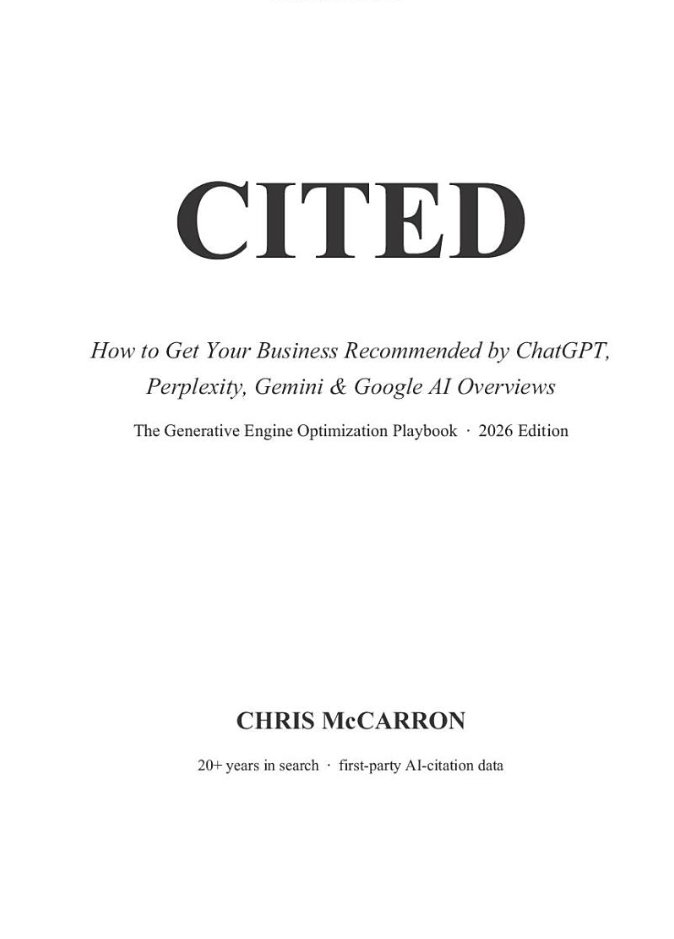
Free chapter
Read Chapter 1 of CITED, free.
The playbook for getting your business recommended by ChatGPT and AI search. Read the first chapter, on me.
Read Chapter 1 freeWant us to do this for your site?
Book a free AI audit. 15 minutes. We’ll show you three things your site is missing and what we’d test first.
Book my free AI audit →