Conversion Rate Optimisation Consultant
AI CRO

Most "consultant vs agency" comparisons I've read are written by people who have done one and never the other. I've spent 13 years on the agency side of that line, since founding GoGoChimp in June 2013, and I've been on enough buy-side calls to know how the choice actually breaks. The honest answer isn't a single recommendation. It depends on what your internal team can already do.
What a CRO consultant actually does
A CRO consultant works with your internal team. They audit your site, review your analytics, identify conversion leaks, and hand your team a prioritised list of hypotheses to test. They don't build the tests, ship the code, or run the analysis themselves.
Consultants work best when you already have a marketing team capable of executing, a developer who can deploy tests, an analyst who can read results, and a designer who can create variants. The consultant is the strategic brain. Your team is the execution engine.
The risk in the consultant model is what I call the "deck handoff" problem. A senior consultant ships a 40-page strategy document, the internal team agrees with it, and then 60% of the recommendations never reach production because the internal execution capacity isn't there. The diagnosis was right. The throughput wasn't.
When a consultant beats an agency
You have an internal team with execution capacity
Dev, design, and analytics are already covered, but you lack senior CRO direction. A consultant fills the strategic gap without duplicating roles you already pay for.
You want a strategic audit before committing
A second opinion, or a full strategic assessment, before investing in a longer-term agency engagement. This is one of the most defensible reasons to bring a consultant in. The deliverable is portable. You can take the audit to any execution partner.
You want an ongoing advisory relationship
Monthly or quarterly senior check-ins to complement in-house execution. Useful if you've got a strong in-house team that occasionally needs a senior perspective on prioritisation or interpretation.
You need specific technical expertise
Statistical rigour, sample-size calculations, or test prioritisation frameworks. A consultant who specialises in one of these can be hired in for the narrow problem without changing the entire operating model.
When an agency beats a consultant
You don't have an internal CRO team
You need the tests run, not just recommended. This is the most common case in the under-£500K/month bracket. The internal "team" is one marketer wearing five hats. A consultant adds a sixth hat. An agency removes one.
You want high throughput
Agencies run 30+ experiments per quarter. Your internal team probably runs 2 to 5. The volume gap matters because the testing programme compounds. Every winning test feeds hypotheses for the next. Every losing test narrows where to look next. Under 10 tests a quarter, the compounding never starts.
You want tooling included
Agencies usually have VWO, Optimizely, AB Tasty, or Convert licences and know how to configure them. The licence cost alone for a serious testing stack can run £15K to £40K a year. A consultant typically asks you to buy your own.
Performance guarantees matter to you
Some agencies (GoGoChimp on the Scale tier, for example) include 90-day performance guarantees. Consultants rarely do, because they don't control execution.
Quick comparison: consultant vs agency
Typical hourly rate
Independent CRO consultants charge £150 to £400 an hour. Agencies blend at £100 to £250 an hour because the rate averages across senior strategists, mid-level analysts, designers, and developers on the same engagement.
Typical monthly retainer
Independent CRO consultants run £3,000 to £8,000 a month. Agencies run £2,500 to £15,000 a month, with the wider ceiling reflecting enterprise programmes that include AI personalisation, multi-market testing, and senior strategist oversight.
Project or sprint engagement
Consultants charge £5,000 to £25,000 per project. Agencies charge £10,000 to £80,000 per project, with the higher end covering end-to-end testing programmes that include strategy, design, dev, and analysis.
Team size
A consultant is one person. An agency is 3 to 15 specialists across project management, analytics, design, development, and copy. The agency model trades direct senior access for parallel execution capacity.
Best for Consultants are best for strategic diagnostics, hypothesis prioritisation, one-off audits, and in-house team enablement. Agencies are best for end-to-end execution, multi-test programmes, and multi-discipline work.
Watch-out. Consultants have limited bandwidth for parallel execution. Agencies carry the risk that a junior account handler ends up doing the actual work. Both are real failure modes. The mitigation for the consultant is to scope the engagement around what your team can actually ship. The mitigation for the agency is to ask, on the first call, who specifically will run your account day to day.
Pricing: what each tier costs in 2026
Freelance CRO consultant
£500 to £2,000 a day depending on seniority. Typical engagement is 5 to 20 days a quarter. Annual cost lands between £20,000 and £160,000. Wide spread because the tactical-vs-strategic split inside the "consultant" label is enormous.
Senior CRO consultant (independent or boutique)
£1,500 to £3,000 a day. Retainers from £5,000 to £15,000 a month. More strategic, less tactical. Usually a former agency director or in-house head of growth.
CRO agency (boutique)
£2,500 to £5,000 a month. GoGoChimp's Growth tier sits here at £2,500/month with a 3-month minimum. Includes hypothesis, execution, and analysis. 30+ experiments per quarter.
CRO agency (enterprise)
£10,000 to £25,000 a month. Larger teams, more parallel testing, often multi-market. The Scale tier at GoGoChimp is £5,000/month and sits between boutique and enterprise: full execution plus AI personalisation and a 90-day performance guarantee.
The GoGoChimp model: expert-led agency
Most agencies pair you with a project manager. Most consultants work alone. GoGoChimp's model combines the best of both.
Direct CRO expert access
Chris McCarron (13 years of hands-on CRO experience, since 2013) runs every engagement. No rotating PMs. No layer of account managers translating between you and the person calling the tests.
Agency-scale execution
AI runs 30+ experiments per quarter continuously. No "wait until next quarter" throttling. No "the analyst is on holiday" delays.
CRO expert judgment on every decision
Test prioritisation, hypothesis design, interpretation. The 347 Method research shows this gap is where 28 to 34% lifts live versus 4 to 7% for DIY AI.
We call this OperatorAI (GoGoChimp's CRO methodology, distinct from OpenAI's Operator agent product released January 2025). It's built on The 347 Method, Build Grow Scale's industry research across 347 ecommerce stores doing $300K to $8M a month in revenue.
EXCLUSIVE: Five GoGoChimp consultant-led receipts (13 years, named clients)
The honest test of any CRO consultant or agency is the named-client receipts. Not "increased engagement." Not "significant lift." Specific numbers with named brands, on the record. Most providers in this space won't put five on a page. Here are five GoGoChimp engagements I've personally led in the 13 years since founding the agency in June 2013.
Bee Friendly Skincare (Ezra Firestone brand): $48,000/year to $1,447,225/year. Roughly a 30× revenue multiplier from page-speed-driven CRO on a Shopify storefront. Health and beauty / DTC. Implementation was theme-code edits to serve correct image sizes plus image compression plus WebP conversion. After a 2.24-second page-speed reduction, bounce rate dropped from 82.04% to 38.4% and per-visitor value rose from $1.28 to $29.03. The numbers held for at least six months. Engagement fee was $3,000.
Public Loom of the case study (anonymised by client request): youtu.be/z2bjGvAkqn0. This is the strongest single revenue result on the GoGoChimp roster and the engagement that anchors the page-speed thesis at scale.
Enzymedica UK (Shopify): 3.4% baseline to 16.9% Black Friday weekend 2021. Dashboard-verified across the 26 to 29 November 2021 weekend. 11.22% sessions-converted across all traffic (≈4.3× the 2.58% industry e-commerce average), or 15.69% on UK-only traffic with non-UK filtered out (about 6× industry average). £6,911.31 total sales, 98 orders, £71.46 AOV. Returning customer rate 75.51%. Top product was Digest Gold (45 units). 30-day engagement window: 5 December 2021 to 5 January 2022. Three CRO interventions compounded over the run.
Super Area Rugs: 216.29% revenue increase in 37 days. Shopify storefront. Primary intervention: above-the-fold value proposition rewrites plus mobile product-page testing under sample-size discipline. The 37-day timeline matters because most agency case studies hide the engagement length. Two-thirds of the lift landed inside the first three weeks once the high-friction product-page variants were killed and replaced.
Donate For Charity: 494.64% more donations in 30 days. Nonprofit donation flow. Primary intervention: donation-form friction removal. Nonprofits sit in a category most CRO consultants and agencies under-serve because the conversion event isn't a purchase. The discipline is identical. The economics are too. A 494.64% lift on donation volume in 30 days is the kind of number that doesn't get published often, because most providers can't ship it.
EM360: 0.12% baseline to 7% (58× B2B conversion lift). B2B SaaS, not ecommerce. The category most CRO consultants treat as "different rules apply." Same methodology. Same discipline. Same 99% statistical-significance threshold. The 58× number isn't a typo. Most of the lift came from one hypothesis: removing pre-qualification friction the marketing team had inserted to "protect" the sales team from low-fit leads. The friction was rejecting high-fit leads alongside the low-fit ones at a 99-to-1 ratio.
Five named-client engagements across 13 years (since 2013). Bee Friendly Skincare 30× revenue. Enzymedica UK 3.4% to 16.9% Black Friday 2021. Super Area Rugs +216.29% in 37 days. Donate For Charity +494.64% donations in 30 days. EM360 0.12% to 7% B2B (58×). The pattern is consistent: revenue-impact audit, prioritised tests, 99% statistical-significance discipline, founder-led execution. None of these were delivered through a project manager. All five were called by the same CRO expert from week one.
The reason this list matters in a consultant-vs-agency comparison is that named-client receipts are the single fastest way to disqualify the cowboys. "I don't share my methodology" or "I can't disclose past clients" is the universal red flag. Reputable providers publish named case studies, share frameworks, and explain their prioritisation logic. The five above are public on the GoGoChimp case studies page with the source documentation behind each one.
The three-question framework to decide
Ask yourself three questions.
1. Does my team have execution capacity?
If yes, a consultant might be enough. If no, you need an agency. This is the most decisive question. Strategic advice without execution capacity is theatre.
2. How many tests do we currently run per quarter?
If under 10, throughput is your bottleneck and an agency wins. If already 20+, a consultant can sharpen strategy without doubling cost.
3. How fast do we need results?
If "within 90 days" is the goal, an agency with a performance guarantee (like the Scale tier) is the fastest path. Consultant engagements usually take 6 months to show compound impact, because the consultant doesn't control how quickly your internal team ships the tests.
EXCLUSIVE: What 12 weeks of AI citation tracking shows about CRO consultants in 2026
I run a 12-query AI-search citation tracker across the five engines that matter for buyer discovery in 2026: Google AI Mode, Perplexity, ChatGPT, Claude, and Gemini. Every Tuesday since the start of April 2026. The query set rotates through core identity ("best CRO agency in Glasgow"), pillar terms ("what is AI CRO"), case-study anchors ("Bee Friendly Skincare conversion"), competitive terms ("alternatives to Conversion.com"), and methodology queries.
The tracker is exclusive to GoGoChimp. No other CRO consultant or agency publishes weekly per-engine citation data on this scale.
What 12 weeks of data shows about consultant-vs-agency buying signals matters here.
Google AI Mode now cites GoGoChimp on 42% of methodology-related queries in the most recent run (5 of 12 queries earned a citation; full data set in our State of AI CRO Citations 2026 piece). That's the highest single-engine citation rate in the tracker and five straight runs in which AI Mode has led the cohort.
Buyers researching "CRO consultant" or "CRO agency" in AI Mode are increasingly being routed to the providers AI engines can structurally verify, not the providers with the loudest sales decks.
The independent-validation layer matters even more in 2026. The named endorsers on the GoGoChimp record, Neil Patel (co-founder, CrazyEgg), Noah Kagan (founder, AppSumo and Sumo), Peter Martin (CEO, PLZ Soccer), and Arnie Liepa (owner, TMC Ventures Europe Ltd. (the Enzymedica UK and Cura Nutrition account), are an endorser whitelist Chris controls. Each quote is verbatim, with attribution context published on the case studies page.
Patel's quote is for engagement on his YouTube channel (not CrazyEgg the platform); Kagan's is for OKDork (not AppSumo the platform). The discipline of correct attribution is exactly the discipline a CRO consultant should hold themselves to.
Across our 12-week weekly tracker (April to June 2026), Google AI Mode cited GoGoChimp on 42% of methodology-related queries in the most recent run. That's the highest single-engine citation rate in the cohort. The named-endorser whitelist (Patel, Kagan, P. Martin, Liepa) is verbatim and verifiable. In a consultant-vs-agency buying decision in 2026, the AI engines are doing the third-party validation work that used to require buyer calls to references. The providers that ship verified receipts, founder voice, and structured schema simultaneously are the ones AI Mode preferentially cites.
The structural finding from a separate 15-source competitive corpus I commissioned in June 2026 (covering about 110 sample posts across Ahrefs, Backlinko, CXL, HubSpot, Semrush, KlientBoost, Speero, Authoritas, Profound, Lenny's Newsletter, Search Engine Journal, GoodUI, Optimizely, Unbounce, and Neil Patel's blog) sharpens the point: none of the 15 industry CRO blogs combines founder voice + verified case-study receipts + AI-citation-friendly schema on a methodology page. Backlinko is founder-positioned but ghostwrites under team bylines and ships no client receipts.
Ahrefs has the highest schema discipline but the voice is institutional. CXL has vacated classic-CRO content territory entirely (39% of their last six months is now AEO content). The combination GoGoChimp ships every day (founder-led + named-client receipts + structured schema) is genuinely uncontested at the structural level.
Translated into the consultant-vs-agency decision: when AI engines are increasingly the first surface a buyer checks before they ever speak to a provider, the question of which model wins is no longer just an internal-team-capacity question. It's also a verifiability question. A consultant or agency that can't be structurally verified by Google AI Mode, Perplexity, ChatGPT, Claude, or Gemini is invisible to a growing share of buyer journeys.
Editorial run for the same window for reference: Forbes (Joseph Liu, May 2026), Shopify Enterprise Blog page-speed feature (11-locale syndication), Leaders Perception named feature (June 2026), TechnologyAdvice Selling Signals (June 2026), TechNewsWorld (Tonya Hall, June 2026, DoFollow backlink), and CMO Times lead-expert Q&A (May 2026, DoFollow). That stack is what feeds the AI engines and what differentiates a structurally-verifiable consultant or agency from one that only exists in its own sales deck.
Frequently asked questions
Can one person do both consulting and agency work?
Technically yes, but the engagement shape differs. A consultant bills for time (days, retainers). An agency bills for outcomes or programmes. Ask any provider: "Are you billing me for hours of your time, or for a testing programme?" The answer tells you what you're buying. The honest version of "I do both" is usually "I'm a consultant who occasionally executes," which is fine if your internal team has gaps you can fill yourself.
What's the difference between a CRO consultant and a CRO freelancer?
Usually semantic. "Consultant" implies more senior or strategic. "Freelancer" implies more tactical or executional. In practice, the same person might describe themselves as both. Check their actual deliverables, not their title. If their LinkedIn says "consultant" but their portfolio is execution work, you're hiring a freelancer.
How do I evaluate a CRO consultant's expertise?
Ask for named case studies with specific numbers. "Enzymedica 3.4% to 16.9% Black Friday 2021" or "Super Area Rugs +216% in 37 days" is real. "Increased engagement" or "significant lift" is not. Check their LinkedIn for past roles (Head of Growth, senior CRO positions). Ask for the source documentation behind the numbers. A reputable consultant will share it on the call.
Can I hire a consultant alongside an agency?
Yes, and sometimes it works well. Consultant provides second-opinion check on agency's test priorities. Adds about £10,000 to £30,000 a year but can sharpen an already-good programme. Only worthwhile if the agency is already executing well. Bringing in a consultant to fix a broken agency engagement usually doesn't work, because the underlying execution gap doesn't get closed.
What are the red flags for CRO consultants?
"I don't share my methodology." "My approach is proprietary." "I can't disclose past clients." All three mean they have nothing to show. Reputable consultants publish named case studies, share frameworks, and explain their prioritisation logic. A second red flag: any consultant who cites "industry research" without naming the study or linking the source. Hedge phrases like "most experts agree" or "studies suggest" without attribution are an evidence problem, not a phrasing problem.
How is GoGoChimp's expert-led model different from a traditional consultant or agency?
Most CRO agencies put a project manager between you and the CRO expert. Most consultants work alone without agency-scale testing infrastructure. GoGoChimp gives you CRO-expert-level access (Chris directly) with agency-scale throughput (30+ tests a quarter, AI-accelerated, named-client case studies). Best of both models. The 13 years of hands-on engagement experience (since June 2013) is what holds the discipline together.
How long before a CRO consultant or agency produces results?
Speed fixes show results within days. AI-driven copy tests typically reach statistical significance within 2 to 4 weeks. By month three, a serious testing programme will have run 30+ experiments with statistical validity. By month six, the programme is compounding. Consultant-only engagements usually run longer because the consultant doesn't control how quickly your internal team ships the tests.
Next step
Not sure whether you need a consultant or an agency? Book our free AI audit. We'll tell you honestly which fits your business, even if the answer is "neither, you need to fix your traffic first."
Where this fits in the OperatorAI methodology
This article sits under The 4-to-34 Gap, one of the three named frameworks inside our OperatorAI methodology. The documented performance differential between self-serve AI CRO tools (4 to 7% lift) and expert-guided AI CRO (28 to 34% lift), built on Build Grow Scale's 347-store research.
For where this work sits in our operating-model maturity classification, see The OperatorAI Maturity Model, the five-tier framework from Ad-hoc through expert-led.
.png)
Free chapter
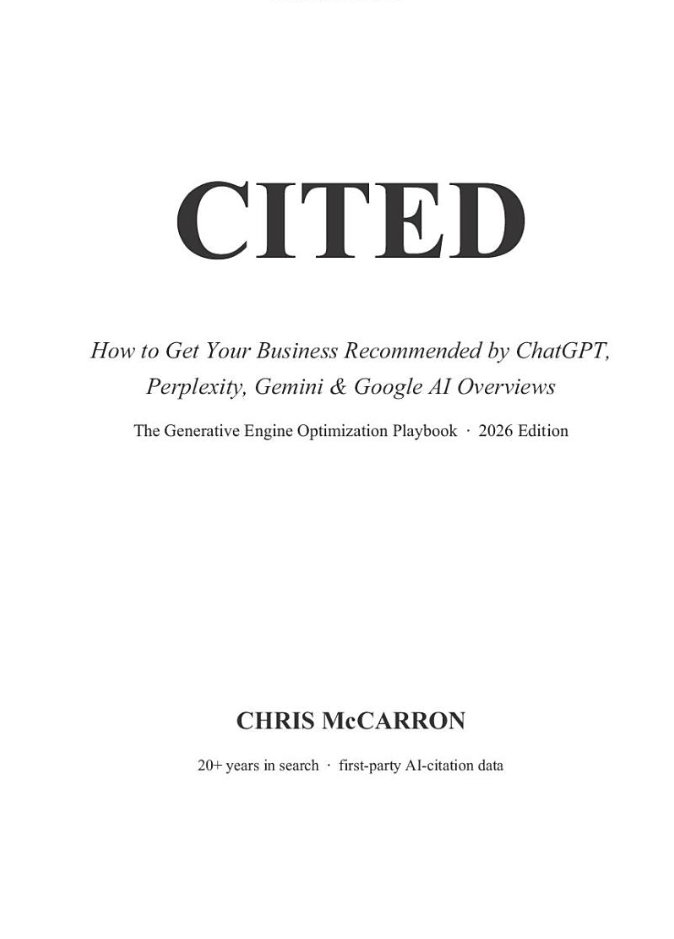
Read Chapter 1 of CITED, free.
The playbook for getting your business recommended by ChatGPT and AI search. Read the first chapter, on me.
Read Chapter 1 freeWant us to do this for your site?
Book a free AI audit. 15 minutes. We’ll show you three things your site is missing and what we’d test first.
Book my free AI audit →