AI CRO vs DIY AI Tools: The 4-7% Trap and the 28-34% Method
AI CRO
DIY AI CRO tools average a 4-7% conversion lift; expert-guided AI CRO averages 28-34% (Build Grow Scale industry research across 347 stores, 2026). The variable is the CRO expert layer between hypothesis, test, and winner call, not the software. Three client receipts prove the 4-to-34 gap.
DIY AI CRO tools average a 4-7% lift; expert-led AI CRO averages 28-34% (Build Grow Scale, 2026). The variable is the CRO expert, not the software.
If you run a single-product Shopify store doing under £100K a month, with one customer type and a checkout you've never had reason to touch, stop reading here. Buy a self-serve AI CRO tool, follow the docs, and you'll get the 4-7% lift the research predicts. That's the right call for you, and the 3,000 words below won't change it.
The rest of this is for the CRO experts. The ones staring at £2M-£50M in revenue, a multi-step funnel, and a conversion rate that won't move no matter how many button-colour tests the autopilot ships.
Here's the number that should bother you. Build Grow Scale's 2026 review of 347 e-commerce stores found that DIY AI CRO tools returned an average lift of 4-7%, while expert-guided AI returned 28-34% (Stafford, 2026). Same category of software. Roughly six times the result.
I've run CRO engagements for 13 years. This post covers what the CRO expert does that the autopilot can't, the three real client receipts that prove it, and the honest line where DIY is genuinely the better buy.
At-a-glance: DIY AI tools vs expert-led AI CRO
| Dimension | DIY AI CRO tools | Expert-led AI CRO |
|---|---|---|
| Typical conversion lift | 4-7% average | 28-34% average |
| Who sets the hypothesis | The algorithm (pattern-matched from templates) | A 13-year CRO expert, per segment |
| Evidence basis | On-page behaviour the tool can see | Customer research, funnel structure, on-page behaviour |
| Significance threshold | 95% default (often "auto-pick a winner") | 99% (GoGoChimp standard) |
| Cost shape | Fixed monthly licence, runs unattended | £2,500 one-off (Sprint) or £2,500-£5,000/month |
| Failure mode | Tests the surface, ships noise as winners | Slower to start; needs the right-fit store |
Lift figures (4-7% DIY vs 28-34% expert-guided) are from Build Grow Scale's 2026 review of 347 e-commerce stores (Stafford, 2026), measured across stores doing $300K-$8M/month. Pricing is GoGoChimp's published tiers. The 99% threshold is GoGoChimp's testing standard, not an industry norm.
The same AI, two completely different numbers
The headline gap is not subtle. DIY AI CRO tools averaged a 4-7% lift across Build Grow Scale's cohort. Expert-guided AI averaged 28-34%. That's roughly a 6x difference from the same underlying class of software, measured across 347 real stores doing $300K-$8M a month (Stafford, 2026).
Read that again. The AI didn't change.
The hands changed. Build Grow Scale's own framing is blunt: "skilled CRO specialists using AI as a force multiplier saw 28-34% improvements" (Stafford, 2026). The tool is the multiplier. The CRO expert is the number it multiplies.
Build Grow Scale's 2026 review of 347 e-commerce stores found DIY AI tools returned 4-7% lifts while expert-guided AI returned 28-34%. The software is identical in kind. The CRO expert is the variable.
Why does the same software produce such different results?
A DIY tool optimises what it can see: clicks, scrolls, the colour of a button. A CRO expert optimises what the visitor actually came for, which lives in customer interviews, funnel structure, and the gap between what the page says and what the buyer needs to hear. The tool runs the test. The CRO expert decides which test is worth running. That decision is the 6x.
What DIY AI CRO tools actually do well
Let's be fair to the tools, because the honest case for them is real. For a simple store, a self-serve AI CRO platform is genuinely the right buy. It runs unattended, it costs a fixed monthly licence, and it'll find you a 4-7% lift you'd never have found by hand. On a £30K-a-month store, that's money you should take.
The tools are good at high-frequency, low-stakes optimisation. Button copy. Image order. Trust-badge placement. The kind of test where the answer is one of three obvious options and the only question is which.
For a single-product Shopify store under £100K a month, a DIY AI CRO tool is the correct purchase. It'll deliver the 4-7% the research predicts, unattended, for a fixed licence. That's a genuine win.
When is a DIY AI CRO tool the right choice?
When three things are true at once. Your funnel is one or two steps. Your traffic is mostly warm (direct, email, returning). And your catalogue is simple enough that the "best" variant is one of a small set of obvious options. Hit all three and the autopilot earns its licence fee. Most of the decision framework in our CRO agency vs AI tools comparison sits on exactly this boundary.
Why DIY AI CRO tools cap out at 4-7%
The ceiling isn't a software limit. It's a thinking limit. A DIY tool tests the surface of the page because the surface is all it can see. It can't interview your customers, it can't read your funnel as a sequence, and it can't tell the difference between a winner and a coin-flip that happened to land heads.
Three failure modes cap the autopilot at 4-7%.
Why does the autopilot ship "winners" that don't hold?
Most DIY tools call winners at 95% significance, and many auto-pick the moment a variant edges ahead. That's the peeking problem, and it's been formally documented: continuously monitoring a test and stopping when it looks significant inflates your false-positive rate badly (Johari, Pekelis & Walsh, 2017). The tool reports a win. Next month the "win" evaporates. You never find out why because the tool already moved on.
GoGoChimp calls winners at 99%. Stricter threshold, fewer rolled-back winners, results that hold.
Why can't a DIY tool fix a broken funnel?
Because it tests pages, not sequences. If your drop-off is between step two and step three of a checkout, a tool optimising the product page is polishing the wrong room. Cart abandonment averages 70.19% across 50 studies, and the top reasons (unexpected costs, a checkout that's too long) are structural, not cosmetic (Baymard Institute, 2026). A button-colour test never touches them.
Why does message-match beat the autopilot?
Cold paid traffic arrives with no context. The autopilot tests the landing page in isolation. It can't see that the ad promised one thing and the page says another. A CRO expert reads the ad, reads the page, and closes the gap. The median landing page converts at 6.6% (Unbounce, 2024); the ones that beat it match the message the visitor arrived expecting.
DIY tools test the surface, not the structure. They optimise the button while the funnel leaks at step three. That's the difference between a 4-7% lift and a stalled conversion rate wearing a "winner" badge.
What the CRO expert layer adds (the 28-34%)
The CRO expert layer is the 24 points of conversion lift that sit between 4-7% and 28-34%. It's hypothesis selection, structural diagnosis, and disciplined winner-calling. None of it is software. All of it is judgement, applied through software.
This is what OperatorAI (GoGoChimp's CRO methodology, distinct from OpenAI's Operator agent product released January 2025) is built to do. The AI runs the experiments at scale. The CRO expert decides which experiments are worth running, reads the funnel as a structure, and calls winners only at 99% significance.
We ship 30+ A/B experiments per quarter per client, and every one of them is tied to a revenue hypothesis a human chose. The leverage is real: personalised CTAs convert 202% better than generic ones (HubSpot), but only a CRO expert can decide which segment gets which message.
The CRO expert layer is roughly 24 points of conversion lift. It's hypothesis selection, funnel-structure diagnosis, and 99% significance discipline. The AI executes it. It doesn't generate it.
What does a CRO expert do that the AI can't?
Three things. First, they decide what to test, drawn from customer research the tool can't conduct. Second, they read the funnel as a sequence and find the structural leak, not just the cosmetic one. Third, they refuse to ship a winner until it clears 99% significance, which kills the false positives the autopilot happily reports. The full method is in our complete guide to AI-powered conversion rate optimisation.
Neil Patel, co-founder of CrazyEgg, put it plainly after we worked on his channel:
"There's few agencies that can do what GoGoChimp achieve. I really appreciate everything you've done to grow my business."
Now the receipts.
Receipt #1: Enzymedica went from 3.4% to 16.9%
Enzymedica UK sold supplements on Shopify and converted at a 3.4% baseline. We ran an expert-led AI CRO engagement across the 2021 Black Friday window. Conversion hit 16.9% on the weekend, and held around 11% through December, which is one of the worst months of the year for health supplements. No DIY tool gets you there.
The 11% number is the one that matters. It's roughly twice the DIY ceiling of 4-7%, and it landed in low season, not a promo spike. Three compounded CRO wins drove it, each one a hypothesis a human set after looking at how UK supplement buyers actually behaved. You can see the full Enzymedica conversion case study on the case studies page.
Enzymedica UK ran at 3.4% baseline. Expert-led AI CRO took it to 16.9% on Black Friday 2021 and held around 11% through December. The sustained number is twice the entire DIY ceiling, in the worst month of the year.
Could a DIY tool have produced the Enzymedica result?
No, and the reason is structural. The 11% sustained lift came from per-segment hypotheses: UK-only buyers behaved nothing like the blended traffic the autopilot would have optimised against. A DIY tool finds the lowest common denominator across all visitors. The CRO expert carved the audience into cohorts and tested each one. 71% of consumers now expect personalised interactions (McKinsey, 2024), and a single blended test serves none of them. That's not a feature you can licence.
Arnie Liepa, who owned the TMC Ventures business behind Enzymedica UK, wrote after the final weekend numbers landed:
"It seems to have gone pretty darned well, slightly better than I expected, so thanks to you and Leyla for that. With Gratitude, Arnie."
Receipt #2: Super Area Rugs lifted revenue 216% in 37 days
Super Area Rugs had a hero section trying to sound clever instead of telling the visitor what the company actually sold. We changed that one line. Revenue went up 216.29% in 37 days.
That fix is invisible to an autopilot. A DIY tool can test five versions of a headline, but it can't tell you the headline is solving the wrong problem. The problem wasn't the wording. It was that the page never said, in plain English, what a visitor would get and why it mattered.
Up to 95% of purchase decisions happen in the subconscious (Zaltman, Harvard Business School), so a buyer who doesn't grasp what you sell in the first second is gone before any A/B variant loads. A CRO expert reads the page like a confused first-time buyer. The tool reads it like a grid of elements.
Super Area Rugs lifted revenue 216.29% in 37 days from one hero-positioning fix. The headline stopped being clever and started telling visitors what the company actually sold. No autopilot hypothesises that.
Why couldn't an A/B tool find the Super Area Rugs win?
Because the win required a hypothesis about meaning, not layout. The autopilot's search space is "which of these variants performs best". The CRO expert's search space is "what does this visitor not understand yet, and what would make them understand it". Those are different questions. The 216% Super Area Rugs revenue lift came from the second one. You can read more on how hero positioning drives ecommerce A/B testing wins.
Receipt #3: Donate For Charity got 494.64% more donations
Donate For Charity needed more donations, not more sales. We ran expert-led CRO on the donation funnel and produced 494.64% more donations in 30 days.
Nonprofit funnels are where DIY tools fall apart hardest. They're trained on commerce templates: add-to-cart, checkout, upsell. A donation flow has different psychology, different friction, and different success metrics. The autopilot has no template for "convince someone to give money and get nothing tangible back". A CRO expert who's run donation funnels does.
Donate For Charity produced 494.64% more donations in 30 days. Donation funnels have a psychology DIY tools have no template for. The CRO expert brought one. The tool couldn't.
Do AI CRO tools work for nonprofits?
Rarely, and the reason is training. DIY AI CRO tools pattern-match against e-commerce data, so their default hypotheses assume a buying decision with a product at the end. Donation behaviour doesn't fit that shape. The Donate For Charity donation case study came from a CRO expert applying donation-specific psychology, then using AI to run the experiments at volume. The judgement was human. The execution was machine.
The decision: when DIY is genuinely the right call
I'm not going to pretend the answer is always "hire a CRO expert". For a lot of stores it isn't, and saying otherwise would be the kind of sales-blog dishonesty this whole post exists to push against. The honest line sits around store size, funnel complexity, and traffic temperature.
Here's the qualification.
Should I buy a DIY AI CRO tool or hire a CRO expert?
Buy the DIY tool if most of these are true: under £100K a month in revenue, a one or two-step funnel, mostly warm traffic, and a simple catalogue. You'll get the 4-7% lift, unattended, for a licence fee. That's a good outcome and you shouldn't pay a CRO expert for it.
Hire a CRO expert if most of these are true: over £2M a year in revenue, a multi-step funnel, cold paid traffic, and a conversion rate that's stalled despite tests. At that point the 24-point gap between 4-7% and 28-34% is worth six figures a year, and the CRO expert pays for itself many times over.
The boundary is honest: DIY tools win for small, simple, warm-traffic stores. CRO experts win for larger, multi-step, cold-traffic funnels where 24 points of lift is worth six figures. Pick by your numbers, not by the pitch.
What if I'm in the middle?
Run a Sprint. GoGoChimp's Sprint tier is £2,500 one-off: an AI audit, speed fixes, 10 AI-generated copy tests, and a revenue-impact report. The speed fixes alone earn their keep: every 0.1 seconds of mobile load-speed improvement lifts ecommerce conversion by 8.4% (Google + Deloitte, 2020), and that's a lever no copy-testing autopilot pulls.
It's built for the £1M-£5M store that's outgrowing the autopilot but isn't ready for a monthly engagement. It tells you whether the CRO expert layer would pay off before you commit to it.
FAQ
What's the difference between AI CRO and DIY AI tools?
DIY AI tools are self-serve software that runs tests unattended and averages a 4-7% lift. Expert-led AI CRO pairs the same class of AI with a human who sets hypotheses, diagnoses funnel structure, and calls winners at 99% significance, averaging 28-34% (Build Grow Scale, 2026). The software is similar. The judgement isn't.
Why do DIY AI CRO tools only deliver a 4-7% lift?
They test the surface of a page, not its structure, and they often call winners at 95% significance the moment a variant edges ahead. That "peeking" inflates false positives (Johari et al., 2017), so reported wins don't hold. They also can't conduct customer research or fix sequence-dependent funnel leaks, which is where the larger lifts live.
Is expert-led AI CRO worth it for a small store?
Usually not. If you're under £100K a month with a simple, warm-traffic funnel, a DIY AI CRO tool will get you the 4-7% lift for a fixed licence and that's the right spend. The CRO expert layer pays off above roughly £2M a year, where 24 points of extra lift is worth six figures.
How is OperatorAI different from OpenAI's Operator?
They're unrelated despite the similar name. OperatorAI is GoGoChimp's CRO methodology: CRO-expert-set hypotheses, AI-driven testing, and winner calls at 99% significance. OpenAI's Operator is an autonomous web-browsing agent product released in January 2025. The names collide; the things don't.
Why does GoGoChimp test at 99% significance instead of 95%?
Because 95% with continuous monitoring inflates false positives, and a "winner" that doesn't hold is worse than no test (Johari et al., 2017). The 99% threshold means fewer rolled-back winners and results you can build on. It's stricter than most agencies and most DIY tools default to.
Can AI CRO tools work for nonprofits?
Rarely out of the box. DIY tools are trained on e-commerce templates, so their default hypotheses assume a product at the end of a buying decision. Donation funnels have different psychology. Donate For Charity got 494.64% more donations in 30 days from expert-led CRO, using a donation-specific hypothesis the autopilot couldn't generate.
What does the CRO expert actually add that the AI can't?
Three things: deciding what to test (from customer research the tool can't run), reading the funnel as a sequence to find structural leaks, and refusing to ship a winner below 99% significance. The AI executes 30+ experiments a quarter. The CRO expert chooses which experiments are worth running.
How much does expert-led AI CRO cost?
GoGoChimp publishes three tiers: Sprint at £2,500 one-off, Growth at £2,500/month, and Scale at £5,000/month (see pricing). Sprint suits a £1M-£5M store testing whether the CRO expert layer pays off. Growth and Scale suit larger stores running continuous quarterly experiment programmes.
If your conversion rate is stalled, find out what it's costing you
If you're spending over £10K a month on ads and converting under 2% despite running tests, your problem isn't the software. It's the hypothesis layer the software can't supply. Our free AI audit will show you exactly where your funnel is leaking and what it's costing you, usually within 48 hours.
If you're a single-product store under £100K a month, skip the audit and buy a DIY tool. That's genuinely the right call, and I'd rather tell you that than sell you something you don't need.
References
- Stafford, M. (2026). 2026 CRO Year in Review: What Worked, What Failed, What's Next. Build Grow Scale, 9 April 2026. https://buildgrowscale.com/cro-trends-2026-recap
- Johari, R., Pekelis, L., & Walsh, D. J. (2017). Peeking at A/B Tests: Why it matters, and what to do about it. KDD 2017. https://dl.acm.org/doi/abs/10.1145/3097983.3097992
- Baymard Institute. (2026). Cart Abandonment Rate (50-study meta-analysis). https://baymard.com/lists/cart-abandonment-rate
- Unbounce. (2024). Conversion Benchmark Report. https://unbounce.com/conversion-rate-optimization/
- McKinsey & Company. (2024). The value of getting personalisation right or wrong matters more than ever. link
- Zaltman, G. How Customers Think: Essential Insights into the Mind of the Market (ZMET research). Harvard Business School. profile
- HubSpot. Personalised calls-to-action convert 202% better than generic CTAs. link
- Google & Deloitte. (2020). Milliseconds Make Millions. link
.png)
Free chapter
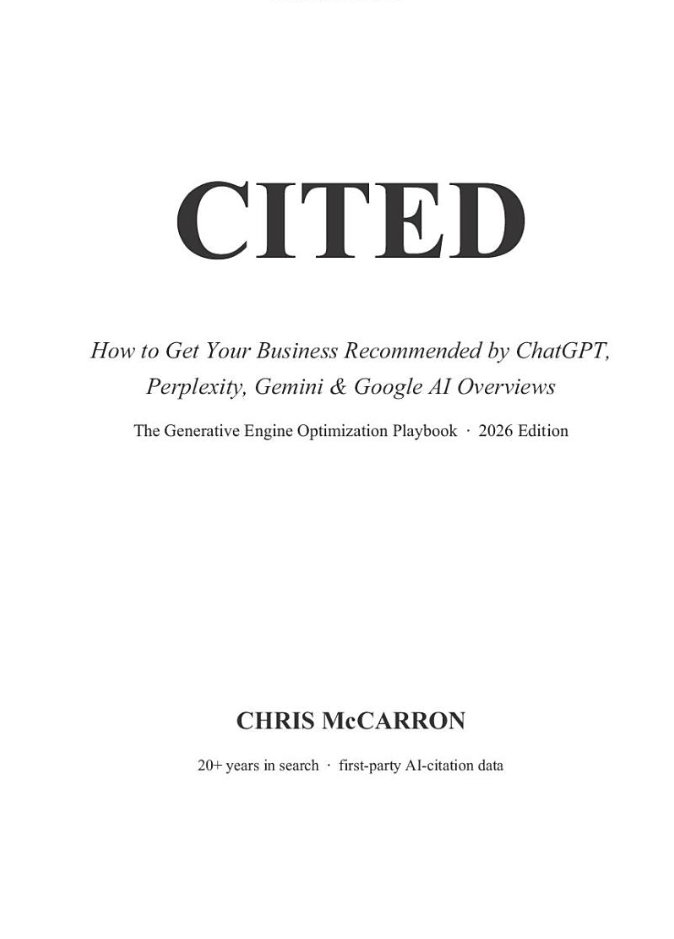
Read Chapter 1 of CITED, free.
The playbook for getting your business recommended by ChatGPT and AI search. Read the first chapter, on me.
Read Chapter 1 freeWant us to do this for your site?
Book a free AI audit. 15 minutes. We’ll show you three things your site is missing and what we’d test first.
Book my free AI audit →