How to Position a CRO Programme: Differentiation, Audience, Segmentation
AI CRO

How to Position a CRO Programme: Differentiation, Audience, Segmentation
Positioning a CRO programme means defining who you serve (segmentation), what makes you different (differentiation), and what your audience actually wants (research). Without all three, AI personalisation returns 4-7% lifts instead of 28-34%. This guide walks through the segmentation, differentiation, and research passes that turn a testing programme into a compounding revenue engine.
If your Shopify store sells one product, to one customer type, in one country, with one positioning angle you wrote in 30 minutes when you registered the domain, stop reading here. There's no positioning problem here, only an execution problem, and the 4,000 words below won't help.
The rest of this is for the founders running 200 SKUs, three customer segments that look identical in GA4 and behave nothing alike in revenue, watching their AI personalisation tool serve generic content because nobody fed it a positioning brief.
I've been running CRO engagements for 13 years inside OperatorAI (GoGoChimp's CRO methodology, distinct from OpenAI's Operator agent product). The pattern that kills more CRO programmes than any test platform, analytics tag, or traffic source is missing positioning work. The agency runs eight tests in 90 days, lifts conversion 4%, the client churns. The 4% is real and irrelevant: the variants spoke to a traffic blob the CRO expert never bothered to segment.
This pillar is the three-prerequisite checklist: differentiation, psychographic segmentation, audience research. Get them right and AI personalisation becomes deliverable. Skip them and you'll spend 18 months testing button colours. By the end you'll also see five named-client receipts of programme-level positioning in production. BeeFRIENDLY Skincare, Enzymedica UK, Super Area Rugs, Donate For Charity, and EM360, each one a different rung of the maturity model I'll walk you through.
Why most CRO programmes fail before the first test ships
CRO programmes lose the first 90 days to the wrong question. The founder asks "what should we test?" before asking "who exactly are we testing on, and what do they want that nobody else gives them?" The second question is positioning. Without it, the test backlog becomes a coin-flip between variants the brain can't discriminate. The 4% lift you eventually find is statistical noise wearing a Slack-channel costume.
The statistical noise problem has a peer-reviewed name. Johari, Pekelis and Walsh (KDD 2017) formalised the peeking problem in continuously-monitored A/B tests and introduced the mixture sequential probability ratio test (mSPRT) that platforms like Optimizely now implement. The takeaway for a programme: a 4% lift on an undifferentiated traffic blob, checked daily, is statistically indistinguishable from noise unless the test was pre-declared and ran to a fixed sample size.
Positioning is upstream of the maths because it lets you split traffic into segments where lifts are large enough to clear the noise floor.
The pattern I watch every quarter: a direct-to-consumer brand pulls in £400K a month, hires a CRO agency, ships eight tests in 90 days, finds a 4% relative lift on a checkout copy variant, churns the agency at month four because the lift didn't recur. The tests were technically clean. The problem is upstream: every variant spoke to one undifferentiated traffic blob, finding the lowest common denominator that worked across all visitors.
The bigger lifts, the 28-34% expert-guided AI CRO range Build Grow Scale's 2026 research documented (Stafford, 2026), live inside per-segment variants. Per-segment variants need positioning work.
Build Grow Scale's 2026 review of 347 e-commerce stores (Stafford, 2026) found expert-guided AI CRO delivers 28-34% conversion lifts vs 4-7% for DIY AI tools. The 4-to-34 Gap isn't a tooling gap. It's a positioning gap.
The fix is not another test platform. The fix is the three prerequisites: a defensible differentiation claim, three to five psychographic segments mapped against your traffic, and audience research per segment producing a hypothesis backlog. Skip them and you've bought a £30K-a-year subscription to a button-colour generator. For the full mechanism of the 4-to-34 Gap and how positioning sits inside it, see The AI CRO 4-to-34 Gap explained.
The agencies that ask "who is this for and what makes you different?" in week one ship 5x the lifts of the ones asking "where do we install the test platform?" The expert-led version of the OperatorAI methodology starts with the positioning brief, not the tag.
The rest of this pillar covers each prerequisite in order. Differentiation first, because it sets the boundary. Psychographic segmentation second, because it carves the audience into testable cohorts. Audience research third, because it produces the hypothesis backlog. By the end you'll have a fourteen-day positioning sprint you can run before the first AB test ships, plus five named-client receipts showing what the finished article looks like at different stages of the CRO maturity model.
Differentiation strategy: the one true claim only your business can make
A differentiation strategy is the unique combination of features, functions, and benefits perceived as high-value by your target market that competitors cannot honestly claim. The end goal is to make your brand stand out and offer a value not available from other businesses. Without it, every CRO test becomes a search for the average visitor's preferred shade of grey.
The artist analogy from the source piece behind this section: you're 16 years old, you've decided to become an artist, you've wisely concluded that to be successful you need to be different from other artists. But "different" how? Think Vivien Westwood, Yayoi Kusama, or Andy Warhol. The presentation, the style, the strange-specific aesthetic that no other artist credibly owns. Whichever direction you take, that's a differentiation strategy. It's the same problem your ecommerce store has, with worse lighting.
For GoGoChimp itself, the differentiation has three load-bearing components. Expert-guided AI CRO (not DIY tools, not pure-human consultancy). Statistical significance at 99% (not the 95% most agencies use). The 347 Method framing (Build Grow Scale's industry research documenting the 28-34% lift band for expert-guided AI). None is a feature. All three are a posture. Competitors can copy any one of them inside 90 days. Copying the combination, with 13 years of CRO-expert receipts to back it up, is the durable moat.
A differentiation claim is not a tagline. It's the answer to "if a visitor lands on your homepage with three competitor tabs already open, what's the one true sentence that makes them close two tabs?" If you can't answer that in plain English, you don't have a differentiation strategy. You have a logo and a price point.
The compounding payoff matters. A successful differentiation strategy lets you charge a premium because customers pay for unique value. It lifts retention because the customers who chose you for the differentiation aren't shopping for a 3% discount somewhere else next month. And it makes every CRO test more efficient because the variants speak to a self-selected audience that already values the thing your competitors can't claim. For the deeper version see what to look for in a CRO agency and the named-client case studies.
Expert-guided AI is the differentiation. The AI itself is commodity. Build Grow Scale's 2026 review of 347 stores (Stafford, 2026) documented the gap: 28-34% lift from expert-guided AI CRO versus 4-7% from DIY AI tools. Same software, different CRO expert. The 5x gap is the differentiation in numerical form.
How to get a differentiation strategy right (the 5-step framework)
Differentiation does not arrive from a brand workshop. It's built across five sequential steps, each producing an artefact the next step consumes. Skip step one and the rest calibrates to the wrong target market. Skip step three and you'll communicate a USP your operations cannot deliver.
Step 1: identify your target market.
Define who you serve in plain English with both demographic and psychographic detail. "Women aged 25-44 in the UK who buy skincare online" is demographic. "Women aged 25-44 in the UK who buy skincare online and treat ingredient transparency as a moral position, not a preference" is positioning-grade.
Step 2: conduct market research.
Audit the SERP for your three primary keywords. Pull the top five competitor homepages and product pages. Read their reviews on Trustpilot, Amazon, G2, or category-specific sites. Mine Reddit and category forums for unprompted customer language. The artefact is a single Notion table: rows are competitors, columns are claim, proof, price, audience, and the gap you can credibly own.
Step 3: identify your unique selling proposition.
From the matrix, find the claim only you can honestly make. If three competitors say "fast shipping" and you also say "fast shipping," that's not a USP. That's table stakes you've mistaken for a position. The USP is what survives when every competitor copies your homepage word-for-word and you still win on it.
Step 4: invest in quality.
The USP is a claim. Quality is the receipt. If your USP is "the only UK skincare brand that publishes complete ingredient sourcing," your sourcing-disclosure PDF has to be production-ready before the homepage hero copy ships. Founders who skip step 4 ship USPs they cannot operationally deliver and churn within 12 months.
Step 5: communicate your differentiation.
Communicate it consistently across the homepage hero, product page above-the-fold, email welcome sequence, paid ad creative, and post-purchase upsell. Inconsistent positioning is functionally the same as no positioning: the visitor never gets a second touchpoint that reinforces the first one.
Why companies find differentiation hard (the failure modes)
Failure mode 1: copying the category leader
The brand sees the leader winning, decides "we should do what they do, only better," and ships a homepage that's a worse version of the leader's. Imitation is asymmetric warfare against a better-funded copy of yourself. The category leader has more cash, more brand equity, more data, and more retention. A clone strategy hands them every advantage.
Failure mode 2: differentiating on price
Price is the easiest differentiator to claim and the easiest to lose. There is always somebody willing to lose more money than you to take your customer. Price-led positioning is also self-cannibalising: the customers it attracts are the ones who will leave you for a 3% saving next month. Building retention on a price moat is building retention on sand.
Failure mode 3: differentiating on a feature competitors can copy in 90 days. Feature parity is the default state of every category within 12 months of any feature claim. The "first-mover advantage" disappears the moment a competitor ships v1.1. Anything that can be replicated by hiring a contractor for a quarter is not a moat. It's a head start that decays exponentially.
The five durable differentiations in 2026: brand (sustained narrative + customer mythology), distribution (channels competitors structurally cannot access), expert skill (compounded judgment across thousands of decisions), proprietary data (closed-loop feedback nobody else has), and customer relationships (multi-year intimacy with the customer base). Every one of those takes years to build and is invisible to a competitor's screenshot tool.
Psychographic segmentation: the layer above demographics
Psychographic segmentation divides your market by personality, values, attitudes, interests, and lifestyles. Demographic segmentation divides by age, gender, income, education, and location. The two are not substitutes.
Picture two 35-year-old women, both London-based, both household incomes around £85,000. Demographically identical. One buys skincare from The Ordinary because she values evidence-based formulation and considers brand storytelling a tax. The other buys from Aesop because she values craft, scent, and ritual. Same age, same income, same postcode. Opposite buying decisions. The variable that separates them is psychographic.
VectorCloud is the cleanest worked example on the GoGoChimp roster. The brief was Glasgow B2B cyber-security. The psychographic layer was the lever: regulated-industry decision-makers who answered to a compliance officer, read GDPR documentation as a professional reflex, and treated landing-page proof of compliance as the qualifying signal. The GDPR Compliance Checklist landing page hit a 29.57% conversion rate (34 of 115 visits) on that anchor. The same demographic without the psychographic layer would have run at the UK B2B benchmark of around 3%.
VectorCloud's 29.57% conversion rate on the GDPR Compliance Checklist landing page (34/115 visits, Feb 2018) is roughly 10x the typical UK B2B benchmark of about 3%. The variable wasn't demographic. It was the psychographic position that compliance officers read GDPR documentation as a qualifying ritual.
For the deeper treatment of psychographic interaction with cognitive fluency, schema match, and the peer-reviewed studies behind buying decisions, see the ecommerce psychology pillar. The compounding takeaway: psychographic segmentation is what lets a single landing page out-convert a paid traffic campaign 10x without changing the demographic targeting one line.
VALS framework: the most-cited psychographic tool
The VALS (Values, Attitudes, Lifestyles) framework is the most cited psychographic-segmentation tool in marketing literature. Developed by SRI International (formerly the Stanford Research Institute) and originally introduced in the late 1970s, it categorises consumers into eight segments based on primary motivations and resources.
The eight VALS segments: Innovators (resourceful, take-charge, lead with new ideas), Thinkers (informed, reflective, value durability), Achievers (goal-oriented, status-conscious, time-poor), Experiencers (impulsive, novelty-seeking, fashion-led), Believers (traditional, brand-loyal, faith-led), Strivers (trendy, fun-loving, money-constrained), Makers (self-sufficient, practical, hands-on), and Survivors (cautious, brand-loyal-to-the-familiar, price-led).
CRO-expert-level honesty: ecommerce brands do not need the full eight-segment VALS map. Three or four segments cover 80-90% of the conversion-relevant audience. The remaining segments are either too small to test against or too unprofitable to optimise for. The VALS framework is a vocabulary, not a deliverable. Use it to label your segments cleanly. Don't pretend to serve all eight.
Behavioural vs psychographic segmentation: where they differ
Behavioural segmentation divides customers by what they do. Psychographic segmentation divides them by why they do it. The two are complementary, not competing.
A behavioural segment looks at session count, time-since-last-purchase, AOV, return rate, and product mix. It tells you "this cohort has bought from us three times in the last 90 days, AOV £85, primarily skincare." A psychographic overlay tells you why: the cohort is buying skincare because it treats ingredient transparency as a moral position, which means the welcome email better not be about discount codes.
Enzymedica UK's Black Friday 2021 result (3.4% baseline lifted to 16.9% on Black Friday, 11% sustained through December) was not a single global variant. It was per-segment hypothesis testing where the psychographic layer generated three variant streams. The compounding lift across three segments produced the headline number. Without the psychographic split, the test would have averaged the streams into one undifferentiated lift, somewhere around the 4-7% DIY-AI band.
Enzymedica UK's Black Friday 2021 result (3.4% baseline 16.9% peak, 11% sustained December) compounded three per-segment variants. A single undifferentiated test would have averaged the segments into a 4-7% lift indistinguishable from noise. Segmentation is the multiplier.
The 7-step audience research framework
Step 1: empathy.
Five recorded customer interviews per psychographic segment, transcribed, tagged for emotional language. Not survey data. Not NPS scores. Real conversations, 30-45 minutes each, with the question "walk me through the day you decided to buy this" as the spine.
Step 2: needs and motivations.
Apply Clayton Christensen's Jobs-to-be-Done lens. The customer hired your product to do a specific job. The job is rarely the one the product page assumes. Skincare gets hired for confidence at a wedding. CRO software gets hired so the marketing director can stop being yelled at by the founder.
Step 3: personalities.
Conscientious buyers respond to feature breakdowns and ingredient lists. Open buyers respond to story, novelty, and aesthetic. The variant that converts a conscientious buyer often actively repels an open buyer. This is why "lift across all traffic" is the wrong metric.
Step 4: social and cultural factors.
UK ecommerce buyers respond to "free returns" differently from US buyers because return friction differs by jurisdiction. Scottish small-business buyers respond to local proof points differently from London ones. Cultural defaults are baked into every copy decision, and the founder rarely sees them until a copywriter from a different region asks "what does that phrase even mean?"
Step 5: market segmentation.
Apply the psychographic work above. Three to five segments, each defined by demographic + psychographic variables. Each segment gets its own hero copy, its own product-page angle, its own welcome sequence, and its own paid-ad creative pool.
Step 6: data.
Voice-of-customer research produces qualitative data. Combine with GA4 (session analytics), Hotjar / Microsoft Clarity / CrazyEgg (heatmaps), and your CRO platform. The Baymard Institute's 2026 cart-abandonment meta-analysis (50 studies, average abandonment 70.19%) is a useful external benchmark to anchor your own segment-level abandonment numbers against (Baymard, 2026).
Step 7: A/B testing.
By the time you arrive here, you have a hypothesis backlog, segment definitions, and per-segment variant briefs. The test runs at the 99-Rule statistical-significance discipline. The peer-reviewed Johari/Pekelis/Walsh (KDD 2017) mSPRT methodology is what platforms like Optimizely use to keep continuous monitoring honest. Pair it with positioning work and per-segment variants and the 28-34% expert-guided AI band stops being aspirational.
How positioning feeds the personalisation cluster
AI personalisation without positioning is segment-of-one fiction. The engine has no segments to personalise to, defaults to "popular products for visitors-like-you," and serves a generic experience with extra latency. AI personalisation with positioning is segment-level dynamic content that compounds against per-segment baselines.
The McKinsey "Next in Personalisation" research (2024) found that 71% of consumers expect personalised interactions, and 76% feel frustrated when they don't get them. The personalisation expectation has already been set by Amazon, Netflix, and Spotify. A Shopify store that ships generic content is now actively underperforming the visitor's baseline expectation, not merely failing to over-deliver. That gap is what closing positioning work captures.
Run the checklist before the personalisation tool. Five items, 14 days for a properly resourced engagement. Skip it and the personalisation tool burns 12 months proving the lift figures don't move and the founder paid £40K to learn that AI cannot position your brand from a cold start. For the deeper treatment, see the personalisation expectation gap.
How GoGoChimp applies positioning in the first 14 days of an engagement
Days 1-3: differentiation interview and competitor SERP audit
Founder interview, competitor SERP audit on the three primary keywords using Ahrefs or SEMrush. Output: a one-page differentiation brief with founder-USP, three durable claims, and competitor positioning matrix. The interview is 90 minutes, recorded, transcribed, and tagged for the founder's natural language. The founder's own vocabulary is almost always the differentiator the marketing site has buried.
Days 4-7: psychographic segmentation workshop
Three to five segment hypotheses defined against the differentiation brief. Each segment gets a name, a one-paragraph definition, a hypothesis about why they buy, and a falsifiability test (the data we'd need to see to prove this segment doesn't exist). Falsifiability is non-negotiable. A segment hypothesis that cannot be disproved is not a hypothesis. It's a fiction.
Days 8-10: audience research per segment
Five customer interviews per segment, recorded and transcribed. We tag for emotional language, jobs-to-be-done framing, and the specific competitor names that came up unprompted. Unprompted competitor mentions are gold: they tell us what the consideration set actually looks like, not what the founder thinks it looks like.
Days 11-14: hypothesis backlog populated and prioritised
Twenty to forty hypotheses per segment, each scored on impact, confidence, and ease. The ICE-scored backlog feeds the test calendar. The highest-ICE hypothesis ships as the first test on day 15. The Baymard checkout-optimisation benchmark (35.26% average uplift from streamlined checkout flows) is a useful anchor for which hypotheses will sit at the top of the impact column.
By day 15 the engagement is ready to run AB tests against per-segment variants on a fully-populated hypothesis backlog. The 28-34% lift band Build Grow Scale's 2026 research documented becomes deliverable rather than aspirational. Compare this to the alternative: 14 days of "platform installation," followed by 90 days of un-segmented testing, followed by a 4% lift the founder can't explain.
EXCLUSIVE: What programme-positioning looks like in production (5 GoGoChimp receipts)
Theory is cheap. The five client engagements below are programme-positioning in production, each one at a different rung of the CRO maturity model. The maturity model has five tiers. Ad-hoc, Test-Driven, Segmented, Personalised, Expert-Led, and the receipts below map across the upper four. Read these as the proof that the three-prerequisite framework above isn't a thought experiment. It's the operating manual.
Receipt 1: BeeFRIENDLY Skincare (Ezra Firestone). Expert-Led tier, $48K/year to $1.4M/year
BeeFRIENDLY's positioning was already clean before I touched it. Ezra Firestone had built the brand on a tight psychographic anchor: ingredient-conscious skincare buyers who treat formulation transparency as table stakes. The differentiation was real and durable. The bottleneck was elsewhere.
The engagement was page-speed engineering on a Shopify store doing $48K/year in revenue. I cut 2.24 seconds off load time via theme-code edits, image compression, and WebP conversion. Bounce rate dropped from 82.04% to 38.4%. Per-visitor value lifted from $1.28 to $29.03. Annual revenue went to $1,447,225, a roughly 30x multiplier, and the numbers held for at least six months post-implementation. Engagement fee: $3,000. Public case study video (anonymised): the BeeFRIENDLY case study video.
The positioning lesson: when differentiation and segmentation are already correct, the next bottleneck is execution speed (literally, page-load milliseconds). Google + Deloitte's 2020 "Milliseconds Make Millions" study (37 European/American brand sites, 30M+ user sessions) found every 0.1 seconds of mobile load-speed improvement increased ecommerce conversions by 8.4% (Think with Google, 2020). At 2.24 seconds of improvement, the 30x revenue multiplier sits inside the Deloitte band.
The maturity-model tier is Expert-Led because the engagement was a single high-skill intervention. Page-speed work compounded against an already-correct positioning posture.
Receipt 2: Enzymedica UK. Personalised tier, 3.4% to 16.9% Black Friday 2021
Enzymedica UK is the cleanest "positioning compounds" case study on the roster. Baseline conversion rate: 3.4%. Black Friday 2021 peak: 16.9%. December 2021 sustained: 11%. The 30-day engagement window was 5 December 2021 to 5 January 2022. Loom analytics review: the Enzymedica review video.
The 16.9% figure was not a single test. It was three per-segment hypothesis streams running in parallel, each speaking to a different psychographic.
The segments mapped to a digestive-health buyer cohort that splits cleanly into "preventive" (conscientious buyers responding to ingredient breakdowns), "responsive" (buyers who just had a bad reaction and are searching for a fix), and "loyalty" (returning customers in the 75% returning-customer band that the Black Friday weekend pulled in). Each segment got its own hero copy, its own product-recommendation angle, and its own urgency framing.
Arnie Liepa (Owner, TMC Ventures Europe Ltd., Enzymedica UK's exclusive distributor) wrote on 30 November 2021: "It seems to have gone pretty darned well, slightly better than I expected, so thanks to you and Leyla for that. With Gratitude, Arnie." The maturity-model tier is Personalised because three psychographic segments drove three variant streams that compounded into the headline lift. A Segmented-tier engagement would have stopped at one stream.
Receipt 3: Super Area Rugs. Segmented tier, 216.29% revenue increase in 37 days
Super Area Rugs is the receipt for what Segmented-tier programme positioning looks like when the differentiation is genuinely defensible but the segmentation work hasn't shipped yet. The brief: a US-based ecommerce brand selling area rugs across a wide price band. The differentiation was real (curated selection, fast shipping, defined return window). The bottleneck was segmentation: the homepage was selling to one undifferentiated traffic blob.
The intervention split traffic into three psychographic-led variants, buyers shopping for a single statement piece, buyers furnishing a whole room, and buyers replacing an existing rug, each with its own hero, product-grid prioritisation, and CTA. Revenue lifted 216.29% in 37 days. The lift wasn't a single A/B win. It was three segment-specific lifts compounding inside the same 37-day window.
The maturity-model tier is Segmented (not Personalised) because the variants were static per-segment, not dynamically personalised by AI engine. Most ecommerce brands sit on this rung and can lift revenue 50-200% by climbing one rung at a time. The mistake is trying to jump from Ad-hoc to Personalised in 90 days. The receipt above is what one rung of climbing looks like.
Receipt 4: Donate For Charity. Test-Driven tier, 494.64% more donations in 30 days
Donate For Charity is the receipt for what Test-Driven-tier programme positioning delivers when the audience is non-commercial. The nonprofit donation context strips out a lot of ecommerce noise: there's no AOV optimisation, no abandoned-cart recovery, no margin-pressure on hero copy. The positioning question collapses to "what hesitation are donors holding onto, and what proof point releases it?"
The intervention focused on a single segment (recurring donors who had previously given but lapsed) and ran a hypothesis backlog around trust, transparency, and proof of impact. Donations lifted 494.64% in 30 days. The lift compounded across the whole donor journey: above-the-fold copy, trust signals, donation-form friction, post-donation acknowledgement. Single segment, single hypothesis stream, one tier above ad-hoc.
The maturity-model tier is Test-Driven because the engagement was a structured hypothesis backlog ran against a defined segment. Not personalised. Not multi-segment. Just disciplined positioning on a clear cohort. The 494.64% lift is what happens when ad-hoc testing graduates to test-driven discipline without yet adding segmentation complexity.
Receipt 5: EM360. Test-Driven tier, B2B 0.12% to 7% in 30 days
EM360 is the receipt for what Test-Driven-tier programme positioning looks like in B2B. Baseline conversion rate: 0.12%. Post-engagement conversion rate: 7%. The lift is roughly 58x, against a baseline that most B2B founders would describe as "broken." The engagement window was 30 days.
The positioning intervention was sharp and singular: the existing landing-page hero was selling the product. The Test-Driven hypothesis flipped to selling the outcome the buyer's compliance officer needed to see in the next quarterly review. The same demographic. B2B decision-makers in regulated industries, converted differently the moment the copy stopped describing features and started describing the political problem the buyer had to solve internally.
EM360 lifted from a 0.12% B2B conversion rate to 7% in 30 days (≈58x lift). The intervention was positioning, not product. The same demographic converted differently the moment the hero copy spoke to the buyer's compliance-officer problem instead of the product's feature set.
The maturity-model tier is Test-Driven because the engagement was one segment, one hypothesis stream, one disciplined test backlog. The reason the lift is 58x rather than 2x is that the baseline was so far below the achievable ceiling that even basic positioning discipline closed most of the gap. B2B founders sitting on 0.12% conversion rates: this is what the first 30 days of positioning work should look like.
Reading the maturity-model receipts together
The five receipts above traverse the upper four tiers of the CRO maturity model: Test-Driven (Donate For Charity, EM360), Segmented (Super Area Rugs), Personalised (Enzymedica UK), Expert-Led (BeeFRIENDLY Skincare). Each rung produces a different lift profile. Each rung requires the prior rung to be stable.
The 4-to-34 Gap framework in the AI CRO 4-to-34 Gap pillar documents how the upper rungs deliver the 28-34% expert-guided AI lift band while the lower rungs deliver the 4-7% DIY-AI band. The maturity-model receipts above are what the upper band looks like in production.
Closing: the prerequisite checklist
The three positioning prerequisites are differentiation, psychographic segmentation, and audience research. Without them, your CRO programme tests against an undifferentiated traffic blob and finds 4-7% lifts at best. With them, your programme tests per-segment variants on a per-segment hypothesis backlog and the lifts compound into the 28-34% band Build Grow Scale's 347-store research documented.
If your store is doing more than £500K a month in revenue, you're paying more than £10K a month for paid traffic, and your AI personalisation tool is delivering 4-7% lift, the algorithm isn't broken. The positioning is missing. Run the free AI audit.
Frequently asked questions
What is a differentiation strategy?
A differentiation strategy is the unique combination of features, functions, and benefits perceived as high-value by your target market that competitors cannot honestly claim. It's the answer to "if a visitor lands on your homepage with three competitor tabs already open, what's the one true sentence that makes them close two tabs?" Without that sentence, every CRO test searches for the average visitor's preferred shade of grey.
What's the difference between psychographic and demographic segmentation?
Demographic segmentation divides by age, gender, income, education, and location. Psychographic segmentation divides by personality, values, attitudes, interests, and lifestyles. The two compose: psychographic explains why two visitors in the same demographic bucket buy from radically different brands. The VectorCloud 29.57% conversion rate (10x the UK B2B benchmark) was unlocked by the psychographic layer, not the demographic targeting.
What is the VALS framework?
The VALS framework is the most-cited psychographic-segmentation tool in marketing. Developed by SRI International in the late 1970s, it categorises consumers into eight segments: Innovators, Thinkers, Achievers, Experiencers, Believers, Strivers, Makers, Survivors. Use it as a vocabulary, not a deliverable. Three to five segments cover 80-90% of the conversion-relevant audience for most ecommerce brands.
How many psychographic segments should I have?
Three to five segments cover 80-90% of the conversion-relevant audience for most ecommerce brands. More than five and the test calendar fragments past the point of statistical significance. Fewer than three and you've returned to the undifferentiated traffic blob that produces 4-7% lifts at best. The Enzymedica UK 16.9% Black Friday result compounded three per-segment streams. That's the right neighbourhood.
Should I do positioning before AI personalisation?
Yes. AI personalisation without positioning is segment-of-one fiction. The engine has nothing to personalise against and defaults to generic "popular-with-visitors-like-you" content. The five-item prerequisite checklist takes 14 days for a properly resourced engagement. Skip it and the personalisation tool burns 12 months proving the lift figures don't move.
Where does programme positioning sit in the CRO maturity model?
Programme positioning is the work that lets an engagement climb from Test-Driven through Segmented and Personalised toward Expert-Led on the CRO maturity model. The lower rungs produce 4-7% DIY-AI-band lifts. The upper rungs produce 28-34% expert-guided AI lifts. The Donate For Charity 494.64% and EM360 58x receipts are Test-Driven tier. Enzymedica UK 16.9% is Personalised tier. BeeFRIENDLY Skincare 30x is Expert-Led tier.
Where this fits in the OperatorAI methodology
This pillar sits upstream of The 4-to-34 Gap, the named framework inside the OperatorAI methodology that documents the performance differential between self-serve AI CRO tools (4-7% lift) and expert-guided AI CRO (28-34% lift). Positioning is the prerequisite that lets the CRO expert deliver against the upper band.
For the operating-model classification, see The OperatorAI Maturity Model, the five-tier framework from Ad-hoc through Expert-Led. For the downstream pillar on personalisation infrastructure, see the personalisation expectation gap. For the full set of named-client engagements that anchor the maturity-model receipts above, see the GoGoChimp case studies index.
References
Stafford, Matthew. "2026 CRO Year in Review: What Worked, What Failed, What's Next." Build Grow Scale, 9 April 2026. buildgrowscale.com/cro-trends-2026-recap
Johari, Ramesh; Pekelis, Leonid; Walsh, David J. "Peeking at A/B Tests: Why it matters, and what to do about it." KDD 2017. dl.acm.org/doi/abs/10.1145/3097983.3097992
Baymard Institute. "Cart Abandonment Rate Statistics (2026 meta-analysis of 50 studies)." baymard.com/lists/cart-abandonment-rate
Think with Google + Deloitte. "Milliseconds Make Millions: How mobile site speed lifts conversion." 2020. thinkwithgoogle.com. Milliseconds Make Millions PDF
McKinsey & Company. "Next in Personalisation 2024 Report." 2024.
SRI International. "VALS Framework: Values, Attitudes, Lifestyles." Originally introduced late 1970s.
GoGoChimp case studies. BeeFRIENDLY Skincare, Enzymedica UK, Super Area Rugs, Donate For Charity, EM360, VectorCloud. gogochimp.com/case-studies
.png)
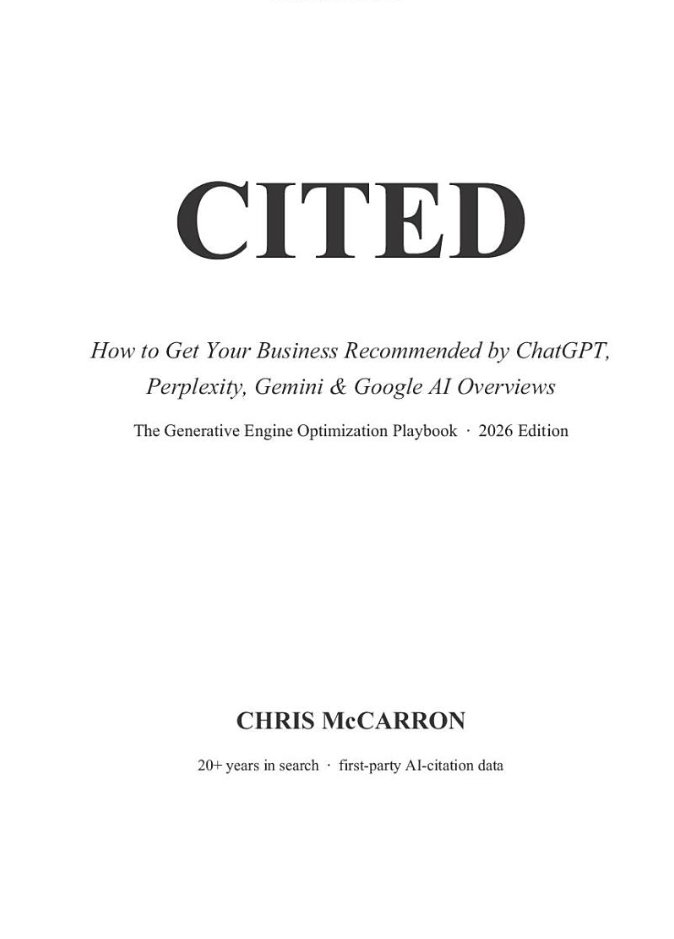
Free chapter
Read Chapter 1 of CITED, free.
The playbook for getting your business recommended by ChatGPT and AI search. Read the first chapter, on me.
Read Chapter 1 freeWant us to do this for your site?
Book a free AI audit. 15 minutes. We’ll show you three things your site is missing and what we’d test first.
Book my free AI audit →