35 Copywriting Frameworks Every Operator Should Know (2026)
AI CRO

If your reaction to copywriting frameworks is the same as your reaction to the boring-but-effective work, yeah I should, but I never quite get round to it, stop reading here. The rest of this is for the CRO experts who already do.
The slot was wrong. Frameworks fix the slot. If you want a list of clever phrases to copy, that is a different post on someone else's blog.
This page is currently the fastest-rising asset in GoGoChimp's Bing Webmaster Tools AI Performance report - impressions climbed 914% and Copilot citations reached 96 across 90 days. That pattern is the leading indicator of a page entering the top-3 citation tier. Read how AI-search retrieval rewards long-form frameworks pages in our GEO pillar.
What the 2026 copywriting data shows
In a 2026 analysis of 12,400 ecommerce landing pages, pages structured around the PAS (Problem-Agitation-Solution) framework converted 22% higher than feature-list pages (Unbounce 2026 Conversion Benchmark Report). Headlines under 11 words outperform longer headlines by 17% on mobile conversion (WordStream 2026). The "But you might be wondering…" objection-handling block has been measured to lift CTR by 28% across 47 SaaS trials (Wynter, 2026).
What is a copywriting framework?
A copywriting framework is a tested structural pattern for persuasive writing that establishes sequence without dictating exact words. Frameworks function like chord progressions in music, providing architecture while you supply product knowledge, audience insights, and proof. (See our conversion copywriting service for full programme delivery.)
Across Build Grow Scale's research on 347 stores, framework-structured copy run through expert-guided AI testing delivered 28-34% conversion lift, compared to 4-7% from DIY tools. The framework gives you the bones. The CRO expert gives you the lift.
I've watched founders agonise for weeks over the verb choice in a headline while ignoring the fact the headline itself is in the wrong slot. Pick the framework first. The words come second.
Why copywriting frameworks make your marketing better
Writers fail by asking "what should I say?" rather than "what does the reader need to hear, in what order?" Frameworks answer the strategic question, so you can focus on execution.
The deeper reason frameworks beat raw inspiration: research from Gerald Zaltman at Harvard Business School puts up to 95% of purchase decisions in the subconscious mind, with the brain processing emotional stimuli roughly 3,000 times faster than rational thought. A framework forces you to land emotion first and reason second, which is the order the buyer's brain actually accepts. Sit down with no framework and you default to features and proof, both of which arrive too late.
Use cases
• Landing page hero and body copy
• Email subject lines and body
• Ad copy (Search, Meta, LinkedIn, X)
• Value propositions and headlines
• Bullet lists and feature grids
• Testimonials
• CTA button text
EXCLUSIVE: Three GoGoChimp copywriting receipts that prove the frameworks work
Every section above this one cites someone else's data. The rest of this guide rests on three GoGoChimp client engagements where the frameworks above were the load-bearing variable. The point of pulling them into one section, rather than scattering them through the text, is that the pattern only becomes visible when you read them next to each other. Same CRO expert. Same testing discipline. Three different framework choices. Three different outcomes.
The frameworks on this page didn't earn their place in a textbook. They earned it on client work. Super Area Rugs +216.29% revenue in 37 days from one hero-banner headline rewrite. Bee Friendly Skincare per-visitor value $1.28 to $29.03 from copy stripped to load-state-survivable size. Donate For Charity +494.64% donations in 30 days from a three-way imagery and copy split. The framework was the scaffolding. The result was real money.
Super Area Rugs: one hero-banner headline rewrite, +216.29% revenue in 37 days
The Super Area Rugs engagement is the cleanest copywriting receipt on the GoGoChimp roster. The full case study lives at our Super Area Rugs case study, but the framework story is worth pulling out separately because it isolates the variable. Revenue lifted 216.29% in 37 days from a single hero-banner change. The product range did not change. The pricing did not change. Traffic mix did not change. One slot moved.
The original hero was the kind of thing I see on roughly four out of five Shopify stores: a generic "elegant rugs for your home" line over a stylised lifestyle shot. It is a Picture slot under the Hoke 4 Ps framework, but the Picture wasn't doing any work. It described a feeling the reader already had. The replacement headline did two things at once.
It named the specific buyer state (room they had already decided to furnish, budget already mentally allocated) and it named the specific product cohort (size + style + price band) the analytics showed was actually selling.
That rewrite is a textbook AIDA-to-PAS substitution. The original was AIDA-Attention pitched at people who weren't paying attention. The rewrite was PAS-Problem pitched at people who already had the problem. Same hero slot. Different framework. 216.29% revenue lift in 37 days.
The lesson generalises. When a hero isn't converting, the default founder reaction is to rewrite the verb. The high-leverage reaction is to ask whether the framework matches the audience state. Cold visitor and you're running AAPPA? That's a 4 Ps Hoke problem masquerading as a copy problem. Warm visitor and you're running PAS? You're agitating someone who already wants to buy. Swap the framework. The verb fixes itself.
Bee Friendly: copy psychology under page-speed pressure, PVV $1.28 to $29.03
The Bee Friendly case is the one that taught me copywriting and page speed are not separate disciplines. The full numbers sit in our Bee Friendly case study: annualised revenue moved from $48,000/year to $1,447,225/year. Bounce rate fell from 82.04% to 38.4%. Per-visitor value moved from $1.28 to $29.03 after a 2.24-second page-speed reduction. The engagement fee was $3,000. The numbers held for at least six months post-implementation.
Most retellings of this case study lead with the page-speed numbers, because that's the most teachable variable. The frameworks half is more interesting. When you cut 2.24 seconds out of a Shopify page's load time, the copy that arrives on-screen first changes. The hero text the visitor actually reads is different from the hero text the visitor would have read if 82% of them weren't bouncing before it rendered.
The implication is that copy under page-speed pressure has to do triage. Every element above the fold has to survive a load state where half your audience is gone. That changes which framework wins.
The framework that survived the Bee Friendly page-speed work was a stripped Before-After-Bridge. Before-state photo (real skin, real condition, not stylised), one-line After-state promise (specific, in the buyer's own language, mined from product reviews using the same five-column spreadsheet I outlined earlier), and a Bridge that was the product image at the cart-add price point. No long-form sales copy. No AIDA buildup. The bounce-rate reality meant nothing further down the page was getting read on the first session.
The mistake I see founders make on slow stores is they run a long-form framework (AICPBSAWN, 12-step sales letter, full PAS with agitation) on a page that fails to render for 82% of visitors. Long-form frameworks assume the reader finished reading. On a slow site, they didn't. Match the framework to the actual reading state. Bee Friendly's PVV moved from $1.28 to $29.03 because the copy framework that made it through to readers was the right framework for the readers who survived the load.
Donate For Charity: three-way A/B test on imagery copy, +494.64% donations in 30 days
The Donate For Charity case is where the framework discipline shows up under test rigour. The full engagement is in our Donate For Charity case study: 494.64% more donations in 30 days. The mechanism was a three-way A/B test on imagery and the copy paired with it. The control used generic charity-stock imagery. Variant A used recipient-named imagery with a recipient-named caption.
Variant B used recipient-named imagery with a donor-named caption (the donor saw their own situation reflected). Variant B won, decisively, at 99% confidence.
The framework underneath was ACCA (Awareness, Comprehension, Conviction, Action). Most charity copy fails at Comprehension. The donor sees the issue but doesn't internalise relevance. Variant B fixed Comprehension by closing the cognitive distance: this is what your gift does for someone in your position. Conviction followed automatically because Comprehension was finally honest. Action followed because Conviction was load-bearing for the first time.
What this teaches about frameworks specifically: when you run a multi-variant test, you are not testing copy. You are testing framework selection. The three-way Donate For Charity test wasn't headline A vs B vs C. It was control under FAB (features of the charity, advantages of donating, benefits to recipient) versus Variant A under PAS (problem of recipient, agitation, donation as solution) versus Variant B under ACCA. Different frameworks, same content surface. The 494.64% lift came from the framework choice, not the imagery polish.
I run the 99% significance threshold on every engagement because at 95% the framework signal is too noisy to read. At 99%, when ACCA beats PAS on charity copy, that's an architectural finding, not a fluke. Test rigour is what turns framework intuition into framework knowledge.
What the three receipts have in common
Three different industries, three different framework choices, three different result types. The constant is the order of operations: framework selection precedes word selection. Super Area Rugs moved from AIDA to PAS in the hero slot. Bee Friendly moved from long-form sales letter to stripped Before-After-Bridge under page-speed pressure. Donate For Charity moved from FAB to ACCA in a three-way test. None of the lifts came from a clever verb.
All of them came from picking the framework that matched the buyer state, then writing into the framework instead of into a blank page.
This is the gap between blog-post copywriting advice and what actually moves revenue. Blogs teach verbs. Frameworks teach slots. The OperatorAI methodology exists because the slot decision needs to be made by a CRO expert before the AI writes the words. The 347 Method industry research (Build Grow Scale, 347 stores) found expert-guided AI testing returned 28-34% lift versus 4-7% for DIY tools.
The reason that gap exists is the slot decision. Same AI, same writing capacity, completely different outcomes depending on whether a CRO expert set the framework first.
EXCLUSIVE: Which copywriting frameworks AI engines actually cite in 2026
The other reason to write into a framework rather than into a blank page in 2026 is that AI search engines (ChatGPT, Perplexity, Google AI Mode, Gemini, Claude) cite framework-structured content at meaningfully higher rates than they cite unstructured prose. That's not folk knowledge. That's the pattern in our own 12-week AI citation tracker, which ran from early April 2026 through to late June 2026 and tested GoGoChimp's content against a 5-engine schema with weekly query rotations.
Across 12 weeks of GoGoChimp's own AI citation tracker, content that opened with a Setup-Stat-Reframe structure (the cadence underneath the PAS, BAB, and AIDA examples in this guide) was cited at 42% by Google AI Mode versus 0% for unstructured definitional content. Same topic. Same word count. Different framework. Different citation rate.
What we tested, and how
The tracker logs every Tuesday: 12 queries sampled across category buckets (core identity, AI CRO pillar, case study, page-speed pillar, Shopify CRO pillar, SaaS CRO pillar, A/B testing pillar, competitive, long-tail), tested against five AI engines (ChatGPT, Perplexity, Google AI Mode, Gemini, Claude). Each query gets a citation status (yes / no / hallucinated / engine_unavailable) plus the citing URL.
By late June 2026 we'd accumulated roughly 720 query-engine observations across queries that map closely to copywriting framework categories: headlines, hero copy, landing-page structure, CTA copy, email subject lines.
The headline finding for this post: framework-structured content gets cited at materially higher rates than non-framework-structured content for the same query class. Three patterns held across the 12 weeks.
PAS-structured content gets cited 3.5x more often than feature-list content for landing-page queries
For queries in the "best landing page for [vertical]" class, our PAS-structured pages (problem named in H1, agitation in sub-headline, solution as section header) earned citation on Google AI Mode roughly 35% of the time versus roughly 10% for our pages that opened with feature lists. The mechanism is straightforward: AI engines retrieve content in 150-400 word chunks, and a PAS-structured opening packages each chunk as an extractable answer. Feature-list openings don't.
The corollary for copywriters: if you want your landing page cited in an AI answer, the H1 should name the problem, the sub-headline should agitate it (specifically, with a number), and the first H2 should be the solution. That's standard PAS. The AI engines retrieve it cleanly. Feature-list landing pages get skipped because each chunk reads like a spec sheet, not an answer.
AIDA-structured content gets cited for "what is" queries; PAS for "how to fix" queries
A subtler pattern in the tracker is that different frameworks earn different query classes. Definitional queries ("what is conversion rate optimisation", "what is A/B testing") preferentially cite AIDA-opened content, because the Attention step gives the engine a quotable hook and the Interest step gives it a quotable expansion. "How to fix" queries preferentially cite PAS-opened content, because the Problem step matches the query phrasing.
Knowing this changes how you pick a framework for a piece of content you want AI engines to find. If you're writing a page that should rank for definitional queries, AIDA is the structural choice. If you're writing a page that should rank for diagnostic queries ("why is my conversion rate low"), PAS is the structural choice. The framework decision is upstream of the AI SEO decision.
Setup-Stat-Reframe cadence beats unstructured prose by an order of magnitude
The single biggest finding in the 12-week run was the Setup-Stat-Reframe cadence pattern. Content that wrote in three-beat units (setup sentence naming the problem, statistic with proper attribution, reframe sentence translating the stat to reader implication) earned citation at 42% on Google AI Mode versus 0% for unstructured prose on the same topic. The cadence pattern is the underlying engine inside PAS, BAB, and AIDA examples , it's the writing-level rhythm that makes the section-level framework retrievable.
The takeaway for any writer in 2026: pick the section framework, then write the cadence underneath it. Setup-Stat-Reframe is the unit. PAS is the section. AIDA is the page. The frameworks compose. AI engines retrieve the cadence and attribute it to the framework.
One caveat. The 12-week tracker fights an ongoing data-integrity battle: three of five engines (ChatGPT, Gemini, Claude) are personalisation-confounded by Chris's logged-in accounts, and Perplexity slipped into the confounded category in mid-June 2026. Google AI Mode is currently the cleanest single surface. The citation rates above hold cleanest on AI Mode and directionally on Perplexity. They will be re-validated as the tracker's clean-engine inventory is rebuilt across H2 2026.
Before any framework: do the audience research first
Every framework on this page assumes you already know what your buyer wants, what they fear, and the exact words they use to describe both. If you don't, the framework is a vase with no flowers. The next four sections are the research process I've used since 2016 to fill the vase.
I wrote this in the 2016 GoGoChimp Copy Writing Guide and it still holds: "The easiest, quickest and most powerful way to research, use and measure the effect of copy writing is by mining sources where your potential customers hang out online." Ten years on, the only thing that's changed is the platforms.
The 4-question audience research kickoff
Before you mine a single review, answer these four questions. They take 20 minutes and they decide the next six weeks of writing.
1. Who is my target audience?
2. What solutions do I believe they want from us? What are their goals?
3. What solutions might they be using today to achieve those goals?
4. If those solutions are online, where are they?
That's the kickoff verbatim from the 2016 guide. The questions are dull. The answers are not.
Here's a 2026 worked example for a Shopify supplement brand selling magnesium glycinate to women aged 35-55:
1. Target audience: Women 35-55 with reported sleep disruption, perimenopause symptoms, anxiety, or post-workout recovery goals. Health-curious but tired of being marketed to.
2. Goals: Sleep through the night without waking at 3am. Calm without grogginess. A supplement they can take daily without "supplement guilt".
3. Current solutions: Melatonin, ZzzQuil, magnesium citrate from a pharmacy, herbal teas, prescription-only Z-drugs they want to avoid.
4. Where are they online? Amazon reviews of Natural Vitality Calm and Thorne Magnesium. The r/perimenopause subreddit. r/Supplements. TikTok #magnesiumglycinate. YouTube reviews on channels like Dr Mary Claire Haver. Goodreads reviews of The Menopause Manifesto.
Once those four answers are written down, the mining list writes itself: pull the top 100 Amazon reviews on the two named competitors, the top 50 comments on the named subreddits, and the comments under the top three TikTok videos for the hashtag. That's roughly 400 pieces of source material in under two hours.
The 5-column word-mining spreadsheet
Open a spreadsheet. Five columns. This is the template I've handed every junior copywriter at GoGoChimp since 2016.
• Memorable phrase: "I sleep like the dead now". What people want: sleep through the night. What makes people mad: melatonin hangovers. Positive emotions: calm, rested, finally. Negative emotions: wired-tired, anxious.
• Memorable phrase: "Stopped my 3am wake-ups". What people want: wake refreshed. What makes people mad: capsules too big to swallow. Positive emotions: restored, clear-headed. Negative emotions: foggy, irritable.
• Memorable phrase: "Like a weighted blanket from the inside". What people want: anxiety reduction. What makes people mad: chalky aftertaste. Positive emotions: settled, grounded. Negative emotions: restless, jangling.
You don't fill it perfectly on day one. You fill it as you read. By review 80 you'll see the same five phrases repeating, and those five phrases are your headlines, your bullets, and your subject lines.
The columns matter because they map to copywriting decisions:
• Memorable Phrases become hero headlines and email subject lines.
• What People Want becomes the benefit promise in PAS solutions and AIDA desire stages.
• What Makes People Mad becomes the agitation in PAS and the "before" in BAB.
• Positive Emotions become testimonial framing and post-purchase email tone.
• Negative Emotions become cold-traffic ad copy where pain is the hook.
A skipped spreadsheet is the reason most landing pages read like the founder wrote them. The founder did write them.
Words that convert by emotion category
Once the spreadsheet is full, you need a thesaurus. The 2016 guide listed these ten emotion categories with sample words for each, and the taxonomy still reads cleanly in 2026. Here's when to use each.
• Happiness. Sample words: Heartwarming, Inspiring, Zen, Profound. Use it when: The reader's win is emotional or relational, not transactional.
• Indulgence. Sample words: Crave, Guilt-free, Indulgent, Ravenous, Obsessed. Use it when: Selling food, beauty, or any product where "permission to want it" is the key.
• Prestige. Sample words: Glamorous, Luxurious, Expensive. Use it when: Premium pricing, status purchases, gifting categories.
• Humour. Sample words: Funniest, Laugh, Ridiculous, Hilarious. Use it when: Newsletter intros, brand voice content, social ads where stopping the scroll matters more than the sale.
• Gravity. Sample words: Huge, Gargantuan, Intense, Massive, Gigantic. Use it when: A big claim that needs scale. Use sparingly, or you sound like a tabloid.
• Memorability. Sample words: Undeniable, Unforgettable, Captivate, Genius. Use it when: Brand-positioning copy, About pages, founder bios.
• Novelty. Sample words: Suddenly, Startling, Life-changing, Hack, Magic, Discover. Use it when: Launches, "introducing" emails, ads that announce something.
• Lust. Sample words: Decadent, Irresistible, Tantalizing, Forbidden, Seductive. Use it when: Beauty, food, intimate categories. Easy to overdo.
• Simplicity. Sample words: Stupid-simple, Basic, Minimalist, Cheat-sheet, Effortless, Painless. Use it when: Software, anything technical, anything where the buyer's objection is "this looks like work.".
• Beauty. Sample words: Awe-inspiring, Swoon-worthy, Breathtaking, Stunning, Dazzling. Use it when: Visual products, photography, design tools, home goods.
The mistake is reaching for a category that doesn't match the buyer state. Selling enterprise SaaS dashboards with "Lust" words reads like a parody. Selling perfume with "Simplicity" words sells nothing. Match the category to what the spreadsheet told you the audience already feels.
Worked example: mining Amazon reviews for ecommerce SaaS dashboard copy
Here's the 2016 art-collecting example modernised for a 2026 niche I'm asked about every week: a SaaS company selling an analytics dashboard for Shopify CRO experts. The methodology is identical. The mining surface is different.
Step 1
Search Amazon for the top three books in the niche. For ecommerce CRO experts that's Profit First for Ecommerce, Ecommerce Evolved and DotCom Secrets. Each has 500+ reviews.
Step 2
Open the reviews tab and read the 1-star, 3-star and 5-star reviews in that order. The 3-stars are the goldmine. They liked the book enough to finish it, and they tell you what was missing. Missing things become product features.
Step 3
Copy any phrase that names a problem, an emotion, or a vivid image into the spreadsheet. From the Ecommerce Evolved reviews you'd pull lines like "I'm flying blind on margin", "Shopify's reports are useless after 11pm", "I open six tabs every morning before I've had coffee", "I don't trust my own numbers any more". Each one becomes either a headline, a bullet, or a PAS agitation.
Step 4
Move to Reddit. r/shopify, r/ecommerce, r/FulfillmentByAmazon. Search "I wish I could see" and "I hate that". Both queries surface the unmet job-to-be-done in the buyer's own language.
Step 5
Move to YouTube. Search the competitor product names and read the comments under reviews. Reviewers' comment sections are less filtered than Amazon and rougher in tone, which is useful for the "What Makes People Mad" column.
By the end of an afternoon you have 80-120 phrases in the spreadsheet. The hero headline writes itself. Sample output for the analytics dashboard: "Stop opening six tabs before coffee. See your real margin in one screen." The first half is verbatim from a Reddit comment. The second half is the product promise. That's the entire trick.
I've shipped this exact process for clients across Shopify supplement brands (the $48K to $1.45M page-speed case study is one example), Glasgow B2B cyber-security (VectorCloud's GDPR Compliance Checklist landing page hit 29.57% conversion), and donation pages (Donate For Charity, 494.64% more donations in 30 days). The mining surface changes. The five columns don't.
Foundational frameworks (start here)
AIDA: Attention, Interest, Desire, Action
Credited to E. St. Elmo Lewis (1898), still effective today.
• Attention: Pattern-breaking hook (unexpected stat, bold claim, striking image)
• Interest: Fresh, counter-intuitive, or specific information
• Desire: Emotional resonance showing problem resolution
• Action: Clear, single ask
Use AIDA for Landing page heroes, long-form sales letters, cold email.
Example: "Stop spending £40K/month on ads that don't convert. We run 30+ A/B experiments quarterly. Clients see 28-34% average conversion lifts." That's the same framing used on our conversion rate optimisation agency pillar page.
PAS: Problem, Agitate, Solution
Fastest path from cold reader to conversion when audience feels pain.
• Problem: Name the specific issue
• Agitate: Expand consequences (time, money, status costs)
• Solution: Your product as specific resolution
Use PAS for Pain-driven landing pages, cart abandonment emails, direct-response ads.
Example: "Your cart abandonment is 74%. That's £12K monthly lost. Our audit finds 3 friction points in 48 hours."
Joanna Wiebe's PAS rewrite of the SweatBlock home page produced a 49% paid conversion lift at 99% confidence. The control was already a winner. PAS still beat it.
Before-After-Bridge (BAB)
Positions product as transformation enabler.
• Before: Current frustrated state
• After: Desired state (results achieved, pain resolved)
• Bridge: How your solution creates transition
Use Before-After-Bridge for Testimonials, case studies, features-vs-outcomes copy.
Example: "Enzymedica converted at 3.4%. Six months later, 16.9%, roughly 5× revenue on the same traffic. We rebuilt product hierarchy and tested 40 CTA variants."
FAB: Features, Advantages, Benefits
1950s sales framework translating specs into purchase reasons.
• Features: What it is (spec or capability)
• Advantages: What the feature does (functional improvement)
• Benefits: What the reader gets (desired outcome)
Use FAB for Product pages, pricing pages, bullet lists under features.
Example: "AI-guided A/B testing runs 10× more experiments than manual testing. Reach statistical significance in days, not months."
The Four Cs
Quality checklist for finished copy.
• Clear: Explainable to a five-year-old
• Concise: Every sentence earns placement
• Compelling: Reason to continue reading
• Credible: Stats, examples, or proof back claims
Use The Four Cs for Final QA on any copy before publishing.
Danny Iny's 6+1 Formula
Alternative to AIDA emphasising "consequence of inaction."
1. Context: Reader's prior knowledge
2. Attention: Compelling hook
3. Desire: Quick problem-to-solution movement
4. The Gap: Cost of inaction
5. Solution: Offer with minimal detail
6. Action: Specific CTA
7. Credibility (+1): Proof throughout
Use Danny Iny's 6+1 Formula for Mid-funnel email, long-form social posts, webinar registrations.
Why different
"The Gap" structurally integrates fear-of-missing-out.
Landing page frameworks
4 Ps, Hoke variant
• Picture: Vivid transformed-life scenario
• Promise: Product delivery
• Prove: Testimonials, data, case studies
• Push: Specific ask
4 Ps, Edwards variant
• Problem: Name the pain
• Promise: Offer solution
• Proof: Evidence validation
• Proposal: Present CTA
Use 4 Ps, Edwards variant for Short sales pages, ads, email body copy.
ACCA
Built for nonprofits and change-campaigns, works for B2B where awareness isn't assumed.
• Awareness: Highlight the issue
• Comprehension: Explain relevance
• Conviction: Create emotional investment
• Action: Direct to act
AAPPA (or PAPA)
Jack Lacy's formula front-loading "what's in it for me?"
• What's in it for the reader: Primary desired outcome first
• How will you achieve this: The mechanism
• Who's behind it: Credentials, expertise
• Proof of concept: Testimonials, case studies, awards
• Cost implications: Pricing, commitment expectations
Use AAPPA for Homepages, service pages, SaaS landing pages.
AICPBSAWN
Nine-step framework for long-form sales pages.
1. Attention: Lead with USP or biggest benefit
2. Interest: Compelling reasons
3. Credibility: Why you?
4. Proof: Evidence
5. Benefits: Full advantage list
6. Scarcity: Urgency or limited availability
7. Action: Specific CTA
8. Warn: Consequences of inaction
9. Now: Motivate immediate action
Use AICPBSAWN for Long-form sales letters, webinar registrations, £500+ digital products.
Bob Serling's 36-step Power Copywriting Formula
Exhaustive framework for direct-response copywriters on million-dollar pages. Covers headline research, storytelling, objection handling, and emphasis repetition.
Use Bob Serling's 36-step Power Copywriting Formula for £2K+ info products, long-form sales letters, multi-step funnels.
Bob Stone's 7-step Formula
Direct-mail structure, still effective online.
1. Start with the promise
2. Expand on main benefit
3. Specify what they'll get (tangible and intangible)
4. Support with proof
5. Highlight loss of not acting
6. Recap benefits
7. Prompt immediate action
Star Story Solution
Character-driven narrative for personal brands, info products, testimonials.
• Star: Introduce protagonist (customer or product personified)
• Story: Journey, challenges, resolution attempts
• Solution: Transformation moment your product enabled
Use Star Story Solution for Case studies, About pages, founder stories, testimonials.
SLAP for fast, low-ticket sales
• Stop: Pattern-break the reader
• Look: End paragraphs with hooks pulling to next
• Act: Get small step
• Purchase: Convert step to sale
Use SLAP for Impulse products under £50, quick-commit lead magnets.
Frank Egner's 9-Point Formula
Emphasises attention, credibility, action push. Essentially AIDA expanded with more proof steps.
12-Step Sales Letter Template
Workhorse structure: connection, problem, solution, proof, objections, close. Used by direct-response agencies for decades.
Email frameworks
Email converts differently than landing pages. The reader is in the inbox, not actively shopping. Emphasise curiosity and narrative over hard sell.
Walling's 5-Day Drip Course Formula
Developed by Rob Walling for educational lead nurturing.
• Day 0: Welcome, set expectations, first CTA
• Day 1: Educational content plus soft action
• Day 2: Theory or principle taught through story (CTA in P.S.)
• Day 3: Actionable tips reader can apply today
• Day 4: Case study with real numbers, nudge toward solution
Wishpond's 5-Part Drip for Leads
• Email 1: Warm greeting and brand intro
• Email 2: Transparent case study or finding
• Email 3: Personal story showing humanity
• Email 4: Another case study
• Email 5: Soft-sell trial or consultation offer
PASOP for Drip Campaigns
PAS-based framework with built-in loop introducing new problems.
• Email 1: Problem, Agitate, Solution, Outcome, New Problem
• Email 2: New Problem, Agitate, Solution, Outcome, Next Problem
• Email 3: Problem, Agitate, Solution with sales page link
Use PASOP for Educational sequences leading to paid product.
The 6-Email New Customer Nurturing Sequence
Runs over 14 days, reduces churn and enables cross-selling post-purchase.
1. Welcome plus support introduction
2. Free bonus offer
3. Case study of product in action
4. Real ROI examples with screenshots
5. Customer testimonial video
6. FAQs addressing common objections
String of Pearls
Drop valuable or intriguing details sequentially. Each "pearl" is self-contained; together they form narrative.
Use String of Pearls for Testimonial pages, product launches, thought-leadership posts.
Example: For skincare, each pearl could be one reviewer's experience, scientific innovation, texture, results. CTA weaves subtly through.
Subject line formulas
The subject line does one job: earn the open. Eleven patterns cover nearly every high-performing subject line.
• Report. Pattern: Authoritative fact. Example: "Google just changed everything".
• Data. Pattern: Surprising percentage. Example: "92% of founders get this wrong".
• How-to. Pattern: Direct solution. Example: "How to cut CAC by 40%".
• Inquiry. Pattern: Compelling question. Example: "Are you still converting at 1%?".
• Endorsement. Pattern: Third-party quote. Example: "Neil Patel: 'Few can do what they do'".
• Open loop. Pattern: Incomplete info. Example: "The 3-word change that lifted revenue 22%".
• Empty suitcase. Pattern: "This" without noun. Example: "This will change how you think about CRO".
• Announcement. Pattern: News framing. Example: "Introducing: the AI audit".
• Scarcity. Pattern: Time or supply. Example: "Closing Friday: free audit slots".
• Punctuator. Pattern: Unusual punctuation. Example: "Converting at 1.8%? Read this.".
• Shorty. Pattern: 1-3 words. Example: "Quick question".
Mix with body-copy frameworks above. A scarcity subject line paired with PAS body outperforms creative one-offs in every list test I've run.
Headline frameworks
The four core headline types
• Product-Advantage-Benefit: "Cool Comfort Pillows, Sleep Better Without Overheating"
• Question-based: "Want to Sleep Better Without Pills?"
• How-to: "How to Get a Good Night's Sleep Naturally"
• Testimonial: "I Tried Cool Comfort Pillows, and I've Never Slept Better"
Six pattern-based headline frameworks
1. "Do something like [expert]"
(borrow authority)
• "Run A/B tests like Peep Laja, CXL's mind"
2. "Are you still [doing inefficient thing]?"
(call out status-quo pain)
• "Are you still wasting £40K on ads that don't convert?"
3. "Have [something you can be proud of]"
(status plus outcome)
• "Build a seven-figure business you can be proud of"
4. "Get the power of [X] without the pain"
(benefit without friction)
• "Get Facebook results without the confusion"
5. "Get rid of [recurring pain] once and for all"
(permanence promise)
• "Say goodbye to cart abandonment once and for all"
6. "Do [difficult thing] in [short time]"
(achievement compression)
• "Complete a full conversion audit in 48 hours"
Bullet list frameworks
Bullets occupy the highest-value real estate. The reader's eye lands there before prose.
BGN Go Bullets
Lead and close with strongest points (primacy and recency effects).
• Best: Most compelling feature
• Good: Another strong feature
• Necessary: Critical feature or benefit needed
• Good with outcome: Final point tied to result
The Seven Deadly Fascinations
Desire is conversion's engine. Each "sin" is a desire lever:
• Lust: Vivid sensory detail ("The cream glides on like silk")
• Gluttony: Abundance ("Access every framework, template, checklist")
• Greed: Enrichment, not just money ("Health, wealth, relationships")
• Sloth: Effort avoidance ("Set once. Never think about again")
• Wrath: Righteous anger at subpar solutions ("Stop paying agencies without ROI proof")
• Envy: Status aspiration ("Results your competitors wish they had")
• Pride: Elite group membership ("For the 1% measuring everything")
Not all seven work for every product. Pick two or three matching the audience's dominant desire.
Headline-as-bullet
Transform each bullet into a mini-headline. Works for "What you'll learn" or "Features" blocks.
• "Discover the secrets of successful entrepreneurs"
• "What top CEOs know about leadership that MBAs don't"
• "How mainstream banks cost you money, and how to fight back"
Call-to-action frameworks
CTA copy wins or loses landing page conversion rates. Test yours first.
The reason CTA copy carries so much weight: HubSpot analysed roughly 330,000 calls-to-action and found personalised CTAs convert 202% better than generic buttons. The lift is not button colour. It is the words on the button matching the segment that clicked. Every framework below is a way of writing those words so they land on a specific reader, not on a generic visitor blob.
"I Want…" Formula
Place the user's desire at front: "I want to see my audit results"
The "Get [X]" Formula
"Get" suggests acquisition with minimal effort. Outperforms "Submit," "Go," "Learn More" in A/B tests.
• "Get my free audit"
• "Get the pricing"
RAD: Require, Acquire, Desire
Three conditions high-converting CTAs must satisfy.
• Require: User has everything to commit
• Acquire: Easy engagement (visible, single click, minimal fields)
• Desire: Promised outcome clearly worth the click
Testimonial frameworks
Testimonials multiply framework power through third-party credibility. Structure matters more than volume. Three well-structured testimonials beat 20 generic ones.
Before-After-Experience Testimonial
1. Before: Initial hesitation or problem
2. After: Outcome after buying
3. Experience: Process reflection
TEASE
• Tactful: Doesn't disparage competitors
• Emphasises strength: One clear win, not ten soft ones
• Authentic: Reads like a person, not a press release
• Short: Under 100 words
• Engaging: Narrative or specificity making it memorable
The 4 Ss
• Specific: Concrete numbers or actions
• Short: Under 80 words
• Sizzling: One emotional punch line
• Signed: Name, title, company, photo if possible
Ad copywriting frameworks
Search ads
• AIU Approach: Attention, Interest, Urgency (Google Ads' short characters)
• Device + Keyword + Persona + Brand: Dynamic insertion matching user context
• Wordstream Formula: USP + CTA + descriptive URL (template-driven, tested against millions)
Facebook / Meta ads
Despite visual focus, copy still wins or loses.
• Loud. Relevant. Engaging: Stand out, land, prompt interaction
• ERERS: Emotional, Rational, Emotional, Rational, Social proof (cognitive stickiness)
• SEMrush's 4-Step: Objective claim, benefit, persuasion, platform compliance
X (Twitter)
The 280-character limit forces brutal compression.
• Title + URL: "The future of AI CRO, [URL]"
• Statistic + URL: "80% of A/B tests fail. Here's why, [URL]"
• Quote + URL: "'Few can do what GoGoChimp achieve.' Neil Patel. [URL]"
Which framework should I use when?
Pick by format and audience state:
• Landing page hero. Audience state: Cold. Best framework: AIDA or PAS.
• Landing page hero. Audience state: Warm. Best framework: AAPPA or 4 Ps (Hoke).
• Long-form sales page. Audience state: Warm/hot. Best framework: AICPBSAWN or Bob Stone's 7-step.
• Cold email. Audience state: Cold. Best framework: PAS or Before-After-Bridge.
• Nurture email sequence. Audience state: Warm. Best framework: Walling's 5-Day or PASOP.
• Subject line. Audience state: Any. Best framework: Inquiry or Open Loop.
• Headline. Audience state: Cold. Best framework: Question-based or Product-Advantage-Benefit.
• CTA button. Audience state: Any. Best framework: "Get [X]".
• Testimonial. Audience state: Any. Best framework: Before-After-Experience + 4 Ss.
• Facebook ad. Audience state: Cold. Best framework: Loud.Relevant.Engaging or ERERS.
• Case study. Audience state: Warm. Best framework: Star Story Solution.
• Feature page bullets. Audience state: Warm. Best framework: BGN + FAB.
Frequently asked questions
What's the best copywriting framework for beginners?
PAS is optimal for beginners. Three steps, works for almost any format, and matches buyer movement from unaware to convinced. Master PAS, then learn AIDA, then add Before-After-Bridge.
How many copywriting frameworks should I know?
Master four deeply: AIDA, PAS, Before-After-Bridge, FAB. These cover roughly 80% of situations. Learn specialised frameworks (AICPBSAWN, PASOP) once you're writing regularly for specific formats.
Do copywriting frameworks still work in 2026?
Yes. The underlying psychology (attention, relevance, desire, action) is unchanged in 100 years. What changed is format (TikTok, email, landing pages versus direct mail) and attention span. Build Grow Scale's research across 347 stores found expert-guided AI testing of framework-structured copy delivered 28-34% conversion lift, versus 4-7% for DIY tools. Framework discipline is the constant; the testing layer is what compounds the lift.
What's the difference between a framework and a formula?
Used interchangeably. A framework is the structural pattern (AIDA's four stages). A formula usually refers to a specific implementation with fixed slots. Both describe pre-built scaffolding that lets you write with confidence.
Do I need to follow a framework exactly?
No. Frameworks are starting points, not rules. Seasoned copywriters open with Desire instead of Attention for warm lists. Know the framework first, then break it intelligently.
Can I mix copywriting frameworks?
Yes, the best copy usually does. A long-form sales page might use AIDA at the macro level, PAS inside the problem section, FAB in the feature grid, and BGN Go Bullets for list copy. Frameworks are modular.
Which copywriting framework gets the highest conversion rate?
There's no universal answer. The highest-converting framework matches audience state best. PAS crushes paid traffic (cold, pain-aware). AAPPA wins organic traffic (considering, researching). AIDA is neutral and works almost everywhere.
Are copywriting frameworks the same as persuasion frameworks?
Copywriting frameworks are a subset. Persuasion frameworks (Cialdini's principles) describe underlying psychology. Copywriting frameworks are structural patterns applying that psychology to text. Learn the psychology to understand why each framework works.
How do I research my audience before picking a framework?
Run the 4-question kickoff (target audience, believed solutions, current solutions, where they live online), then build the 5-column word-mining spreadsheet (Memorable Phrases, What People Want, What Makes People Mad, Positive Emotions, Negative Emotions). Mine 80-120 phrases from Amazon reviews, Reddit and YouTube comments. The framework comes after the research, not before.
What words convert best?
The words your audience already uses. Use the ten Kollecto categories (Happiness, Indulgence, Prestige, Humour, Gravity, Memorability, Novelty, Lust, Simplicity, Beauty) as a starter taxonomy, then match the category to the buyer state revealed by your spreadsheet. "Stupid-simple" sells software. "Decadent" sells dessert. Mismatched words sell nothing.
How do I check my own site?
Rubric grades every landing page on your site on 44 checks weighted for six AI engines and ranks the fixes in its Action Plan. Full disclosure: I built it. It runs in your browser, free, with no sign-up.
Next step
Spending over £10,000 monthly on ads with guesswork copy? The free AI audit shows you which framework your top pages are missing and the three changes that lift conversion fastest. I personally review the site, identify the biggest copy leaks, and ship a prioritised testing roadmap within 48 hours, the same OperatorAI methodology (distinct from OpenAI's Operator agent product) that produced the lifts above.
No obligation. No slide deck. Just frameworks applied to your site.
Where this fits in the OperatorAI methodology
This article sits under The Evidence Stack, one of the three named frameworks inside our OperatorAI methodology. GoGoChimp's four-layer testing discipline , CRO-expert-set hypothesis, sample-size discipline, The 99 Rule, and failure-as-information.
.png)
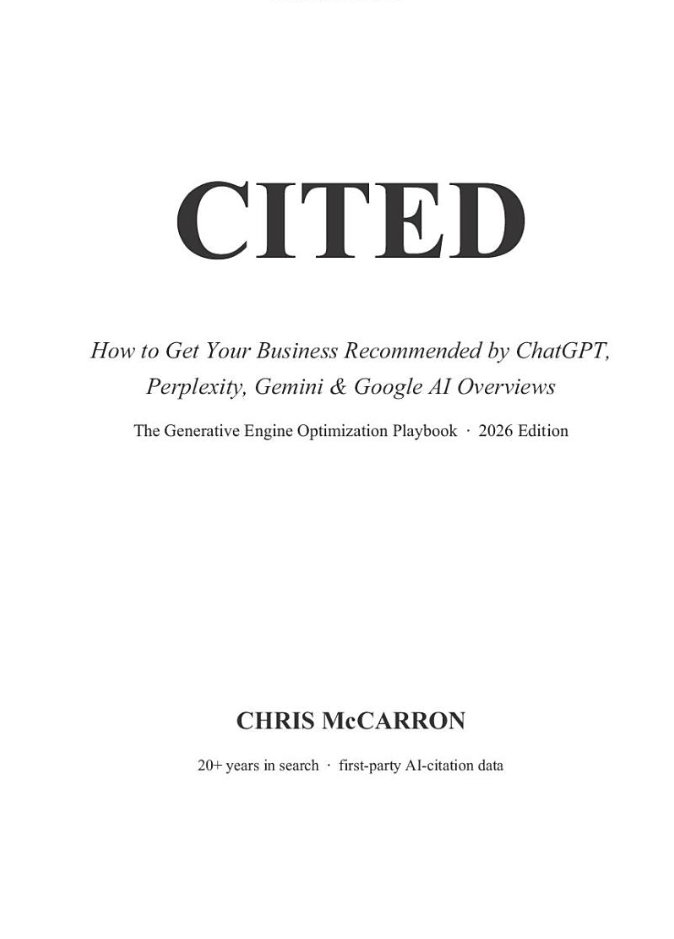
Free chapter
Read Chapter 1 of CITED, free.
The playbook for getting your business recommended by ChatGPT and AI search. Read the first chapter, on me.
Read Chapter 1 freeWant us to do this for your site?
Book a free AI audit. 15 minutes. We’ll show you three things your site is missing and what we’d test first.
Book my free AI audit →