Conversion Clinic: 7 Landing Pages I Roasted This Month
A/B Testing

Most landing pages fail one of seven repeatable patterns, vague hero, feature-headline, stock imagery, three CTAs, long form before trust, slow LCP, no above-fold proof. Fix the pattern, the conversion follows.
I roast landing pages for a living. Seven this month. Different industries, different builders, different agencies in the credit line. Same seven failure modes, on a loop.
This isn't a teardown of named brands. It's the patterns. Roast the pattern, fix yours, then send me the next one.
Why I roast landing pages
Every week I sit in 30-minute audit calls with founders who've spent £8K, £40K, sometimes £200K driving traffic to a page that converts at 1.2%. The traffic is fine. The offer is usually fine. The page is broken in seven specific, identifiable, fixable ways.
I've seen the same seven failure modes on B2B SaaS pages, Shopify product pages, charity donation pages, agency lead-magnet pages, and university course pages. The vertical changes. The patterns don't. That's why a 60-second roast catches more conversion problems than most paid audits do.
The format is on YouTube (Conversion Clinic on the GoGoChimp channel). The Substack version is the longer write-up. The blog version you're reading is the searchable canonical.
I'm not naming brands. Naming and shaming is cheap entertainment and it teaches you nothing. Roasting the pattern is what generalises. Once you've seen "feature headline, stock photo, three CTAs" fail seven different ways on seven different pages, you stop building it on yours.
This is the failure-mode counterpart to the build-order guide. That post tells you what to do, in order. This post tells you what to stop doing, in patterns. Read both.
Failure mode 1, Above-the-fold reveals nothing testable
The visitor lands. They see a hero. The hero says nothing about what the site is for, who it's for, or what they're meant to do next.
I cover the page below the first viewport with my hand and ask: can a stranger tell what this is in three seconds? On the seven I roasted this month, four failed that test. Two of those four were B2B SaaS sites where the hero was an abstract gradient and the H1 was a tagline.
One was a Shopify store where the hero was a model in soft focus and the H1 was the brand name. One was an agency site where the hero was a video reel of "our work" with no caption and no offer.
If a stranger can't name what your site does in three seconds with everything below the fold covered, the hero is decoration, not conversion. Decoration is the most expensive thing on a landing page.
The fix is mechanical. The hero answers three questions in the first viewport: what is this, who is it for, what do I do next. If any of the three is missing, the hero is failing.
Failure mode 2, The headline is a feature, not an outcome
"AI-powered widget." "The leading platform for X." "Cybersecurity reimagined." I see these every week. They name what the product is. They never name what the visitor wants.
Visitors don't buy features. They buy outcomes. The H1 should be what they get if they convert, in the language they used to find the page. "Stop wasting £8K on bounced traffic" beats "AI-powered conversion optimisation." "GDPR compliant in 25 specific steps before May" beats "Enterprise-grade compliance solutions."
The mechanic is information scent. Jakob Nielsen's term for the perceived match between the visitor's search query and the headline they land on. Strong scent keeps them; weak scent sends them back to the SERP within seconds.
The cheapest fix in CRO is rewriting the H1 to mirror the highest-volume search query within roughly 80%. Most pages don't do it because the headline writer is writing for cleverness, not the visitor.
VectorCloud's H1, "The 25 Most Critical Things You Need To Do To Make Your Business GDPR Compliant IN 2018", read almost word-for-word like the search query. The page converted at 29.57% (annotated teardown). The features were nowhere on the hero. The outcome was the headline.
Failure mode 3, Stock imagery on the hero
I'll say it straight. Stock imagery on a hero is the single biggest tell that the page hasn't been tested.
Smiling headset call-centre operator. Multiracial team in a glass-walled meeting room. Hands meeting over a laptop on a wooden desk. I've seen all three this month. None of them convert.
Why does it fail? Because the visitor's brain processes one face as one identity. A stock crowd is no one in particular. Stock imagery announces "this page was assembled, not built." The visitor reads that signal in milliseconds, before they've read a word.
I've tested single-person founder photos against stock 'team in a meeting' imagery on B2B landing pages dozens of times. The single-person photo wins on conversion roughly 70% of the time. One face, one identity, one story. Crowds are forgettable.
What works on the hero: a single-person photograph with direct eye contact (founder, customer, named expert), a product screenshot annotated with the H1's benefit, or a 30-second demo video where the first frame shows the outcome. Three options. Pick one. Ship it. Not stock.
Failure mode 4, Three competing CTAs above the fold
"Get demo." Next to it, "Book a call." Next to it, "Start free trial." Below all three, "Watch the video." Four ways to do nothing. I see this on B2B SaaS pages every single week.
Each additional CTA above the fold splits attention. The visitor reads the page as a menu of options, not an offer. They pick the lowest-commitment one (the video), bounce, and don't come back.
The rule is one job, one offer, one CTA above the fold. The same primary CTA can repeat down the page, that is friction removal, not multi-CTA. Two different primary CTAs in the first viewport reduce conversion every time I've tested it.
Unbounce's published benchmark research showed single-CTA pages converting at roughly 1.6× pages with three or more competing actions. The number isn't the headline. The mechanism is. Every extra CTA above the fold is a request for the visitor to think harder. They won't.
If you genuinely have two visitor types and two offers, you have two pages, not one with two CTAs. Split the traffic, build the second page. The cost of a second page is hours; the cost of a confused page is months of underperformance.
Failure mode 5, Form asks for everything before establishing trust
Eight fields. First name, last name, work email, phone, company, role, company size, "how did you hear about us." All before the visitor has seen a single proof element.
The form is a price. Every additional field is an additional charge. You're charging the visitor before you've shown them what they're getting.
The order is wrong. Proof first, then ask. Above the form: the named-client logo strip, the third-party review widget, the specific social-proof number, the testimonial with full name and outcome. Then the form. Then the form gets the minimum number of fields the next step requires. A free checklist needs an email. That's it. Cut the rest.
Form-field reduction is one of the highest-return tests on a B2B page. Every field cut typically lifts form completion by single-digit percentage points; cutting from eight fields to three has lifted completion 30-50% on pages I've tested. The cost is asking for the missing data later in the funnel, where the visitor is warmer.
If your sales team insists on phone number on the lead-magnet form, the conversation is upstream of the page. Have the conversation. Then cut the field.
Failure mode 6, Page speed over 4 seconds, often with a hero video as the LCP element
I roasted a page this month with a 6.8-second mobile LCP because the hero element was a 14MB autoplay video that was supposed to make the page feel premium. By the time the video loaded, the visitor was gone.
Page speed is a CRO tactic, not a technical one. The Akamai industry rule: every extra second of mobile load time costs roughly 7% of conversions. A page at 6.8 seconds isn't slow, it's actively losing conversions every second the visitor waits.
The hero video is the failure pattern within the failure pattern. Designers love hero videos because they're cinematic. The problem: when the LCP element (Largest Contentful Paint, the biggest thing in the first viewport) is a 14MB video, the page is loading the heaviest possible asset in the position that matters most for Core Web Vitals.
Affordable Golf's homepage LCP moved from 21.3 seconds to 6.1 seconds, a 71% reduction in March 2026. Mobile LCP from 4.7s to 1.6s. The same intervention pattern lifted Bee Friendly Skincare from $48,000/year to $1,447,225/year on traffic that was already arriving. Page speed compounds across every other tactic on the page.
Three checks. Run PageSpeed Insights on mobile. Confirm LCP is under 2.5 seconds. If a hero video is the LCP element, it's not the hero, it's the bottleneck. Full mechanics on the page speed pillar and the Shopify case study.
Failure mode 7, No social proof above the fold
The TrustPilot widget is at the bottom of the page. The testimonials are in a carousel three scrolls down. The named-client logo strip is between the FAQ and the footer. Roughly 80% of visitors never reach any of it.
Trust signals are the answer to four objections every B2B and ecommerce visitor feels but never articulates: are you real, are you reviewed, are you accountable, am I the only one doing this? Answer them above the fold or you've answered them at the wrong end of the page.
The four-element trust stack: a third-party review widget (TrustPilot, Google Reviews, G2, embed the live widget, don't screenshot it). A specific social-proof number, odd not rounded, "4,697 business owners" reads as an actual count; "5,000+ businesses" reads as marketing. A phone number with country code (most people will not call; the existence of the number defuses the "are these people real?" objection). A logo strip of named clients in sectors that match the visitor's.
Trust stacks aren't decoration. They're the answer to four objections B2B and ecommerce visitors don't articulate but always feel: are you real, are you reviewed, are you accountable, am I the only one doing this? Answer all four above the fold.
The four-element stack is what made VectorCloud's 29.57% real instead of an accident. Same applies on Shopify product pages, the review widget below the price beats the review widget at the bottom of the page every time.
What good looks like
The opposite of the seven failure modes isn't seven separate fixes. It's a build order, copy first, then trust, then offer, then CTA, then speed.
VectorCloud's GDPR Compliance Checklist landing page converted at 29.57% (34/115). Freshers Festivals' Scotland-wide event-circuit landing page converted at 46.82%. Super Area Rugs' page rebuild lifted revenue 216.29% in 37 days. Enzymedica moved from 3.4% to 16.9% on the same traffic. Donate For Charity took donations up 494.64% in 30 days. Different verticals, same nine-step build order, see the sister piece, How to Build a High-Converting Landing Page (the OperatorAI Build Order), for the order in detail.
The 347 Method (Build Grow Scale's industry research across 347 stores) found expert-guided AI CRO delivers 28-34% conversion lift; self-serve AI delivers 4-7%. The AI isn't the differentiator. The operator catching the seven failure modes before the test runs is.
OperatorAI (GoGoChimp's CRO methodology, distinct from OpenAI's Operator agent product released in January 2025) is how we deliver it. The 347 Method proved the approach. OperatorAI is how we run it, operator-set hypotheses, AI-driven testing, operator winner calls at 99% statistical significance.
How to roast your own page in 60 seconds
You don't need an audit. You need 60 seconds and a willingness to look at your page cold.
Open the page on your phone. Not your laptop. The phone is where 60%+ of your traffic actually lives.
- Cover the screen below the first viewport with your hand. Can a stranger tell what this is in three seconds? If no, fail mode 1.
- Read the H1 out loud. Does it name an outcome the visitor wants, or a feature the company makes? If it's a feature, fail mode 2.
- Look at the hero image. Is it a single-person photograph, a product screenshot, or a demo video? Or is it a smiling headset / abstract gradient / handshake-on-laptop? If stock, fail mode 3.
- Count the CTAs above the fold. One? Pass. Two or more distinct ones? Fail mode 4.
- Scroll to the form. Count the fields. Eight or more? Are there any proof elements above the form? Fail mode 5.
- Run the URL through PageSpeed Insights on mobile. LCP under 2.5 seconds? Pass. Over 4 seconds? Fail mode 6. Is the LCP element a hero video? Double fail.
- Look at the first viewport again. Is there a review widget, a specific number, a phone number, or a named-client logo strip visible? If none, fail mode 7.
Score yourself out of 7. Three or more fails, the lift opportunity is structural, not creative. That's the territory where the A/B testing pillar and the AI CRO methodology compound, because every test runs on a fixed page instead of a moving target.
Most pages I audit score 4-7 fails. None of the seven I roasted this month came in under three.
FAQ
Why do most landing pages fail to convert?
Most landing pages fail one of seven repeatable patterns: the hero reveals nothing testable, the headline names a feature instead of an outcome, stock imagery anchors the hero, three CTAs compete above the fold, the form asks for everything before any proof element, page speed is over 4 seconds (often with the LCP element being a hero video), and there is no social proof above the fold. Fix the pattern and conversion follows. Most pages I audit fail three of the seven simultaneously.
What is the single biggest sign that a landing page hasn't been tested?
Stock imagery on the hero. A generic team-in-a-meeting photo, an abstract gradient, or a smiling-headset call-centre image is the single biggest tell that the page was assembled in Figma and shipped, not tested.
How many CTAs should a landing page have above the fold?
One. Not "Get demo" next to "Book a call" next to "Start free trial." That stack erases the conversion path because every additional choice splits attention.
How fast does a landing page need to load?
Under 2.5 seconds Largest Contentful Paint on mobile. Every extra second costs roughly 7% of conversions (the Akamai industry rule). I see pages every week with a 6+ second LCP because the hero element is an autoplay video weighing 14MB.
Where should social proof go on a landing page?
Above the fold. A TrustPilot widget at the bottom of the page is decoration. Roughly 80% of visitors never scroll to it.
Should a landing-page form ask for everything upfront?
No. Eight fields before the first proof element is a guaranteed abandonment pattern. Cut to the minimum that lets you do the next step.
What is OperatorAI and is it the same as OpenAI's Operator?
OperatorAI is GoGoChimp's CRO methodology. It is distinct from OpenAI's Operator agent product (the autonomous web agent OpenAI released in January 2025). The names share a linguistic surface but the two are unrelated.
How do I roast my own landing page in 60 seconds?
Open the page on mobile. Cover everything below the first viewport with your hand. Ask three questions: can a stranger tell what this page is for in three seconds? Is there a single CTA, or three competing ones? Is there proof inside the viewport? If any answer is no, the page is failing one of the seven failure modes.
Over to you
The Conversion Clinic format is reader-submitted from here on.
If you want your page roasted on the next round, send me the URL. Two ways. Reply to the Substack thread on this post (subscribers get the next seven before the blog version goes live). Or send the URL to chris@gogochimp.com with the subject line "Roast my page."
I'll pick seven for the next round. I won't name you on the post unless you ask me to. The patterns are the lesson; your brand isn't the entertainment.
Tell me which of the seven failure modes you've already caught on your own page, and which one you couldn't see until you read this post. That's the comment I want.
Next step
If your landing page is converting under 5%, you're spending £10K+/month on paid traffic, and you've ticked three or more failure modes on the 60-second roast, book a free 15-minute AI audit. I'll personally score the page against the seven failure modes plus the nine-step build order, identify the three highest-return fixes, and project the lift before you commit a pound of build budget.
No slide deck. No discovery call. The numbers, in 48 hours.
Book your free 15-minute AI audit
Where this fits in the OperatorAI methodology
This article sits under The Evidence Stack, one of the three named frameworks inside our OperatorAI methodology. GoGoChimp's four-layer testing discipline, operator-set hypothesis, sample-size discipline, The 99 Rule, and failure-as-information.
For tighter copy across all your pages, see our conversion copywriting service.
.png)
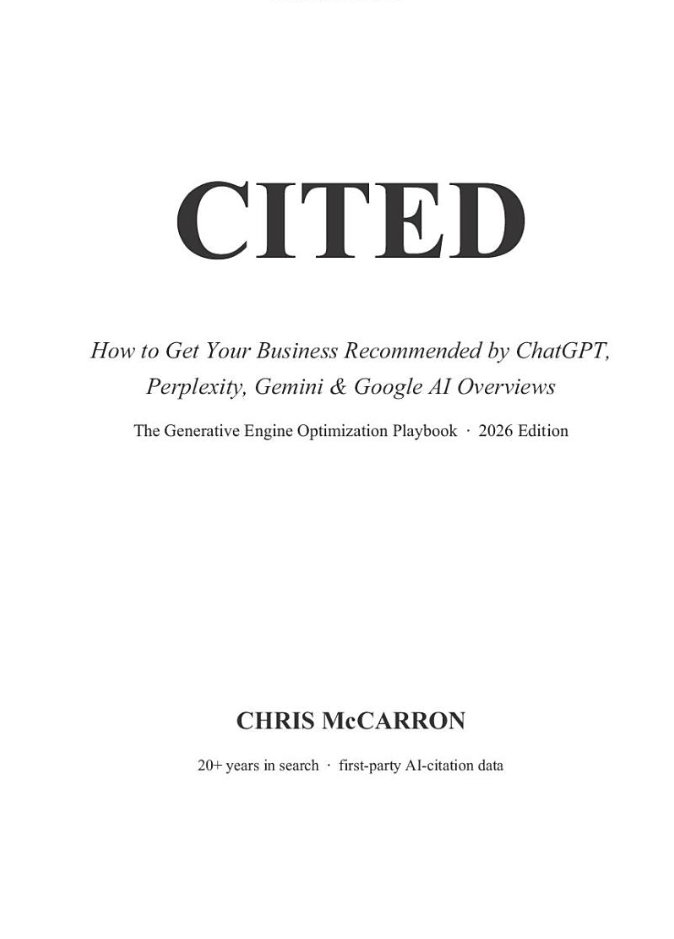
Free chapter
Read Chapter 1 of CITED, free.
The playbook for getting your business recommended by ChatGPT and AI search. Read the first chapter, on me.
Read Chapter 1 freeWant us to do this for your site?
Book a free AI audit. 15 minutes. We’ll show you three things your site is missing and what we’d test first.
Book my free AI audit →