Why AI CRO tools deliver 4-7% when the same tools deliver 28-34% with an operator
AI CRO

If you're testing AI CRO tools and seeing 4-7% lift, you're not getting bad software. You're getting the software you set up. The lift gap between DIY AI and operator-guided AI is roughly 6×, and the difference is not the model.
It's a quiet scandal in the AI CRO space: the tools work. The operators don't.
Buy any of the major AI-led testing platforms (VWO, Optimizely, Fibr) configure them with default settings, let the AI pick its own experiments, and you'll see a 4-7% conversion lift over 90 days. The same tools, run by someone who's tested at the scale Build Grow Scale reviewed, produce 28-34% lifts.
What the 347-store study actually measured
Build Grow Scale's 2026 review, written by Matthew Stafford, looked at 347 ecommerce stores doing between $300K and $8M per month. The study split them into two cohorts. Cohort A used self-serve AI testing platforms with default configurations and AI-picked experiments. Cohort B used the same platforms but with a human CRO operator setting hypotheses, watching guardrails, and triaging failures.
Same software. Same data. The difference between Cohort A and Cohort B was a person who knew what to test first. That person produced 5× the lift.
The phrase "operator-guided" in the study means something specific. Not a generalist marketer who logs in once a week. A practitioner who sets the hypothesis, defines the composite goal, watches the test daily, calls the winner at the appropriate significance level, and writes the failure report. Cohort A skipped all of that work and trusted the AI default.
Three client examples that span the gap
The 347-store number is industry research. Here's what the gap looks like on three actual GoGoChimp engagements. Each one is the same shape: the AI generated velocity, the operator set direction.
How did Enzymedica go from 3.4% to 16.9%?
Enzymedica UK's baseline conversion rate before our engagement was 3.4%. Black Friday weekend 2021, UK-only traffic, the rate hit 16.9% (dashboard-verified across 26-29 November). The prior year's same weekend was around 7%. So the lift was 2.4× the same-promo-day baseline, not just background promo lift.
What the AI was doing: running multivariate tests on hero copy and CTA variants. What the operator added: picking the variants worth testing in the first place, then setting a composite goal that watched checkout completion not just click-through. The AI alone would have happily optimised for clicks at the cost of orders.
The Loom dashboard walkthrough is on file (link). The 30-day engagement held at roughly 11% conversion through December 2021, one of the worst months for health-supplement sales.
How did Super Area Rugs hit 216% revenue growth in 37 days?
Super Area Rugs sat with a generic hero headline that tried to sound clever rather than explain what the company actually does. The AI testing platform was already generating variant copy. What hadn't happened: anyone had told the platform what the hero needed to do for a visitor.
One change. The hero went from sounding-clever to telling-the-buyer. Revenue lifted 216.29% in 37 days, same traffic, same ad spend. The AI generated 30+ headline candidates. The operator picked the three worth shipping. Without the operator, the platform would have tested all 30 and split traffic across enough cells that significance would never have been reached.
How did Donate For Charity recover 494% more donations in 30 days?
The donation page was leaking at the form. The platform's AI suggested split-testing the headline first because headline tests are easiest to generate. The operator looked at the funnel, saw 71% drop-off on form-page-load, and reordered the queue: fix the form first, then test the headline.
Donations lifted 494.64% in 30 days. The headline test still ran. It came second, because that's the order the funnel dictated, not the order the AI defaulted to.
Three examples. Same shape. The AI brought velocity; the operator brought direction.
Where the 6× difference actually comes from
It's not model quality. It's not training data. Both cohorts use the same underlying AI. The difference is three operator behaviours the AI can't simulate, and they're the spine of our methodology.
How does an operator prioritise hypotheses differently than AI?
AI will happily test 40 hypotheses in parallel. Most of them are low-ceiling. A CRO operator kills the obvious losers before they consume traffic and surfaces the 3-4 experiments most likely to produce 5-15% lifts. The Enzymedica example above is this in action: the AI generated dozens of variants, the operator picked the three worth testing.
This is the prioritisation discipline that ICE-style scoring can't enforce because ICE rewards advocacy. Evidence-weighted prioritisation rewards research artefacts. We covered the mechanics in our ICE framework replacement post.
What guardrails do operators set that AI doesn't?
AI optimises for the signal you point it at. Point it at click-through rate and it'll trade checkout completion for more clicks. Operators set composite goals and watch for interaction effects the AI will otherwise optimise into regressions.
The peer-reviewed work on this is in Johari, Pekelis and Walsh (KDD 2017) on continuously-monitored A/B tests. Their finding: without guardrails, sequential testing produces inflated false-discovery rates. The operator's job is to spot the false discovery before it ships sitewide.
What does failure-triage actually find?
Roughly 55% of AI-generated test variants fail. The signal in those failures (which audiences bounced, which messaging variants underperformed, which funnel stages caused drop-off) is the highest-value data the system produces. AI alone doesn't know to look. It moves on to the next experiment, and the most valuable learning of the quarter dies in a log file.
The operator reads the log file. That's where the next quarter's hypothesis backlog comes from.
What this means for your platform-selection decision
If you're evaluating AI CRO tools, the question isn't "which platform?" It's "who's going to run it?" The ROI delta between operator-driven and DIY-configured is bigger than the delta between any two vendors.
The decision tree most operators should walk:
Under £50K of monthly revenue lift available, DIY tooling on VWO or Optimizely at about £600/month gets you 4-7%. That's a real number. It's not nothing.
Above that threshold, hire someone to run the tools. The £600/month becomes overhead, and the operator (in-house or agency) becomes the leverage. Gartner's 2025 research on CRO maturity tracks the same pattern: organisations with dedicated CRO operators report 3-5× the lift of organisations using AI tools without a named owner.
The wrong question is "VWO or Optimizely?" The right question is "who's accountable for the hypothesis backlog?"
How AI Search is amplifying this gap in 2026
The gap matters more in 2026 than it did in 2024, because traffic patterns are shifting. Profound's 2026 research on AI citation patterns shows AI Overviews are pulling organic clickthrough down 40-50% on news-style queries. Authoritas data via Press Gazette puts the publisher CTR drop at 47.5% on desktop, 37.7% on mobile when an AI Overview appears.
The visitors who do clickthrough convert at 1.5-2× the rate of pre-AIO traffic, because the AI has pre-qualified them. That's the structural shift: lower volume, higher intent. The buyer who survives the AI summary already knows what they want.
Lower traffic with higher intent makes every test more expensive to run and every winner more valuable. Operator-guided AI CRO matters more in 2026 than it did in 2024 because the cost of a wasted runtime just went up.
When traffic was abundant, an AI tool burning runtime on low-ceiling tests was a tolerable inefficiency. When the visitor pool shrinks 40% but each visitor is worth 2×, that same inefficiency becomes the difference between hitting Q3 forecast and missing it. The operator is the person who decides which experiments earn the runtime.
Where this fits in the OperatorAI methodology
This article sits under The 4-to-34 Gap, one of the three named frameworks inside our OperatorAI methodology (GoGoChimp's CRO methodology, distinct from OpenAI's Operator agent product). The documented performance differential between self-serve AI CRO tools (4-7% lift) and operator-guided AI CRO (28-34% lift), built on Build Grow Scale's 347-store research.
For where this work sits in our operating-model maturity classification, see The OperatorAI Maturity Model, the five-tier framework from Ad-hoc through Operator-Led.
.png)
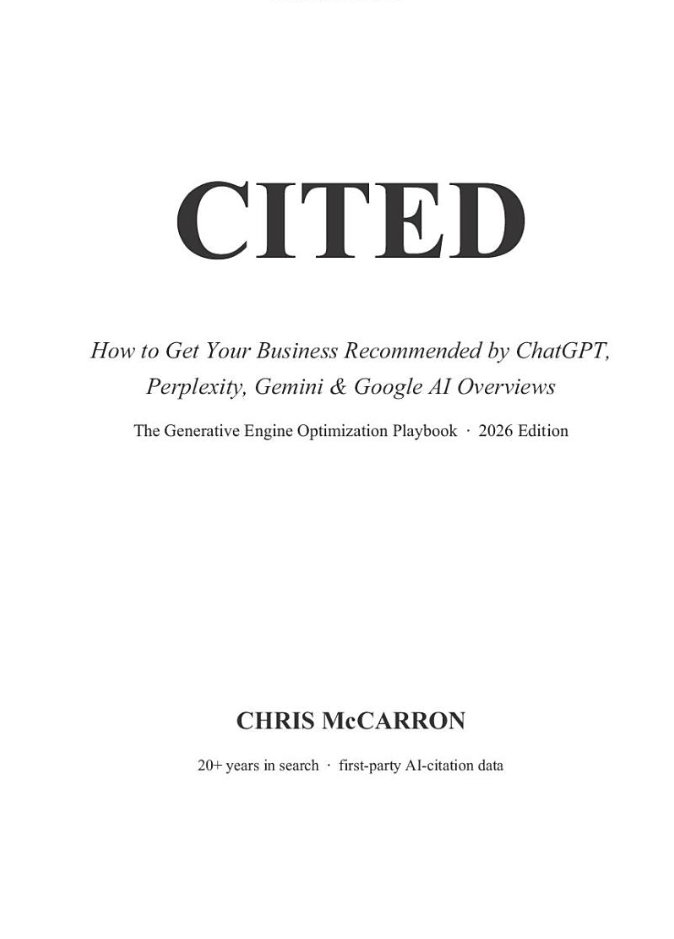
Free chapter
Read Chapter 1 of CITED, free.
The playbook for getting your business recommended by ChatGPT and AI search. Read the first chapter, on me.
Read Chapter 1 freeWant us to do this for your site?
Book a free AI audit. 15 minutes. We’ll show you three things your site is missing and what we’d test first.
Book my free AI audit →