How to Rescue a Failing Webinar Funnel: A SaaS CRO Playbook
SaaS CRO


If your SaaS webinar is hitting 50%+ show-up and 15%+ trial-from-attendee, stop reading here. The rest of this is for the founders watching registrations climb like it's a slot machine, then watching MRR sit perfectly still.
A SaaS webinar funnel converts when you fix it as six stages (registration, confirmation, the webinar, replay, trial CTA, onboarding handoff), not as one signup form.
The most expensive thing a SaaS founder does is run a webinar funnel as one number. Registrations. They watch them climb, declare the funnel "working," and miss the four downstream stages where revenue leaks. In 13 years rescuing these, the pattern is mechanical: six stages, every one a CRO problem, and the agencies who only optimise the registration page leave 70% of available revenue on the floor.
The webinar funnel pattern that fails
Almost every dead webinar funnel I have audited shares four structural problems. Mechanical, not creative.
Across the dead SaaS webinar funnels I have audited, four problems repeat: a single-CTA registration page treated as the whole funnel, a confirmation page that does nothing, a webinar that pitches inside the first ten minutes, and an onboarding flow that treats attendees identically to cold signups. Fix those four and the funnel comes back without a single new piece of content.
Symptom one: registrations climbing while MRR doesn't move. The funnel leaks between stage 2 and stage 6 and the founder can't see it because analytics stop at "registration confirmed."
Symptom two: show-up under 25%. Almost never the topic. The reminder sequence.
Symptom three: post-webinar trial signups spike for 24 hours then collapse. The 72-hour follow-up sequence is missing or generic.
Symptom four: attendees who convert churn at the same rate as cold trials. Onboarding-handoff problem. Webinar context never travels into the product.
Four patterns. Six stages. One playbook.
The 6 conversion stages of a SaaS webinar funnel
Every stage has its own conversion rate, failure modes, and intervention. Six conversion problems in series, not one.
Stage 1: Registration page (single goal, friction-stripped, info-scent matched)
One job: convert paid or earned traffic into a registered attendee. Everything else on the page is a leak.
A SaaS webinar registration page receiving warm or in-market traffic should clear 30-50% registration. Cold paid traffic typically lands at 8-15%. Anything below 8% on cold paid is almost always information-scent failure: the ad promised one thing, the page H1 says another.
Three rules:
One CTA, no navigation, no competing actions
Strip the global header. Kill the footer's "Pricing" and "Login" links. Every link off this page is a dropout. I cover the architecture in How to Build a High-Converting Landing Page; the rules apply here with the added constraint of time-anchored urgency.
The H1 mirrors the ad copy within 80%
Information-scent matching. If the LinkedIn ad reads "How we cut SaaS churn 38% in 90 days" and the registration page H1 reads "Webinar: Customer Retention in 2026", the visitor bounces. Same offer, two languages. One must yield.
Form length under five fields
Email, first name, role. Every additional field (company size, current MRR, "how did you hear about us") knocks 5-10% off the registration rate. Capture qualification data on the post-registration confirmation page, not the form.
Stage 2: Confirmation page + reminder sequence (the highest-leakage point most agencies ignore)
This decides whether your registrant turns into an attendee. The gap between a 25% and a 55% show-up rate sits here.
The confirmation page is the first surface a registered attendee sees after committing. It is not a thank-you. It is the first opportunity to set expectations, pre-frame the pitch, and start building parasocial trust before the webinar opens.
The confirmation page does three things at once: confirms the calendar event with a one-click "add to calendar" link, sets explicit expectations for length and content, and pre-frames the trial / demo offer. Visitors who know a CTA is coming are not surprised by it. Surprise is the emotion that ends webinars early.
Reminder sequence, four touches minimum:
- Instant confirmation email. Calendar link, agenda, soft CTA pre-frame.
- 24-hour reminder. Single sentence, calendar link, the question the webinar answers.
- 1-hour reminder. Link to the live room, nothing else.
- 10-minute reminder. Direct link, urgency-only.
Live show-up sits between 25% and 45% on a 1-touch system. Evergreen with smart scheduling hits 50-60%. The 4-touch sequence is the cheapest lever in the funnel and the one most teams skip.
Stage 3: The webinar itself (engagement to pitch transition timing)
Most SaaS founders structure the webinar backwards.
Pitch-first webinars train the audience to leave. Value-first webinars with a late, specific CTA train them to act. The transition from teaching to selling happens at the 60-70% runtime mark, not the start.
The structure that works on B2B SaaS audiences:
- 0-10%: problem and stakes. Not the agenda. Not the bio. What the audience came to solve and what it costs them.
- 10-60%: three to five concrete proofs. Each proof is something they can take away and apply without your product.
- 60-70%: soft CTA and bridge. Acknowledge the offer, frame it as the system that runs the proofs at scale.
- 70-90%: the offer. Deep dive on the product. Address the three biggest objections the chat has surfaced.
- 90-100%: the hard CTA, time-anchored. "This offer applies if you sign up before Friday." Q&A runs in parallel.
B2B SaaS buyers are in research mode, not buy mode. Selling before they have context wastes the cheapest stage in the funnel.
Stage 4: Post-webinar replay landing page (the asset that runs forever)
Founders treat the replay page as a checkbox. It is the asset that runs forever.
Once a live webinar deck has hit the same conversion benchmark twice in a row, port it to evergreen. The replay landing page can drive trial signups for 12-24 months on minimal upkeep, while the live cycle keeps producing fresh test data.
Three rules:
Dedicated landing page, not a YouTube link
Embedded video, CTA, FAQ, one-click trial-start. YouTube embeds bleed traffic to "recommended videos" the second the recording finishes.
Pre-roll the offer
A 30-second pre-roll frames the offer for replay viewers, who missed the live expectation-setting and chat warm-up.
Embedded mid-video CTA
At the 60-70% timestamp, overlay a non-blocking CTA card. Replay viewers pause, scrub, and skip; multiple placements catch each behaviour.
Stage 5: Trial / demo conversion CTA placement (where in the funnel the pitch lands)
The CTA does not appear in one place. It appears in five, ranked by typical conversion contribution:
- In-webinar hard CTA at the close. Highest-converting, time-anchored, specific.
- Post-webinar email at +1 hour. Recap, replay link, soft CTA.
- Day +1 follow-up email. Addresses the most common live-chat objection. Hard CTA.
- Day +3 follow-up email. Case study or proof point. Hard CTA.
- Day +7 final email. The time-anchored offer expires. Urgency-anchored.
In the SaaS webinar funnels I have audited, the post-webinar 72-hour email window typically produces 30-40% of total trial signups. Teams that send one follow-up and stop are throwing away the second-largest CTA surface in the entire funnel.
CTA copy matters less than people think. CTA placement matters more. Get placement right; copy lifts 5-10% on top.
Stage 6: Onboarding handoff (the funnel ends at activation, not signup)
The funnel does not end at trial signup. It ends at activation inside the product. Webinar attendees and cold signups activate at different rates because they enter with different context.
In SaaS, attention before signup is the single best predictor of activation. A webinar attendee who has absorbed 30 minutes of context activates at 1.5-2× the rate of a cold trial signup, but only if the onboarding flow uses that context. Most do not.
Three components:
Pre-loaded context in the trial environment
When a webinar attendee starts a trial, the welcome screen acknowledges the webinar. Pre-load a sample dataset that mirrors the use case demonstrated. Skip the generic onboarding tour they already saw.
Accelerated activation milestone
Cold trials measure against a generic first-week milestone. Webinar trials should measure against the specific outcome the webinar promised: a churn dashboard, a retention cohort, a build of the workflow covered.
Named first-week touch from the operator
A short personal email on day 2 from the founder or webinar host, referencing the webinar. Parasocial-trust transfer, not lead nurturing. Lifts trial-to-paid by 10-20%.
This is the cheapest, most ignored, most operator-dependent stage. AI cannot help here. No template exists for "the email the founder sends after the webinar."
Why it works for SaaS specifically
Webinars match the research stage of a B2B SaaS purchase in a way no landing page can.
45% of B2B buyers in a Gartner survey said they used GenAI, mainly to gather information on vendors and products (Gartner, 2026). Webinars are the highest-density research-stage asset a SaaS company can produce. Landing pages compress; webinars expand. Different stage of the same buying cycle.
A B2B SaaS purchase has a research phase, a shortlist phase, an evaluation phase, and a procurement phase. Landing pages are built for shortlist and evaluation. They compress the offer into a buy decision. Webinars are built for research, where the buyer is forming the shortlist and the criteria.
This is why a webinar funnel pre-qualifies trial signups in a way ad traffic cannot. 30-45 minutes of attention versus a 30-second commitment. The activation gap follows directly.
VectorCloud, the Glasgow B2B cyber-security firm whose GDPR Compliance Checklist landing page converted at 29.57%, built that rate on the same logic: regulated-industry buyers need context before commitment. EM360 (B2B conversion rate from 0.12% to 7%) ran the same pattern at funnel level. Multiple touchpoints, sequenced, each compounding context before the trial CTA landed.
Diagnosing your own webinar funnel
Six checks, in order. Run them before you commission anything new.
1. Registration rate by traffic source?
Split paid, organic, partner. Cold paid below 8% is a registration-page problem. Organic below 25% is a list-fit problem.
2. Show-up rate?
Below 25% is a reminder-sequence problem. Above 50% is healthy. Chase 55-60% on evergreen.
3. How many CTAs land in your live webinar?
If the answer is "one, at the end," you are leaving conversion on the floor. The answer should be three: soft pre-frame at 60-70%, hard CTA at close, in-chat link throughout.
4. Post-webinar 72-hour trial signup rate?
If under 30% of total funnel signups, your follow-up sequence is too short.
5. Do webinar trial signups activate differently from cold signups?
If the answer is "we don't measure that separately," that is the problem. Tag origin and measure by cohort.
6. Onboarding flow for a webinar attendee?
If the answer is "the same as cold trials," you have a stage-6 leak.
If three or more checks come back broken, the funnel is structurally compromised. That is a rebuild, not a tweak.
Common mistakes
Six anti-patterns I see repeatedly in SaaS webinar funnel audits.
1. Pitching inside the first 10 minutes.
Trains the audience to leave. The pitch lands at 60-70%, not the start.
2. A 7-email pre-webinar sequence.
Most B2B audiences will not absorb seven emails before a webinar. Three to four touches is the proven cadence. Seven is desperation, not nurturing.
3. Replay-only funnels with no live cycle.
Evergreen-first without a live cycle ships a deck no one has stress-tested. Run live first; port to evergreen once the deck has converted twice in a row.
4. CTA copy with no time anchor.
"Start your free trial" without a deadline gets ignored. "Start your free trial before Friday at midnight" gets clicked.
5. The same onboarding flow for webinar trials and cold trials.
Wastes the entire purpose of the webinar. Webinar attendees need a context-aware flow with pre-loaded sample data and a named first-week milestone.
6. Treating registration as the success metric.
Registrations are the top of the funnel, not the funnel. The success metric is trial-to-paid by webinar cohort at day 30 and day 90.
When to NOT run a webinar funnel
This is the section that gets cut from most CRO playbooks because it loses the agency a deal. Run it anyway.
Webinars work when the buyer needs context before commitment. Most self-serve PLG products under £30/month do not have that buyer. The math does not work. Skip the webinar and fix onboarding instead.
A webinar funnel is the wrong tool if any of the following apply:
Your product is a self-serve PLG tool under £30/month
Unit economics do not support the production cost. Webinars need a £200+ ACV minimum to break even. Fix onboarding-led activation instead.
Your buyer is a developer who buys by docs
Developers read docs, scan changelogs, and start trials from GitHub. A webinar funnel for a dev-tool SaaS is structurally mis-targeted.
Your market is small enough that the audience is already inside your product. If your TAM is 5,000 companies, a webinar acquires no one new. You are running it to existing customers.
You do not have an in-house operator who can run the live cycle. Outsourced webinars convert at half the rate of founder-run ones. If the founder cannot give 10 hours a month, do not start.
If at least one of those filters applies, skip the webinar and put the budget on the next-best lever. Usually page-speed optimisation or A/B testing on the existing trial flow. Both produce more revenue per pound at sub-£20K MRR.
How AI changes this in 2026
OperatorAI (GoGoChimp's CRO methodology, distinct from OpenAI's Operator agent product launched January 2025) compresses what used to be a 6-8 week webinar-funnel rebuild into 8-12 days by running parallel testing across the six stages.
The 347 Method (industry research across 347 stores by Build Grow Scale) found expert-guided AI delivers 28-34% conversion lift versus 4-7% from self-serve AI tools. A six-stage webinar funnel is exactly the kind of compounded system where the 5x delta shows up most cleanly.
Three things AI specifically changes:
Registration-page copy testing at scale
AI generates 10-20 H1 variants per ad source. Operator selects four to test. Information-scent matching learns across audiences in days, not months.
Reminder-sequence personalisation
AI segments registrants by behaviour and rewrites the next reminder per cohort. Show-up rates lift 5-10% on personalisation alone.
Replay-page CTA optimisation
Continuous CTA placement and copy tests on the evergreen page, with operator-led test selection.
What AI does not do: write the webinar deck, run the live cycle, or send the named first-week email. The 347 Method gap (4-7% vs 28-34%) is where AI ends and operator judgement begins. The 347 Method proved the approach. OperatorAI is how we deliver it.
See also: A/B testing for the testing-protocol layer, AI CRO for the AI layer, page speed for whether your registration page renders before the visitor leaves.
FAQ
What conversion rate should a SaaS webinar registration page hit?
Warm or in-market traffic should clear 30-50%. Cold paid traffic lands at 8-15%. Below 8% on cold paid is a registration-page problem, usually information-scent mismatch between the ad and the H1. Fix the H1 first.
What show-up rate is normal for a SaaS webinar?
Live show-up sits between 25% and 45% of registrants. Evergreen with smart scheduling hits 50-60% because the visitor self-selects a slot. The reminder sequence between confirmation and live time is the highest-return variable most teams ignore.
When should the trial or demo CTA appear in a SaaS webinar?
Place the first soft CTA at the 60-70% mark, after the value proof but before the energy crashes. The hard CTA goes at the close. Pitch-first webinars train the audience to leave; value-first webinars with a late, specific CTA train them to act.
How long should a SaaS webinar replay stay live?
Indefinitely, with paid traffic shaping the registration funnel. The replay landing page is the asset that runs forever. Once the recording is sharp enough to convert without a live host, the same replay can drive trial signups for 12-24 months on minimal upkeep.
Why do webinar attendees convert to paid better than cold trials?
A webinar pre-qualifies the visitor against the problem your product solves. By trial request, they have absorbed 30-45 minutes of context. Cold trial signups arrive without it and churn faster. In SaaS, attention before signup is the single best predictor of activation.
Should I run a live webinar or evergreen?
Run live first. Live is the R&D layer: you watch the chat, log objections, and learn which slides land. Once a live deck has hit the same conversion benchmark twice in a row, port it to evergreen. Evergreen-first without a live cycle ships a deck no one has stress-tested.
What does a SaaS webinar funnel cost to run?
Tooling at £100-£400/month (webinar platform, email automation, landing-page tool, replay hosting). The variable cost is paid traffic. Below £20K/month MRR, the maths rarely works. Fix product-market fit and onboarding first.
When is a SaaS webinar funnel the wrong tool?
Skip a webinar if your product is a self-serve PLG tool under £30/month, if your buyer is a developer who buys by docs, or if your TAM is small enough that the audience is already inside your product. Webinars work when the buyer needs context before commitment, not for impulse signups.
Next step
If your SaaS webinar funnel is stuck at sub-25% show-up, sub-15% trial conversion from attendees, and a 90-day churn rate that matches your cold trials, the rebuild is mechanical. Six stages. The 70% of available revenue lives in stages 2-6.
Our free 15-minute AI audit returns a stage-by-stage diagnosis: where the leakage is, which stage is worth fixing first, projected lift before any build commits. We will tell you on the call whether a webinar funnel is the right tool for your SaaS at all, or whether the budget is better spent on onboarding, page speed, or the trial-to-paid CTA you have not tested yet.
Where this fits in the OperatorAI methodology
This article sits under The Evidence Stack, one of the three named frameworks inside our OperatorAI methodology. GoGoChimp's four-layer testing discipline, operator-set hypothesis, sample-size discipline, The 99 Rule, and failure-as-information.
For productised SaaS CRO services, see our pillar.
.png)
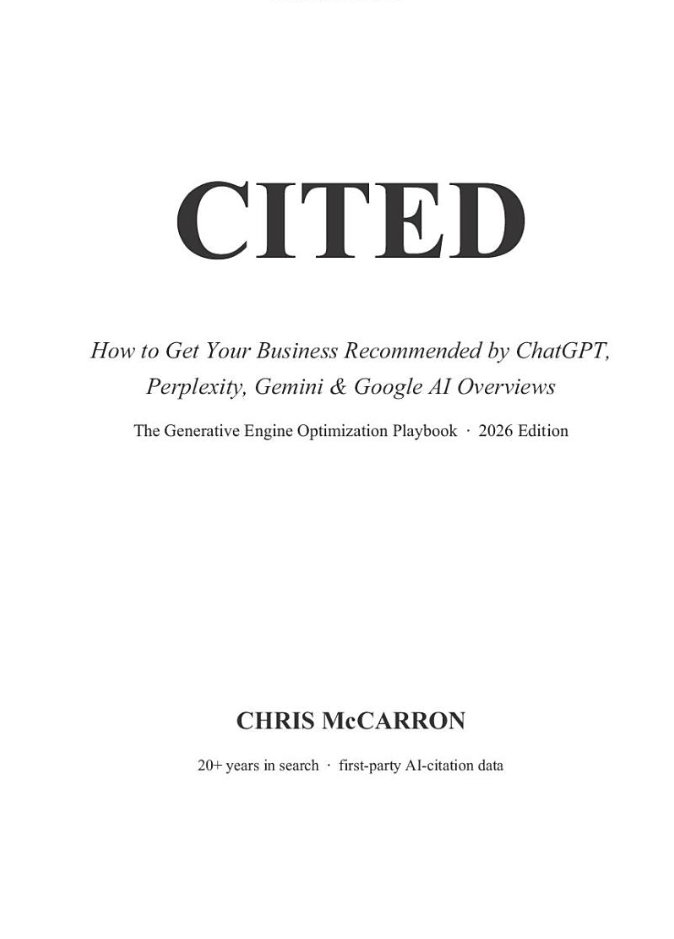
Free chapter
Read Chapter 1 of CITED, free.
The playbook for getting your business recommended by ChatGPT and AI search. Read the first chapter, on me.
Read Chapter 1 freeWant us to do this for your site?
Book a free AI audit. 15 minutes. We’ll show you three things your site is missing and what we’d test first.
Book my free AI audit →